Aircraft
C-130 Hercules
C130
Lockheed Corporation / Lockheed Martin CorporationUnited States
- Role:
- Tactical military transport
- First flight:
- 1954
348kt
Cruise speed
1,800nm
Range
General
- Role:
- Tactical military transport
- Status:
- In production
Programme
- First flight:
- August 23, 1954
- Introduction:
- 1956
- Produced:
- 1954 to present
- Number built:
- 2,700
Crew & capacity
- Crew:
- 3
- Capacity:
- 92 passengers
Dimensions
- Length:
- 98 ft
- Height:
- 39 ft
- Wingspan:
- 133 ft
- Wing area:
- 1,745 ft²
Weights
- Empty weight:
- 75,561 lb
- Maximum takeoff weight:
- 164,000 lb
Powerplant
- Engine:
- 4 × Rolls-Royce (Allison) AE 2100D3 turboprops, 4,637 shp (3,458 kW) each, driving six-blade composite propellers (C-130J)
- Power:
- 4,637 hp (3,458 kW)
Performance
- Maximum speed:
- 362 kt
- Ceiling:
- 27,999 ft
Price
- New in 2008:
- $62M
- New, from:
- $111M
- Used market:
- $10M – $30M
As of 2025-03. See references.
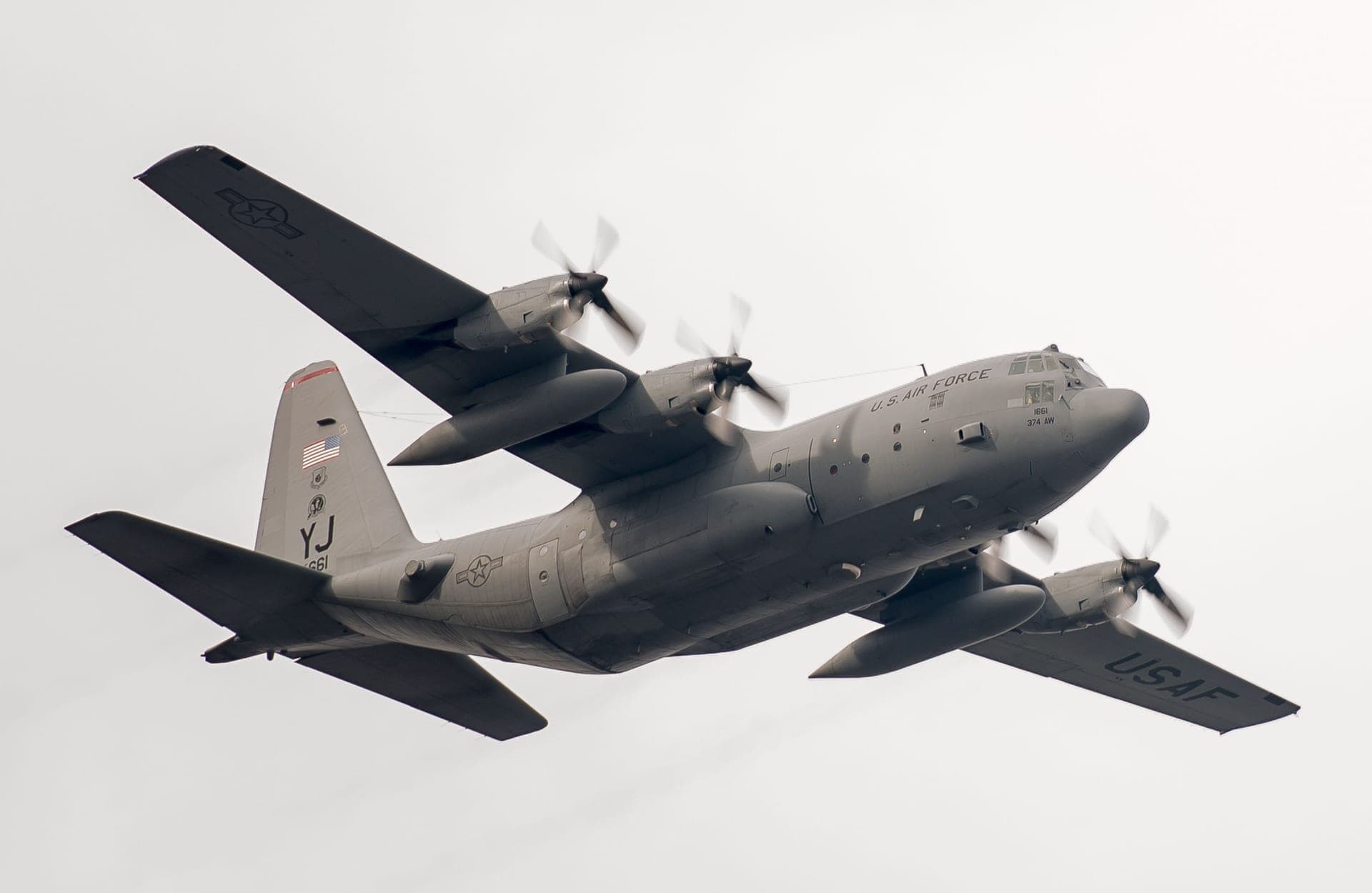
The Lockheed C-130 Hercules is an American four-engined turboprop military transport, designed for tactical airlift into short, unprepared airstrips that no jet transport could use. It has been in continuous production since 1954, longer than any other military aircraft, and remains in production today as the C-130J Super Hercules.
The requirement that produced it, issued by the U.S. Air Force in 1951, asked for a rugged, high-wing transport with a rear cargo ramp, able to carry troops, vehicles and outsized cargo into and out of rough forward airstrips. Lockheed's Georgia division answered with a design built around that mission rather than adapted to it, and the formula proved so sound that it has outlasted the aircraft it was meant to replace, the aircraft that replaced those, and several generations of proposed successors.
More than 2,700 Hercules have been built for over 60 nations, in roles that range far beyond straightforward transport: aerial refuelling tanker, airborne gunship, weather reconnaissance aircraft, electronic warfare platform, ski-equipped polar transport and aerial firefighter among them. Few airframes in aviation history have been adapted to as many distinct missions without a fundamental redesign.
The aircraft's best-known moments span decades and continents, resupplying the besieged garrison at Khe Sanh in 1968, carrying Israeli commandos to Entebbe in 1976, and flying humanitarian airlifts into disaster zones the world over. What unites them is the same unglamorous virtue: an aircraft that can land almost anywhere and get back out again.
Development
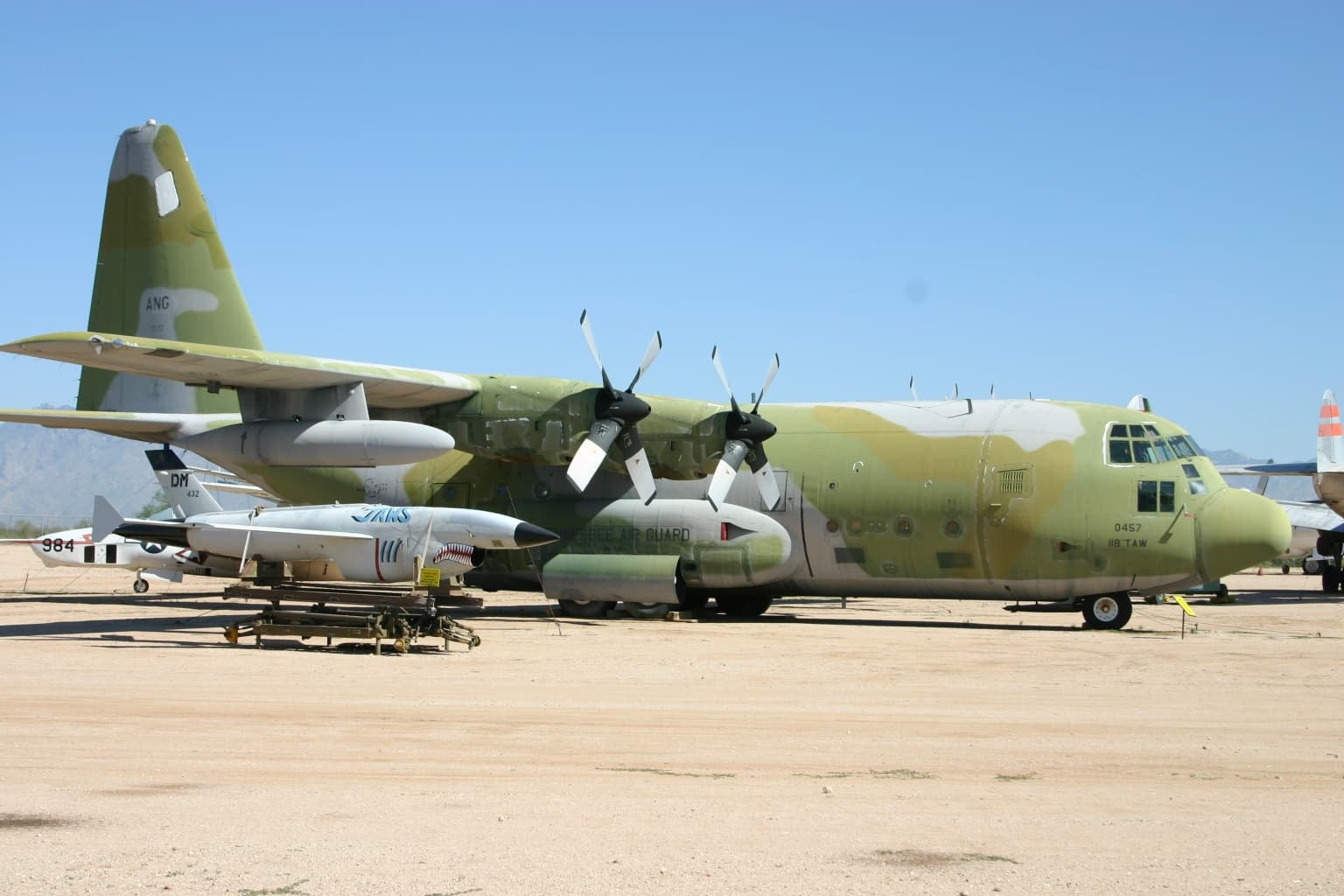 C-130A
In 1951, with the Korean War underway, the U.S. Air Force issued General Operational Requirement 182 for a new tactical transport. It specified a cruising speed of around 300 kt, a combat radius of 1,100 nm, and, the demand that shaped everything else, the ability to operate from short, unimproved strips near the front line. Lockheed's proposal, drafted under chief engineer Willis Hawkins and detailed by a young Kelly Johnson among others, broke sharply with the era's transport designs: a high, straight wing kept clear of the fuselage for a low, flat cargo floor; four turboprops rather than piston engines or pure jets, for the fuel economy and short-field performance neither alternative could match; and a full-width rear ramp that let vehicles be driven straight on and off.
Two YC-130 prototypes were ordered, and the first flew from Burbank, California, on 23 August 1954, piloted by Stanley Beltz and Roy Wimmer. It was, by the standards of the aircraft that followed, a modest machine: shorter, less powerful, without the terrain-following radar and paratroop doors of later production models: but it flew the mission profile the Air Force had asked for, and did so convincingly enough that production was ordered before testing was complete.
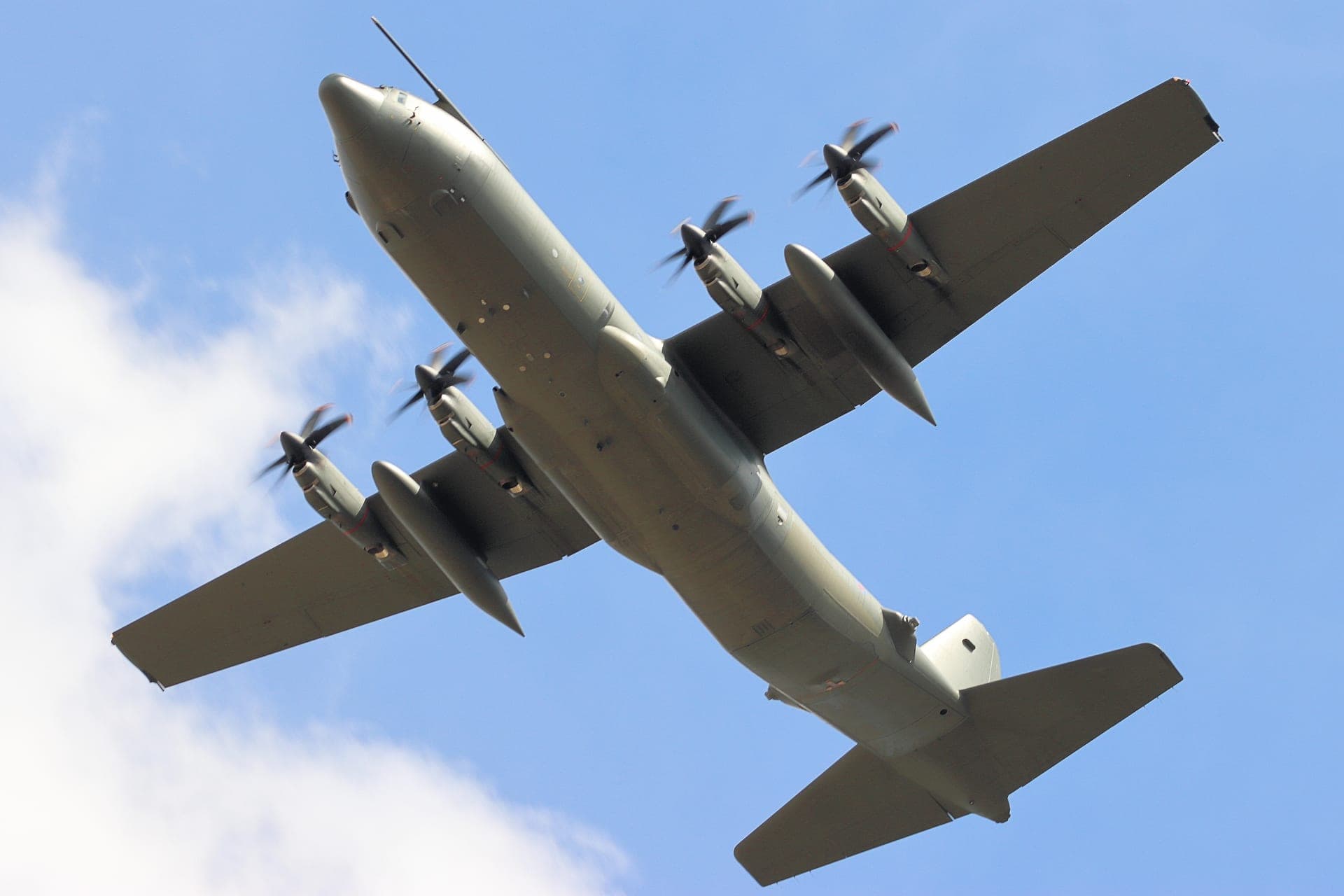 C-130J Super Hercules
The C-130A entered service with the Tactical Air Command in December 1956, the first turboprop transport built into the U.S. Air Force inventory. What followed was not a single production run but a continuous one: successive marks answered new requirements (more range, more power, a rear-loading ramp usable in flight, digital avionics) without Lockheed ever needing to design a replacement. Production has continued at the company's Marietta, Georgia plant for more than seventy years, a run unmatched by any other military aircraft in history.
Design
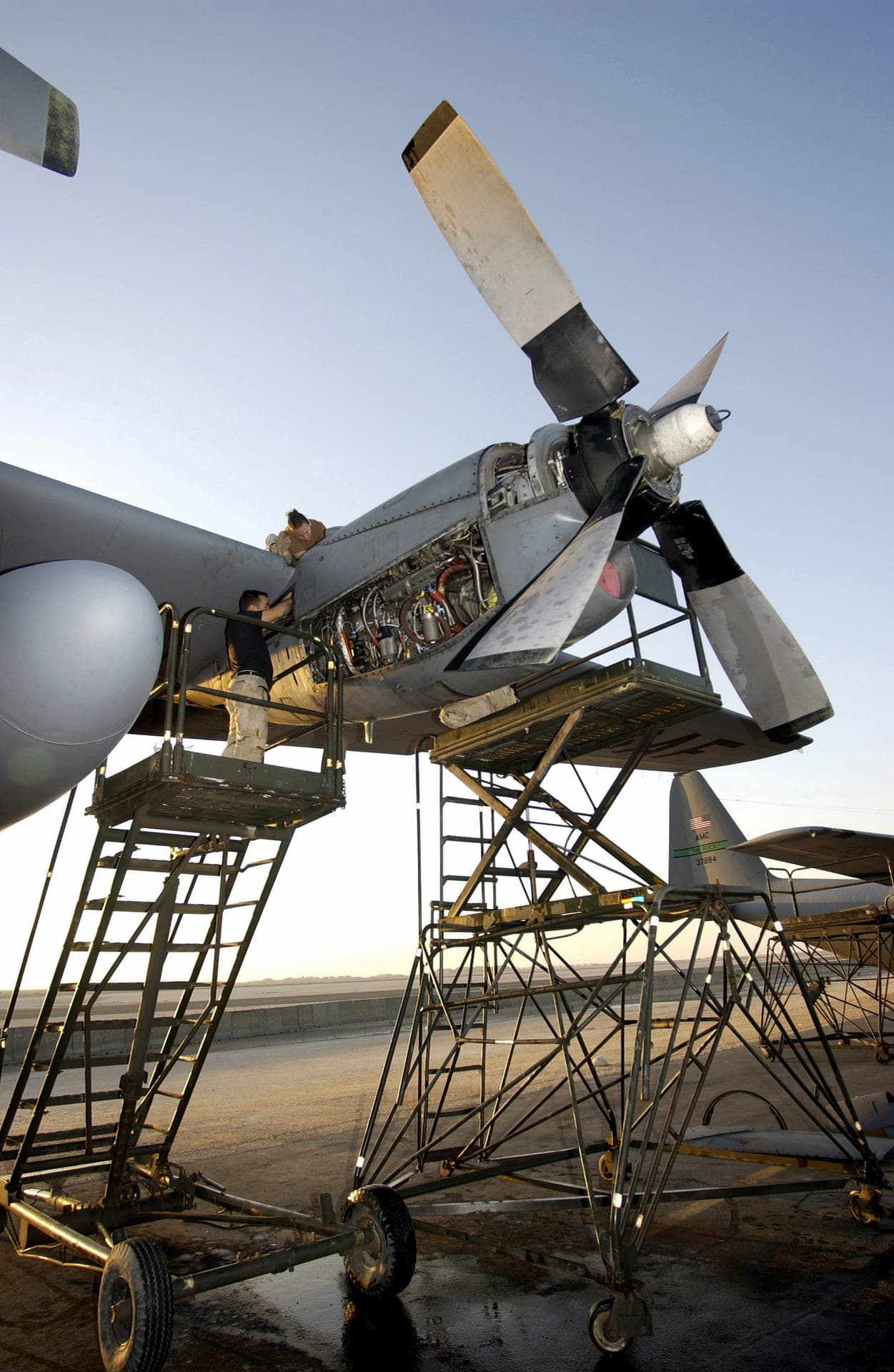
Every enduring feature of the Hercules follows from the 1951 requirement to operate from short, rough strips while carrying a useful load. The high, straight wing sits clear of the cargo hold, which keeps the floor low to the ground, close enough that trucks can be driven up the rear ramp without a separate loading platform. That ramp, hinged at the bottom and openable in flight, is as much a part of the aircraft's identity as its silhouette: it allows para-dropping of troops and heavy equipment, low-altitude extraction of loads without the aircraft landing at all, and straight-in loading of vehicles, artillery and pallets on the ground.
Power has always come from four Allison (later Rolls-Royce-owned) T56 turboprops, chosen over piston engines for their better power-to-weight ratio and over pure jets for far superior fuel economy and short-field thrust response. The T56 family grew substantially across the type's life, from roughly 3,750 shp in the earliest A-model engines to more than 4,600 shp in the AE 2100D3 that powers the C-130J: a near 25 percent gain achieved without changing the basic architecture the airframe was built around.
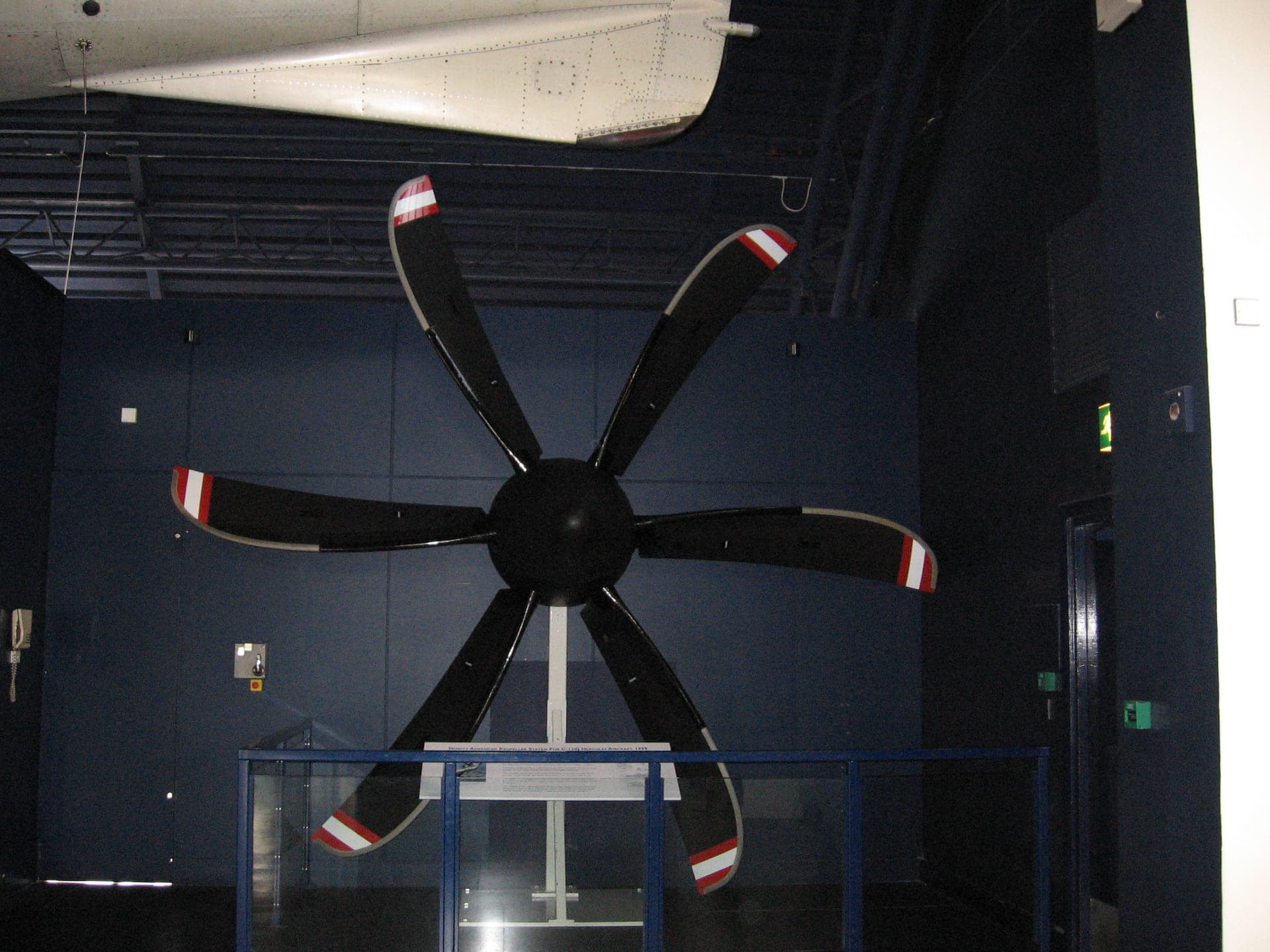 C-130J Super Hercules
The undercarriage and structure were built for unimproved surfaces from the outset: a robust, fixed-geometry main gear tucked into external fairings rather than the wing or fuselage, freeing cabin volume, and a fuselage cross-section sized for standard military pallets, vehicles and litters rather than passenger seating. The result is an aircraft that looks, seven decades on, recognisably like its own prototype: not because it went unimproved, but because the basic proportions solved the problem correctly the first time.
Technical characteristics
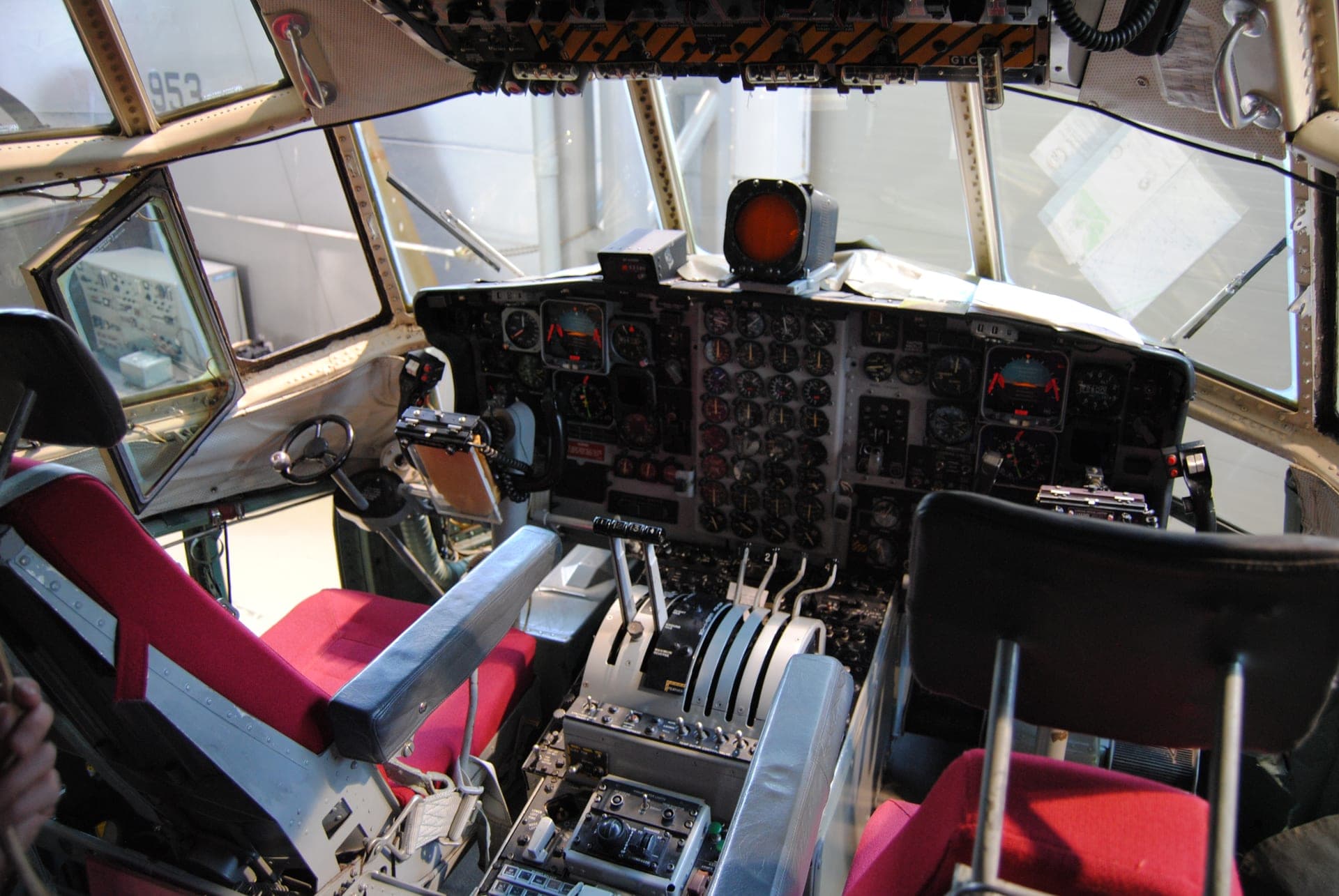
Specifications vary substantially across seven decades and dozens of marks; the figures given here are for the current-production C-130J Super Hercules, the version by which the type is now defined. It is flown by a crew of three, two pilots and a loadmaster, the flight engineer's and navigator's stations of earlier marks having been absorbed into a digital, two-crew flight deck, and can carry up to 92 troops, 64 paratroopers or six standard cargo pallets in its 41 ft hold.
Four Rolls-Royce (Allison) AE 2100D3 turboprops, each rated at 4,637 shp, drive six-blade Dowty R391 composite propellers, giving a maximum speed of about 360 kt and a cruise of around 348 kt, modest by jet-airliner standards, and irrelevant to the aircraft's purpose. Maximum take-off weight is 164,000 lb against an empty weight of 75,561 lb, and the aircraft carries enough fuel for a range of roughly 1,800 nm with a normal payload, extendable considerably with reduced cargo or aerial refuelling.
Wingspan is 132.6 ft, length 97.74 ft and height 38.85 ft: dimensions that have grown only modestly since the original C-130A, whose fuselage the J-model stretches by less than a metre unless the longer C-130J-30 variant is specified. Service ceiling is around 28,000 ft with a substantial payload aboard, well above the terrain the aircraft is typically asked to operate near rather than over.
Military service
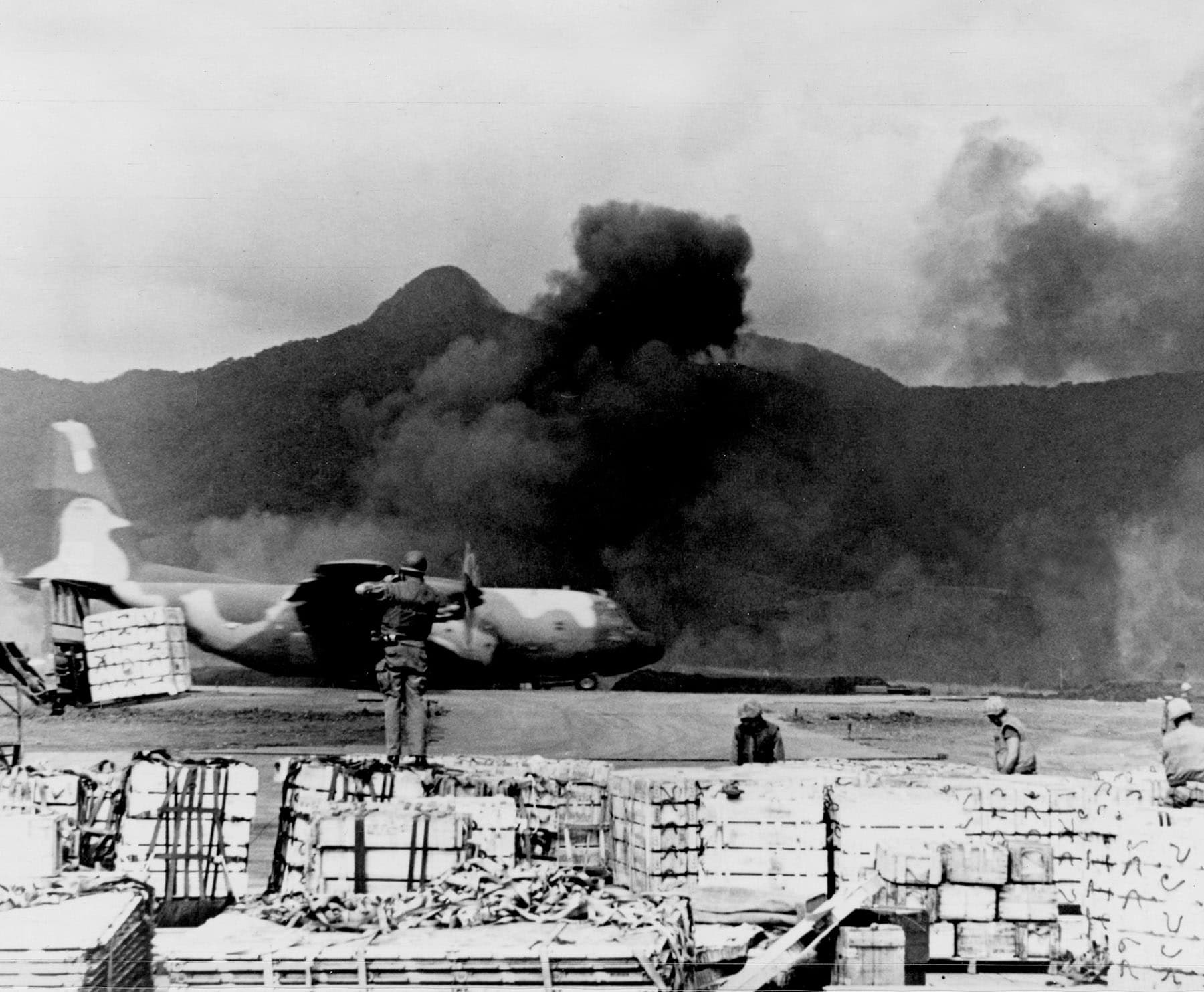
The Hercules has flown in every major U.S. conflict since Vietnam and in the militaries of more than sixty other nations, and its combat record is inseparable from the airlift missions that make up most of its flying. In Vietnam, C-130s flew resupply into forward strips across the country, most famously into Khe Sanh in early 1968, where the airfield came under sustained artillery fire during a 77-day siege; crews delivered supplies by landing under fire, by low-altitude extraction without touching down, and, when the runway itself became too dangerous, by parachute.

The airframe's adaptability produced an entire family of specialised military variants. The AC-130 gunship, first fielded over the Ho Chi Minh Trail in 1967, replaced cargo capacity with side-firing cannon and, later, precision sensors, turning a transport into one of the most effective close air support platforms in American service: a lineage that runs from the Vietnam-era AC-130A through the AC-130H Spectre to today's AC-130J Ghostrider. The HC-130 combat search-and-rescue variant and the KC-130 tanker extend the same airframe to recovering downed aircrew and refuelling other aircraft in flight, including, in Marine Corps service, fighters such as the F-35.
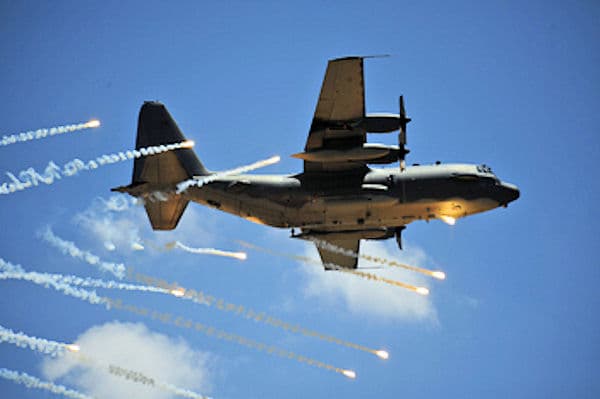 AC-130
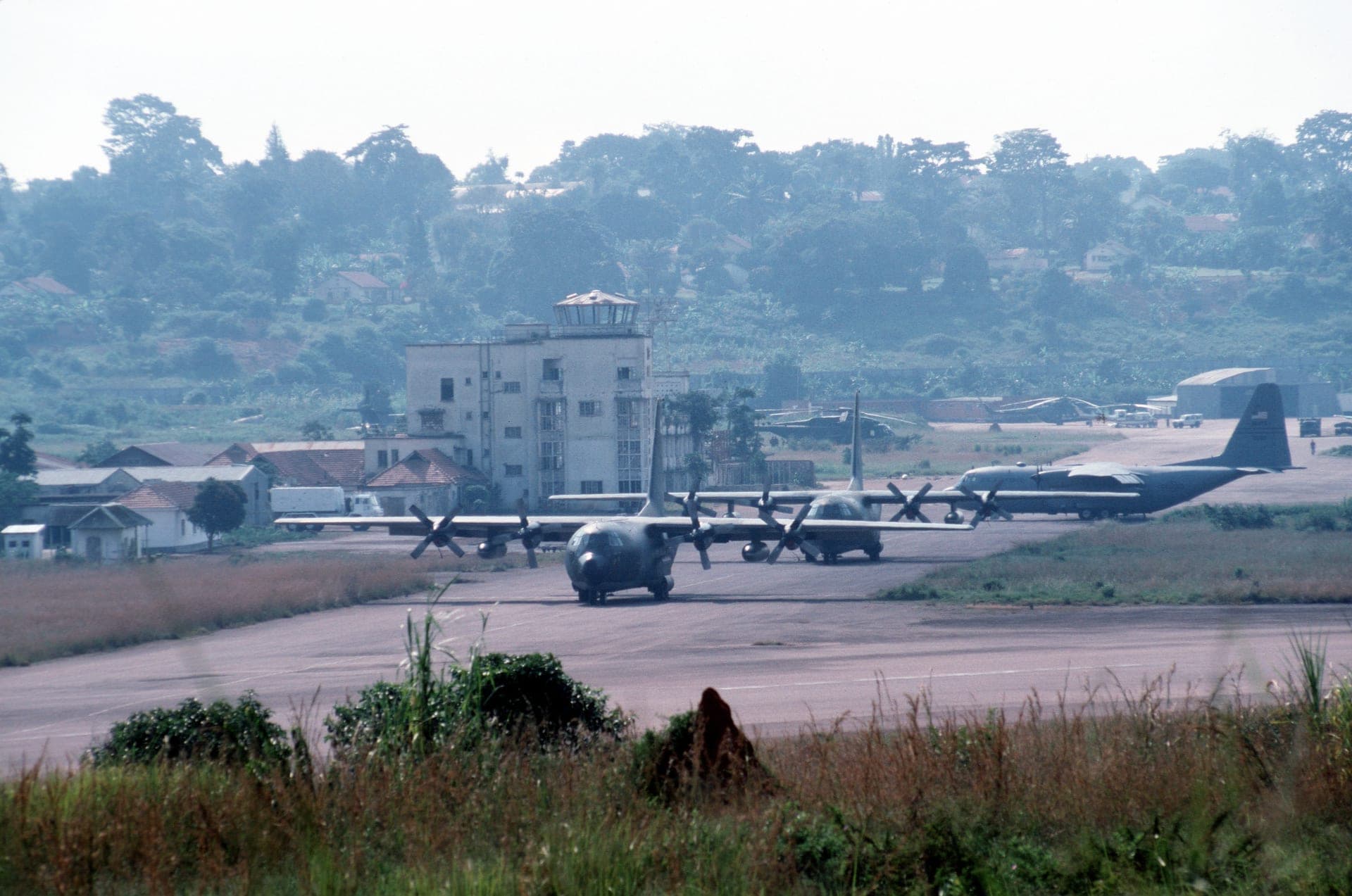
The aircraft's most famous single mission remains Operation Thunderbolt, the Israeli raid on Entebbe Airport, Uganda, on 4 July 1976. Four Israeli Air Force C-130s flew roughly 2,200 nm at very low altitude, without mid-air refuelling, to land commandos who freed more than 100 hostages held after an airliner hijacking. The mission is still studied as one of the most audacious hostage-rescue operations ever executed, and it depended entirely on the Hercules's ability to land, unload and take off again from an unfamiliar runway at night.
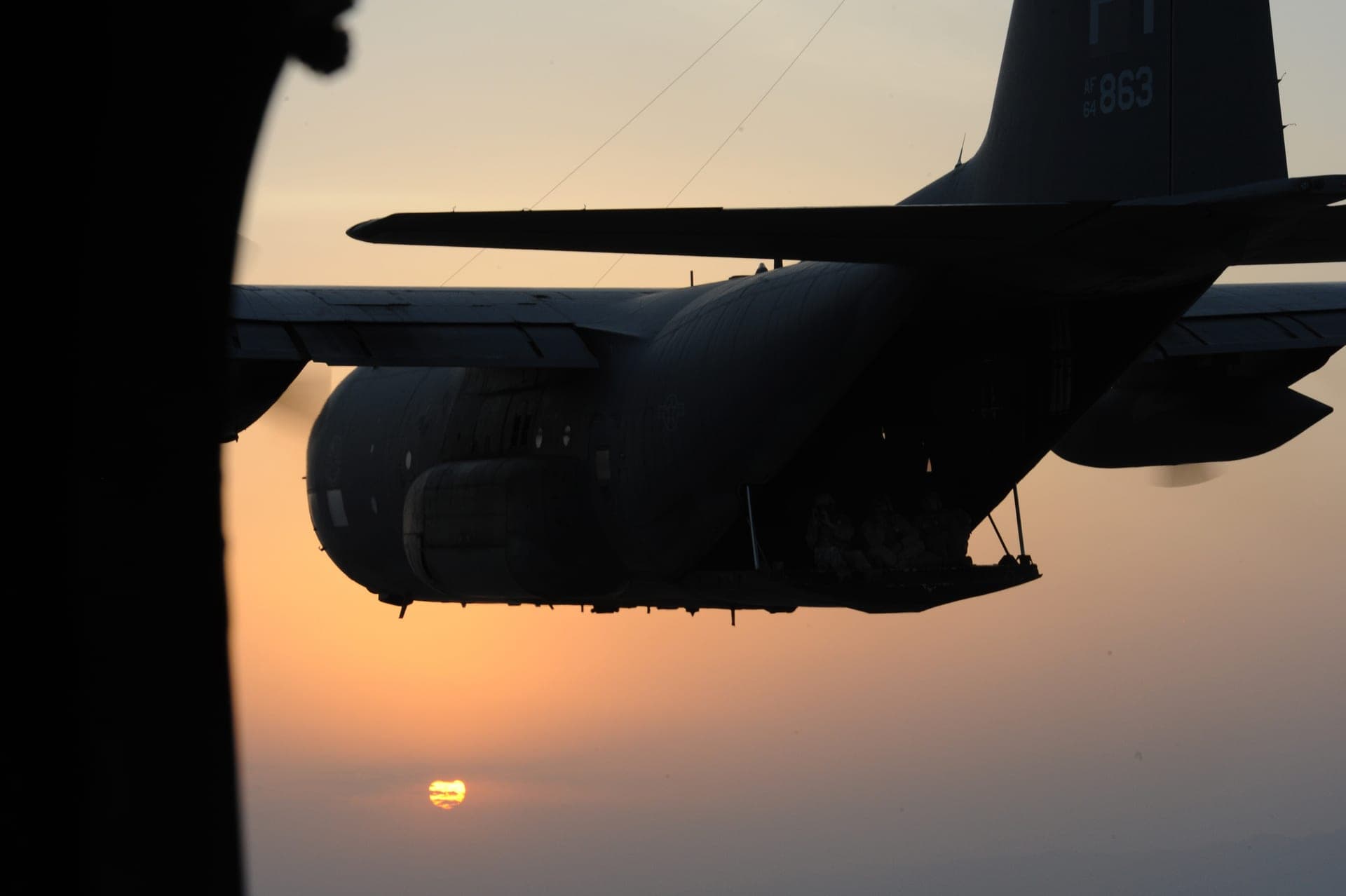 HC-130
Not every military use has gone well. On 25 April 1980, during Operation Eagle Claw, the failed attempt to rescue American hostages in Iran, a Marine Corps RH-53D helicopter collided with an EC-130E during a chaotic night withdrawal from the desert staging site codenamed Desert One, killing eight servicemen. The disaster, caused by a sandstorm, mechanical failures among the helicopter force and inadequate coordination between services, led directly to the creation of U.S. Special Operations Command and to a lasting overhaul of how the American military plans joint operations.
Operators
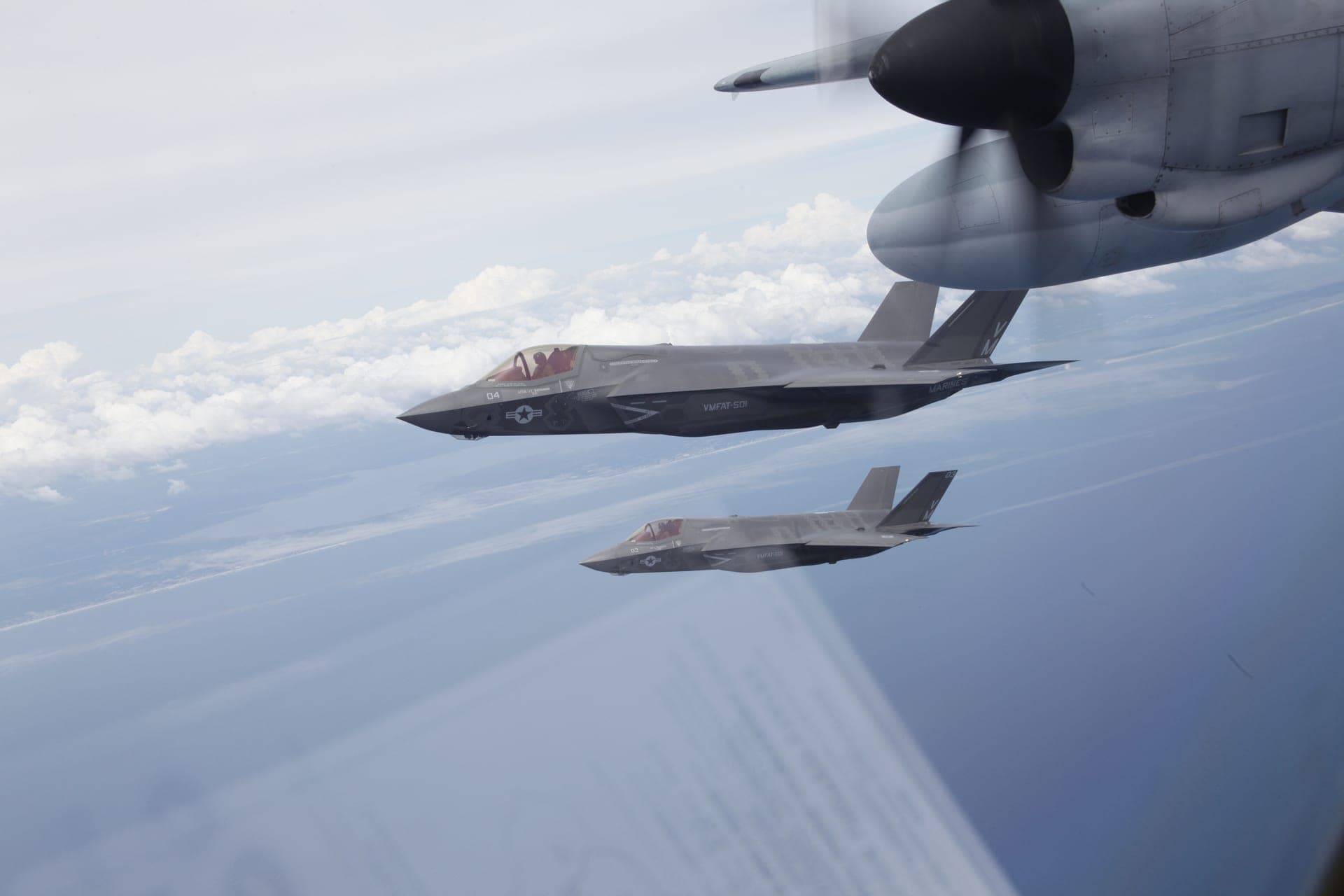 KC-130
Beyond the United States, more than sixty air arms have operated the Hercules, and the aircraft's specialised variants have found roles well outside the battlefield. The LC-130, fitted with retractable skis over its wheels, is the only large aircraft capable of landing on the polar ice sheets in routine service, and has supported American, and later multinational, scientific research in Antarctica and Greenland since the early 1960s. The EC-130 family covers a wide span of electronic missions, from psychological-operations broadcasting to airborne command-and-control and communications relay, reflecting how readily the airframe's volume and endurance suit it to carrying equipment rather than cargo.
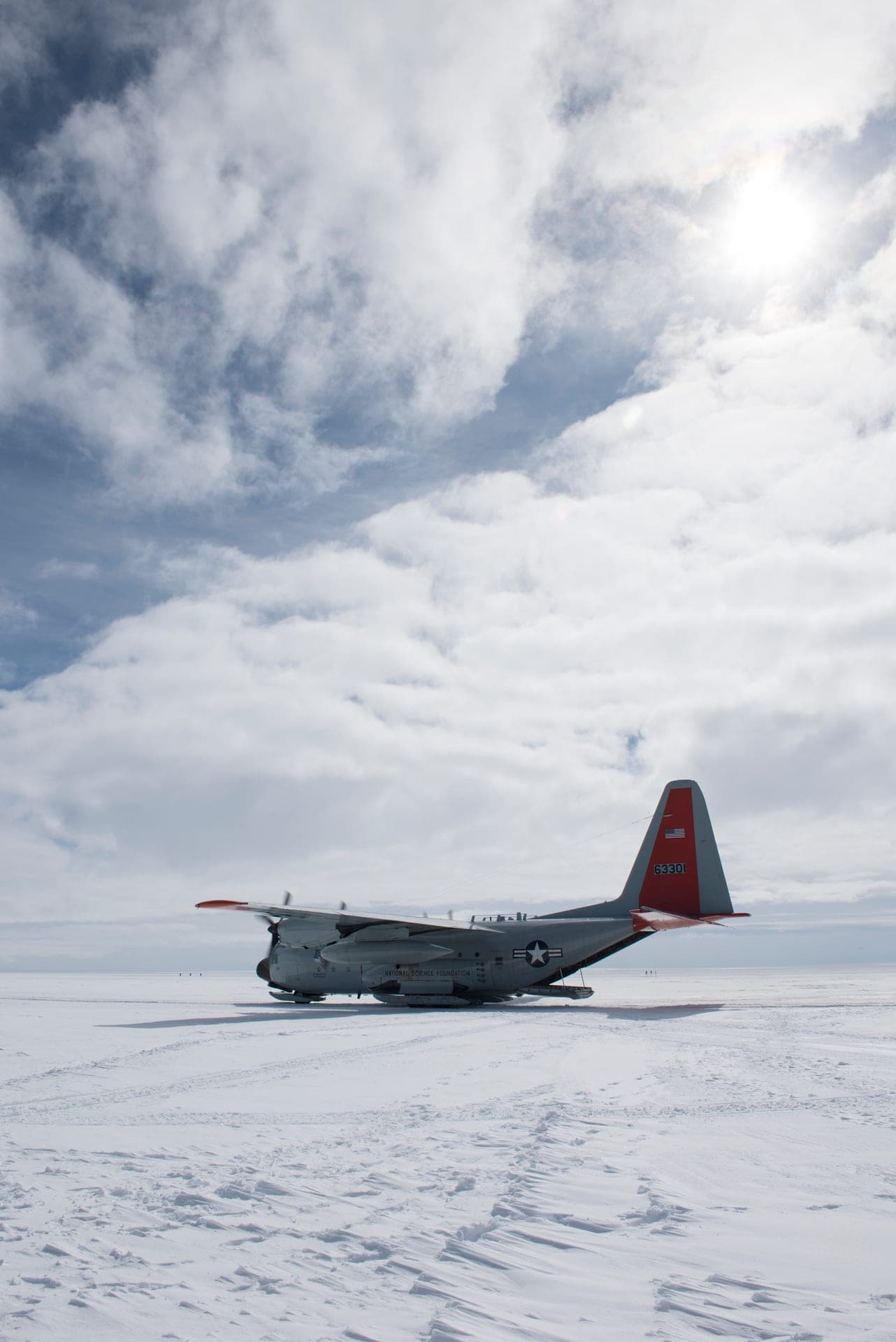 LC-130
Many export operators received their aircraft second-hand rather than new. Austria, for instance, leased three C-130K Hercules: the export designation used for British-built aircraft, broadly equivalent to the American C-130H, from Royal Air Force surplus in 2002, decades after their original construction, and continued flying and upgrading them for another two decades. That pattern, of Hercules airframes moving between air forces long after their first delivery, is common across the type's export history and reflects the airframe's structural longevity as much as its acquisition cost.
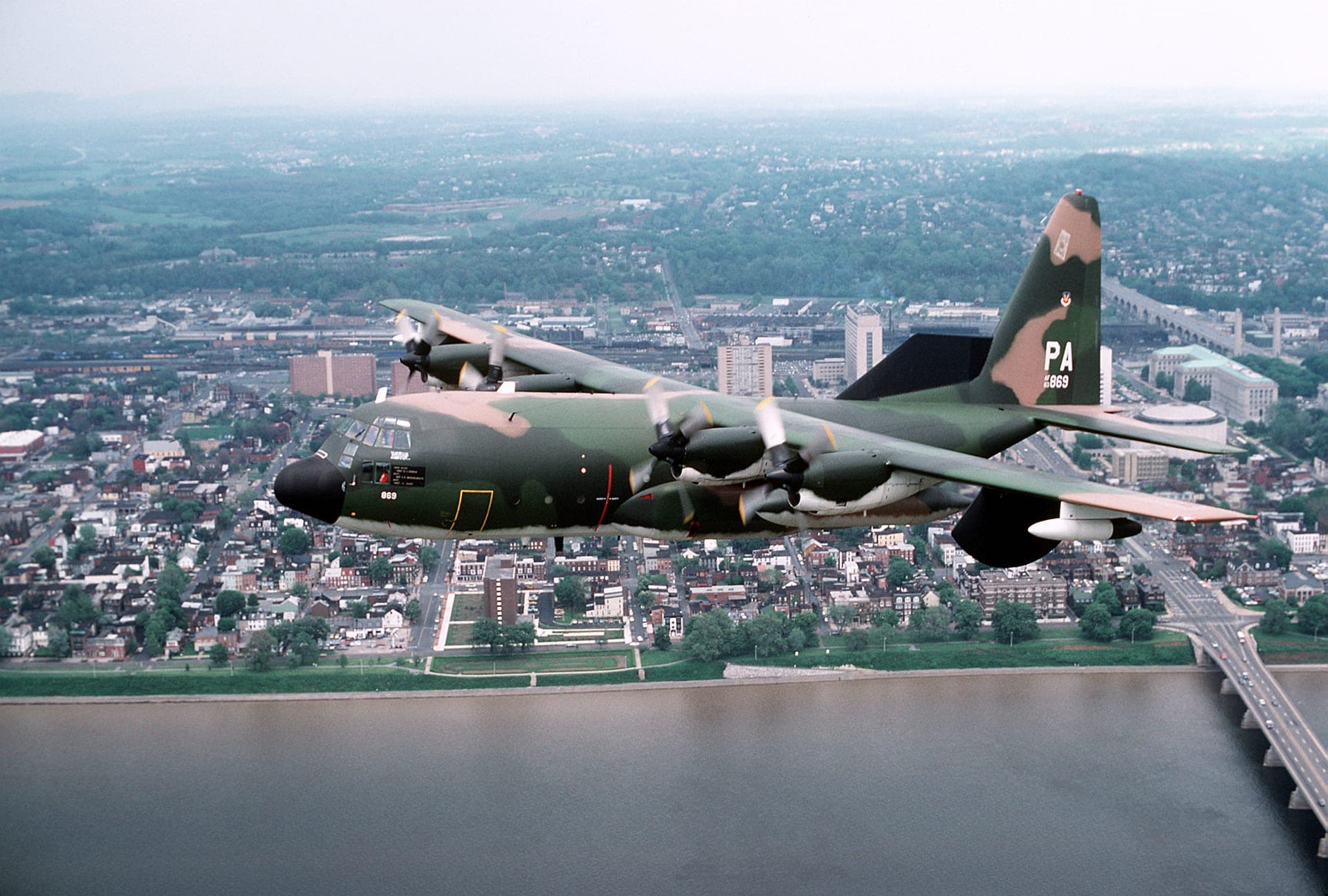 EC-130E
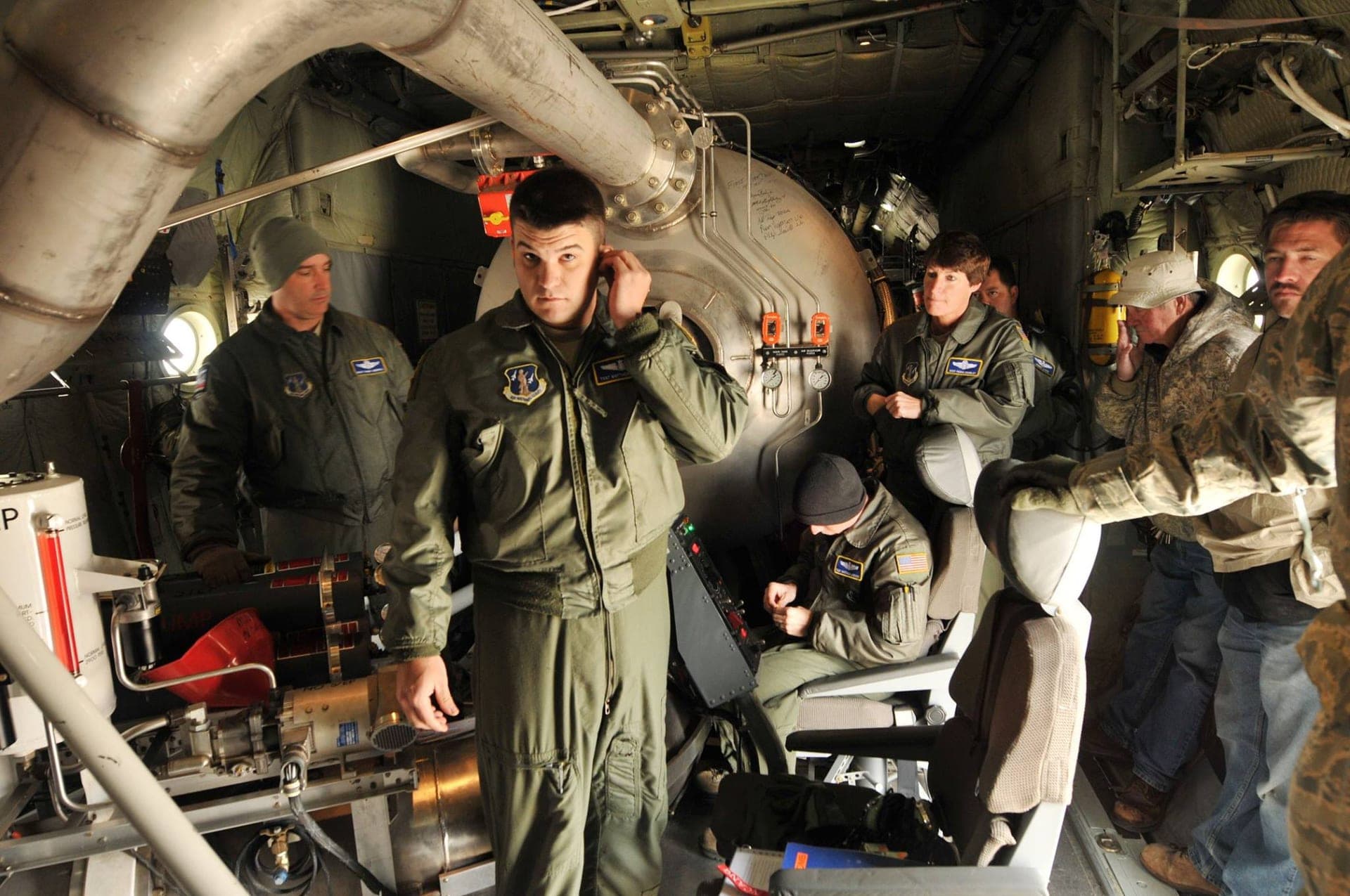
Aerial firefighting has become one of the aircraft's most visible civilian-facing roles. Air National Guard and other C-130s fitted with the Modular Airborne Firefighting System, a removable pallet-mounted tank and delivery system, drop retardant on wildfires across the western United States and, on request, in allied countries: a mission that draws on exactly the same short-field, high-payload characteristics the airframe was designed around in 1951, applied to a threat no one anticipated at the time.
In service
 AC-130A
The Hercules's history is, more than most aircraft, a history of continuous adaptation rather than a single narrative arc. Successive marks kept pace with what each era demanded: the C-130B added greater fuel capacity and structural strength in 1959; the C-130E, the definitive Vietnam-era model, extended range with external pylon tanks; the C-130H of 1964 brought uprated engines and improved systems; and the C-130J, developed through the 1990s, replaced the analogue flight deck, the flight engineer and the navigator with a digital, two-pilot cockpit and new engines and propellers, the most substantial redesign the type has undergone.
That continuity has not meant an absence of setbacks. Beyond Desert One, individual C-130 losses have occurred throughout the type's service, in combat, in training and in the firefighting role, as they have for every aircraft flown for seven decades at low altitude, often into short or unimproved strips, by dozens of air forces. The type's overall safety record over that span, and the breadth of missions it has been asked to fly, are usually cited together, because the aircraft has done more dangerous, improvised flying than almost any comparable transport.
What is not in dispute is longevity. In 2024 the C-130 program marked seventy years of continuous production from first flight to current delivery, a record unmatched by any other military aircraft, and the U.S. Air Force alone plans to operate C-130s well into the 2040s. Lockheed Martin continues to build C-130Js for the United States and export customers from the same Marietta, Georgia plant that built the first C-130A in the 1950s.
Legacy
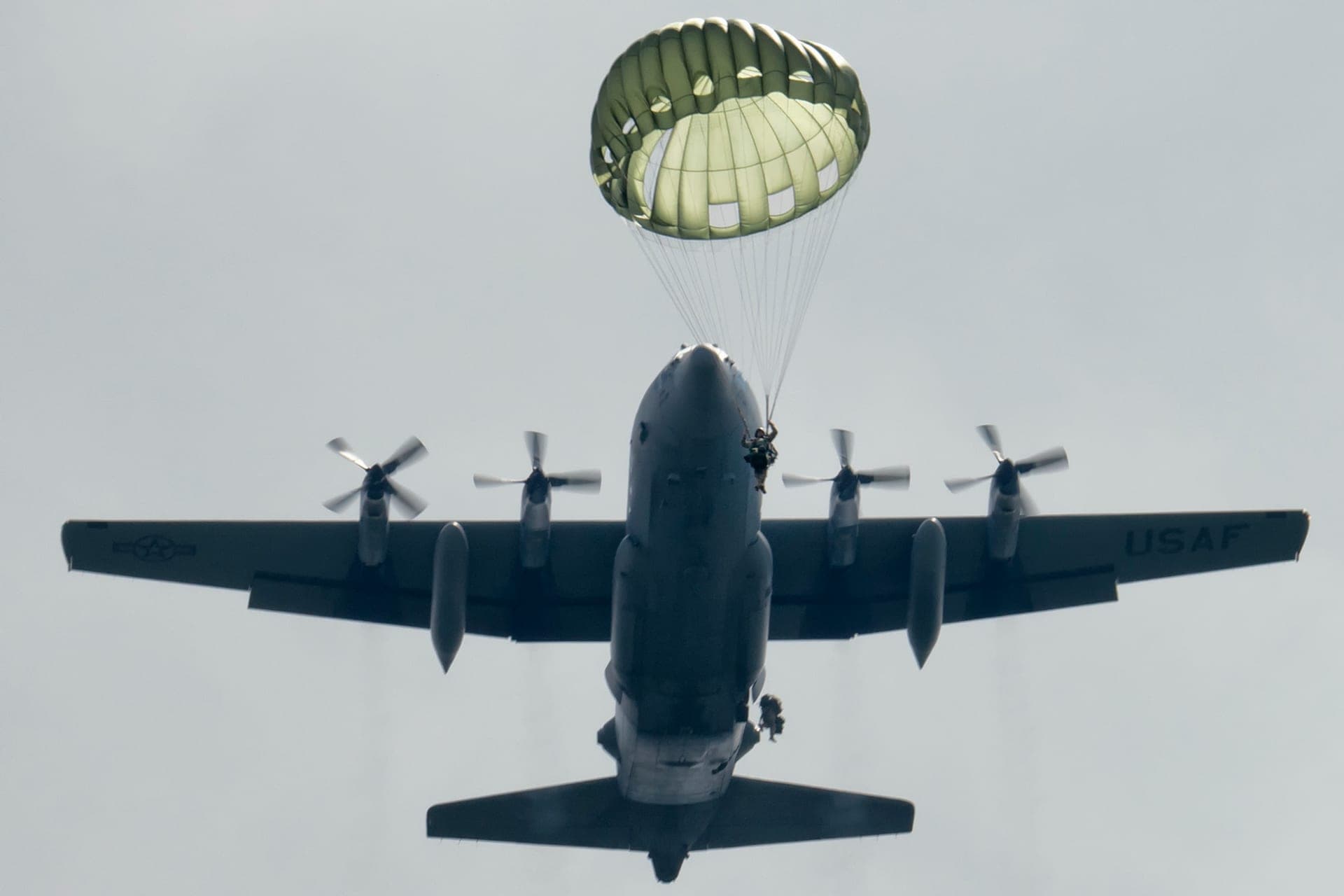
No other military aircraft has matched the Hercules for the sheer range of roles it has filled from a single, largely unchanged airframe. It has carried paratroopers, evacuated the wounded, hunted enemy transport by night as a gunship, dropped retardant on wildfires, refuelled helicopters and fighters in mid-air, and landed on the polar ice, often within the career of a single, much-modified airframe. Few design decisions from 1951 have proved as durable as the low, wide cargo floor and rear ramp that made all of it possible.
Its closest rivals (European, Soviet and now Brazilian and Japanese tactical transports) have generally been built to match some part of what the Hercules already did, rather than the reverse, and none has approached its production run or the diversity of its derivatives. The aircraft's own replacement, when one eventually comes, will be measured against a standard the C-130 itself set and has spent seventy years defending.
 C-130K
That is the simplest way to state what the type means: an aircraft designed to solve one narrow problem, get useful cargo into a place with no proper runway, turned out to solve so many adjacent problems so well that seven decades and several complete redesigns later, air forces are still ordering new ones.
Model evolution
C-130A
1956The initial production variant, developed directly from the two YC-130 prototypes that first flew on 23 August 1954. It entered U.S. Air Force service in December 1956 as the first turboprop tactical transport built for straight-in rear-loading and unimproved-strip operation, and 231 were built.
Four Allison T56-A-1A turboprops of about 3,750 shp each driving three-blade propellers, a rounded nose without the radome of later marks, and a shorter fuselage than every mark that followed. Built to meet the U.S. Air Force's 1951 requirement for a tactical airlifter able to carry troops and cargo into and out of short, unprepared airstrips, a role no existing transport filled.
C-130B
1959A refined version of the A model, entering service in 1959 with increased fuel capacity and a strengthened structure to support the heavier loads squadrons wanted to carry on the same airframe.
Increased internal fuel tankage, a strengthened wing and undercarriage, and uprated T56-A-7 engines, giving greater range and payload than the A model without altering its external proportions. Early operational experience showed squadrons wanted more range and payload from the same basic airframe rather than a new design, so Lockheed strengthened and re-engined it instead.
C-130E
1962The definitive Vietnam-era Hercules, introduced in 1962 and built in greater numbers than any mark before it. It formed the backbone of tactical airlift throughout the Vietnam War, flying resupply into contested and besieged airstrips such as Khe Sanh.
Underwing pylon fuel tanks nearly doubling range over the B model, a strengthened landing gear and centre wing box for sustained high-tempo operations, and further-uprated T56-A-7 engines. Southeast Asian operations demanded far greater range between austere strips than earlier marks offered, without waiting for a new airframe design.
C-130H
1964The most widely exported Hercules, introduced from 1964 and still in front-line service with many air forces decades later. It became the standard tactical transport of the Cold War and post-Cold War era across dozens of countries.
Uprated T56-A-15 engines, improved avionics and structural updates extending fatigue life for sustained operations, refined progressively across a production run that lasted into the 1990s. Export customers and the U.S. military wanted a more capable, longer-lived successor to the C-130E that could be built and supported over a long production run.
AC-130 gunship
1967A heavily armed derivative that replaced cargo capacity with side-firing cannon and sensors, first fielded over the Ho Chi Minh Trail in 1967. The lineage runs from the Vietnam-era AC-130A through the AC-130H Spectre and AC-130U Spooky to today's AC-130J Ghostrider.
Side-firing 20mm, 40mm and 105mm weapons aimed via a pylon turn rather than aircraft heading, progressively paired with infrared and low-light sensors, fire-control computers and precision-guided munitions on later marks. Ground forces needed sustained, accurate night fire support that fixed-wing fighters of the era could not loiter long enough to provide.
The gunship proved so effective against night truck traffic and, later, in close support of ground troops that the lineage has been continuously maintained for more than fifty years, longer than almost any other dedicated attack aircraft programme.
HC-130
1964The combat search-and-rescue variant, equipped to locate, refuel and coordinate the recovery of downed aircrew far from friendly territory, and operated by the Air Force, Coast Guard and other services.
Extended-range fuel tanks, search radar, aerial refuelling pods for helicopters, and in some versions a Fulton surface-to-air recovery system for extracting personnel without landing. Downed aircrew in contested or remote areas needed an aircraft that could search, refuel rescue helicopters mid-mission and stay on station far longer than a helicopter alone.
EC-130
1965An umbrella designation for electronic-mission Hercules, spanning airborne command posts, psychological-operations broadcasting and communications relay across variants including the EC-130E and later EC-130H Compass Call.
Cargo volume given over to racks of transmitters, receivers and electronic countermeasures equipment, with distinctive external antennas that vary sharply between sub-variants according to mission. The airframe's volume, endurance and electrical generating capacity suited it readily to carrying mission equipment rather than cargo, at far lower cost than a purpose-built platform.
LC-130 (ski-equipped)
1960A ski-equipped variant supporting American and multinational polar science, in continuous use in Antarctica and Greenland since the early 1960s and still flown by the New York Air National Guard.
Retractable skis fitted over the standard wheels, allowing landing on snow and ice, plus reinforced structure for the loads that landing gear configuration imposes. Only a large, wheel-and-ski aircraft could deliver the volume of cargo polar research stations needed, and no other in-production transport could be adapted to the role.
KC-130
1958The aerial refuelling tanker variant, operated principally by the U.S. Marine Corps since 1958 and by several export customers, refuelling both fixed-wing aircraft and helicopters.
Wing-mounted hose-and-drogue refuelling pods and an internal fuel system reconfigured for transfer rather than only self-consumption, while retaining the standard transport's cargo capability. The Marine Corps needed an organic, land- and carrier-independent tanker able to refuel its own fighters and helicopters without relying on Air Force assets.
C-130J Super Hercules
1999The current-production variant and the most substantial redesign in the type's history, developed through the 1990s and in service since 1999. It is now the version by which the aircraft is defined for new-build customers worldwide.
A digital, two-crew flight deck with head-up displays that eliminated the flight engineer and navigator stations, new Rolls-Royce AE 2100D3 engines producing roughly 25 percent more power, and six-blade Dowty R391 composite propellers replacing the earlier four-blade metal design, together giving markedly better short-field, high-altitude and hot-weather performance. Sustaining a fifty-year-old design against modern threats and rising crew and maintenance costs required a fundamental cockpit and propulsion redesign rather than another incremental upgrade.
Early development was troubled by aerodynamic and de-icing problems that pushed costs well past initial estimates, but the type has since become Lockheed Martin's best-selling Hercules, with more than 570 delivered to over twenty nations by the mid-2020s.
Blueprints
- C-130J Super Hercules, Lockheed Martin
- C-130 Hercules, U.S. Air Force
- Lockheed AC-130A Spectre, National Museum of the United States Air Force
- Lockheed C-130A, Pima Air & Space Museum
- Operation Eagle Claw, U.S. Department of Defense, Office of Inspector General
- How Much Does a C-130 Cost? Hercules Prices Explained, Military Machine
- Lockheed C-130 Hercules, Wikipedia
- Lockheed Martin C-130J Super Hercules, Wikipedia
Checked September 2, 2026