Aircraft
SR-71 Blackbird
SR71
Lockheed CorporationUnited States
- Role:
- Strategic reconnaissance aircraft
- First flight:
- 1964
1,739kt
Cruise speed
2,916nm
Range
General
- Role:
- Strategic reconnaissance aircraft
- Status:
- Retired
Programme
- First flight:
- December 22, 1964
- Introduction:
- 1966
- Produced:
- 1964 to 1970
- Number built:
- 32
Crew & capacity
- Crew:
- 2
Dimensions
- Length:
- 107 ft
- Height:
- 19 ft
- Wingspan:
- 56 ft
- Wing area:
- 1,605 ft²
Weights
- Empty weight:
- 67,461 lb
- Maximum takeoff weight:
- 171,961 lb
- Fuel capacity:
- 12,199 US gal
Powerplant
- Engine:
- 2 × Pratt & Whitney J58 (JT11D-20) turbo-ramjets with afterburner, 145 kN thrust each with reheat
Performance
- Maximum speed:
- 1,906 kt
- Ceiling:
- 84,974 ft
Price
- New in 1966:
- about $34M
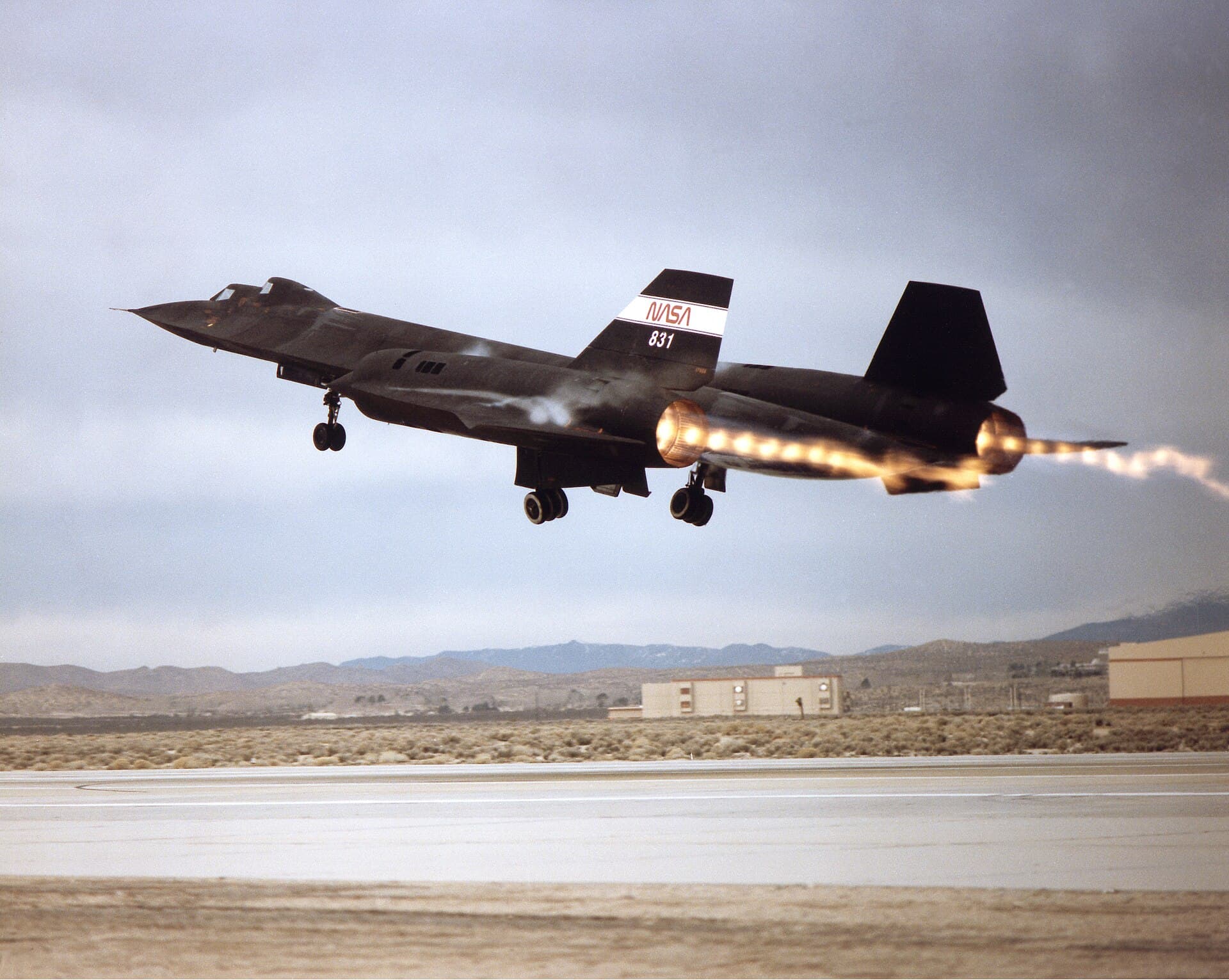
The Lockheed SR-71 Blackbird did not merely fly fast; it made sustained flight at more than three times the speed of sound an ordinary operating condition, something no aircraft before or since has managed as a matter of routine. Where other supersonic designs treated Mach 2 or Mach 3 as a brief dash to be endured, the SR-71 cruised at Mach 3.2 for hours at a stretch, at the edge of space, on missions that could last most of a working day.
Everything about the aircraft follows from that one demand. At cruise speed the skin of the airframe reached temperatures above 300°C, hot enough to soften conventional aluminium, so Lockheed built the SR-71 from titanium: much of it, in one of the Cold War's stranger footnotes, bought quietly through shell companies from the Soviet Union, the only country producing the metal in the quantities and grades required. The airframe itself was assembled with deliberately loose tolerances: on the ground the panels did not fit tightly and the aircraft leaked fuel from its seams, because those same seams were engineered to expand and seal only once heat from friction and compression had done its work in the air.
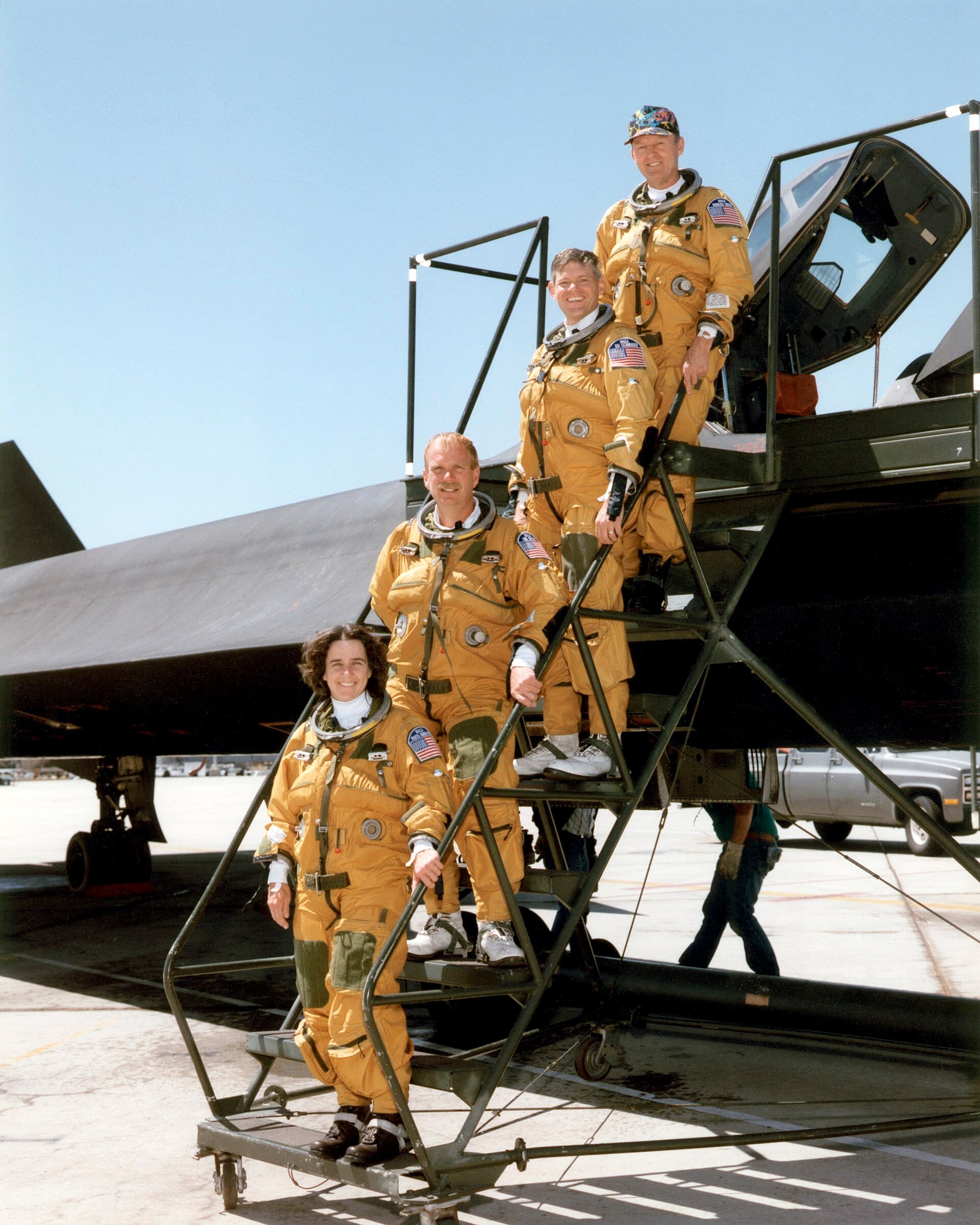
The two Pratt & Whitney J58 engines were turbojets at low speed and something closer to ramjets at cruise, as movable inlet spikes redirected air around the compressor and let the engine's casing itself do most of the work of propulsion. The fuel that powered them, JP-7, was formulated to be so resistant to ignition that a lit match dropped into a tank of it would go out; the engines needed a separate chemical, triethylborane, injected to get combustion started at all. The two crew members flew in full pressure suits, sealed and fed oxygen like astronauts, because a canopy breach at operating altitude would have been fatal within seconds.
Designed by Kelly Johnson's Skunk Works as a reconnaissance derivative of the CIA's A-12, the SR-71 entered U.S. Air Force service in 1966 and flew until 1998, photographing and eavesdropping on denied territory from an altitude and speed that made it, in practice, impossible to intercept. No SR-71 was ever shot down or lost to enemy action; outrunning missiles, rather than evading or outmanoeuvring them, was the aircraft's actual doctrine. It shares that single-minded pursuit of a speed regime with its near contemporary the Concorde, though the two arrived from opposite directions: one built to carry passengers past Mach 2 in aluminium, the other built to carry two crew and cameras past Mach 3 in titanium: and both were, in the end, retired chiefly because of what they cost to operate.
History
The Blackbird family began not with the SR-71 but with the A-12, a single-seat reconnaissance aircraft Lockheed developed for the Central Intelligence Agency under the codename OXCART, starting in 1959 as a successor to the U-2 after Francis Gary Powers was shot down over the Soviet Union in May 1960. The CIA, needing a follow-on that no radar could track and no missile could reach, funded and directed the program itself, working with Kelly Johnson's Skunk Works team at a remote test site at Groom Lake, Nevada, which iterated through more than a dozen configurations before settling on the chined, double-delta shape that would define every aircraft in the family. The A-12 first flew in April 1962 and began CIA operational missions in 1967, flying reconnaissance sorties over Vietnam and North Korea under the program name Black Shield.
The U.S. Air Force wanted its own version, larger and carrying a second crew member to operate sensors, and Lockheed built it as the SR-71. It first flew on 22 December 1964, and by January 1966 the 4200th (later 9th) Strategic Reconnaissance Wing at Beale Air Force Base in California was flying it operationally, quickly building an unmatched record of reconnaissance missions over Vietnam, the Middle East and the Soviet periphery. For most of its career only a small number of airframes were airborne at any time, the fleet never exceeded about a dozen active aircraft, flying from forward bases at Kadena in Okinawa and RAF Mildenhall in England as well as from Beale itself.
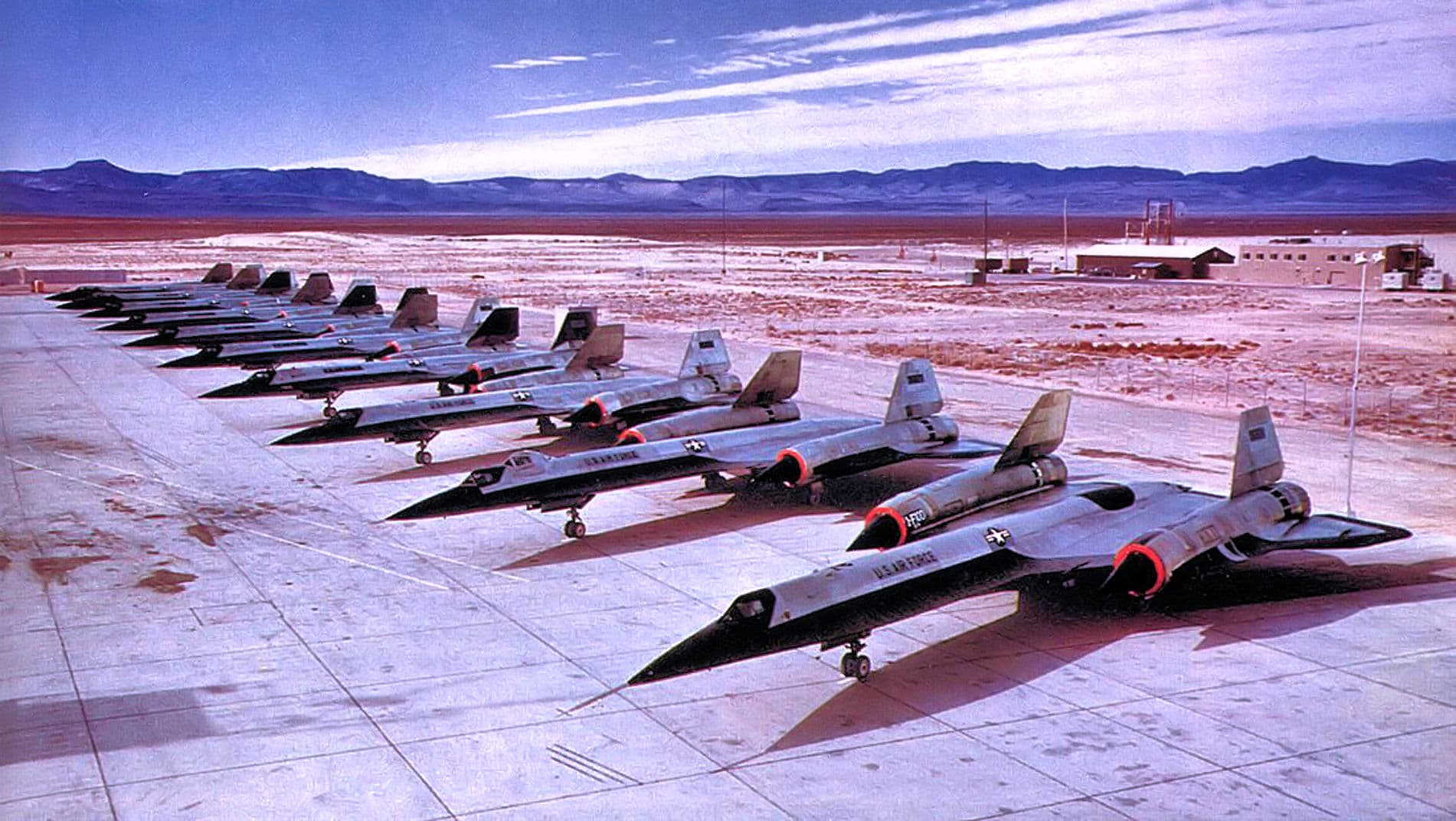
The program also had its own quiet tragedy. On 30 July 1966, an M-21 mothership launching a D-21 reconnaissance drone was struck by the drone after a faulty separation; both crew ejected over the Pacific, but launch control officer Ray Torick drowned when his pressure suit filled with water before rescue, and the M-21/D-21 launch concept was abandoned immediately afterward. That loss was not isolated: of the 32 SR-71s built, roughly a dozen were destroyed over the program's life, nearly all in accidents tied to the aircraft's extreme operating envelope, engine failures, structural failures during high-speed testing, and one mid-air refuelling collision, rather than to enemy action, a toll the Air Force accepted as the cost of flying so far beyond any other aircraft's performance.
The Air Force retired the SR-71 in 1989-1990, judging that satellite reconnaissance had made it too expensive to keep flying; the retirement flight, on 6 March 1990, doubled as a transcontinental speed record as the aircraft was delivered directly to the Smithsonian National Air and Space Museum. Congress restored funding for a handful of aircraft in 1995 after crews and analysts argued that satellites could not match the SR-71's ability to be tasked and repositioned on short notice, but that second career ended for good in 1998. NASA continued flying two SR-71s from its Dryden Flight Research Center for high-speed and high-altitude research until 1999, the last flights the type would ever make.
Development
Kelly Johnson's design brief was, on its face, contradictory: build an aircraft that could sustain Mach 3 flight for hours, at altitudes above 79,000 ft, while remaining survivable and controllable by a human crew. No existing material, engine or fuel was suited to the task, so the Skunk Works team had to develop or commission most of them from nothing, working in near-total secrecy and, for years, without acknowledging the aircraft's existence.
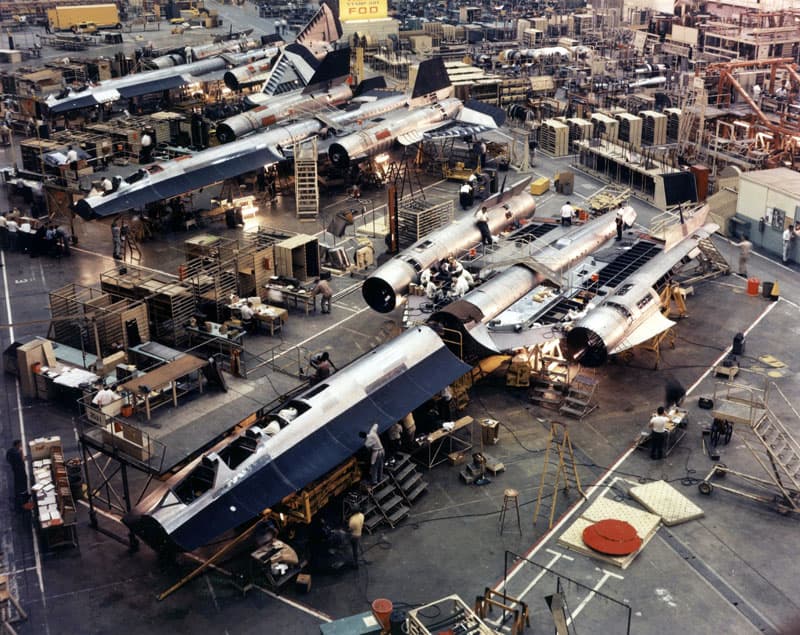
Titanium was the only metal light and strong enough to survive the heat of Mach 3 flight, but American titanium production in the early 1960s could not supply the quantities or the purity Lockheed needed. The CIA arranged to buy the metal covertly through third countries and shell corporations, in an operation that meant a Cold War American reconnaissance aircraft was built substantially from Soviet titanium, a detail declassified only decades later. Lockheed also had to invent tooling from scratch: conventional cadmium-plated steel tools embrittled the titanium on contact, forcing engineers to develop new manufacturing processes as they built the aircraft.
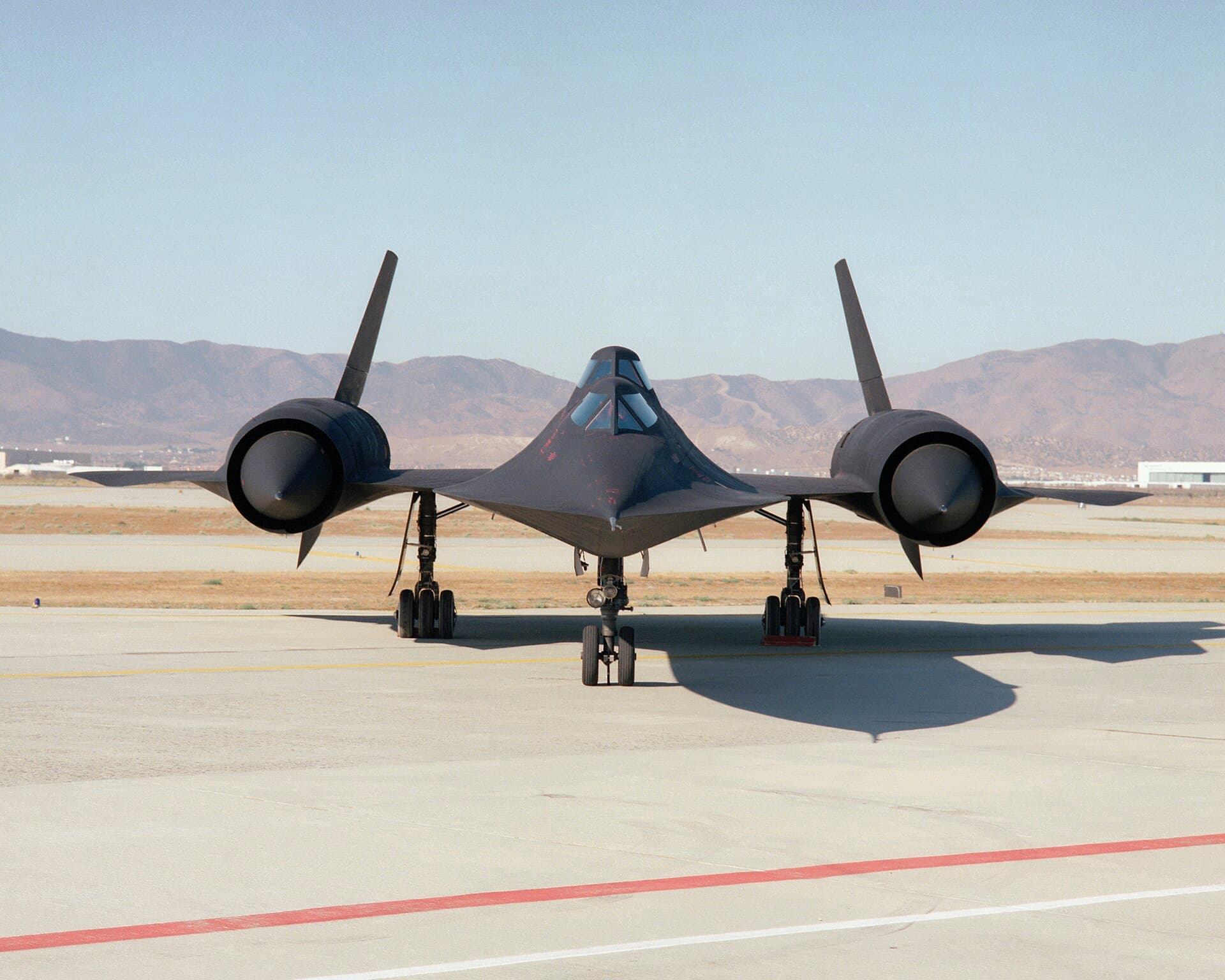
The design settled on a long, chined fuselage that generated lift along its entire length rather than only at the wing, and twin canted vertical tails positioned to reduce the aircraft's radar cross-section, an early, unpublicized step toward what would later be called stealth shaping, though the aircraft was never intended to be invisible to radar, only harder to hit. The distinctive black paint, from which the Blackbird takes its name, was a radar-absorbent, high-emissivity finish chosen to help the airframe shed heat as well as to reduce its detectability.

Development produced three closely related airframes rather than one aircraft: the CIA's single-seat A-12, the Air Force's two-seat, sensor-carrying SR-71, and the YF-12A interceptor prototype, armed with radar-guided missiles, which never entered production but set world speed and altitude records for its class in 1965. A fourth branch, the two-seat M-21, was built to launch an unmanned reconnaissance drone from its back, an idea abandoned after a fatal mid-air collision during a test launch in 1966.
Design
The SR-71's airframe was built loose by design. Its titanium panels were fitted with expansion gaps that left the aircraft looking, on the ground, almost ill-fitting, and its fuel tanks were not fully sealed at room temperature, a parked Blackbird dripped JP-7 from its belly onto the tarmac before every flight. Only once the airframe heated from friction and compression at cruise speed, expanding by several centimetres along its length, did the panels close and the tanks seal. Ground crews accepted the leak as the price of a structure that could survive conditions no fully sealed aircraft of the era could withstand.

About 85 percent of the SR-71's structure was titanium alloy, with the remainder largely a composite material in areas requiring radar transparency or additional heat resistance. The fuselage chines, the long, flattened extensions running from the nose back along both sides of the forward fuselage, served double duty, generating aerodynamic lift that reduced the wing loading and burying much of the fuel volume and equipment bays within a shape that also helped mask the aircraft from radar.
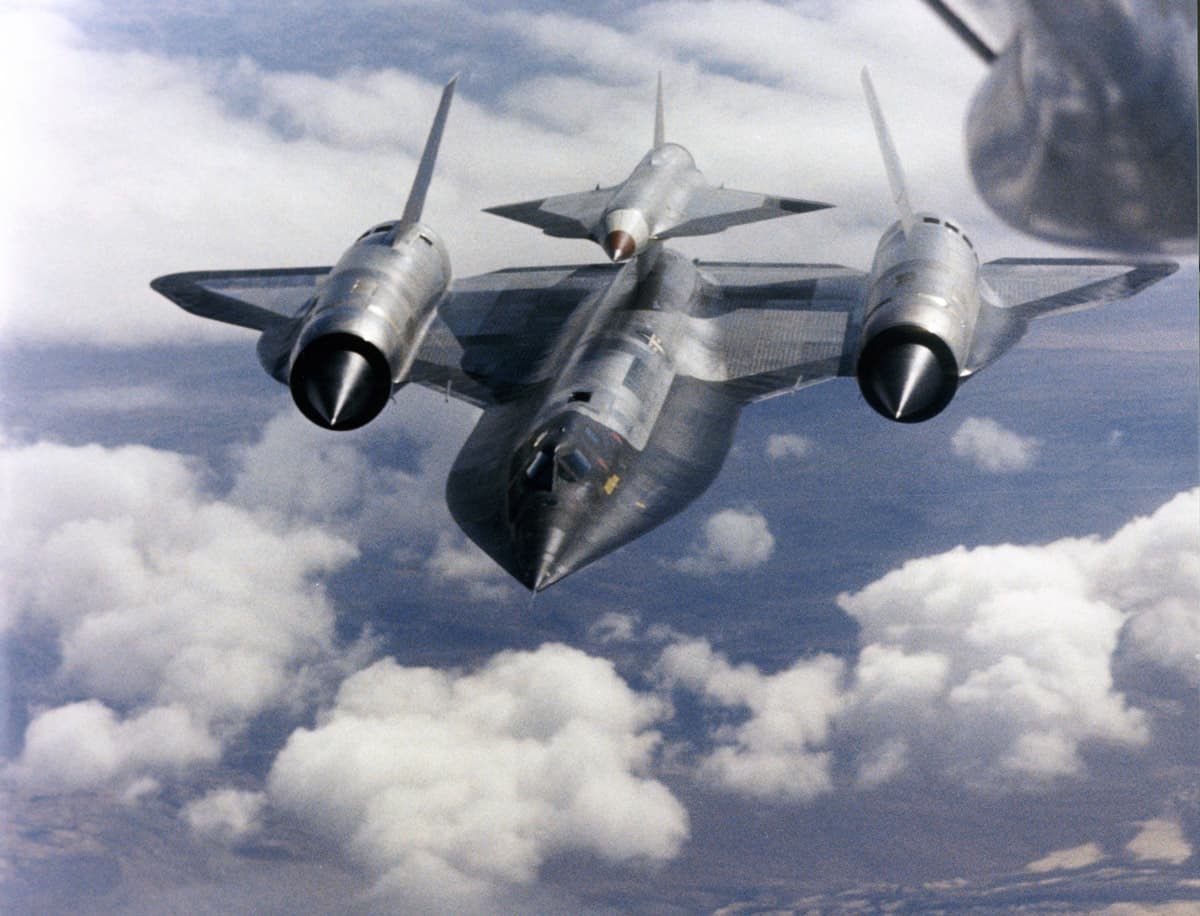
The two Pratt & Whitney J58 engines were the single most unusual element of the design. At low speed they behaved as conventional afterburning turbojets, but as the aircraft accelerated past roughly Mach 2, movable conical spikes in the engine inlets slid forward, progressively diverting incoming air around the compressor and turbine and into the afterburner section directly. By cruise speed the compressor supplied only a fraction of total thrust; the engine had effectively become a ramjet, with the inlet and afterburner doing most of the work, a transformation unique among production aircraft engines.
Heat management touched nearly every system. The specially formulated JP-7 fuel, chosen for its resistance to auto-ignition and its stability at high temperature, doubled as a heat sink, absorbing engine and airframe heat before being burned, and the aircraft's hydraulic fluid, tyres and canopy glass were all developed or adapted specifically to survive sustained heat that would have destroyed standard aviation components. Because ordinary ignition sources could not reliably light JP-7, engine start and afterburner light required injecting triethylborane, a chemical that burns on contact with air, through the fuel system.
Technical characteristics
The SR-71's core specifications describe an aircraft built almost entirely around one performance envelope. It measured 107.4 ft in length and 55.58 ft across its wingspan, with a maximum takeoff weight of about 170,000 lb, of which nearly half could be JP-7 fuel carried in six fuselage and wing tanks. Empty, the aircraft weighed about 67,500 lb: a reminder of how much of its bulk at takeoff was simply fuel needed to sustain a Mach 3 cruise.
Its two Pratt & Whitney J58 engines each produced roughly 145 kN of thrust with afterburner engaged, drawing air through large, variable-geometry inlets whose movable centrebody spikes, translating up to several centimetres depending on speed, were as critical to the propulsion system's performance as the engines themselves. Above roughly Mach 2, the inlet and afterburner did most of the propulsive work, with the compressor stages contributing a comparatively small share of total thrust at cruise.
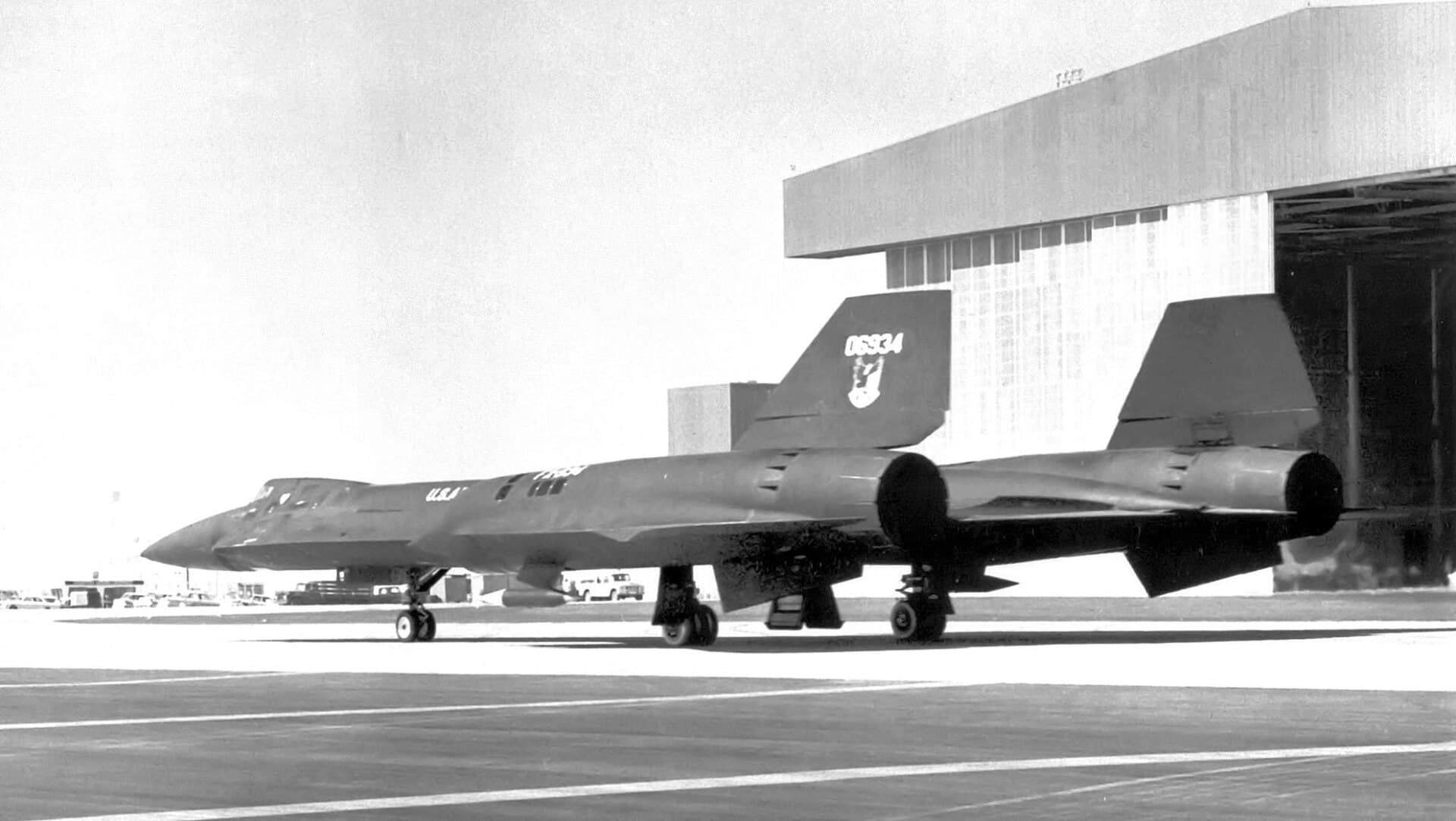
Official figures give a cruise speed of Mach 3.2, roughly 1,740 kt, at altitudes above 79,000 ft, with an operational ceiling recorded at 85,069 ft during the aircraft's 1976 record flight: figures that describe sustained cruise performance rather than a brief dash, which is what made the SR-71 unusual among aircraft that could reach similar peak speeds only for seconds at a time.
Range depended heavily on refuelling profile rather than fuel capacity alone, since a mission's radius was normally extended by in-flight refuelling before and after the high-speed leg; unrefuelled range at high-speed cruise is generally given as around 2,900 nm. Sensor payload: cameras, side-looking radar and signals-intelligence equipment carried in the forward fuselage and chine bays: varied by mission and was reconfigurable between sorties, a flexibility the aircraft's designers built in from the start given how few airframes the program would ever have available.
Flight characteristics
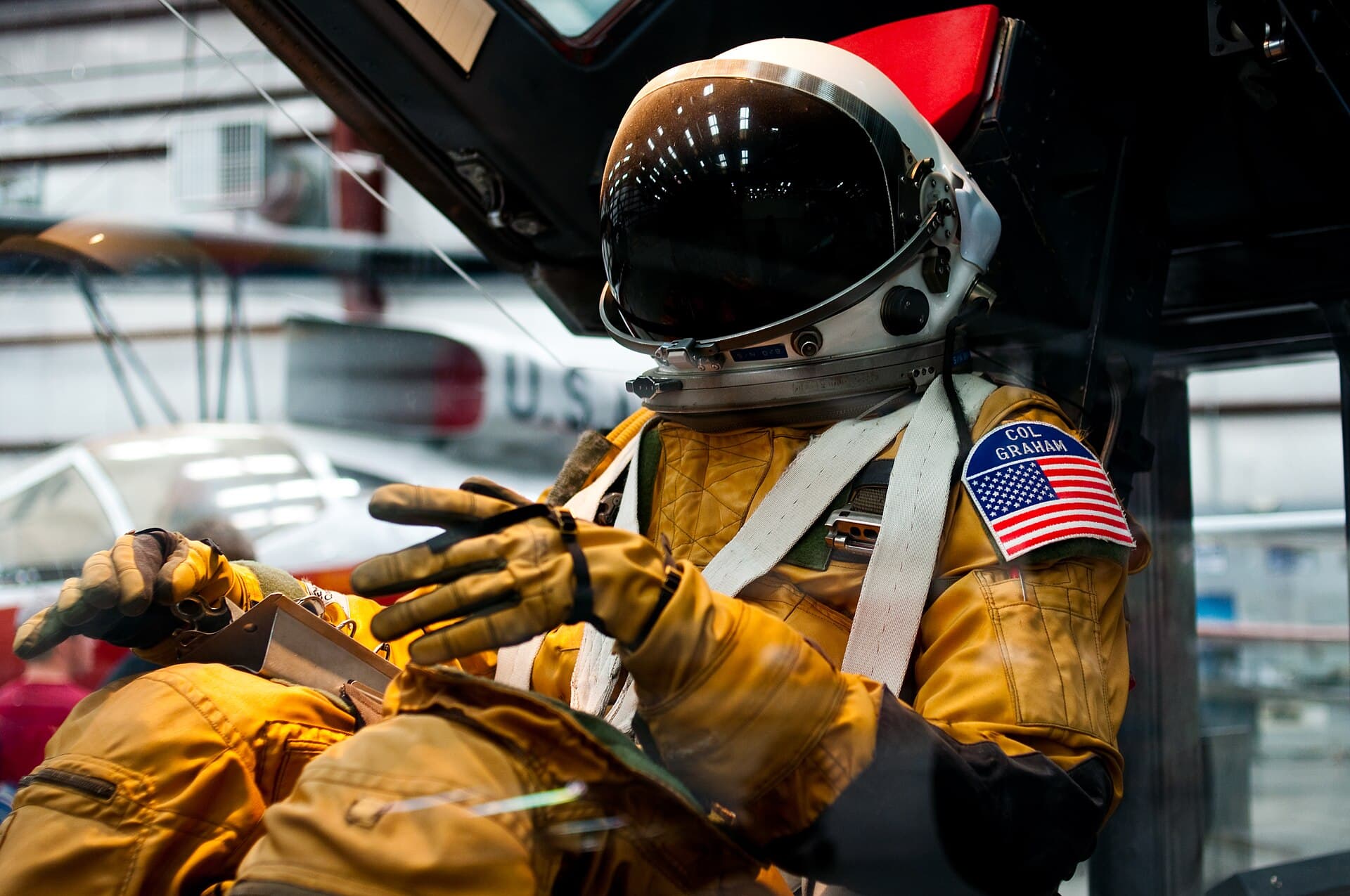
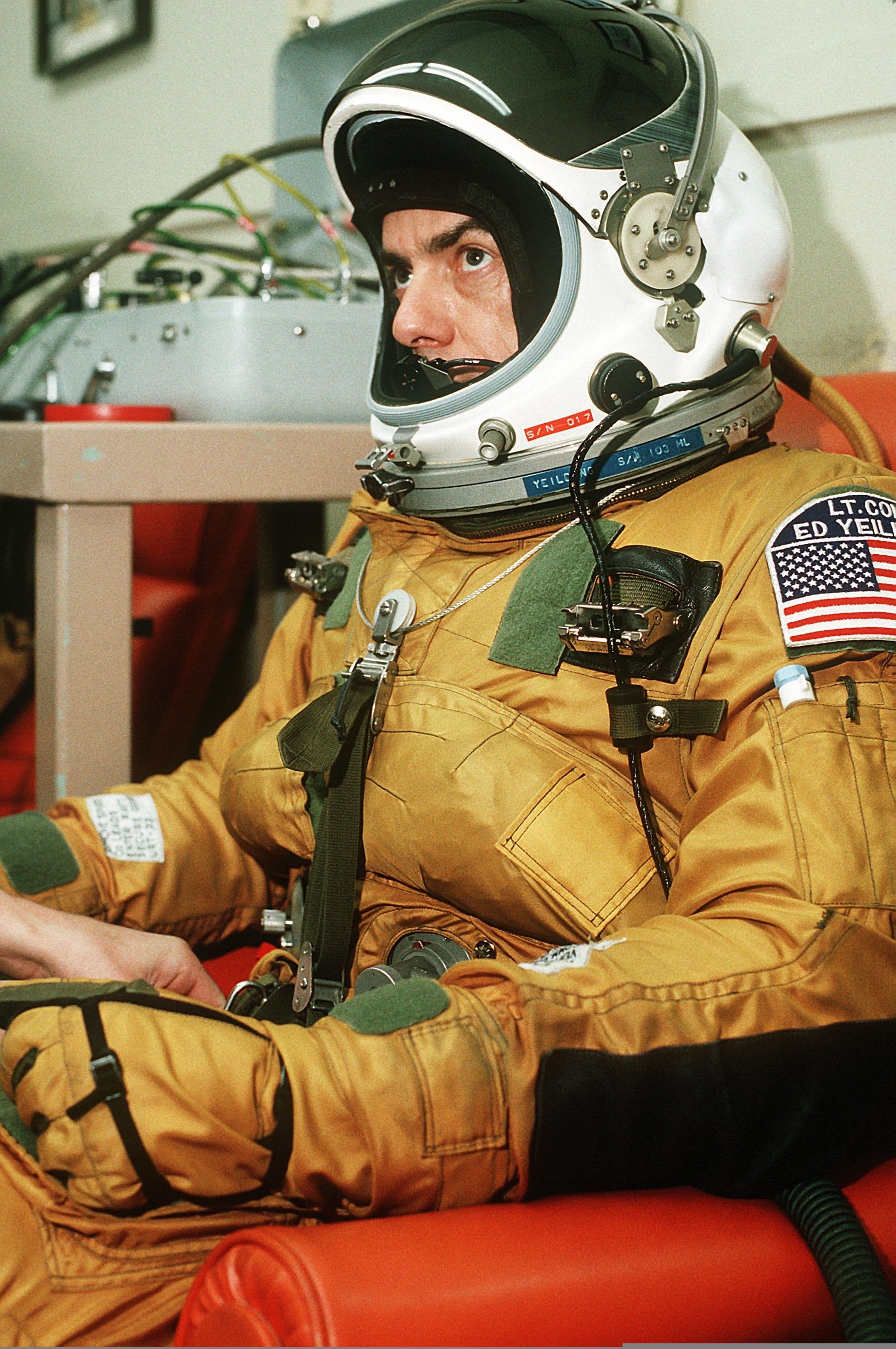
An SR-71 crew of two (pilot and reconnaissance systems officer, seated in tandem, separate cockpits) flew every mission in a full pressure suit derived directly from the suits worn by early American astronauts, built by the David Clark Company and sealed against the near-vacuum conditions at operating altitude. A sudden loss of cabin pressure above 79,000 ft would have been fatal within seconds without one; the suit was not a precaution but a load-bearing part of the life-support system.
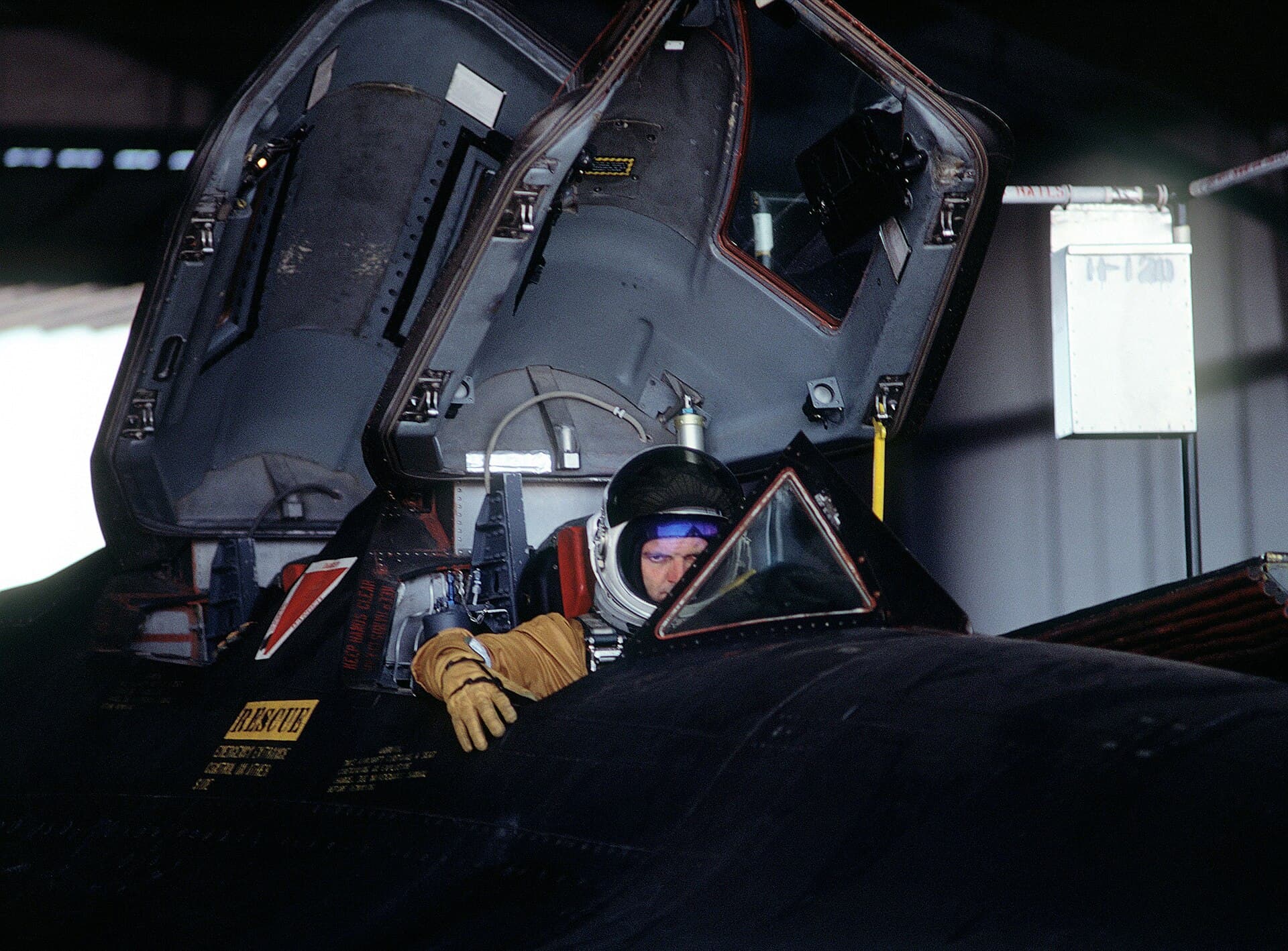
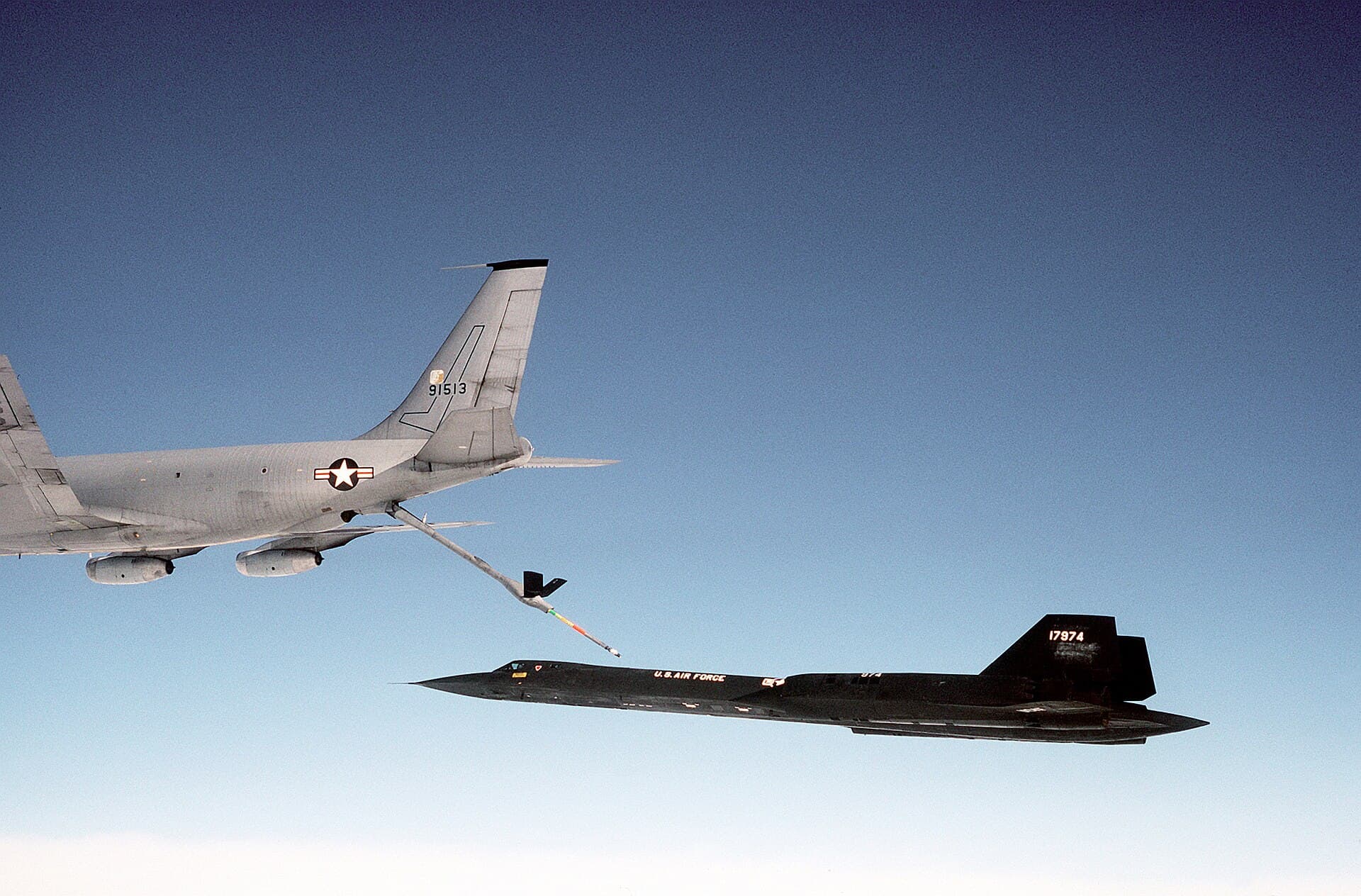
Taking off was itself an event: with tanks only partly filled to keep weight down, the SR-71 accelerated hard down the runway on full afterburner and climbed out trailing shock diamonds in its exhaust, a visible signature of supersonic flow inside the plume. Because the aircraft could not carry enough fuel to reach cruise altitude and complete a long mission, in-flight refuelling from specially adapted KC-135Q tankers, carrying the same JP-7 fuel, was built into almost every sortie, typically soon after takeoff and again during the return leg.
The climb to cruise altitude and the acceleration through the transonic and low-supersonic regimes were the most demanding phases of flight, requiring the pilot to manage the moving inlet spikes and engine bypass doors carefully to avoid an 'inlet unstart': a sudden, violent loss of supersonic airflow into one engine that could yaw the aircraft sharply and, in the worst cases, damage the airframe. Once established at Mach 3.2 and above 79,000 ft, however, the aircraft flew a comparatively smooth, high, straight profile for the bulk of a mission, the crew monitoring systems rather than actively manoeuvring.
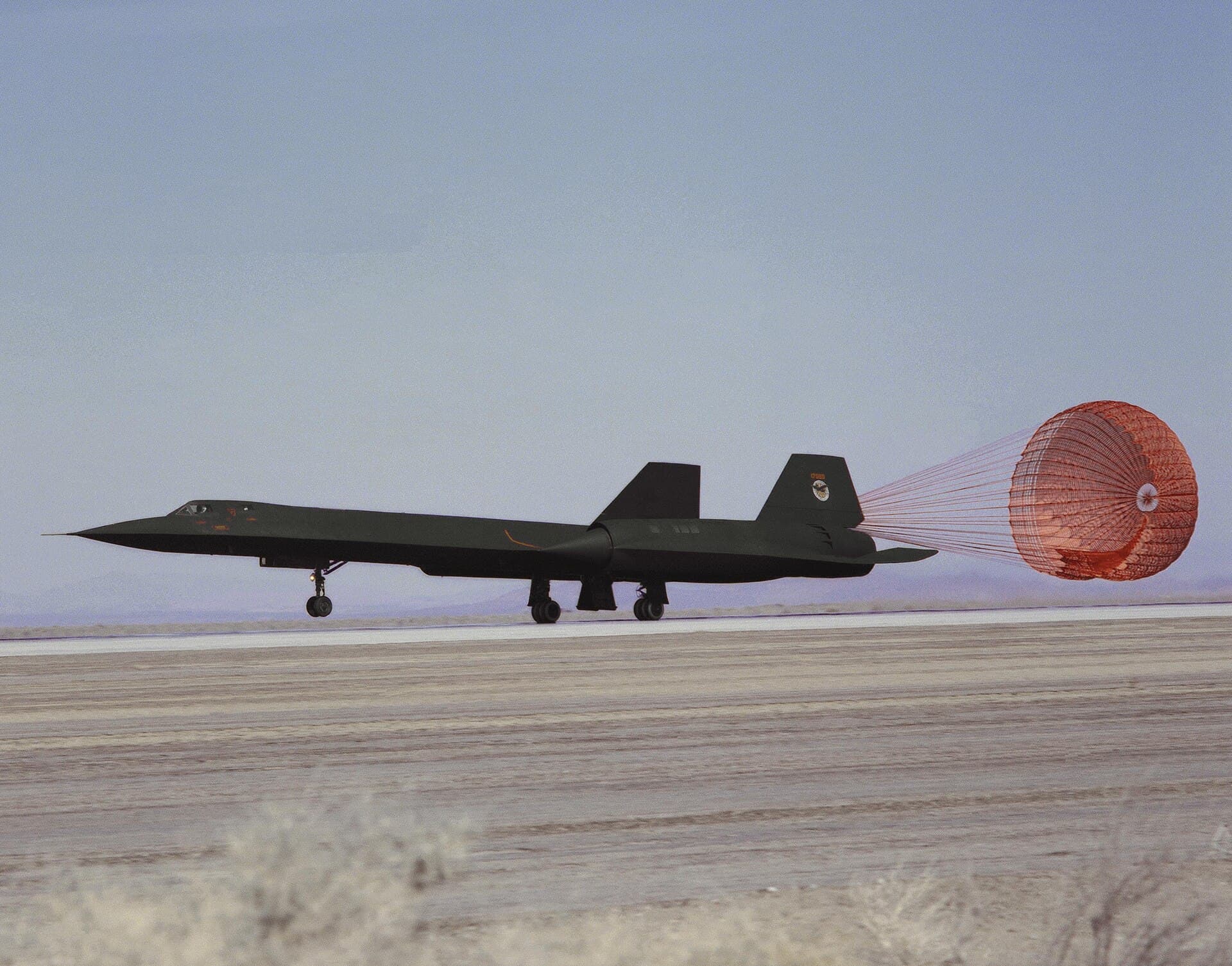
Landing reversed the sequence: a long, careful descent and deceleration, a final approach flown notably fast by the standards of conventional aircraft, and a touchdown followed immediately by deployment of a drag chute to help slow the aircraft on the runway. Missions were long by the standards of any high-performance aircraft, several hours from takeoff to landing, and left crews physically drained by the heat, the suit and the sustained concentration the aircraft demanded throughout.
Military service
The SR-71's operational doctrine was, in essence, to be unreachable rather than undetectable. Adversary radar could and did track the aircraft, and surface-to-air missile crews fired on it on numerous documented occasions over the course of its career, but no SR-71 pilot ever needed to manoeuvre defensively against a missile in the way a fighter pilot would: by the time a missile reached altitude, the Blackbird's combination of speed and continuing acceleration had usually carried it out of engagement range. Standard procedure on detecting a launch was simply to keep flying the planned profile.
That record held across a long and geographically varied operational history. SR-71s flew reconnaissance over North Vietnam and Laos during the Vietnam War, monitored Soviet naval movements and missile tests, photographed the aftermath of the 1973 Yom Kippur War for the U.S. and Israel, tracked developments in Libya and the Middle East through the 1980s, and flew missions along the periphery of the Warsaw Pact for the entirety of the aircraft's Cold War service. Squadrons based permanently or on rotation at Kadena Air Base in Okinawa, where the aircraft earned the local nickname 'Habu', after a venomous snake native to the island, and at RAF Mildenhall in England extended its reach across both the Pacific and European theatres.
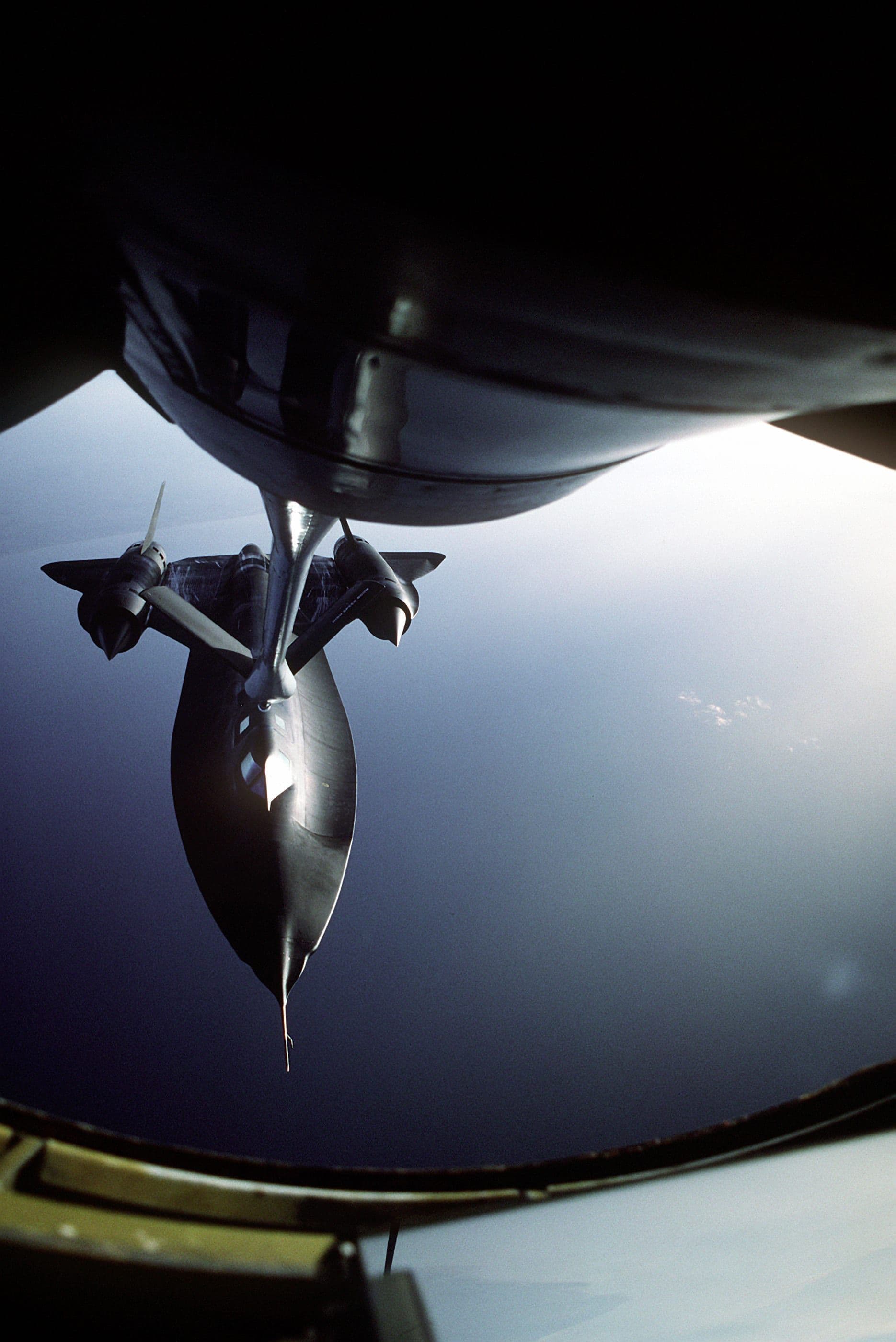
In-flight refuelling from KC-135Q tankers, carrying JP-7 exclusively for the Blackbird fleet, was as much a part of the mission as the reconnaissance run itself, and tanker crews trained specifically to the SR-71's unusual approach speeds and handling. A single sortie could involve two or three refuellings and cover thousands of kilometres, gathering photographic and signals intelligence over denied territory in a single high-speed pass that a satellite, fixed to a predictable orbit, could not match for responsiveness.
The aircraft's greatest vulnerability, in the end, was not enemy action but cost: each SR-71 required extensive, specialised maintenance between flights, its unique fuel and fluids had to be produced and transported separately from every other aircraft in the inventory, and the rise of reconnaissance satellites through the 1970s and 1980s steadily eroded the case for keeping so expensive a manned platform in service, even one that had never lost an airframe to hostile fire.
Production
Lockheed built 32 SR-71s between 1964 and 1970, all at the Skunk Works facility in Burbank, California, alongside 15 A-12s and 3 YF-12As built to closely related designs on the same production line and tooling. Every airframe in the family was hand-built in comparatively small numbers, a far cry from the mass-production runs typical of contemporary military aircraft, reflecting both the exotic materials involved and the small, highly specialised customer base of the CIA and the Air Force.
Of the 32 SR-71s built, 12 were lost during the aircraft's operational life, all to accidents, engine failures, structural problems during high-speed testing, and one mid-air refuelling collision, rather than to enemy action. That accident rate reflects how far the aircraft operated at the edge of what its materials and systems could tolerate, particularly in the early years of the program before operating procedures had matured.
Production ended in 1970, and no further SR-71s were built even after the type's temporary retirement and 1995 reactivation; the aircraft the Air Force and later NASA flew for the rest of the century were entirely drawn from the original production run. Two examples were modified into the SR-71B and SR-71C trainer configurations, with a raised second cockpit for an instructor, since the type's handling characteristics, particularly around inlet management at high speed, could not safely be taught in a single-seat aircraft alone.
By the time the last SR-71 flew, in 1999, roughly twenty of the surviving airframes had been placed in museums across the United States and Britain, a distribution that reflects both the aircraft's small production total and the deliberate decision, at retirement, to preserve rather than scrap what remained of a type that had cost so much to build in the first place.
Records and notable flights
The SR-71 holds the official world absolute speed record for an air-breathing aircraft: 1,905.81 kt, or roughly Mach 3.3, set on 28 July 1976 by Captain Eldon W. Joersz and Major George T. Morgan Jr over a fixed course, a record that stands unbroken by any manned, air-breathing aircraft as of this writing. The same aircraft, on the same day, set the sustained altitude record for horizontal flight at 85,069 ft.
Beyond that formal record, individual SR-71 missions produced a string of point-to-point records that captured public attention in a way few military aircraft achievements have. In September 1974 an SR-71 flew from New York to London in 1 hour 54 minutes 56 seconds; the following year another crossed from London to Los Angeles in 3 hours 47 minutes 39 seconds. Both remain, decades later, the fastest crossings of their routes by any aircraft of any kind.
The last of these records was also the aircraft's own retirement flight. On 6 March 1990, Lieutenant Colonel Raymond E. Yeilding and Lieutenant Colonel Joseph T. Vida flew an SR-71 from Los Angeles to Washington, D.C. in 64 minutes 20 seconds, setting a transcontinental speed record en route to delivering the aircraft directly to the Smithsonian National Air and Space Museum, where it remains on display.
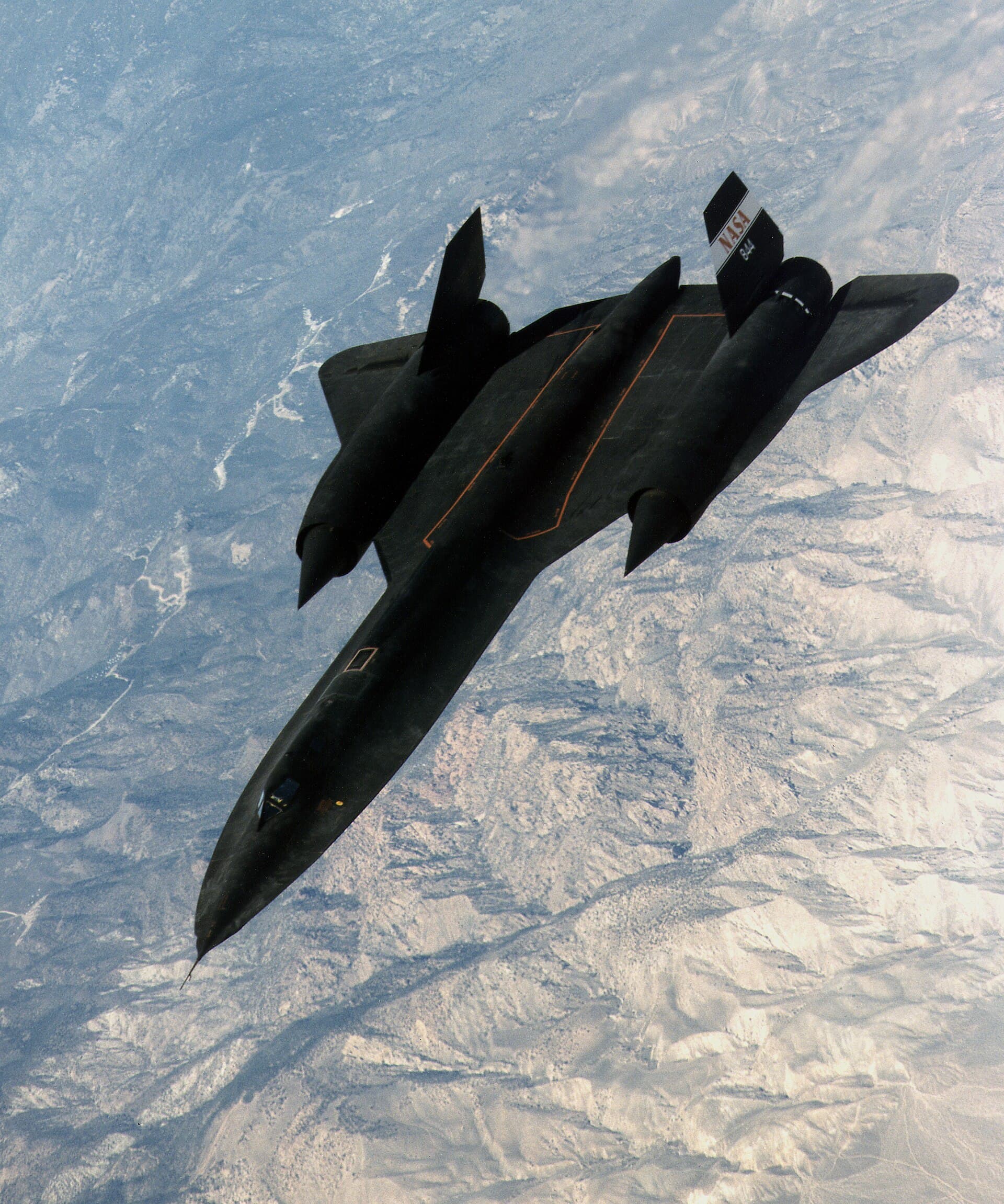
Several performance figures from the SR-71's operational career remain officially unconfirmed. The Air Force never released a precise maximum speed, and figures cited by former crew members in interviews: some well above Mach 3.3: have not been corroborated by declassified official data; where sources disagree, the honest position is that the aircraft's true performance ceiling, as distinct from its ratified record, has never been made public.
Legacy
The SR-71 retired twice: once in 1989-1990 on cost grounds, and again for good in 1998 after a brief 1995 reactivation: and in both cases the decision was driven not by any rival aircraft outperforming it but by the argument that reconnaissance satellites, however less flexible, cost less to keep operating. NASA kept two aircraft flying for high-speed research, including work on the Linear Aerospike engine intended for future launch vehicles, until 1999, giving the Blackbird family a final decade of useful life beyond its military retirement.
No aircraft has since matched the SR-71's combination of sustained Mach 3 cruise and long, high-altitude endurance; hypersonic and unmanned systems developed since have generally pursued the same problem, flying too fast to be intercepted, by entirely different means, leaving the Blackbird's specific approach, a piloted aircraft simply outrunning its threats, without a true successor.
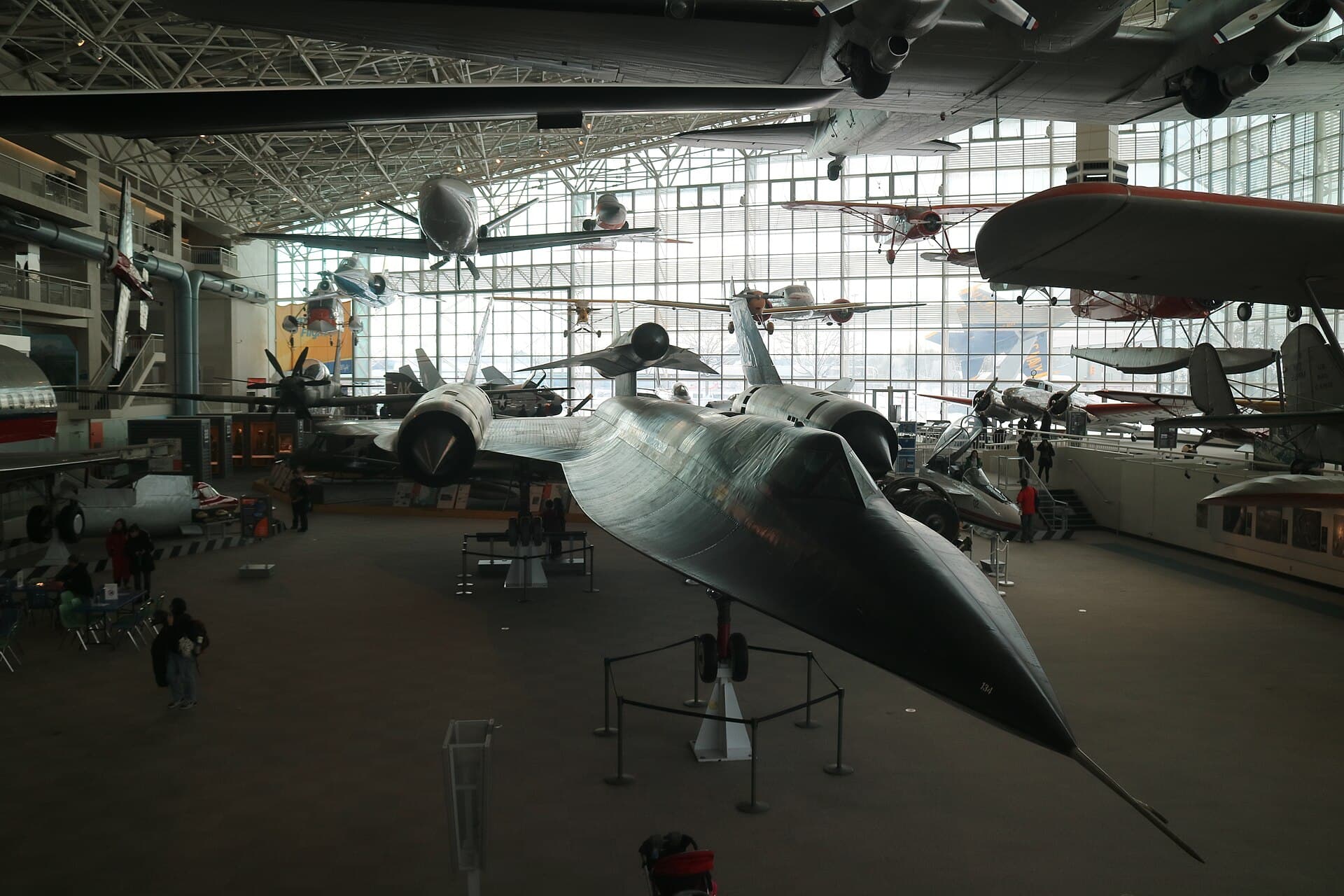
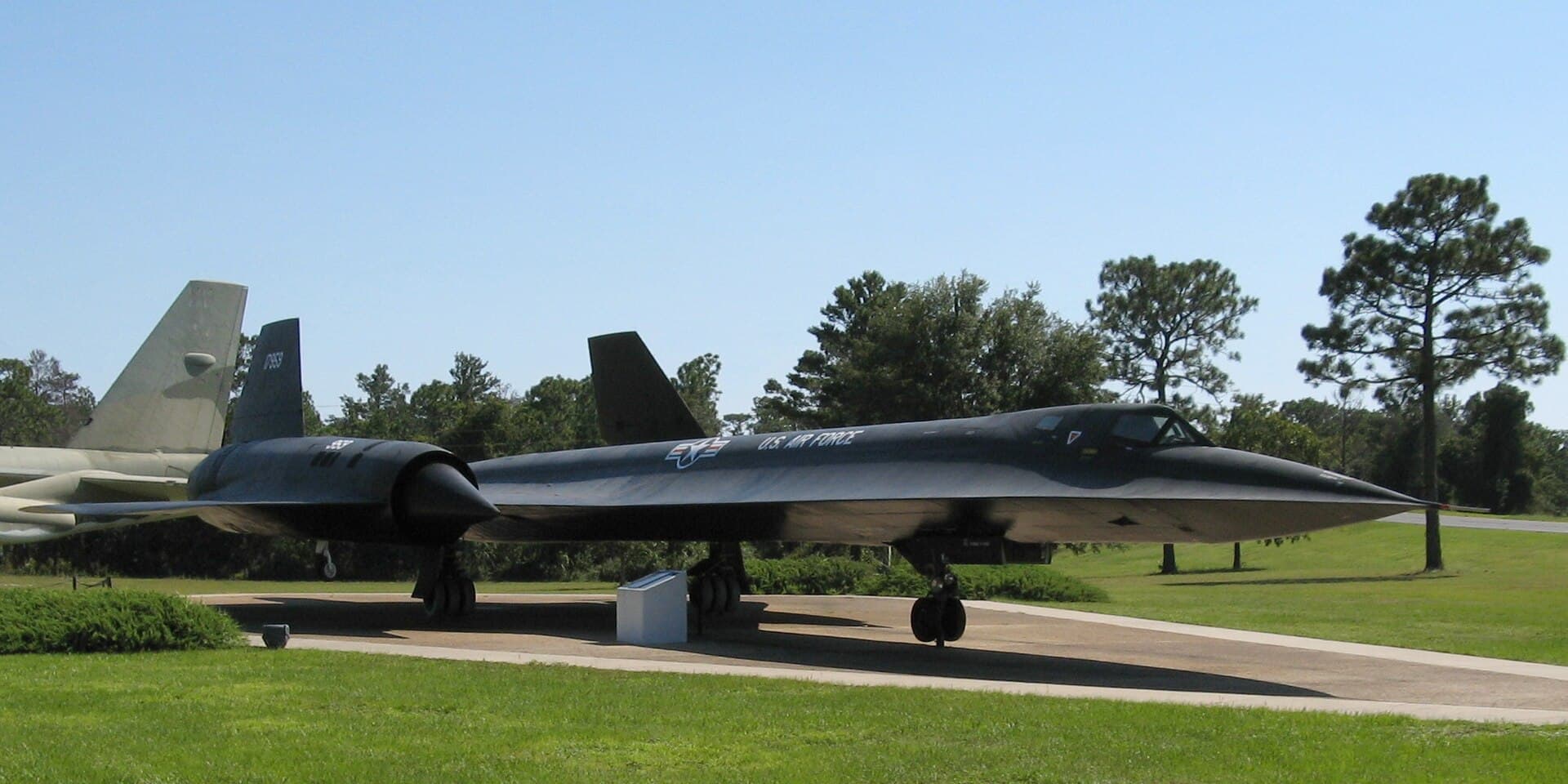
Around twenty surviving airframes are preserved in museums across the United States and in England, including the Smithsonian's National Air and Space Museum, the Museum of Flight in Seattle, and the USAF Armaments Museum at Eglin Air Force Base, each display typically drawing crowds specifically for the aircraft rather than as one exhibit among many, a rare distinction for a retired military type.
The aircraft's closest conceptual relative is the Concorde, its exact contemporary in ambition if not in mission: both were built to make a sustained speed regime (Mach 2 for one, Mach 3 for the other) into something closer to routine operation than a record attempt, one in aluminium for a fare-paying cabin, the other in titanium for two crew in pressure suits, and both were, in the end, retired primarily because what they cost to fly could no longer be justified against what replaced them.
Model evolution
A-12
1962The single-seat reconnaissance aircraft Lockheed built for the CIA under the OXCART program, and the airframe from which every other Blackbird variant descends.
Lighter and slightly shorter than the SR-71, with a single cockpit and no second crew station, optimised purely for high-altitude photographic reconnaissance. Developed to replace the U-2 after Francis Gary Powers was shot down over the Soviet Union in 1960, giving the CIA a reconnaissance aircraft too fast and too high to be intercepted.
Flew CIA reconnaissance missions over Vietnam and North Korea from 1967 under the Black Shield program before being retired in 1968 in favour of the Air Force's SR-71.
YF-12A
1963An interceptor prototype armed with radar-guided AIM-47 missiles, built on the A-12 airframe with a modified nose and a second crew station for a fire-control officer.
Added a large nose radar, missile bays in place of the A-12's camera equipment, and canard fins for stability at the modified centre of gravity. Built to test whether the Blackbird airframe could serve as a long-range interceptor against Soviet bombers, a role the Air Force ultimately did not pursue into production.
Set world speed and altitude records for its class in 1965, but the interceptor program was cancelled in 1968 for cost reasons and only three YF-12As were built.
M-21
1963A two-seat A-12 derivative built to carry and launch the D-21 unmanned reconnaissance drone from a dorsal pylon.
Added a second cockpit for a launch control officer and a reinforced dorsal mount and pylon strong enough to carry and separate cleanly from the D-21 drone at speed. Built to deliver the D-21 drone deep into denied airspace for reconnaissance the CIA judged too risky to fly with a piloted aircraft.
Ended after a fatal mid-air collision during a drone launch in July 1966 killed launch control officer Ray Torick; the D-21 program continued using B-52 motherships instead.
SR-71A
1966The main production reconnaissance version flown operationally by the U.S. Air Force from 1966 to 1998, with tandem cockpits for a pilot and a reconnaissance systems officer who managed the aircraft's cameras, side-looking radar and signals-intelligence equipment. It is the variant most people mean when they say 'SR-71', and the one that carried out the type's entire operational reconnaissance record over Vietnam, the Middle East and the Soviet periphery.
Lengthened and structurally reinforced relative to the single-seat A-12 to accommodate a second crew station, substantially greater internal fuel volume for longer unrefuelled legs, and a larger, reconfigurable sensor suite in the nose and chine bays that could be swapped between missions rather than fixed to one reconnaissance task. Built for the Air Force rather than the CIA, which needed a crewed reconnaissance platform it operated and tasked directly, with enough fuel and sensor flexibility to fly sustained, repeatable strategic reconnaissance rather than the CIA's more narrowly targeted overflight missions.
SR-71B / SR-71C
1965Trainer versions with a second, raised cockpit for an instructor, used to teach pilots the aircraft's demanding high-speed handling, above all inlet management through the transonic and supersonic regimes, before they were entrusted with operational missions in the single-cockpit SR-71A.
The instructor's rear cockpit was raised well above the pilot's forward seat so the instructor retained a usable forward view for training; the SR-71C was a one-off assembled from surviving YF-12A structural components and static-test airframe parts after an SR-71B was destroyed in a 1968 training accident, giving the fleet a second trainer despite no further airframes being built. The type's handling at the edge of its envelope, particularly managing the movable inlet spikes to avoid a violent 'unstart', could not be taught safely from the ground or in a single-seat aircraft, so a dedicated two-seat trainer with dual controls was needed before any pilot flew operational sorties.
Blueprints
- SR-71 Blackbird, Lockheed Martin
- SR-71 Blackbird, NASA
- Lockheed SR-71A Blackbird, Smithsonian National Air and Space Museum
- Lockheed SR-71A Blackbird, The Museum of Flight
- SR-71 Fact Sheet, National Museum of the United States Air Force
- Archangel: CIA's Supersonic A-12 Reconnaissance Aircraft, Central Intelligence Agency
- Skunk Works: A Personal Memoir of My Years at Lockheed, Ben R. Rich and Leo Janos
- SR-71 Blackbird, Wikipedia
Checked September 2, 2026