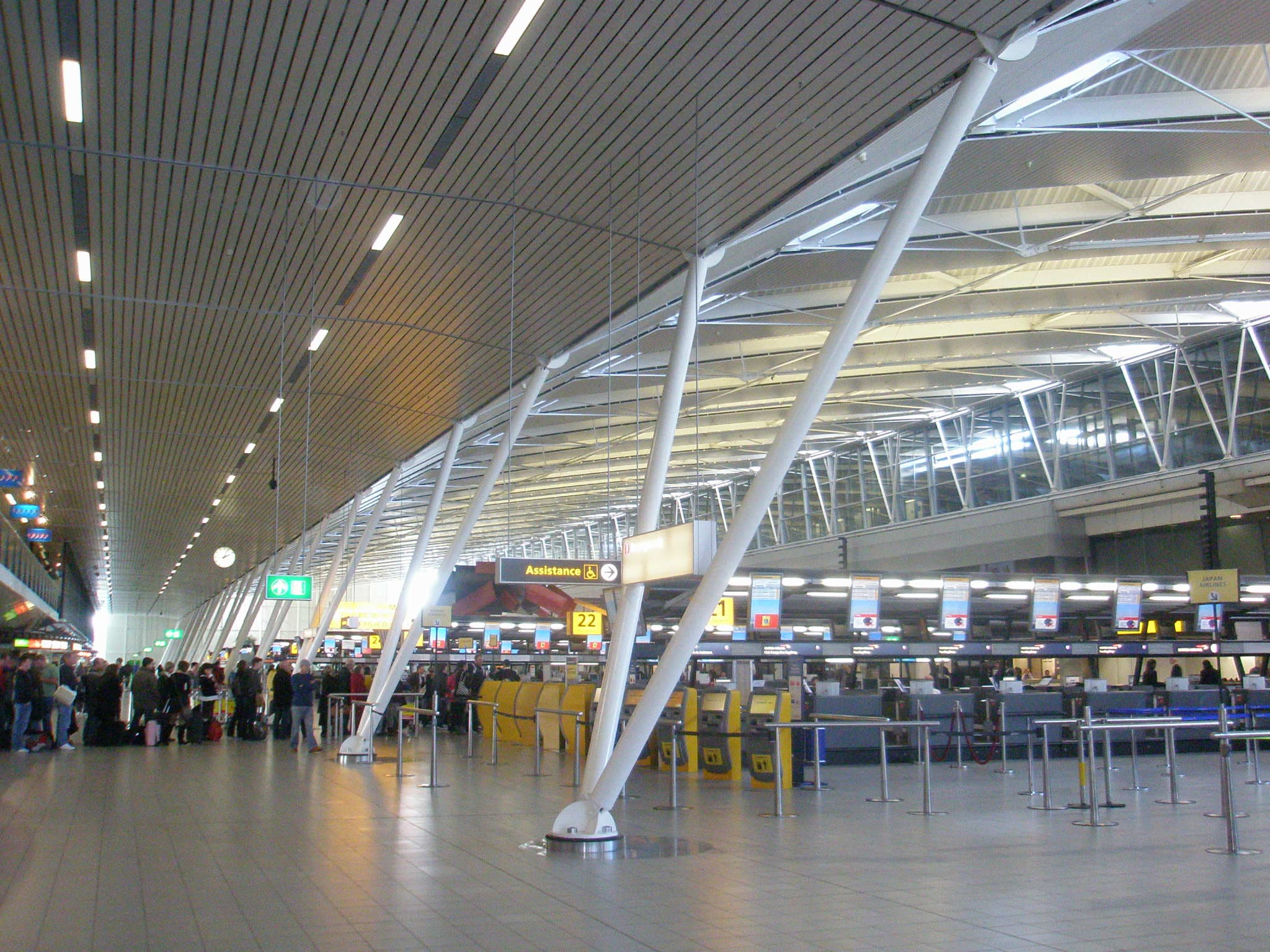
The terminal
Opened 1967
A single terminal of departure halls and piers, grown from the 1967 building; Departure Halls 1 and 2 and piers C, D and E date from then.
Airport
AMS · EHAM
AmsterdamNetherlands
Amsterdam Airport Schiphol
68,767,548a year
Passengers
477,552a year
Aircraft movements
1,428,860t
Cargo
Figures for 2025
Ownership as of 2026
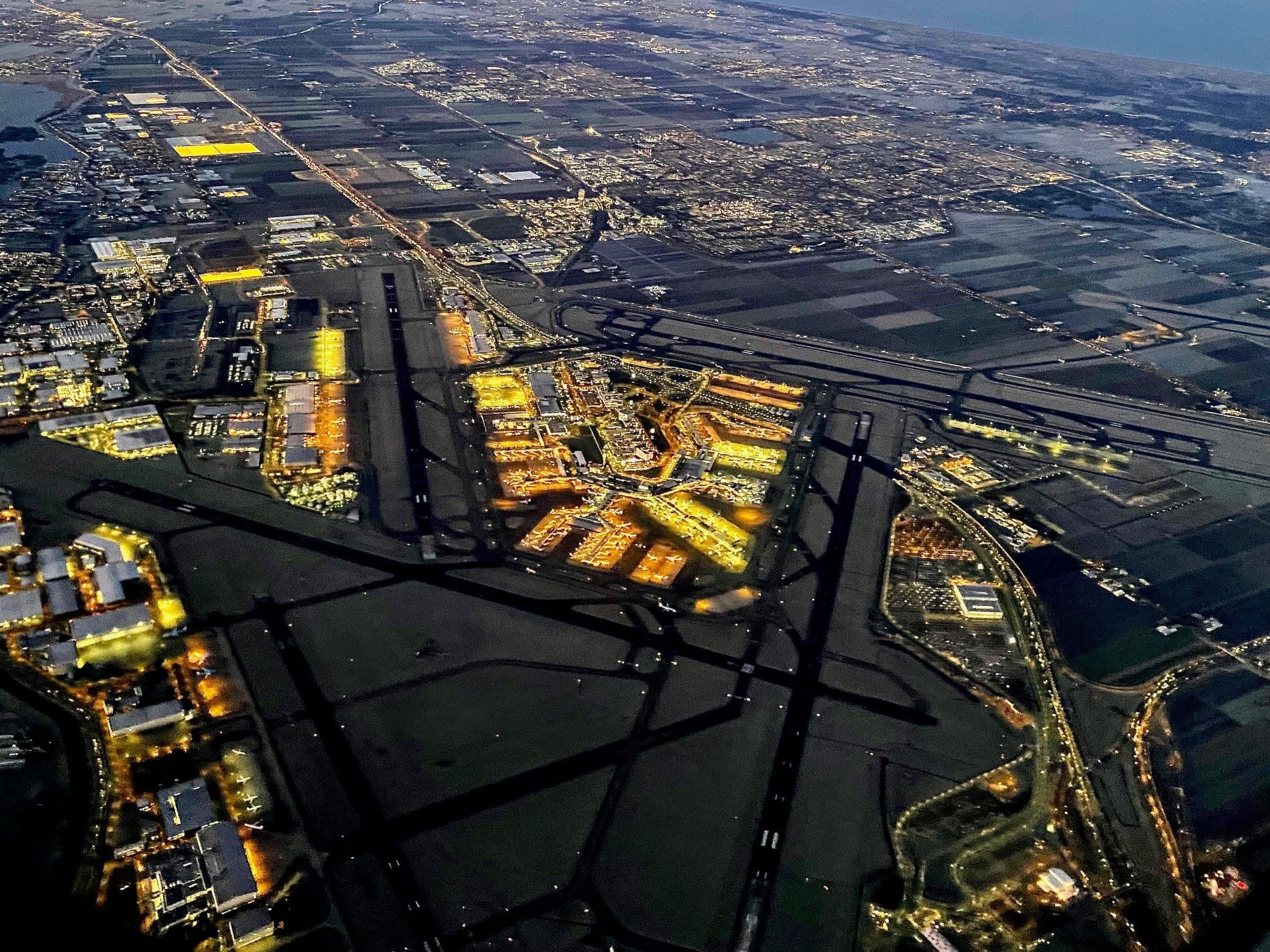
Amsterdam Airport Schiphol is the main airport of the Netherlands, the home and hub of KLM, and one of the busiest in Europe. It lies south-west of Amsterdam in the municipality of Haarlemmermeer, on a polder, land pumped dry in the nineteenth century, and its aprons sit below the level of the sea a few kilometres away.
In 2025 Schiphol handled 68.8 million passengers and was connected to 300 destinations. Transfer traffic is a large part of that: 36.6 per cent of passengers recorded in 2025 were changing planes, while 43.6 million began or ended their journey at Schiphol. The record year remains 2019, with 71,706,999 passengers, a figure traffic had not regained by 2025 after the collapse during the COVID-19 pandemic.
Two things distinguish the airport. The first is its plan: one terminal under a single roof, divided into three departure halls that are joined airside, so that a passenger can walk between any two piers without leaving the building. The second is its six runways, each known to the Dutch by name rather than by number (the Polderbaan, Kaagbaan, Buitenveldertbaan, Aalsmeerbaan, Zwanenburgbaan and Oostbaan) spread wide across the polder to keep their noise away from the towns around them.
The name is far older than the airport. It is recorded as Sciphol in 1447, in a description of land in the jurisdiction of Aalsmeer, and its etymology is uncertain. The Dutch toponymist Moritz Schönfeld linked it to the local Schipholsloot, noting that the Middle Dutch hol could mean the bed or depth of a watercourse, and that as an adjective it could mean low-lying or marshy; the name passed from the settlement to Fort Schiphol, part of the Stelling van Amsterdam defence ring built after the Haarlemmermeer was drained, and from the fort to the airfield. Later writers have proposed other readings (a hollow parcel of land likened to a scheepshol, the hull of a ship) and popular accounts speak of ships lost in the old lake, an explanation the specialist sources do not support.
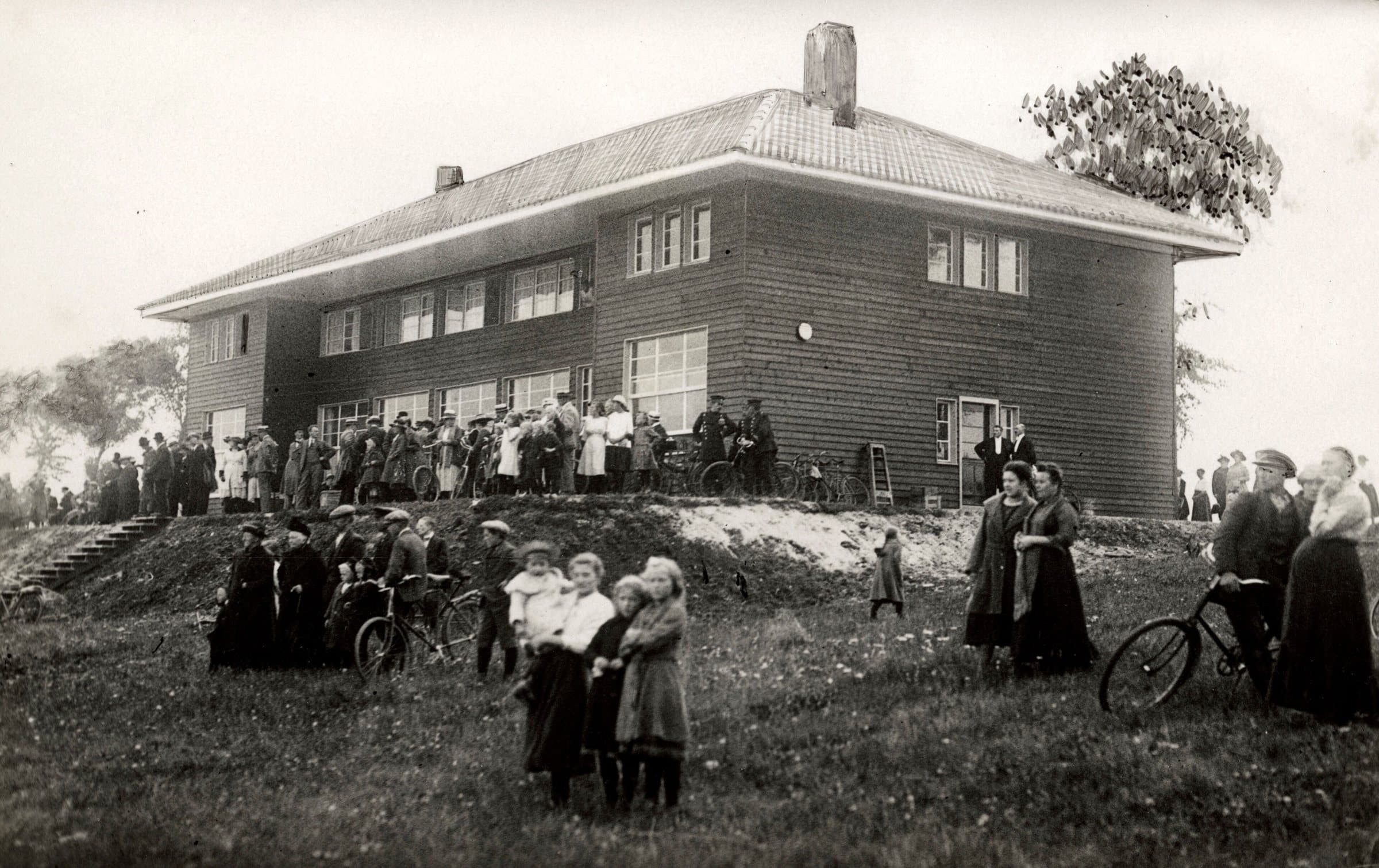
Schiphol itself began in 1916 as a military airfield; the first military aircraft landed on 19 September that year. Civil flying followed the First World War, and on 17 May 1920 KLM's inaugural service from London came in. The field was unpaved and often muddy, which earned it a French nickname: Schiphol-les-Bains. The army left in 1923. Fokker built its Dutch factory in Amsterdam-Noord rather than at the airfield, but put up a hangar at Schiphol in 1924 where aircraft made in the city could be assembled and flown.
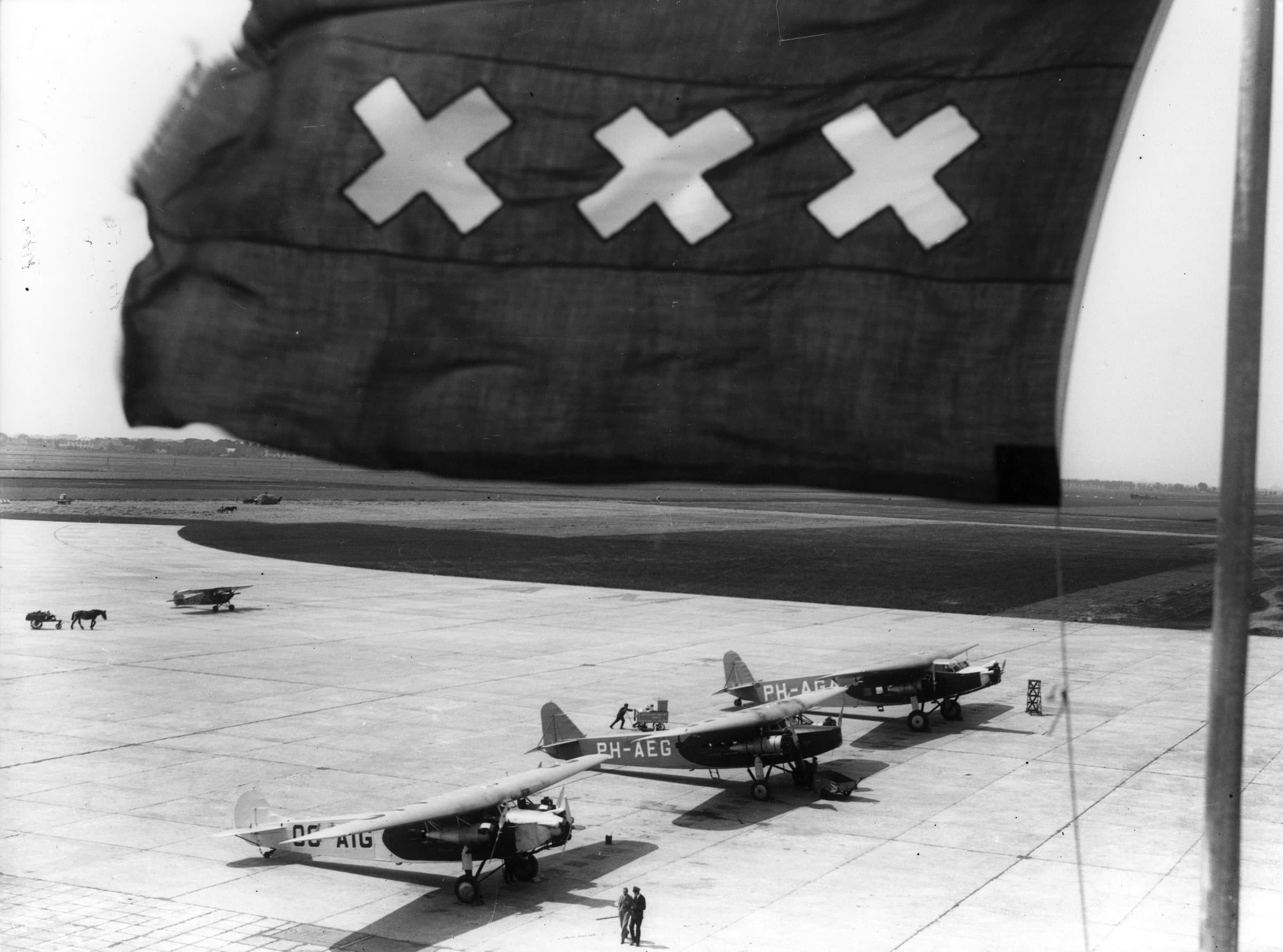
By 1940 there were four asphalt runways set at 45 degrees to one another, none longer than 3,350 ft; one of them was later extended to become today's Oostbaan. The Germans captured the airfield that year and renamed it. They ringed it with anti-aircraft guns, built a railway connection, and laid out decoy airfields at Bennebroek, Vijfhuizen and Vogelenzang to mislead Allied bombers. It was bombed heavily all the same: a raid on 13 December 1943 left it unusable as an active base, after which it served only for emergency landings, and the Germans destroyed what remained at the start of Operation Market Garden.
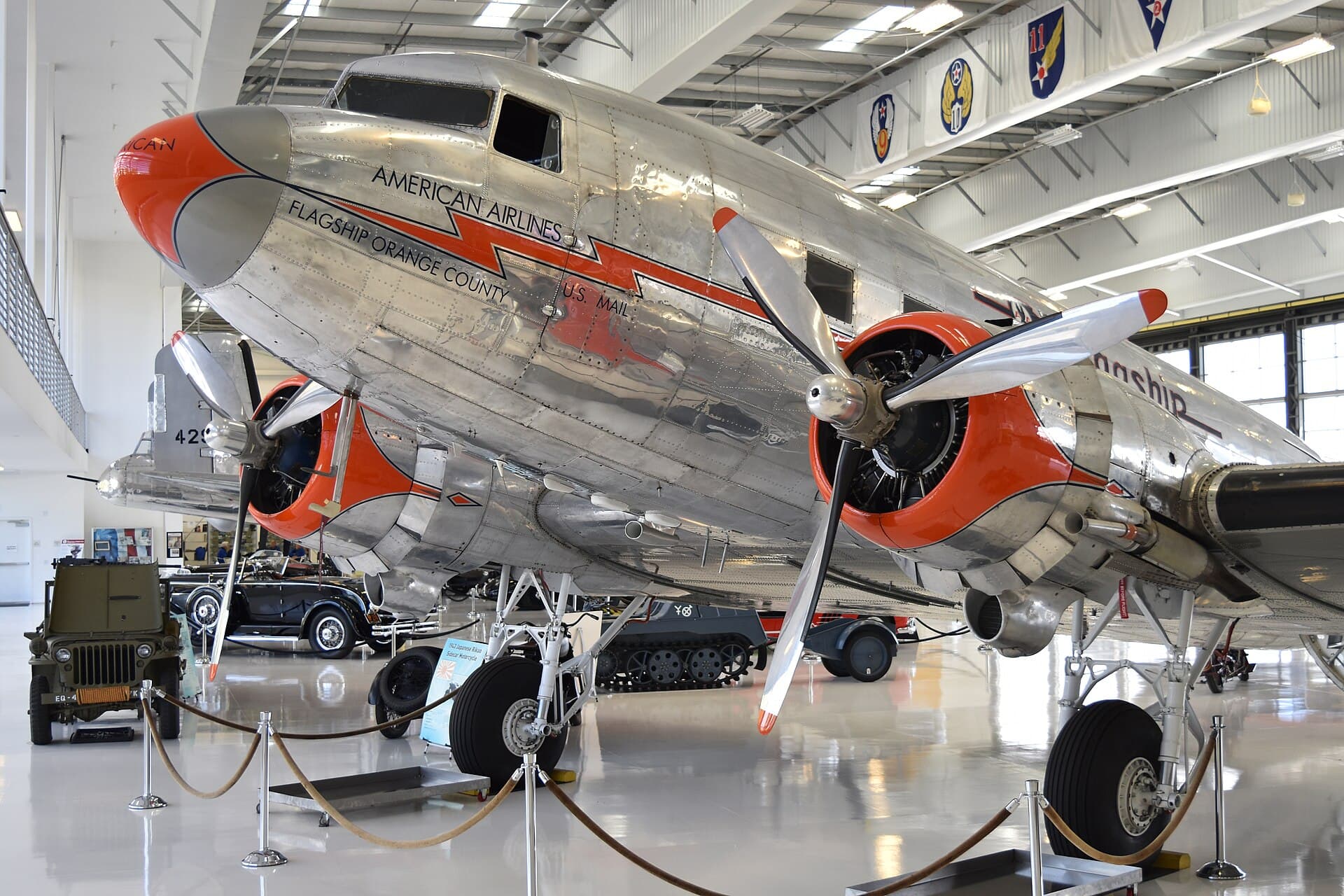
Recovery was quick. The first post-war aircraft, a Douglas DC-3, landed on 8 July 1945. A new terminal was finished in 1949 and Schiphol was chosen as the country's primary airport: an expansion that cost the small town of Rijk, demolished to make room and remembered now only in the name of the Schiphol-Rijk industrial estate.
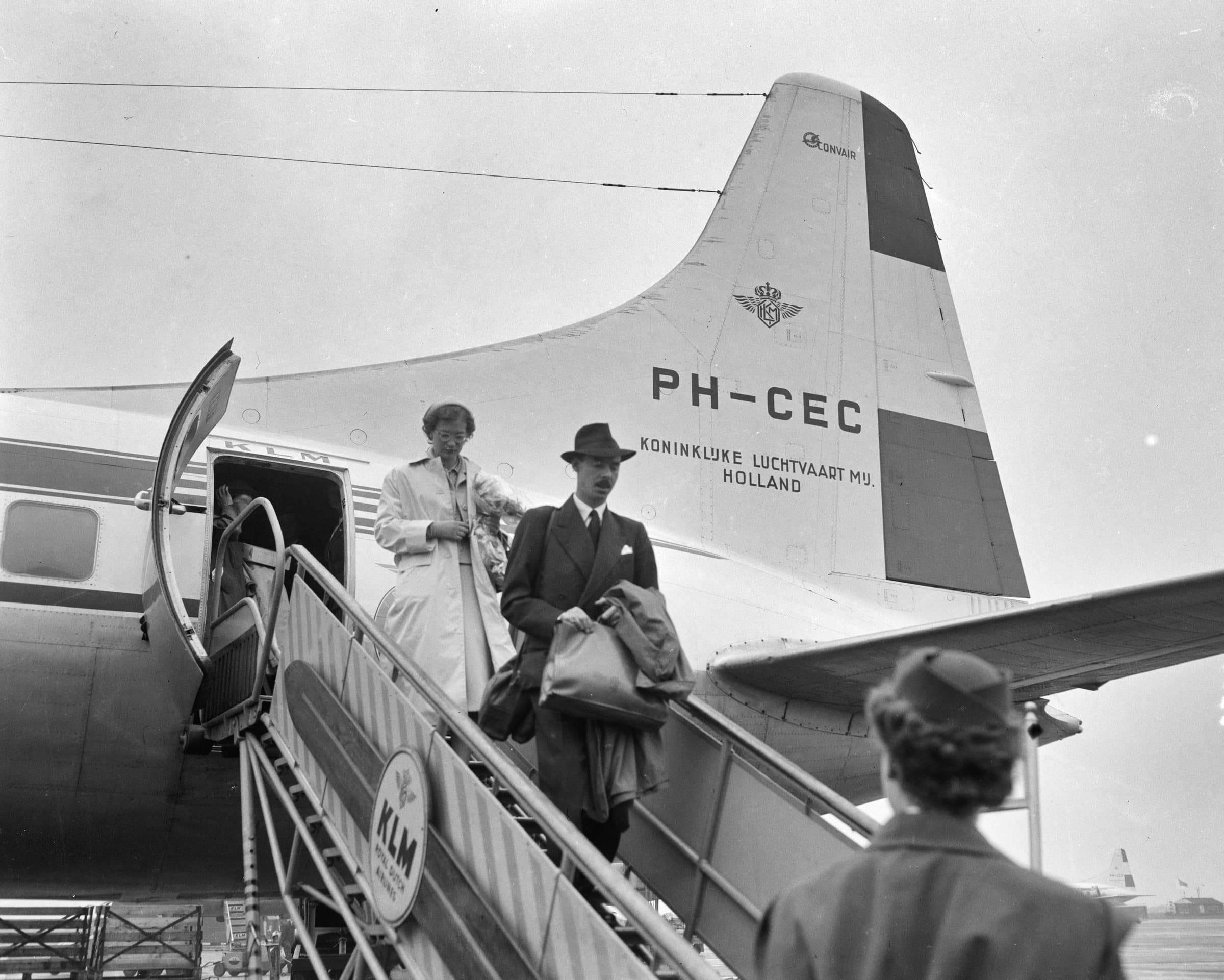
In 1967 the airport moved its passenger buildings to the site they occupy today. Most of that terminal is still in service as Departure Halls 1 and 2, as are parts of its original piers, now lettered C, D and E. The designer Benno Wissing gave it a signage system admired for its clarity and its rigorous colour-coding; to keep it legible he forbade any other sign at the airport to use his yellow and green. The A-pier, now C, was modified in 1970 to take the Boeing 747, a new pier for wide-bodied aircraft followed in 1977, and the first railway station under the terminal opened in 1978.
The airport covers some 6,887 acres, and its six runways are spread across almost all of it. Five carry airline traffic and one, the short Oostbaan, is used mainly by general aviation.
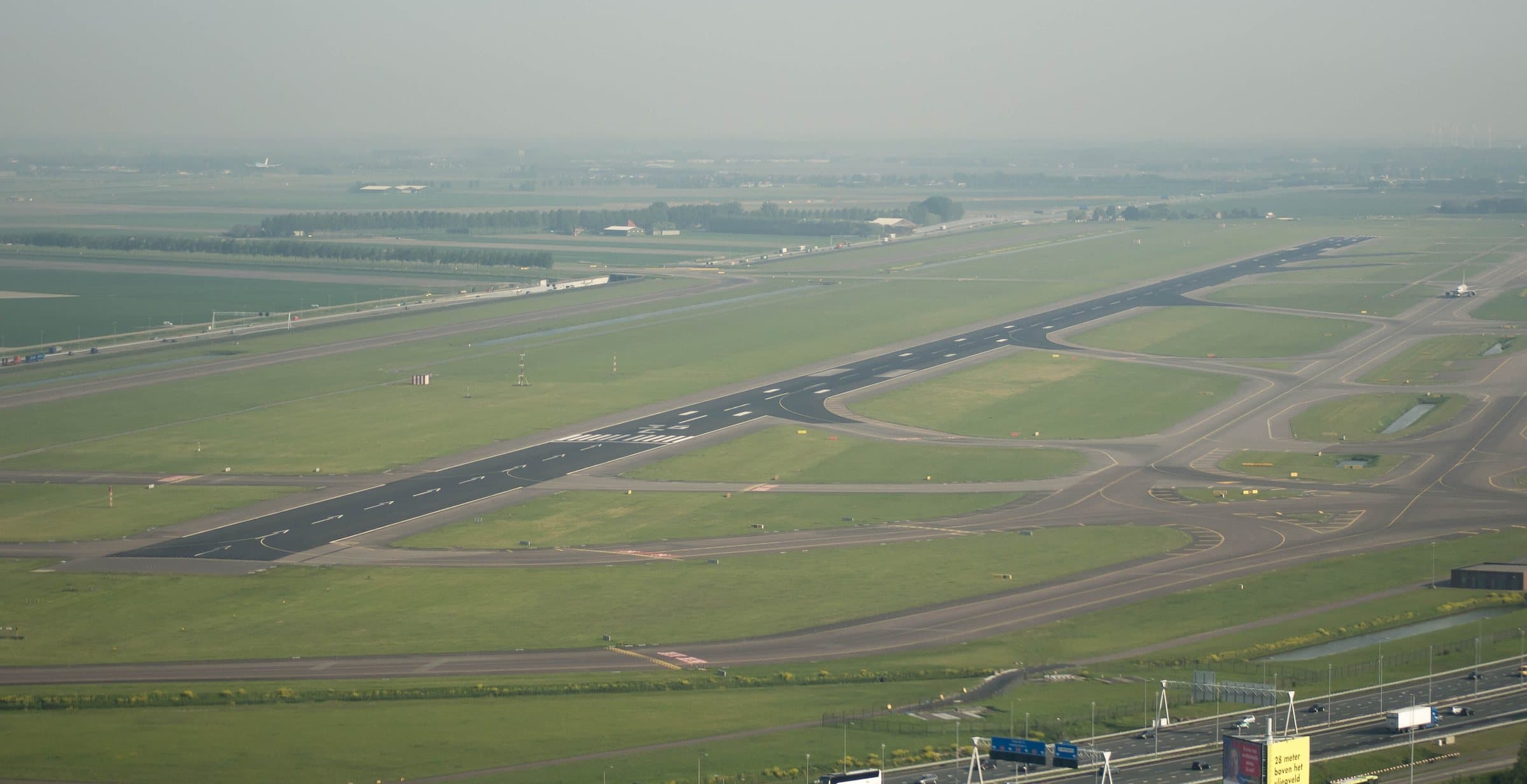
Each has a name as well as a number, and the names come from what lies beneath the approach. The Kaagbaan (06/24), opened in 1960, is named after the village of Kaag beyond its south-western end. The Buitenveldertbaan (09/27), opened in 1967, is named for the Amsterdam neighbourhood under its approach. The Aalsmeerbaan (18L/36R) opened in 1950 and takes its name from the town past its end; the Zwanenburgbaan (18C/36C) opened in 1968 and is named for the village under its approach; the Oostbaan (04/22), the oldest, opened in 1945 and is simply the eastern one. The Polderbaan (18R/36L), the newest and longest at 12,000 ft, was named by public contest after the reclaimed land it stands on.
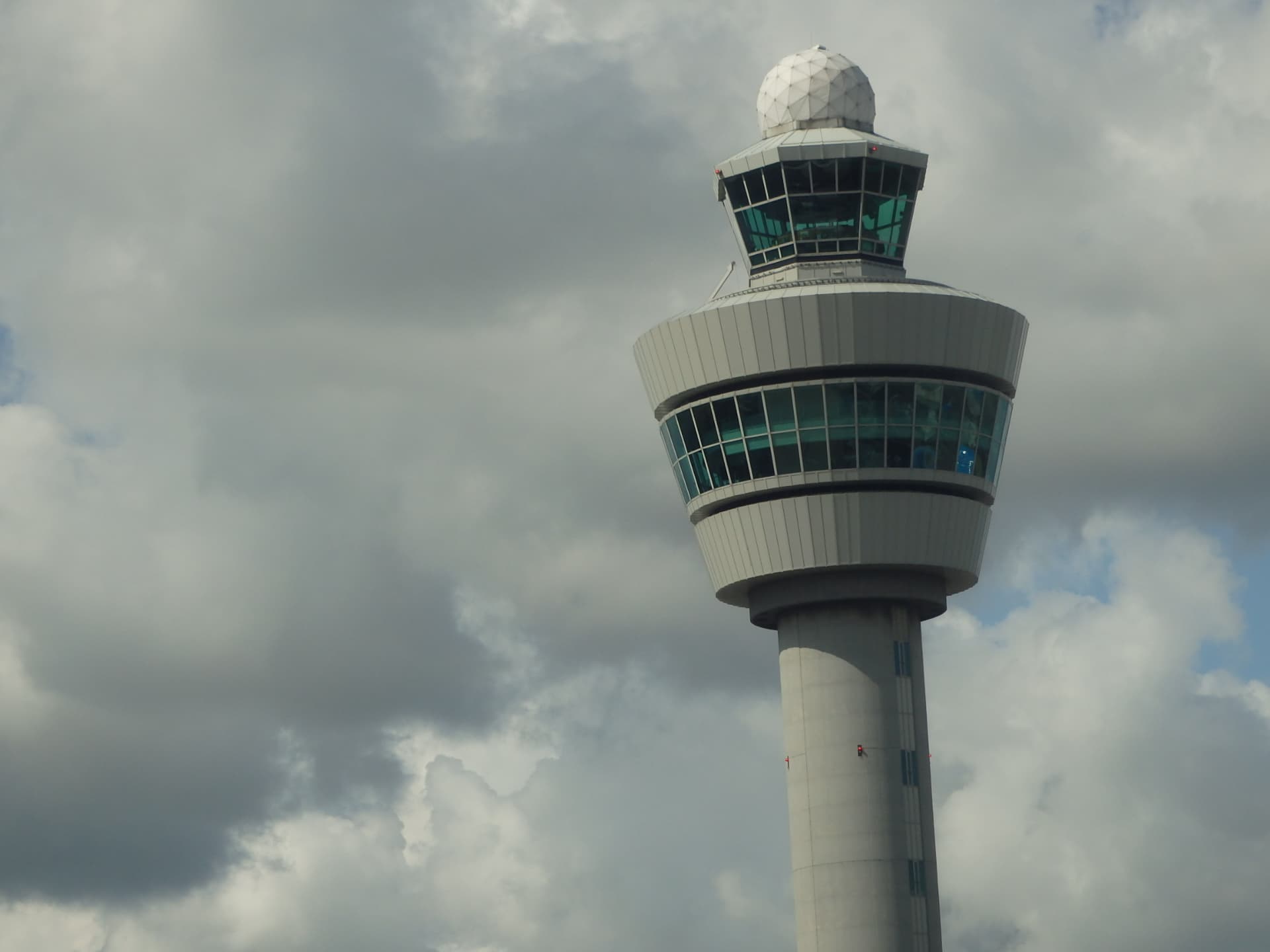
The Polderbaan is the most unusual of the six. It was completed in 2003 far to the west of everything else, precisely to move its noise away from people, and the taxiway that connects it crosses the A5 motorway on a bridge. Its near end is some 3 nm from the terminal, so aircraft spend between ten and twenty minutes taxiing to or from it, and it is worked from a control tower of its own because the main tower (completed in 1991, when the old one could no longer see the whole airfield) is too far away to oversee it. Take-offs from it run north and landings come in from the south.
The runway layout has a cost in taxi time and in complexity, but it is the reason a very large airport can sit in a small, densely populated country: the noise is spread across a wide arc rather than concentrated on one or two approach paths.
Schiphol is built around a one-terminal concept: every facility sits under a single roof, radiating from the central hall, Schiphol Plaza. The terminal is divided into three sections, Halls 1, 2 and 3, and their piers are connected on both sides of security, so a passenger can walk from one to another, although border control separates the Schengen area from the rest. The exception is the low-cost Pier M: once through security there, a passenger cannot reach anything else.
Departure Hall 1 mostly serves Schengen flights and leads to Piers B and C and to gates D59 to D87. Halls 2 and 3 serve a mixture of piers, with check-in allocated according to terminal and baggage capacity and to the ground handler. Piers B, C and M take Schengen traffic and E, F, G and H mainly non-Schengen; Pier D handles both, on separate passenger levels.
In 2025 the airport had 227 aircraft stands, 91 of them at the terminal and 136 remote. Schiphol was long known for an unusual detail: a second jetway that reached over the aircraft's wing, hung from a steel cantilever. Refurbishment has replaced them with conventional bridges, and the last two went out of use in November 2024. Three gates (G9, E18 and E24) are built for the Airbus A380. Emirates was the first airline to bring the type to Schiphol on a scheduled service, in August 2012, and still flies it there twice a day; China Southern also used it on its Beijing route until retiring its A380s at the end of 2022.
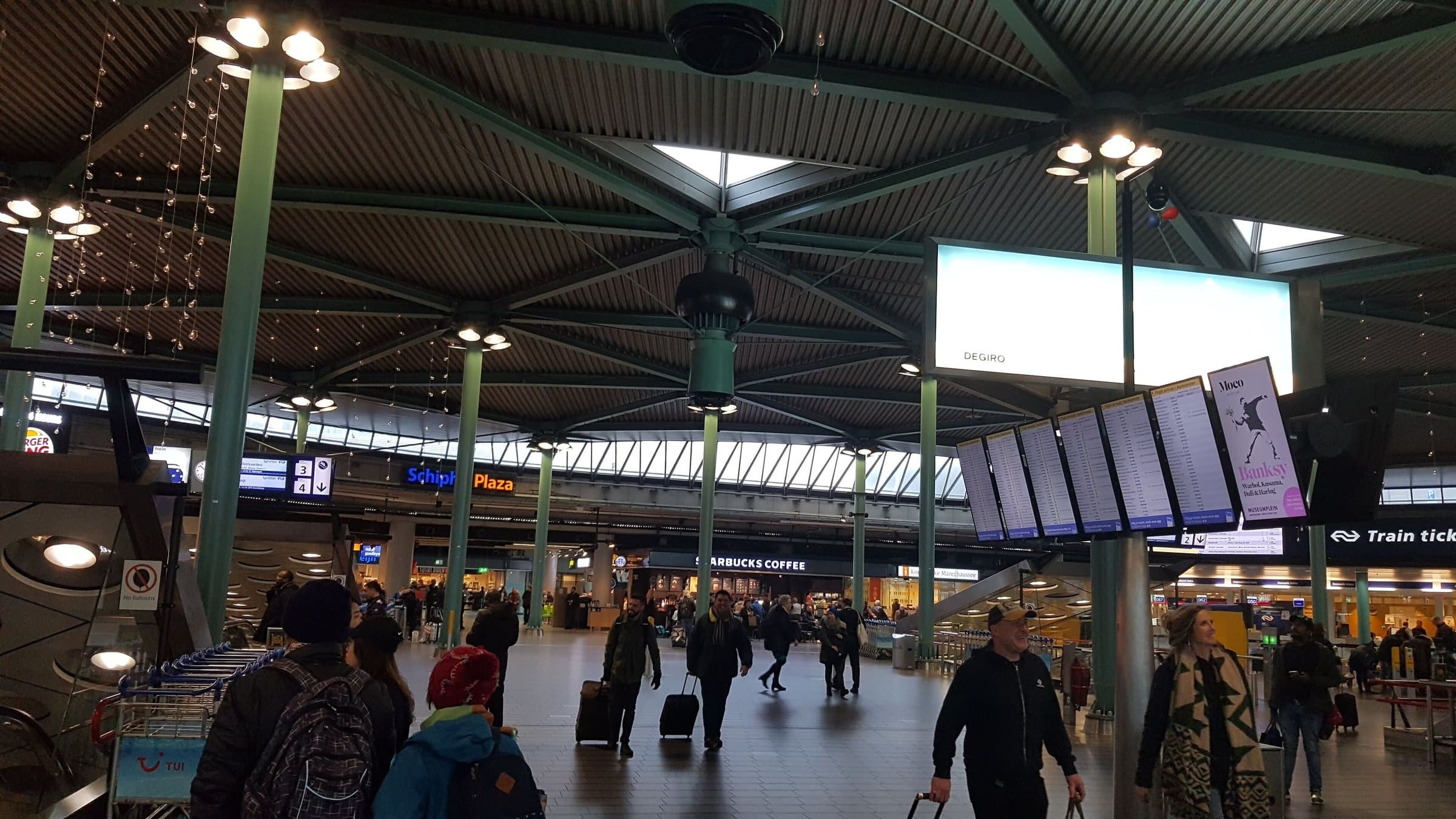
The terminal has collected things few airports have. From 2002 to 2024 the Rijksmuseum ran an annex here, the first art museum inside an airport, showing rotating works from its collection airside. The Schiphol Airport Library opened alongside it in the summer of 2010, with 1,200 books by Dutch authors translated into 29 languages, and music and e-books free to download. The rooftop Panoramaterras, open to the public from the landside without charge, has had a KLM Cityhopper Fokker 100 parked on it as an exhibit since June 2011. There is a clock by Maarten Baas in which a man behind a screen appears to paint each minute by hand, and the airport has its own mortuary. Between October 2006 and 2019 it was also possible to be married here.
A general aviation terminal opened on the east side in 2011 as the KLM Jet Center, 65,000 ft² in all, of which a fifth is terminal and lounge; it was sold to Jet Aviation in October 2018.
Schiphol works in waves, as a connecting hub must. Departures peak between 09:00 and 11:00 and again between 13:00 and 15:00, with as many as 58 departures in the hour from 14:00 on a normal weekday, very nearly one a minute. Arrivals peak earlier, between 08:00 and 09:00, with up to 52 in the hour.
That rhythm exists because of transfer traffic. In 2025, 36.6 per cent of the passengers counted at Schiphol were changing aircraft: and in the airport's own statistics a transfer passenger is counted twice, once on arrival and once on the connecting departure. The remaining 43.6 million began or ended their journeys here.
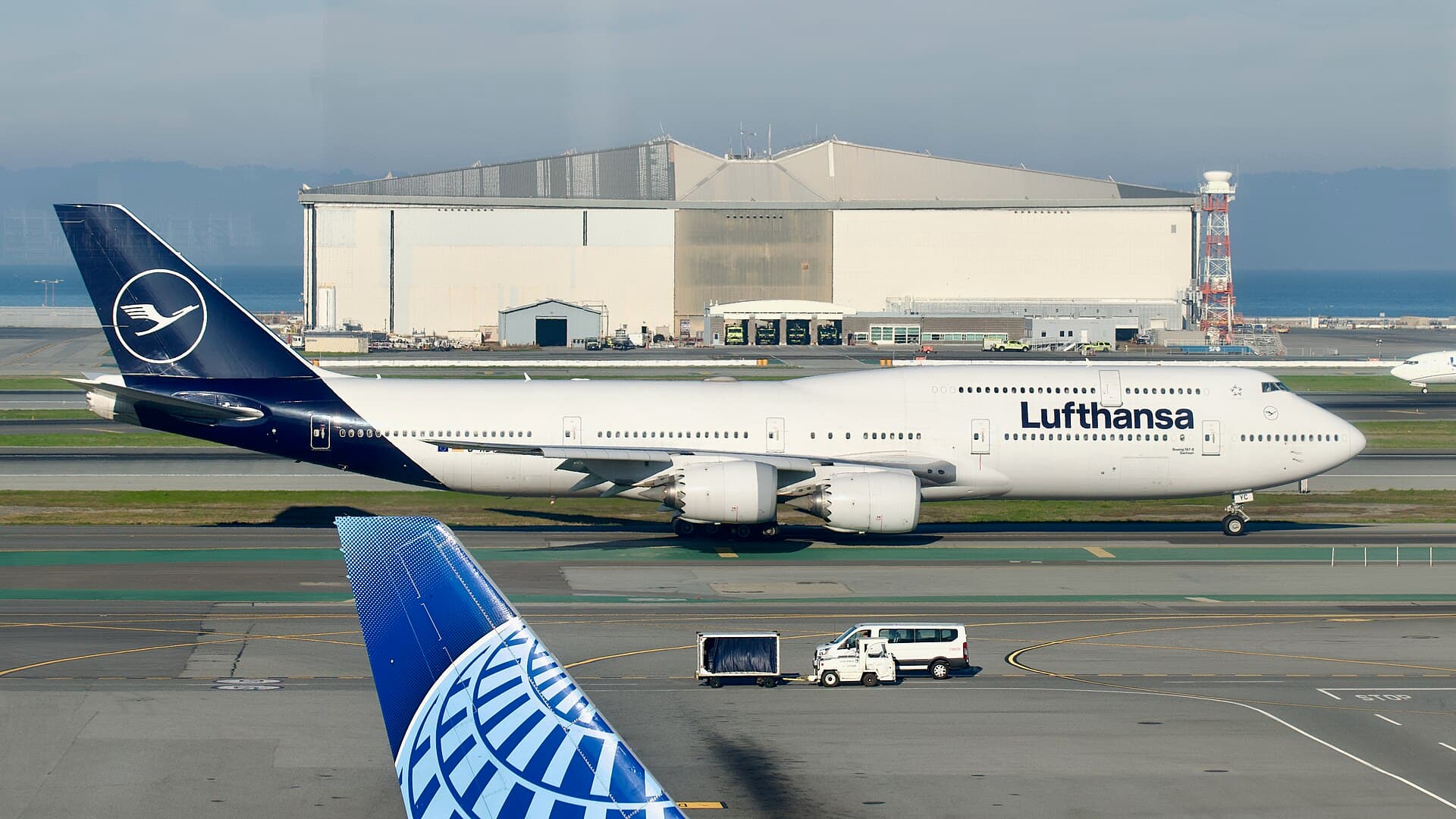
The hub belongs to KLM and its regional arm KLM Cityhopper, with Martinair on the cargo side; between them they set the shape of the wave. The single-terminal plan is what makes it work: a passenger changing from a Schengen flight to an intercontinental one walks through the building rather than being bused between separate terminals.
Schiphol's railway station lies directly beneath the terminal complex and runs 24 hours a day. Nederlandse Spoorwegen, the national operator, links it to the four big cities (Amsterdam, Utrecht, The Hague and Rotterdam) and to much of the rest of the country: Almere, Lelystad, Eindhoven, 's-Hertogenbosch, Leeuwarden, Groningen, Amersfoort, Apeldoorn, Deventer, Enschede, Arnhem, Nijmegen and Venlo all have intercity services through the airport.
International trains run south. Eurostar serves Antwerp, Brussels and Paris Gare du Nord direct from the airport, and Eurocity Direct runs up to sixteen services a day between the Netherlands, Antwerp and Brussels through Schiphol.
Buses call at or terminate in the station in front of the terminal, and KLM runs its own coach from Schiphol to Maastricht railway station by way of Eindhoven and Maastricht airports. By road the airport is reached from the A4 and A9 motorways. Most of the roads into it are closed to bicycles, but it can be reached by bicycle on separate cycle paths.
Royal Schiphol Group is in the middle of the largest rebuilding programme in the airport's history. In 2024 it announced a €6 billion investment in infrastructure; in 2025 it presented plans to spend around €10 billion through 2035, most of it at Schiphol itself.
The work is deliberately conservative about the thing that defines the airport. The Schiphol Centre Master Plan adds a new Terminal South and renews Piers B, C, D and H/M in phases, but keeps the single-terminal concept rather than splitting the airport into separate buildings.
The most visible piece is a new Pier A, under construction south-west of the present complex. It has been delayed repeatedly: it was once expected to open around 2019, but construction problems and a dispute with the previous contractors forced repairs and further delay, and it is now due in service in April 2027. At 590,000 ft² it will have eight gates, three of them able to take the largest aircraft.
Smaller works have already landed. The renovations announced in 2024 covered Pier C, Lounge 1, the baggage system and the passenger walkways, lifts and bridges; the Lounge 1 expansion was finished by November 2024, adding 54,000 ft² of passenger space and a new plaza. In 2024 the airport also recorded 8 per cent more passengers and 8.2 per cent more cargo than in 2023.
Noise has shaped Schiphol more than any other force. The airport sits in a small country among towns whose names its runways carry (Aalsmeer, Zwanenburg, Kaag, Buitenveldert) and every expansion has had to answer to the people beneath the approaches.
The Polderbaan is the clearest expression of that. Rather than add a runway beside the others, the airport built its sixth several kilometres west of the terminal, where fewer people live under the flight path, and accepted a ten- to twenty-minute taxi and a second control tower as the price. Its traffic is one-way by design: departures to the north, arrivals from the south.
The spread-out layout is the same answer at a larger scale. Six runways pointing in several directions let the airport move its noise from one community to another as the wind and the hour allow, instead of concentrating it on a single pair of parallels.
Two of the airport's runways carry the memory of the worst day in Dutch aviation. In 1992 an El Al Boeing 747 freighter, Flight 1862, took off from the Zwanenburgbaan, lost engines from its starboard wing and turned back to attempt a landing on the Buitenveldertbaan; it came down instead into blocks of flats in the Bijlmermeer in south-east Amsterdam.
On 25 February 2005 thieves drove a stolen KLM van into the cargo area and made off with diamonds worth an estimated €75 million, one of the largest such robberies ever. Later that year a fire in the airport's detention centre killed eleven people and injured fifteen, with 350 held in the complex at the time; an investigation a year later found that fire-safety precautions had not been enforced, and the report cost the justice minister, the mayor of Haarlemmermeer and the spatial-planning minister their offices.
On 23 February 2017 a Flybe Dash 8 Q400 arriving from Edinburgh in storm Doris landed on the Oostbaan and suffered a collapse of its right landing gear; none of the 59 passengers and four crew was hurt, though the aircraft was badly damaged.
The summer of 2022 brought a different kind of failure. As traffic returned after the pandemic, Schiphol did not have the security and ground staff to handle it: queues ran out of the building, flights were cancelled, and the airport capped the number of departing passengers it would accept. The chief executive of Schiphol Group, Dick Benschop, resigned in September 2022.
On 29 May 2024 a worker died after being drawn into the engine of a KLM Cityhopper Embraer 190 during pushback for a flight to Billund. The Dutch Safety Board concluded that he had jumped into the running engine deliberately.
Schiphol's influence on other airports is mostly a matter of two ideas. The first is the single terminal: one roof, three halls, piers connected airside, which many later hub airports have imitated and which Schiphol has refused to abandon even in a €10 billion rebuilding programme.
The second is wayfinding. Benno Wissing's signs of 1967, with their reserved yellow and green, and Paul Mijksenaar's redesign of 1993 made the airport a standard reference for how to move strangers through a large building, and the system has been studied and copied far beyond aviation.
What remains particular to Schiphol is the sense that the airport belongs to the country around it: runways named after the villages they disturb, a library of Dutch writing airside, an annexe of the Rijksmuseum, and a viewing terrace where anyone can come to watch aircraft for nothing.
Polderbaan
The Polderbaan: the newest runway, opened in 2003, west of the A5 motorway.
Kaagbaan
Buitenveldertbaan
Aalsmeerbaan
Zwanenburgbaan
Oostbaan
The Oostbaan, the shortest runway.
Opened 1967
A single terminal of departure halls and piers, grown from the 1967 building; Departure Halls 1 and 2 and piers C, D and E date from then.
September 19, 1916
May 17, 1920
1923
1924
December 13, 1943
July 8, 1945
1949
1967
1970
1977
1978
1991
1993
2003
2011
2019
2024
2027
Types whose story is bound up with this airport.
Checked September 19, 2026