Delta Air Lines · JetBlue Airways · American Airlines
Ownership
Operator
The Port Authority of New York and New Jersey
Owner
The land belongs to the City of New York, which leases the airport to the Port Authority of New York and New Jersey, a bi-state public agency, under an agreement concluded in 2004 that runs through 2050. The terminals themselves are built and run by airlines and private consortia on long leases from the Port Authority.
Ownership as of April 2026
20161 / 6
John F. Kennedy International Airport occupies 4,930 acres of filled marshland on the northern shore of Jamaica Bay, in the south-eastern corner of Queens, about fifteen miles by road from midtown Manhattan. It is New York's principal international gateway and has been, for most of the years since the Second World War, the airport through which the United States meets the rest of the world. In 2025 it handled 62.6 million passengers, more than half of them on international flights, and about 1.56 million short tons of cargo.
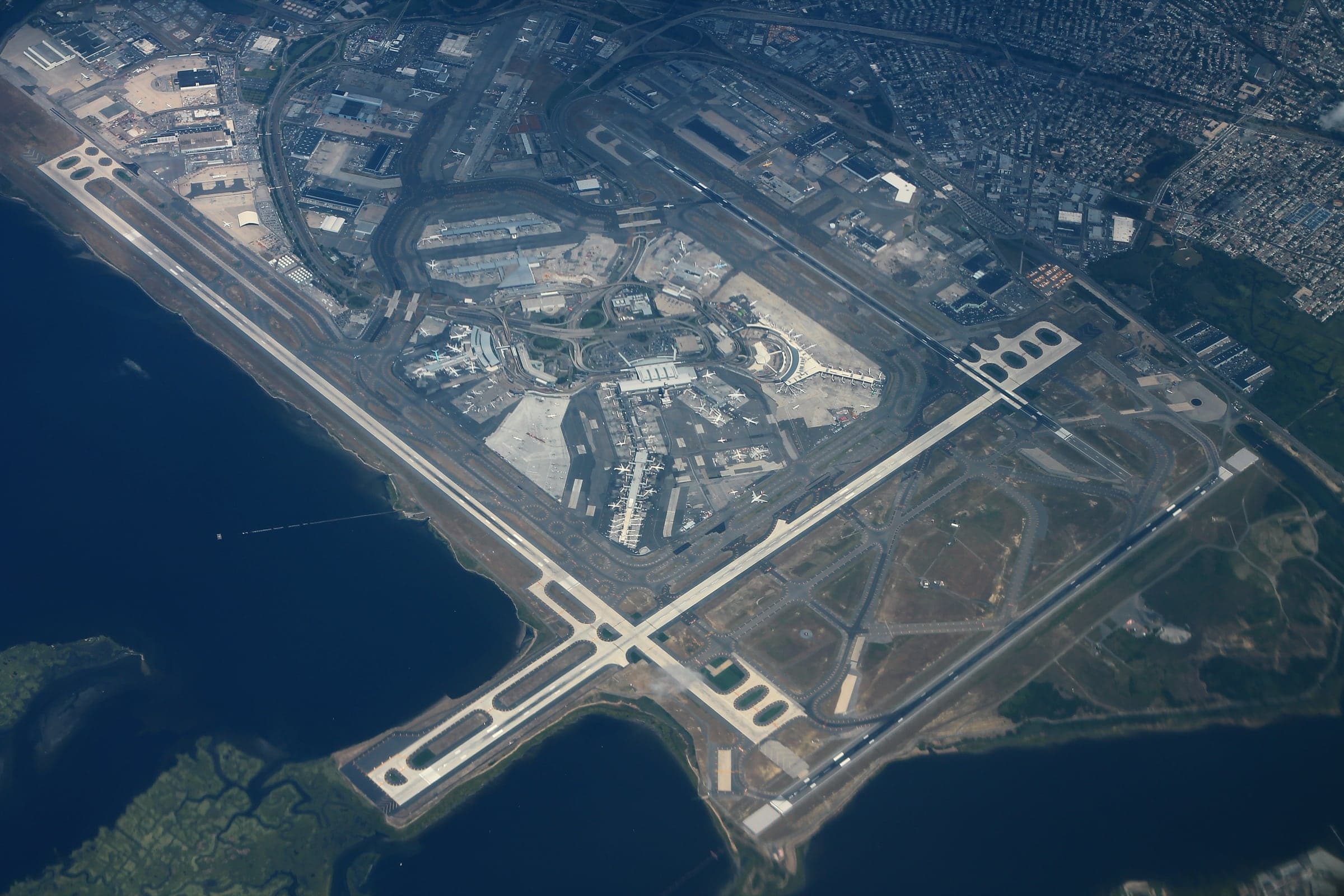
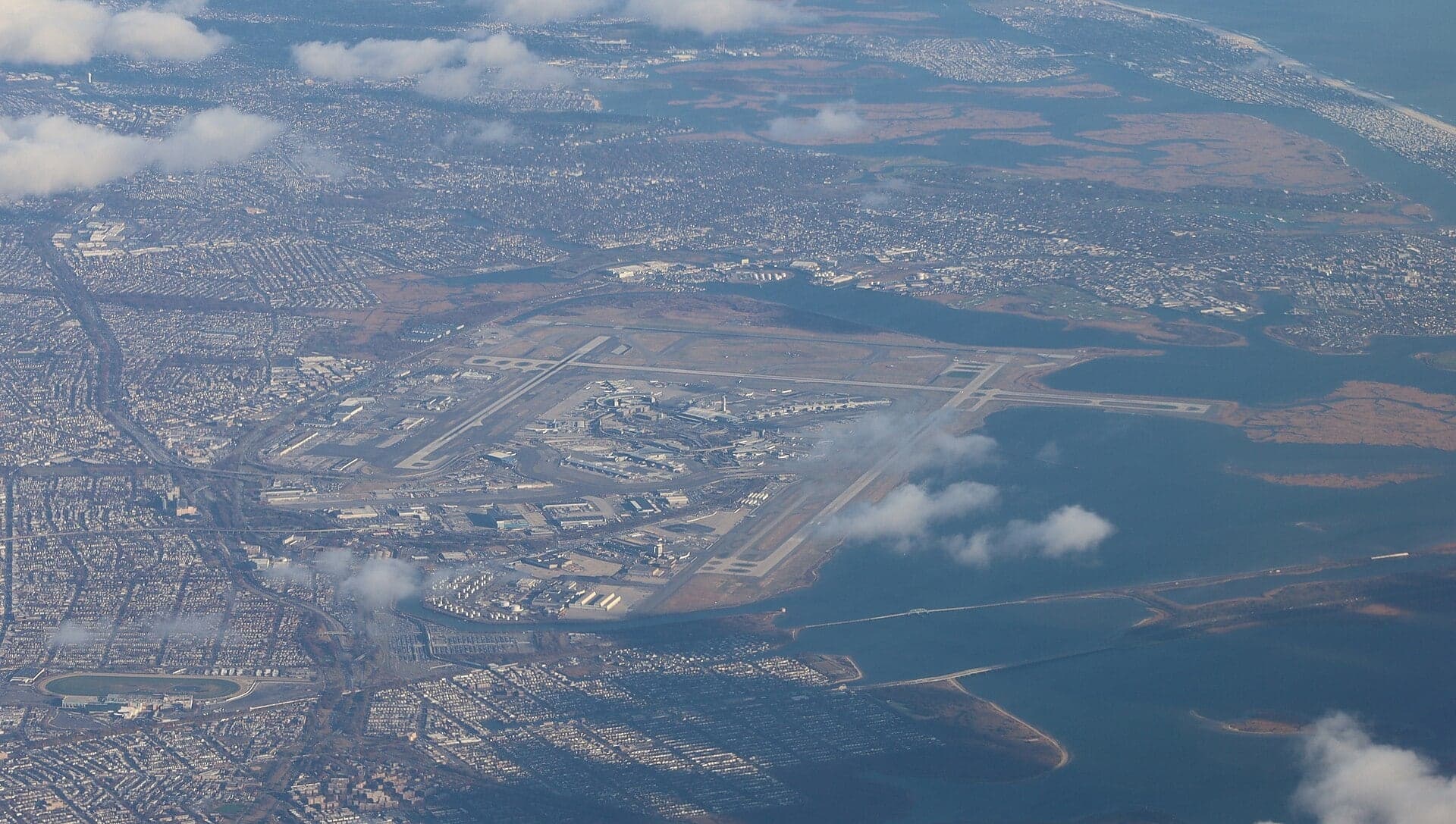
JFK seen from a high altitude in 2021, the runways laid across the marshes and inlets of Jamaica Bay with Queens and Brooklyn behind (2021)
It was built as a city project, opened in 1948 as New York International Airport, and was known to almost everyone as Idlewild after the golf course it replaced. It took its present name in December 1963, a month after the assassination of the president. Since 1947 it has been operated by the Port Authority of New York and New Jersey, the bi-state agency that also runs LaGuardia and Newark.
What makes JFK unlike any European hub is how its terminals came to exist. From the mid-1950s the Port Authority laid out a central ring of land and invited each major airline to build its own building on it. The result was a museum of mid-century commercial architecture, Eero Saarinen's TWA Flight Center, Pan Am's flying-saucer Worldport, I. M. Pei's Sundrome: and, decades later, a set of ageing, disconnected sheds that no single owner could modernise. The airport is now halfway through a $19 billion reconstruction that replaces much of that ring with two large new terminals.
History
In 1941 Mayor Fiorello La Guardia announced a second municipal airport for New York, to be built on a broad stretch of marshland on the south side of Long Island. LaGuardia Field, opened only two years earlier, was already too small for the transatlantic landplanes the war was about to make possible. The land the city assembled included the Idlewild Golf Course, an old summer hotel and the small Jamaica Sea-Airport landing strip. Construction began in 1942, and the name the golf course gave the site outlasted every official one.
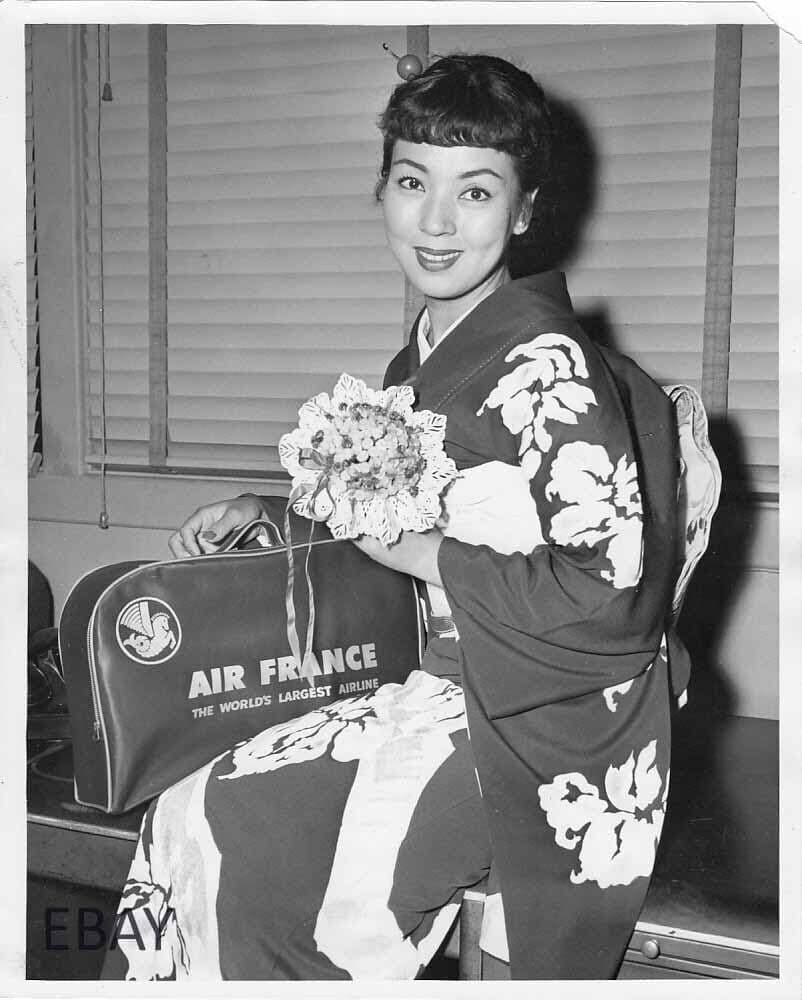
The Japanese actress Machiko Kyō, in a kimono and holding a bouquet and an Air France bag, photographed on arrival at Idlewild around 1955 (1955)
Those official names came and went. In 1943 the airfield was named Major General Alexander E. Anderson Airport, after a decorated veteran of both world wars; in March 1948 the City Council renamed it New York International Airport, Anderson Field. The Port Authority, created in 1921 to manage the harbour, took over the unfinished airport under a lease with the city on 1 June 1947. Commercial flights began in July 1948, using a small cinder-block building and a control tower as the first terminal. For almost a decade that temporary arrangement carried nearly three million passengers.
The decisive choice came in 1954. Rather than build one great terminal, the Port Authority, under Thomas M. Sullivan, deputy director of its aviation department, with Wallace K. Harrison as design coordinator: planned a 'Terminal City': a central International Arrivals Building with flanking wings, which it would build itself, an eleven-storey control tower, and seven terminals to be designed and paid for by individual airlines. The airlines were to compete for passengers in architecture as well as in service.
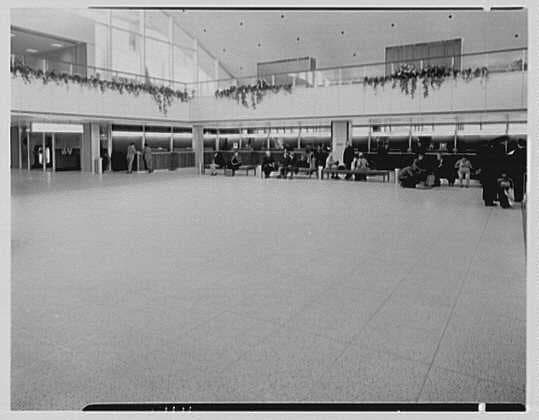
The main hall of the International Arrivals Building at Idlewild in 1957, a long bright concourse with a hanging mobile and waiting passengers (1957)
The International Arrivals Building, by Skidmore, Owings & Merrill, opened in 1957. The airline terminals followed over the next five years: United in 1959, American and Pan Am in 1960, Eastern, TWA and the Northeast to Braniff to Northwest building by 1962. They were being built exactly as the jet arrived. Pan Am had flown the first American transatlantic Boeing 707 service out of Idlewild in October 1958, and several of the new buildings were redesigned while under construction to take elevated walkways, early jet bridges, rather than stairs across the apron.
On 24 December 1963, a month after President Kennedy was killed in Dallas, the airport was rededicated as John F. Kennedy International Airport. The Beatles came through its International Arrivals Building on 7 February 1964, on their first visit to the United States, and gave a press conference there. By then the airport had become the default American landfall for heads of state, for delegations to the United Nations, and for millions of immigrants.
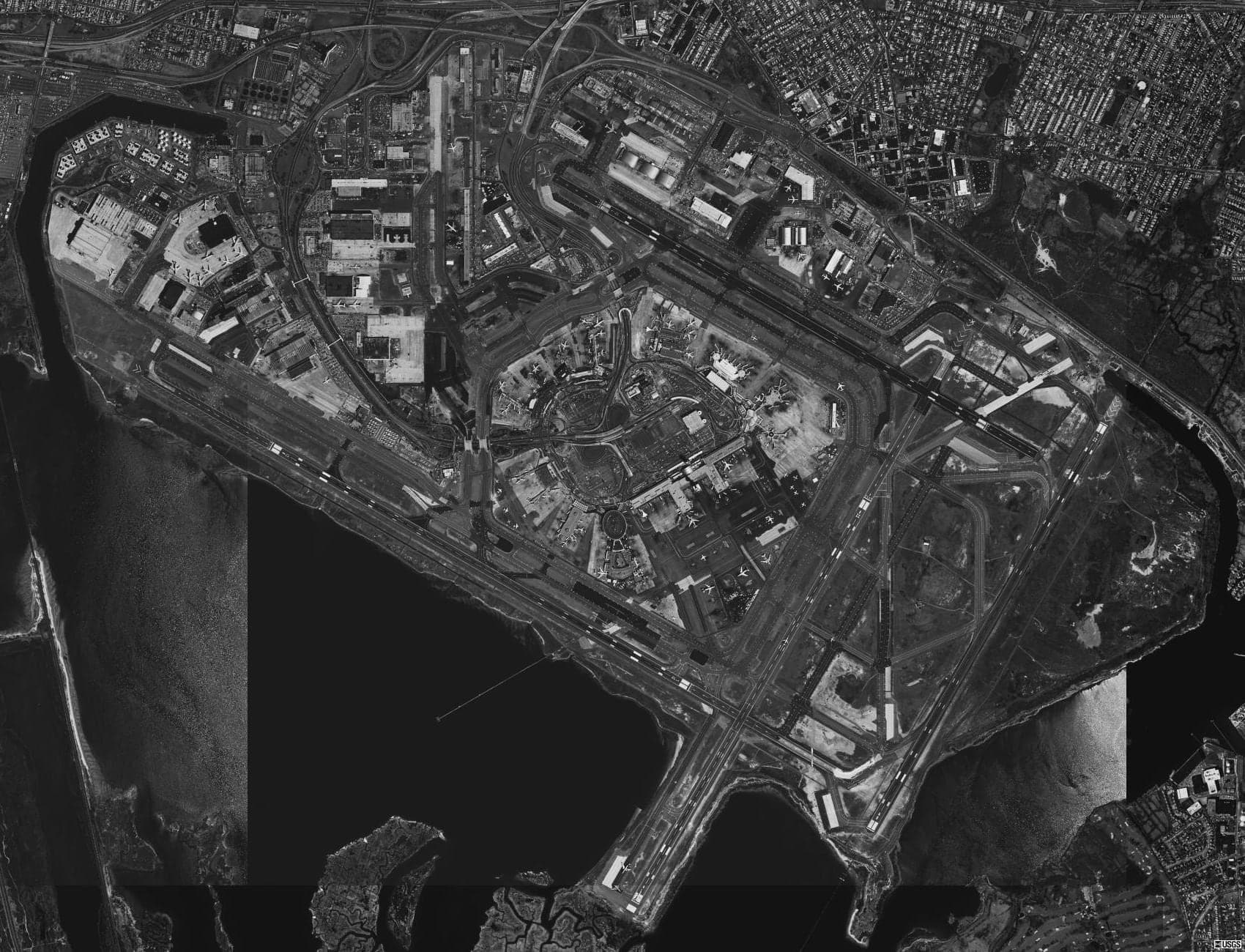
Black-and-white USGS survey image of the airport in April 1994, showing the original ring of individual airline terminals around the central area (1994)
The second generation of buildings arrived with the wide-bodies. British Airways' Terminal 7 opened in 1970, as did National Airlines' glass Sundrome by I. M. Pei. Traffic grew until the airport served its billionth passenger in 2000. Then, one after another, the 1950s terminals reached the end of their lives: the International Arrivals Building gave way to Terminal 4 in 2001, the old American and United buildings to Terminal 8 in 2007, the Worldport was demolished in 2013 to 14, and Terminal 2 closed and came down in 2023.
The airfield
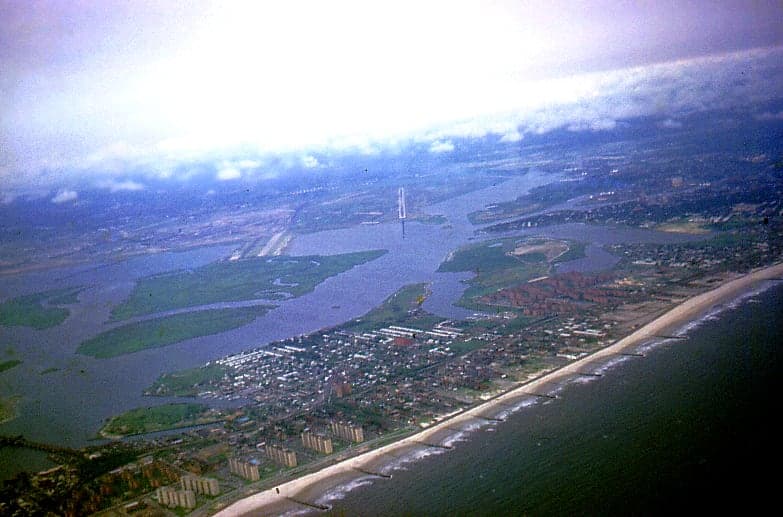
The view from a Qantas Boeing 707 on a ten-mile final into JFK from London in 1969, over the Rockaway peninsula and Jamaica Bay (1969)
JFK's runways are two pairs of parallels set at right angles to each other: 4L/22R and 4R/22L running north-east to south-west, and 13L/31R and 13R/31L running north-west to south-east. Together they add up to more than 7 nm of pavement. The longest, 13R/31L, the Bay Runway, is 14,510 ft long and runs out across filled land into Jamaica Bay; it is one of the longest commercial runways in North America. 4L/22R is 12,080 ft, 13L/31R 10,000 ft and 4R/22L 8,400 ft.
Two crossed pairs give the airport a set of parallels into most winds, and the choice of configuration changes with the weather. In most configurations one runway of a pair handles arrivals and the other departures; the Port Authority describes 13R/31L and 4L/22R as the two departure runways and 4R/22L and 13L/31R as the principal arrival runways.
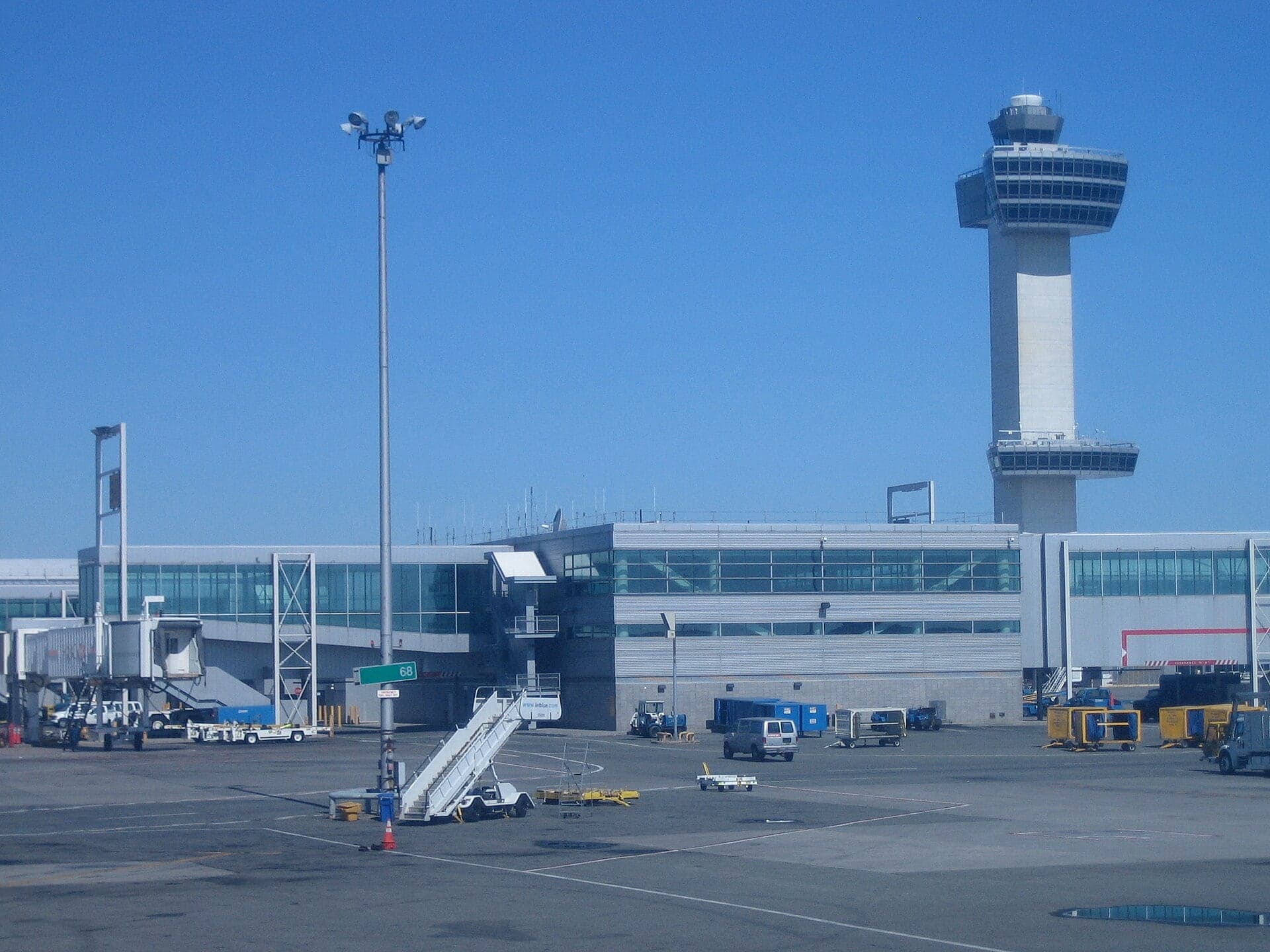
The 321-foot control tower that opened in 1994, rising behind a terminal pier with airstairs on the apron (2009)
The airfield has been almost entirely rebuilt this century. To take the Airbus A380: which first touched down on American soil at JFK on a route-proving flight on 19 March 2007: the Port Authority spent $200 million on taxiways and airside works. Between 2010 and 2015 it spent nearly $600 million reconstructing 13R/31L and 4L/22R in concrete; 4R/22L was rehabilitated for $106 million in 2017, and 13L/31R for $230 million in 2019. Three of the runways are now concrete and all four are 200 ft wide, the width needed for the largest aircraft. About 39 nm of taxiways connect them.
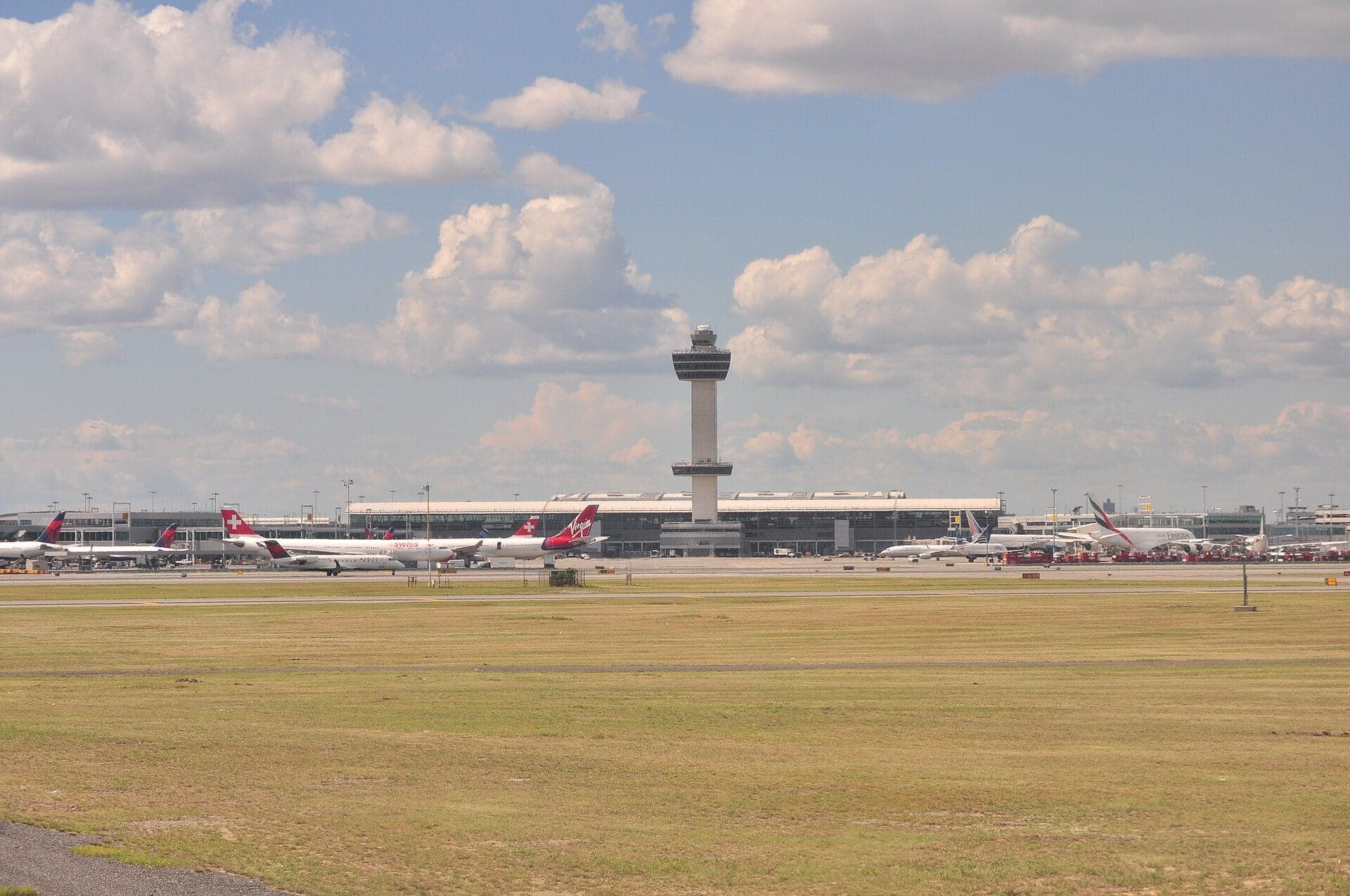
The control tower, 321 ft tall, opened in 1994 in the middle of the central terminal area, replacing the Port Authority's original tower. Outside the terminal ring lies the cargo area: nearly four million square feet of warehouses and offices, all designated a Foreign-Trade Zone, where freighters and the bellies of passenger wide-bodies handled 1.56 million short tons of freight in 2025.
Terminals
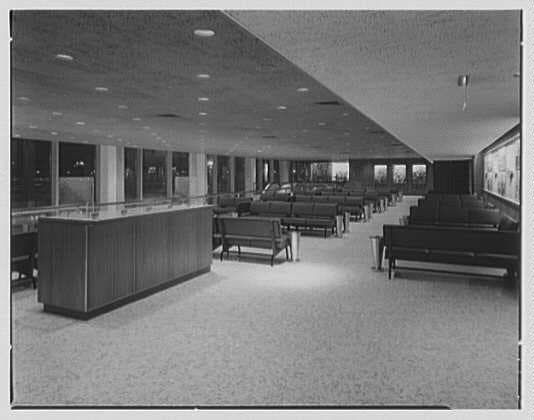
The BOAC departure lounge at Idlewild in 1958: rows of low benches, a service desk and full-height windows (1958)
The Terminal City plan put the buildings on a ring around an oval of car parks, roads and the control tower, with a double ring of taxiways outside them. Each airline got a plot and a free hand. The International Arrivals Building in the middle was long and orthodox, with wings and perpendicular fingers; American's terminal by Kahn & Jacobs used a finger plan with staggered lounges; Eastern's, by Chester L. Churchill, had centralised waiting rooms and loading arcades. TWA was the only airline to adopt the satellite plan, with passengers walking out through tubes to separate gate buildings.
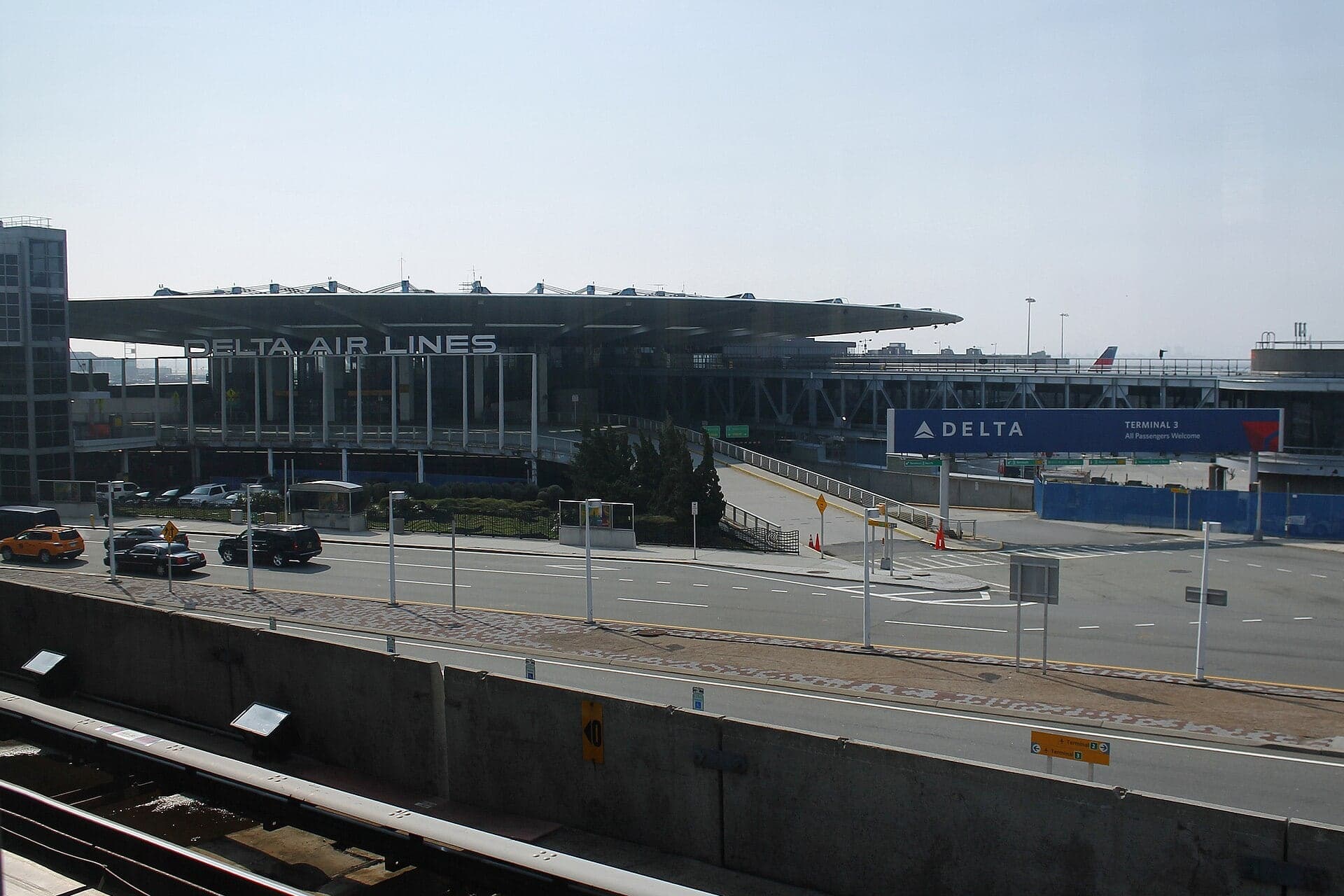
Pan Am's terminal, designed by Tippetts-Abbett-McCarthy-Stratton and opened in 1960, was the boldest engineering answer. A four-acre elliptical concrete roof, cantilevered far beyond its columns, let six jets nose in underneath so that passengers boarded without being rained on. It was enlarged in the early 1970s for the Boeing 747 and renamed the Worldport. After Pan Am's collapse Delta took it over in 1991 as Terminal 3; it was demolished in 2013 to 14, despite a preservation campaign, once Delta had moved to an expanded Terminal 4.
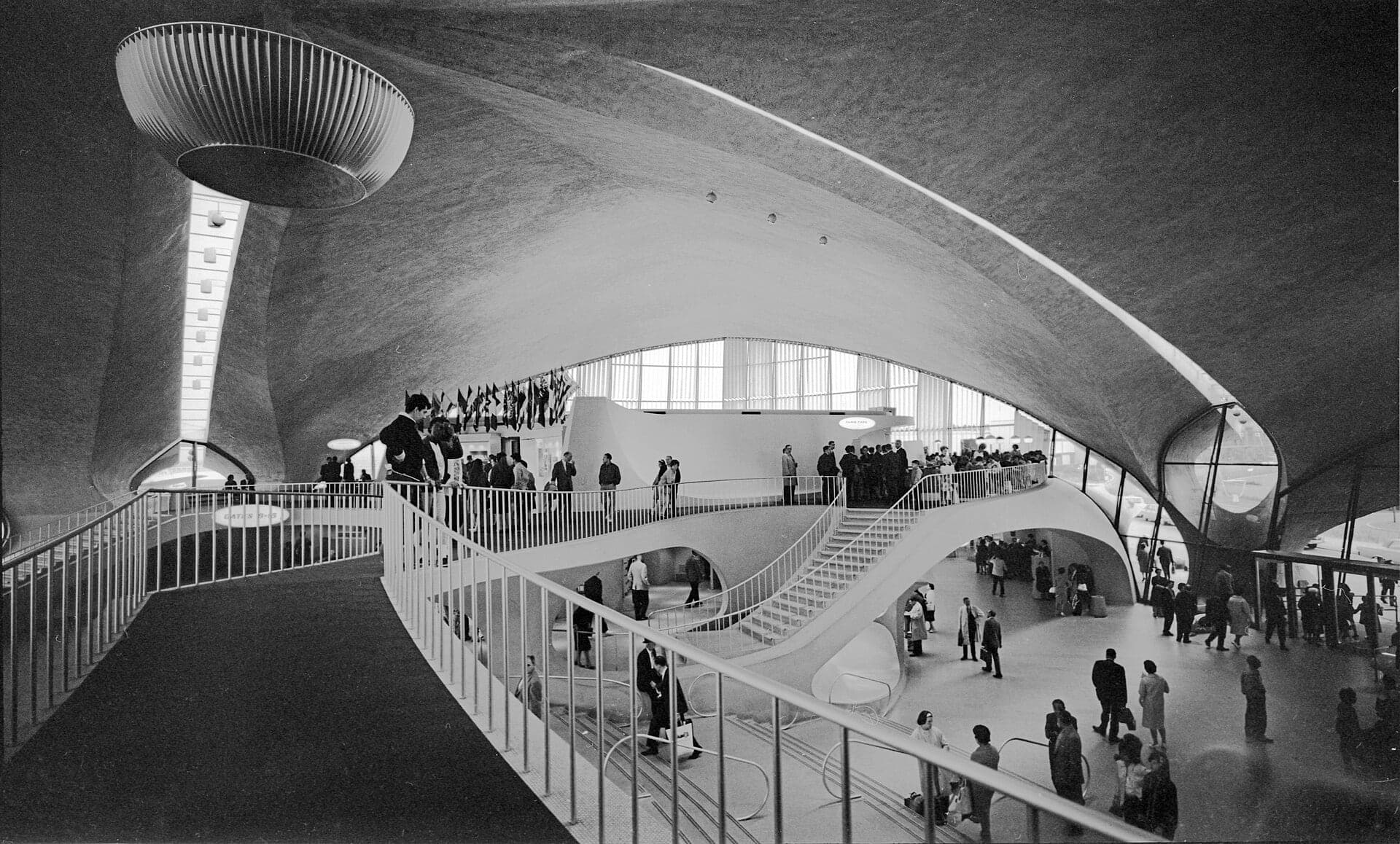
Inside the TWA Flight Center in 1963: sweeping concrete balconies and stairs under the curved shell roof, passengers crossing the main hall (1963)
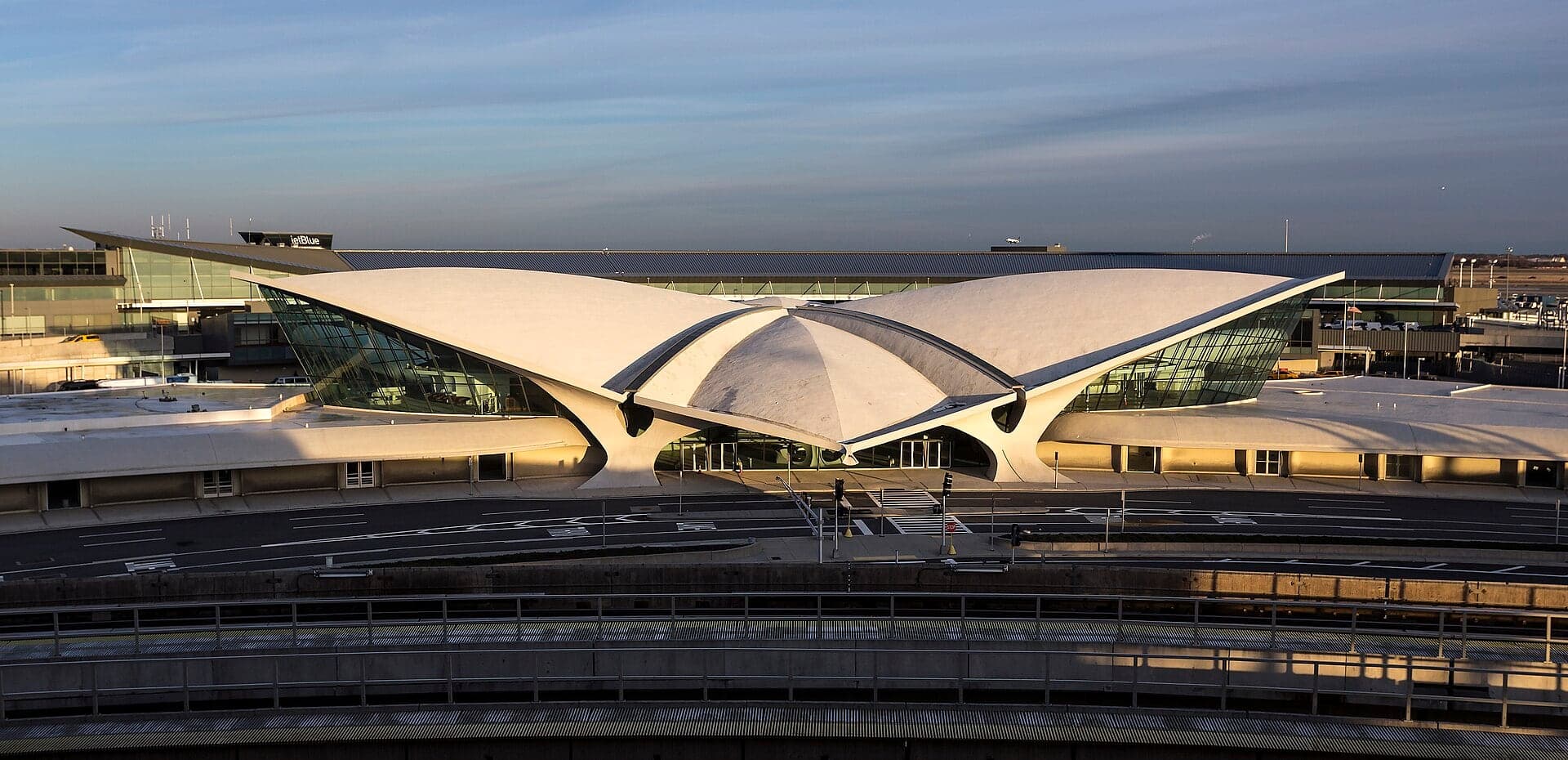
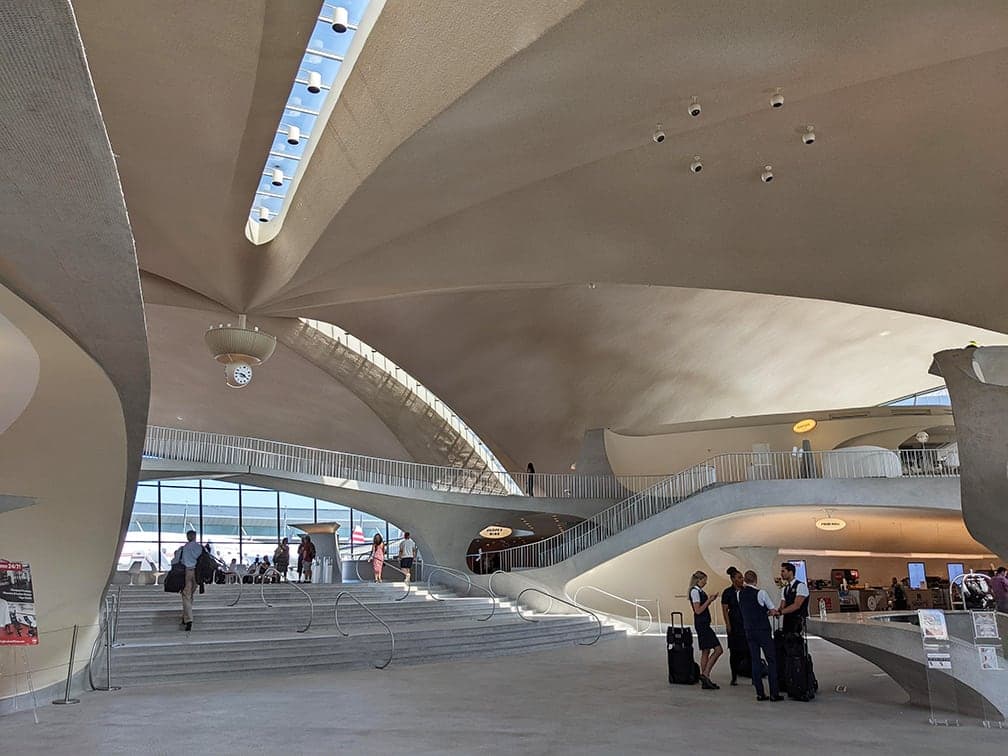
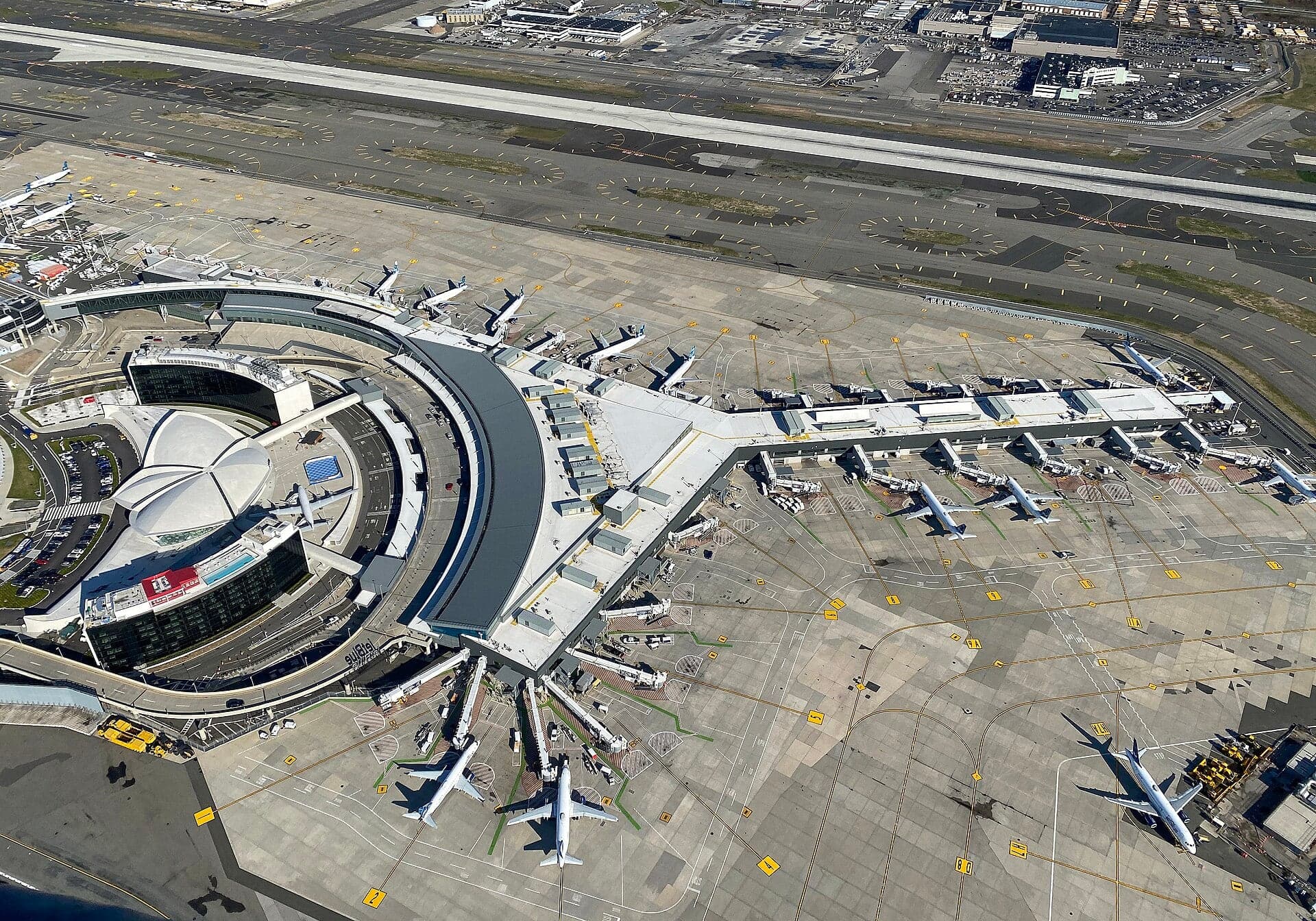
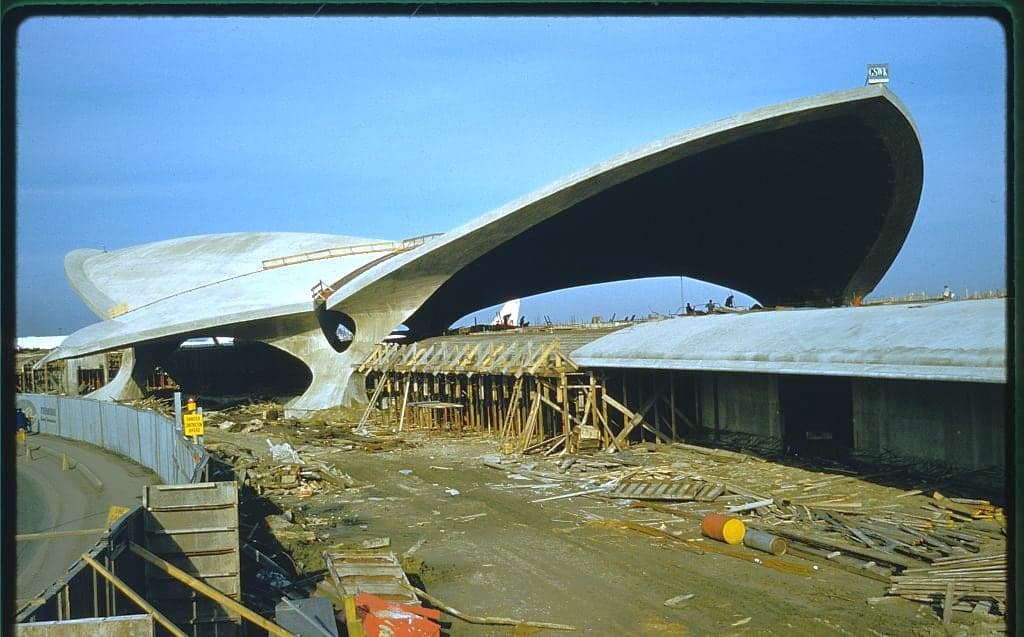
The TWA Flight Center was the building the airport became famous for. Eero Saarinen presented the design in November 1957: four thin concrete shells meeting at a skylit seam, supported on four Y-shaped piers, with every rail, counter and departures board shaped to belong to the same curve. Construction began in June 1959 and the terminal opened in May 1962; Saarinen had died the previous year, and his partner Kevin Roche saw it through. New York City designated it a landmark in 1994. It closed as a terminal after TWA's absorption into American in 2001 and reopened in May 2019 as the 512-room TWA Hotel, with JetBlue's Terminal 5 wrapped around its back.
Today's airport is a set of much larger buildings on the same ring. Terminal 1, opened in 1998 by a consortium of foreign airlines, has 11 gates and is being replaced. Terminal 4, opened in May 2001 on the site of the International Arrivals Building, is Delta's hub: 36 gates and 1.5 million square feet, and in 2025 the airport's busiest building by far, with 26.3 million passengers. JetBlue's Terminal 5, opened in 2008 with an international arrivals extension completed in 2014, has 29 gates. Terminal 7, built for British Airways and opened in 1970, now houses a mix of carriers and is due to be demolished for the second phase of the new Terminal 6. American's Terminal 8, opened in 2007 and expanded in 2022, has shared its gates with British Airways since the two airlines consolidated there.
Operations
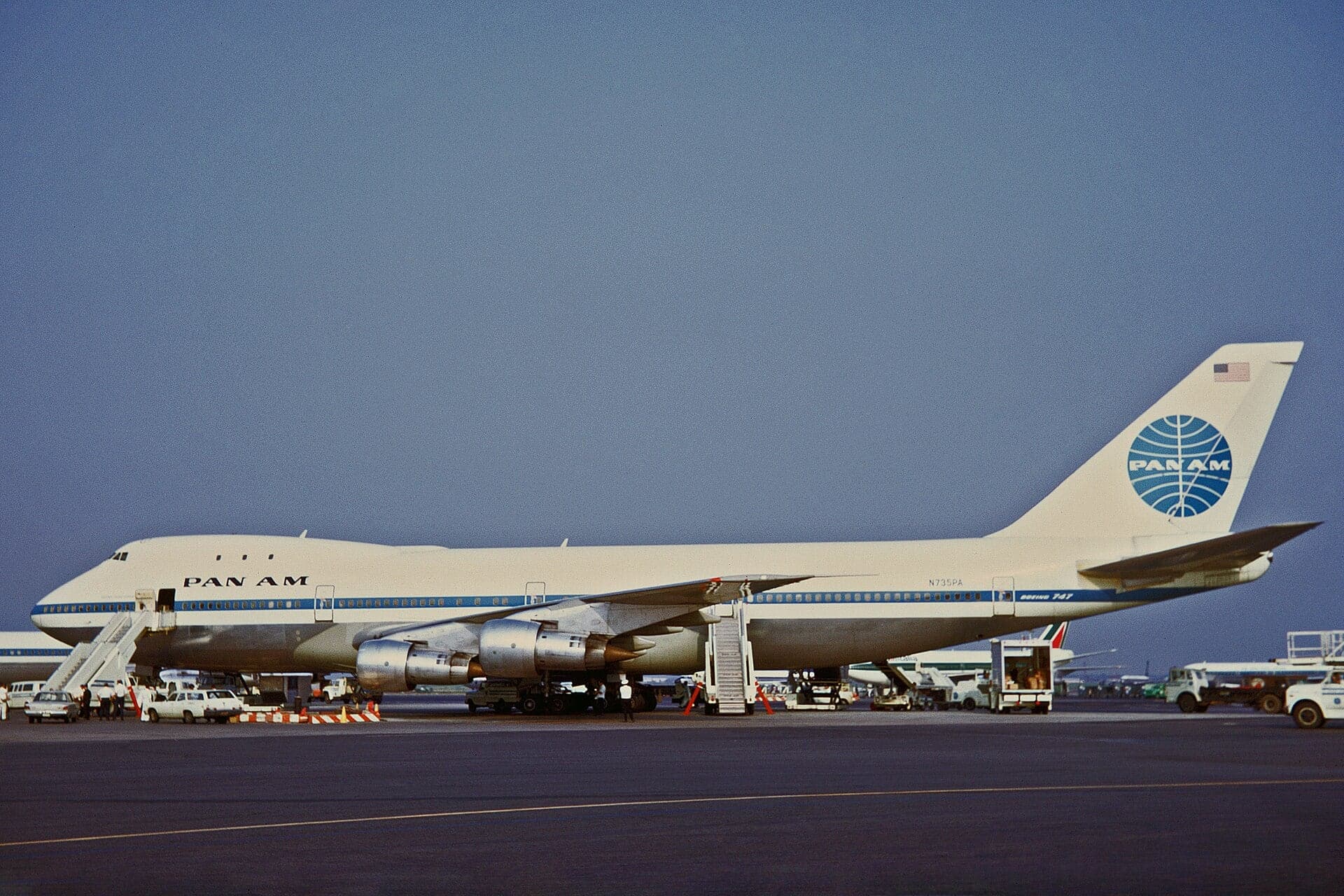
Pan Am Boeing 747-121 N735PA 'Clipper Constitution' on the ramp at JFK on 9 July 1970, six months after the type entered service (1970)
For the first half-century of its life JFK was, above all, Pan Am's airport and TWA's, the two American carriers licensed to fly the Atlantic, with every major foreign flag carrier in the world arriving at the International Arrivals Building in the middle. Pan Am flew the first American transatlantic jet service from Idlewild in October 1958, and on 22 January 1970 it flew the first commercial Boeing 747 service, from JFK to London Heathrow. The airport's terminals, stands and baggage halls were rebuilt around the jumbo within a few years, and for two decades a row of Pan Am and TWA 747s was the image of the place.
Both airlines are gone (TWA was absorbed by American in 2001, Pan Am had ceased flying ten years earlier) and the airport's three American hub carriers today are Delta, JetBlue and American. In 2025 Delta carried 18.5 million passengers through JFK, JetBlue 14.5 million and American 7.4 million; between them they accounted for almost two passengers in three. British Airways, Avianca, Virgin Atlantic, Air France, Emirates and Turkish Airlines were the largest foreign carriers.
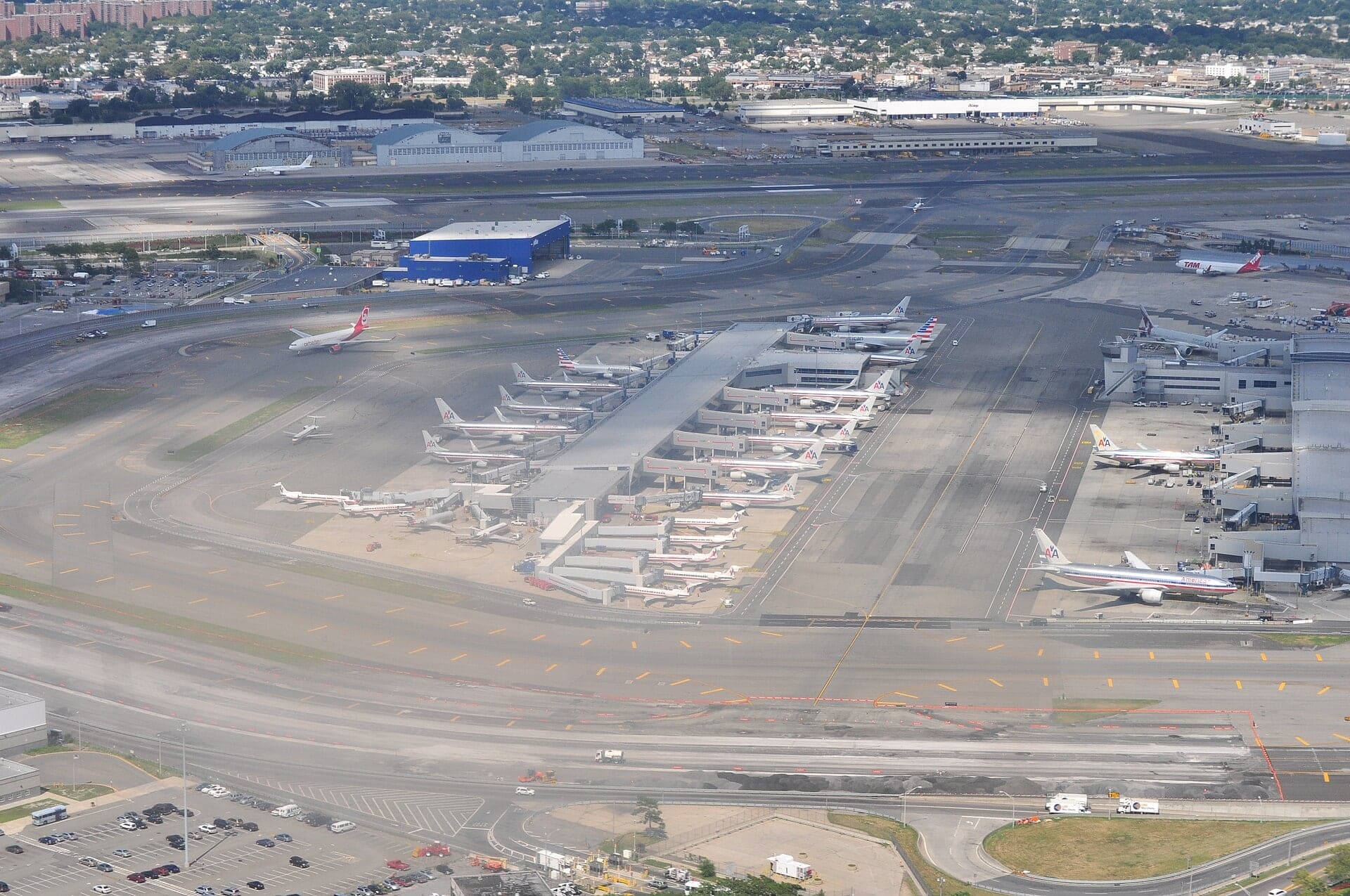
Terminal 8 from the south-west in 2013, American Airlines aircraft at its concourses with Queens stretching beyond (2013)
JFK is an international airport in a sense most large American airports are not. In 2025, 34.5 million of its 62.6 million passengers were on international flights; the transatlantic market alone accounted for 19.3 million, more than any other region, followed by the Caribbean and Latin America. Most of its traffic is local rather than connecting: in the Port Authority's 2025 passenger survey, 76 per cent of departing passengers were starting or ending their journey in New York rather than changing planes, and 41 per cent were foreign nationals.
The airport recorded 464,281 aircraft movements in 2025. Its record month was August 2025, with 6.2 million passengers, 3.7 million of them international. The annual total was slightly below 2024's record of 63.3 million, and the airport has now passed 60 million in five years (2018, 2019 and 2023 to 2025) after falling to 16.6 million in the first pandemic year, 2020.
Ground access
For its first fifty-five years JFK had no rail link of its own. Passengers reached it by car, taxi and coach along the Van Wyck Expressway and the Belt Parkway, or took a subway train to Howard Beach and a shuttle bus from there. Plans for a direct line to Manhattan came and went for decades; the airport and the city never agreed who would pay for one or where it would run.
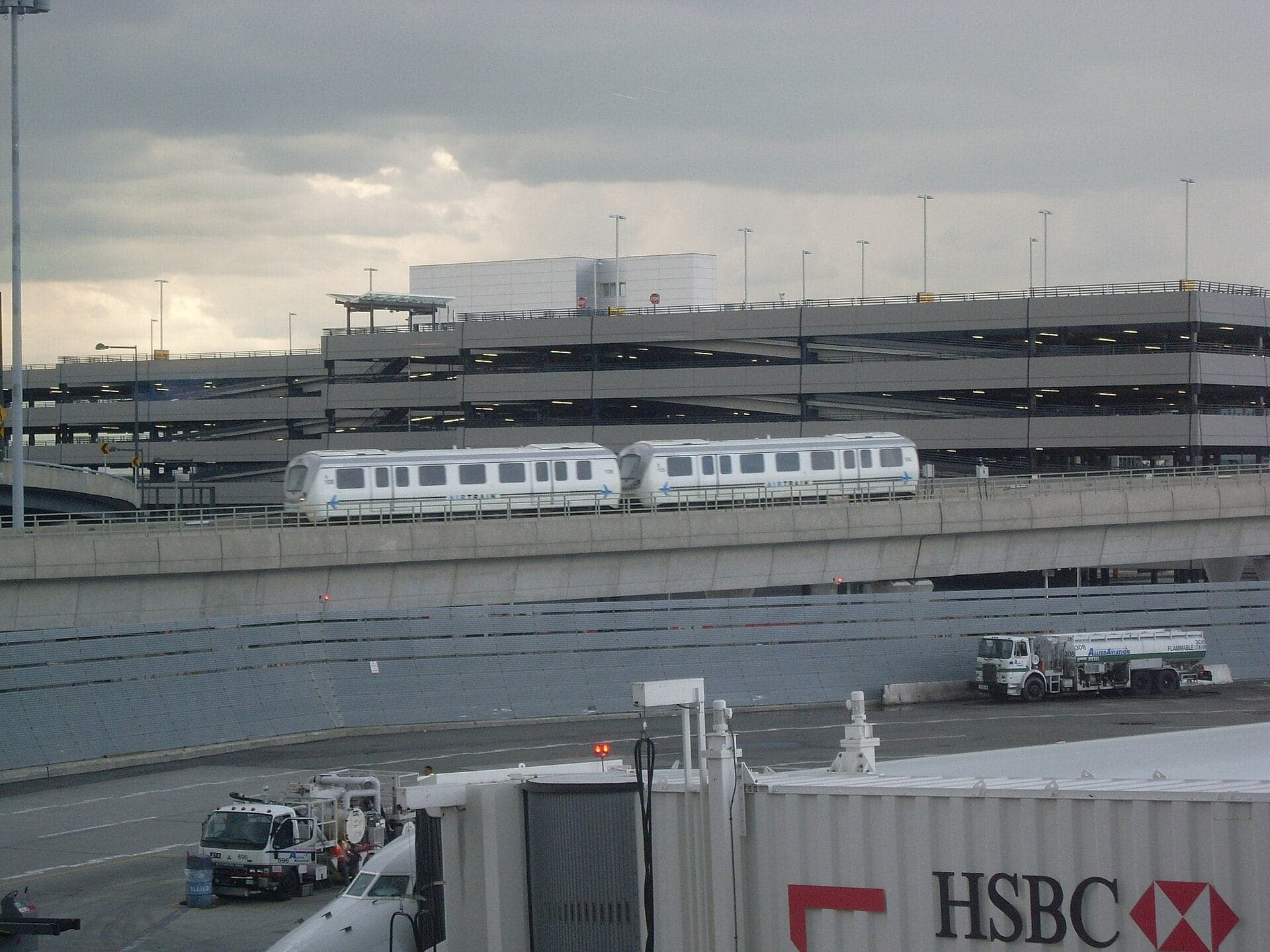
An AirTrain JFK train on its elevated guideway outside Terminal 4 in 2008 (2008)
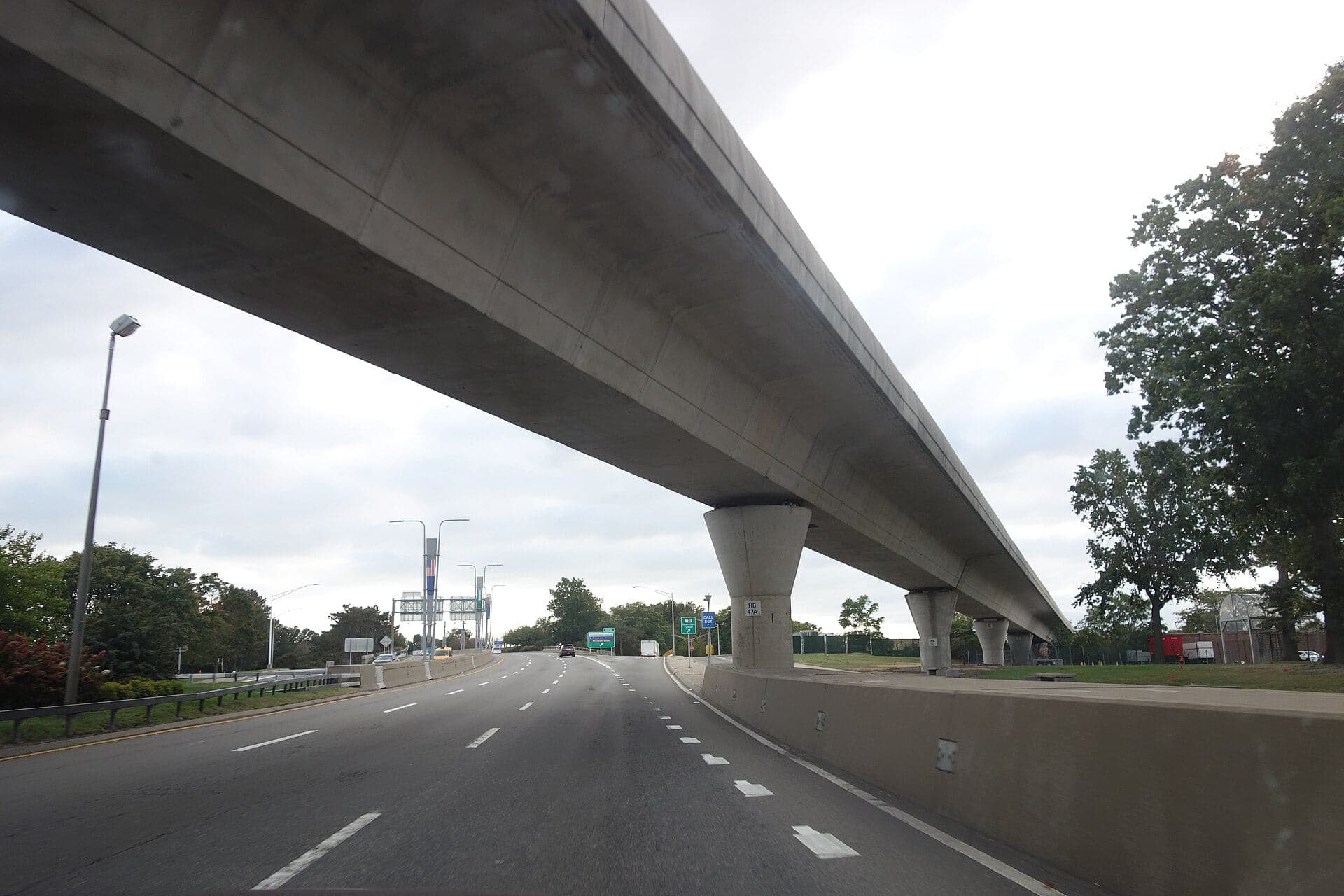
AirTrain JFK, opened in December 2003, was the compromise. It is a driverless light-rail system that loops around the central terminal area and runs out along two branches: one to Howard Beach, for the A train of the New York City Subway, and one above the median of the Van Wyck Expressway to Jamaica, where it meets the E, J and Z subway lines and the Long Island Rail Road. It does not go to Manhattan itself, the last leg is on the subway or the LIRR, but it made public transport a real option for the first time. Ridership reached a record 27 million in 2025.
The concrete AirTrain JFK viaduct running above the Van Wyck Expressway towards Jamaica in 2021 (2021)
The road access is the part of the airport most visibly in upheaval. In June 2023 the Port Authority signed a $1.24 billion contract with a joint venture of Skanska and Halmar International, designed by Parsons, to rebuild the tangle of ramps inside the central area into a simpler network, with a new ground transportation centre and a 1,950-space garage connected to the New Terminal One.
In the Port Authority's 2025 survey of departing passengers, about 16 per cent reached the airport by rail or subway, 22 per cent by ride-share, 16 per cent by taxi or limousine and just over a third by private car. The airport offers about 10,600 public parking spaces.
Expansion
The airline-built ring that made JFK famous also made it hard to fix. By the 2010s the airport had six terminals of different ages, owners and standards, poorly connected to each other and to the roads. In 2017 New York State announced a plan to rebuild it as a single, coherent airport, and the Port Authority turned that into a $19 billion programme: about $15 billion of private investment in terminals and $3.9 billion of public money for roads, utilities and the airfield.
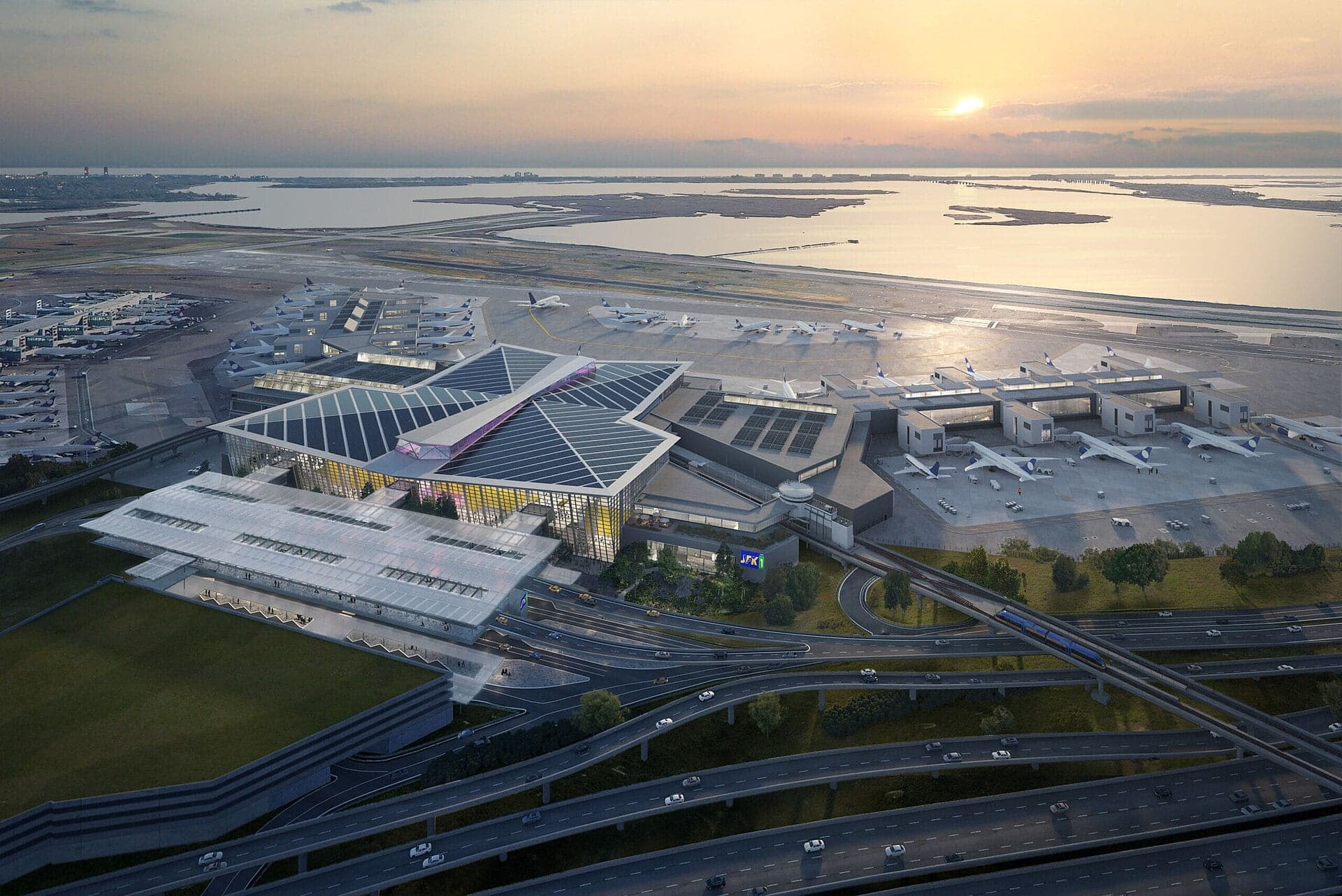
Architectural visualisation of the New Terminal One, published by its developer in 2024: a large glazed building with a folded roof on the south side of the central area (2024)
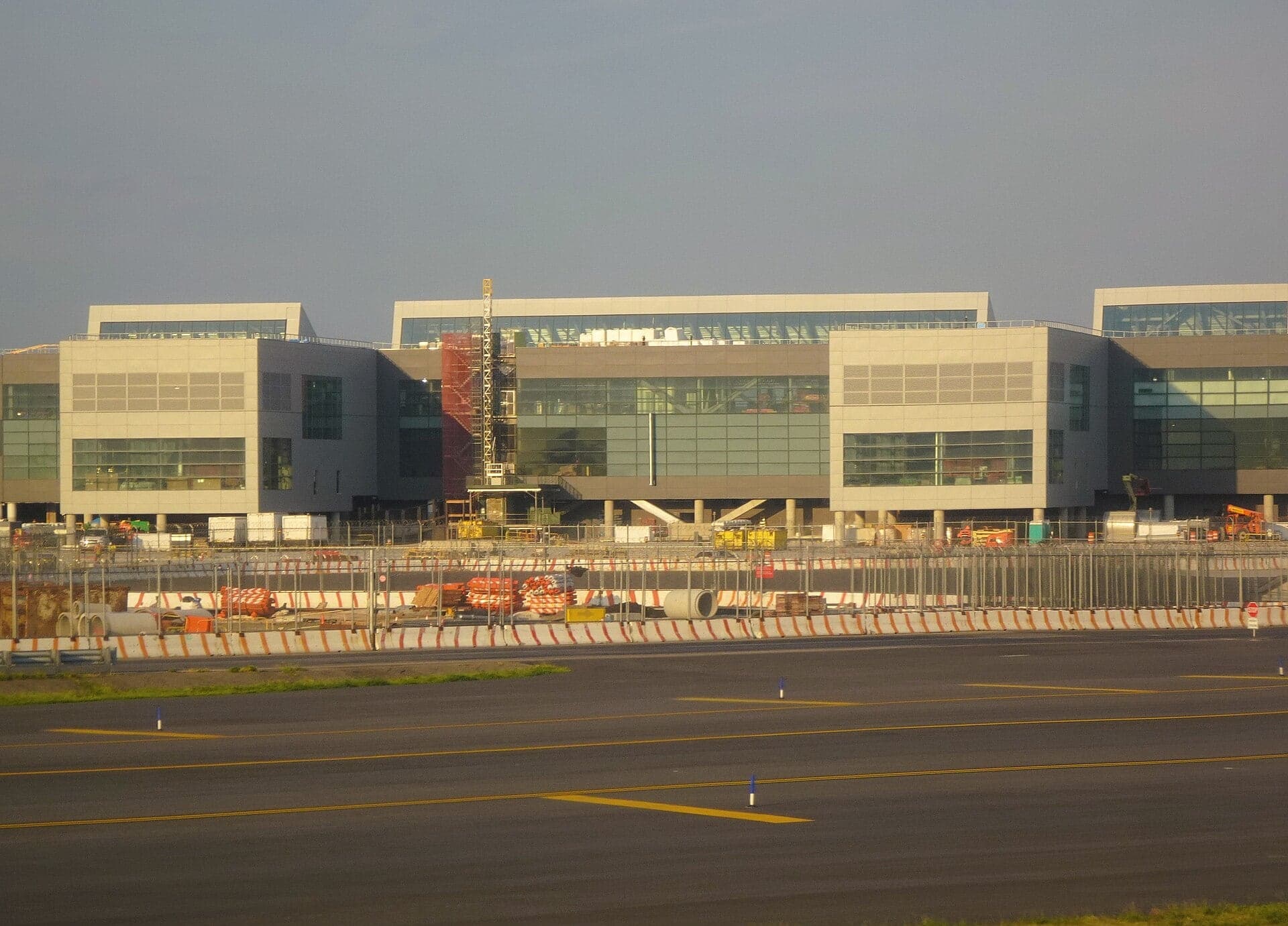
The centrepiece is the New Terminal One, on the south side of the central area. Under an agreement revised in December 2021, a private consortium is building a 2.4-million-square-foot international terminal for $9.5 billion on the sites of the old Terminals 1 and 2, the latter demolished in 2023 to make room. Construction broke ground in September 2022. When complete it will have 23 gates and the capacity for more than 20 million passengers a year, the largest international terminal at the airport. It is opening in three phases; the Port Authority's April 2026 report put the first 14 gates in 2026, with the remaining gates to follow in later phases.
On the north side, JFK Millennium Partners are building a new $4.2 billion, 1.2-million-square-foot Terminal 6 on the site of I. M. Pei's Sundrome, demolished in 2011, and of the present Terminal 7, which will come down for its second phase. It will have ten gates, nine of them for wide-bodies, and is connected airside to JetBlue's Terminal 5 next door. Like the New Terminal One, it opens in phases, with its first gates scheduled for 2026.
The established terminals are being extended at the same time. Terminal 4 has gained ten new aircraft parking positions and an additional baggage claim as Delta and the terminal's operator JFKIAT consolidate there; American completed a $400 million expansion of Terminal 8 in 2022, adding five wide-body gates as British Airways moved in, and a $125 million renovation of its shops and restaurants is due to finish in 2026. When the programme is complete, the airport will have been rebuilt around two new south and north terminal pairs, a simpler road system, and a rebuilt airfield.
Noise and environment
JFK was built by filling in marsh, and it is still surrounded by water. Jamaica Bay, which the Bay Runway reaches into, is a wide tidal estuary of salt marsh and islands, much of it protected as the Jamaica Bay Wildlife Refuge within Gateway National Recreation Area. The refuge draws large numbers of birds, and the risk of collisions between aircraft and gulls, geese and other birds has shaped its operations for decades.
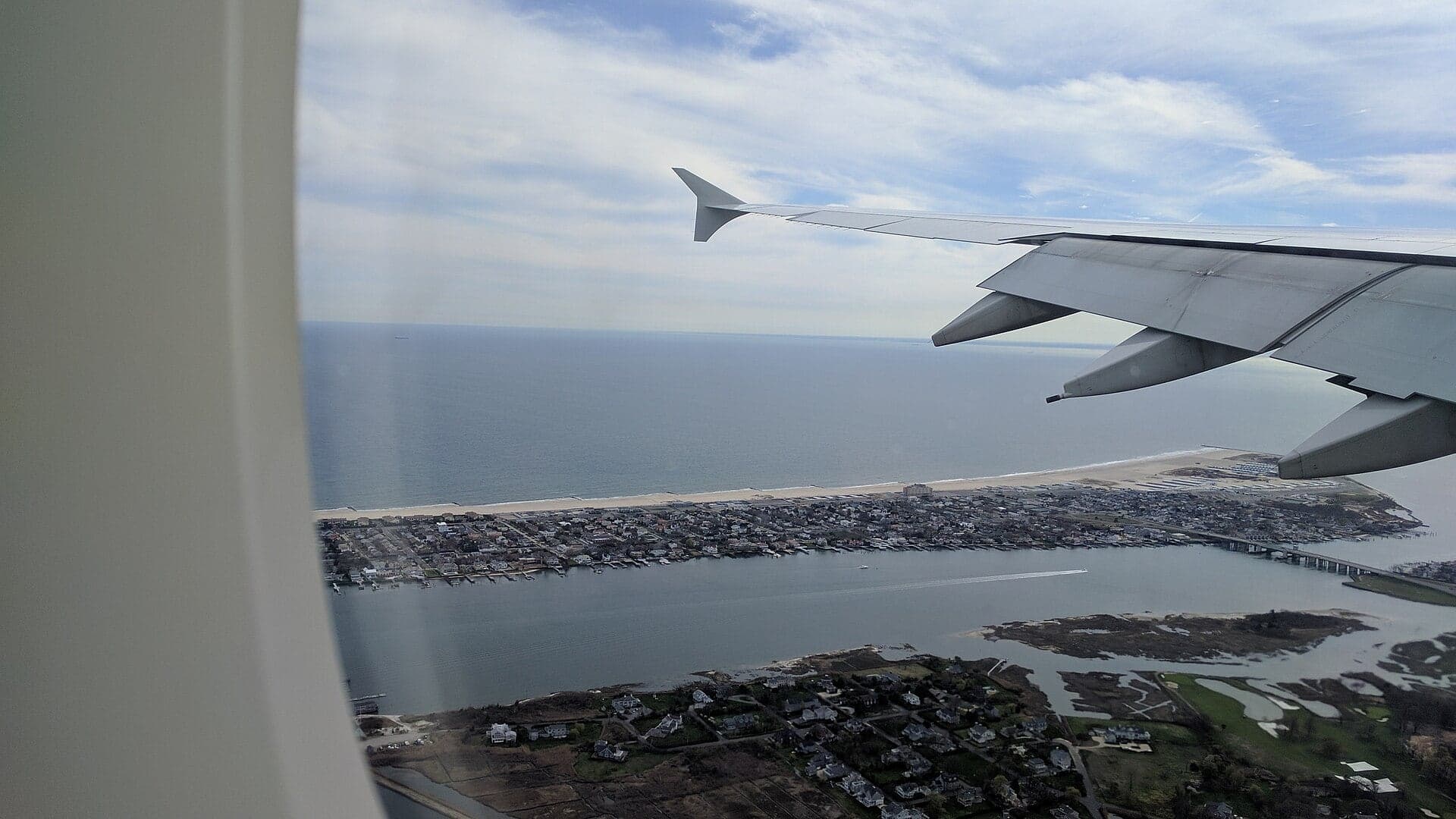
The view from an Air France Airbus A380 from Paris on final approach to JFK in 2017, the wing above the Rockaway shoreline (2017)
Noise has been the other constant. The neighbourhoods around the airport: Howard Beach, Springfield Gardens, Rosedale, Inwood across the Nassau County line, and the Rockaway peninsula under the approaches: lie directly beneath or beside its flight paths, and the arrival of the 707 and then the 747 made JFK a political question for its neighbours. The fight over Concorde in 1976 to 77 was the sharpest form of it: the Port Authority banned the aircraft in March 1976, pending its own noise assessment, and the ban was fought through the federal courts until October 1977.
The current redevelopment has an environmental element of its own. In 2024 the Port Authority began building a 12-megawatt solar canopy with battery storage over the long-term car park, expected to cut greenhouse-gas emissions by about 6,000 tonnes a year and to supply discounted clean power to nearby low-income neighbourhoods as well as to the airport.
Notable events
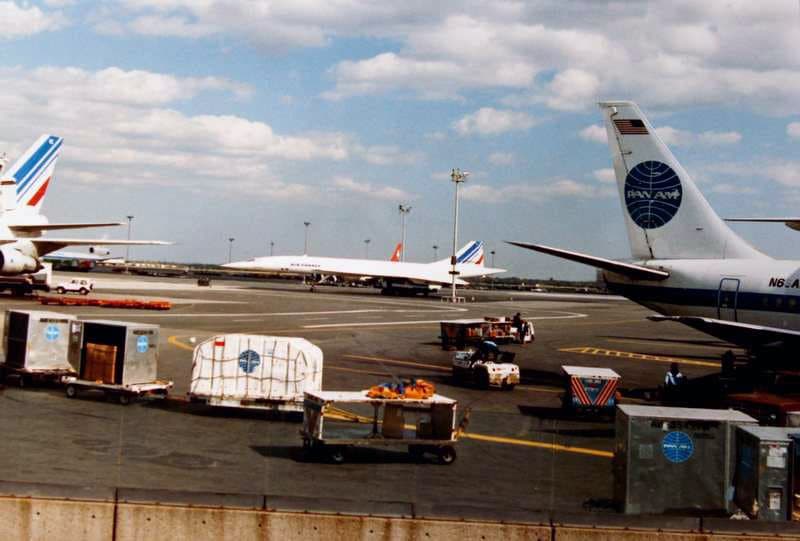
An Air France Concorde on the ramp at JFK around 1987, beside the tail of a Pan Am Boeing 747 and airport ground equipment (1987)
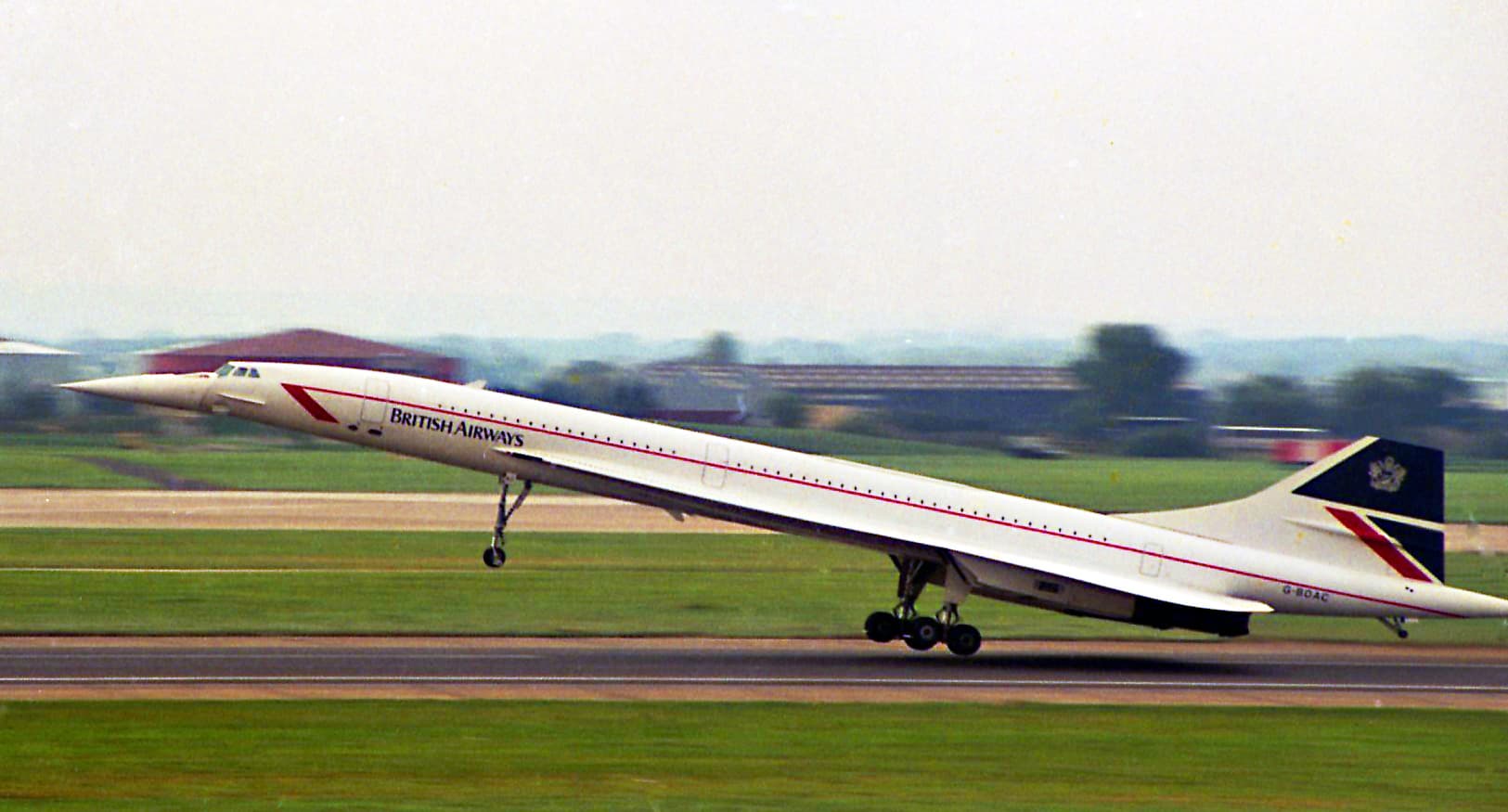
Concorde came to New York only after a year and a half in the courts. The Port Authority barred it from Kennedy in March 1976, citing noise, while the United States government allowed British Airways and Air France to begin services to Washington Dulles. The airlines sued; the case went back and forth through the federal courts until the Supreme Court declined, on 17 October 1977, to keep the ban in place. After noise trials that autumn, scheduled Concorde services from Paris and London to JFK began on 22 November 1977. For the next quarter-century the three-and-a-half-hour crossing made JFK the aircraft's principal destination. Air France ended its Concorde service in May 2003, and the last British Airways commercial Concorde left JFK for Heathrow on 24 October 2003.
The airport has also been the starting or finishing point of some of the worst accidents in American aviation, which are recorded here in outline. On 16 December 1960 a United Air Lines DC-8 inbound to Idlewild collided with a TWA Lockheed Constellation over Staten Island; 134 people died, including six on the ground. On 24 June 1975 Eastern Air Lines Flight 66, a Boeing 727 arriving from New Orleans, struck the approach lights short of runway 22L in a thunderstorm; 113 of the 124 people on board were killed, and the National Transportation Safety Board's investigation made the danger of wind shear from convective storms a central concern of airline safety.
The former Pan Am Worldport as Delta's Terminal 3 in April 2013, weeks before demolition began, its flat saucer roof seen across the AirTrain line (2013)
On 17 July 1996 TWA Flight 800, a Boeing 747 bound for Paris, broke up off Long Island shortly after leaving JFK, killing all 230 on board; the NTSB concluded that a fuel-air explosion in the centre wing tank, most likely ignited by a short circuit, was the probable cause. On 12 November 2001, two months after the September 11 attacks, American Airlines Flight 587, an Airbus A300 bound for Santo Domingo, crashed into the Belle Harbor neighbourhood of Queens moments after take-off; all 260 on board and five people on the ground were killed. The NTSB found that the vertical stabiliser had separated after the first officer's excessive rudder inputs in wake turbulence.
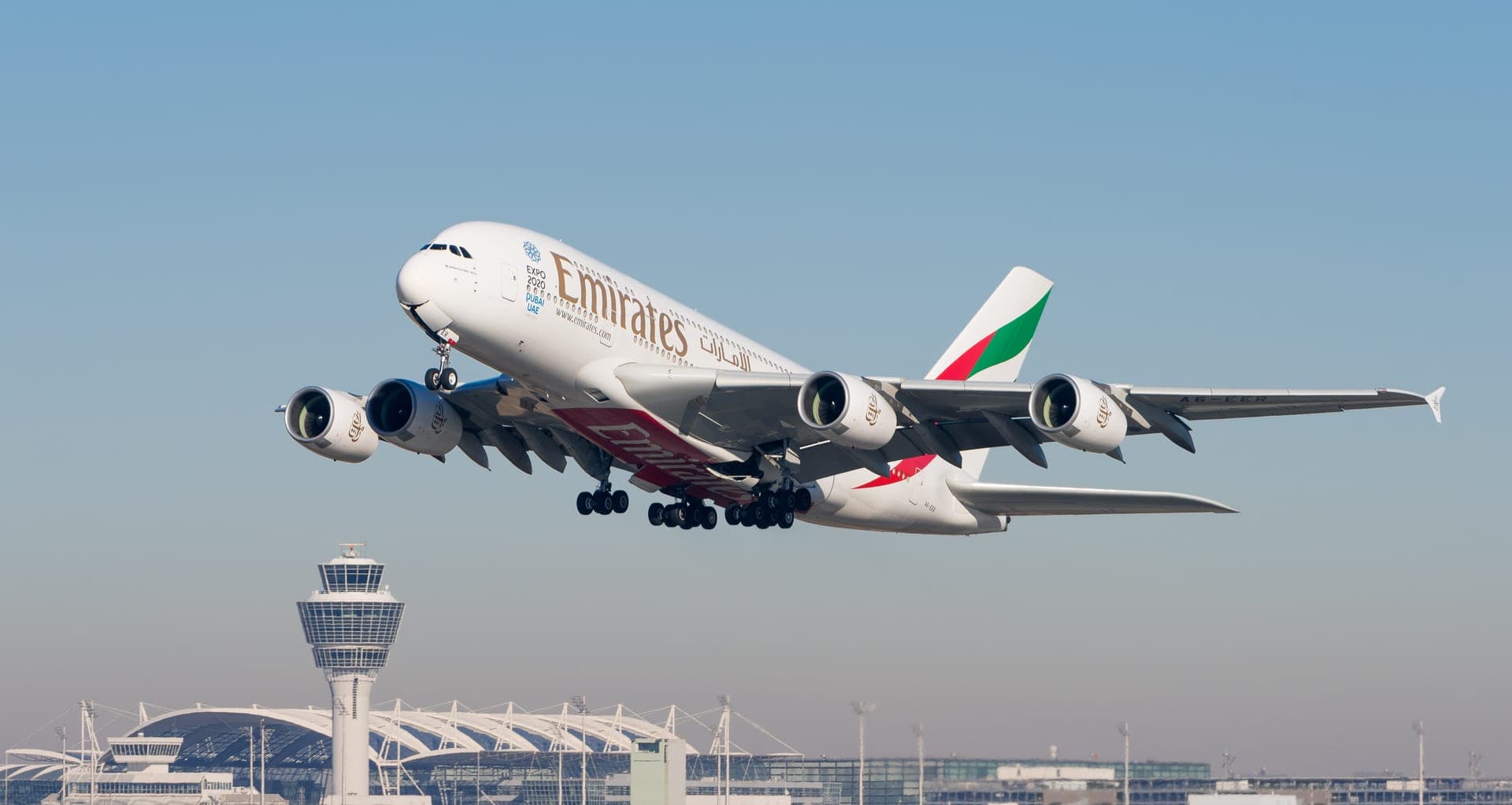
Not every milestone was a disaster. The Beatles' press conference in the International Arrivals Building in February 1964 is one of the defining images of the decade. On 1 August 2008 an Emirates Airbus A380 landed at JFK on the first scheduled A380 service to the United States, a year after the type's first American landing at the same airport.
Place in world aviation
The TWA Flight Center in January 2015, closed and awaiting conversion, its winged roof silhouetted in low evening light above the AirTrain tracks (2015)
JFK's lasting contribution to aviation is an idea that did not quite work and a set of buildings that outlived it. The Port Authority's 1954 decision to let each airline design its own terminal produced a burst of invention unmatched at any other airport, the satellite plan, the umbrella roof, the first generation of elevated boarding walkways, and in the TWA Flight Center one of the few airport buildings to be treated as architecture of the first rank. It also produced an airport that had to be dismantled piece by piece once the airlines that built it merged, failed or moved.
The buildings have fared unevenly. The TWA Flight Center was landmarked in 1994, restored with $20 million of Port Authority preservation work and reopened as a hotel in 2019, where visitors can sit in the sunken lounge and watch aircraft through the same glass walls. The Worldport, which many architects and historians argued deserved the same care, was demolished. The Sundrome, the International Arrivals Building and the first American and United terminals are gone.
The TWA Hotel lobby in 2022, the former terminal's red-carpeted sunken lounge and curved stairs under the vaulted shell (2022)
As a gateway, its place is more secure. For three generations of immigrants, diplomats, touring bands and holidaymakers, JFK has been the first sight of the United States; it served its billionth passenger in 2000, and in 2025 more than a third of the people passing through it were foreign nationals. It was Concorde's principal American destination for twenty-six years, and the first American airport to receive the Boeing 747 in scheduled service and the Airbus A380.
The new terminals rising on the ring will make it a different kind of airport: fewer, larger buildings, each shared by many airlines rather than built for one, and joined by a simplified road network. What they cannot replace is the reason the ring exists. The old airport was built as a competition between airlines; the new one is being rebuilt as a single place.
Runways
13R/31L
13/31 parallels
Length
14,511 ft
Width
200 ft
Surface
Concrete, grooved
The Bay Runway, running out into Jamaica Bay; the airport's longest, rebuilt in concrete between 2010 and 2015 and one of its two principal departure runways.
13L/31R
13/31 parallels
Length
10,000 ft
Width
200 ft
Surface
Concrete, grooved
A principal arrival runway, rehabilitated and widened to 200 ft for $230 million in 2019.
04L/22R
04/22 parallels
Length
12,080 ft
Width
200 ft
Surface
Concrete, grooved
Reconstructed in concrete between 2010 and 2015; the other principal departure runway.
04R/22L
04/22 parallels
Length
8,399 ft
Width
200 ft
Surface
Asphalt, grooved
The shortest runway and the only one not in concrete; a principal arrival runway, rehabilitated for $106 million in 2017.
Terminals
In use
Terminal 1
Opened 1998 · 11 gates
Built by a consortium of foreign airlines and opened in 1998, it handles international carriers only, 6.1 million passengers in 2025. It is being replaced by the New Terminal One and will close when its successor opens.
New Terminal One
23 gates
A $9.5 billion, 2.4-million-square-foot international terminal under construction since September 2022 on the sites of Terminals 1 and 2, built by a private consortium and designed for more than 20 million passengers a year. It opens in three phases, the first 14 gates scheduled for 2026.
Terminal 4
Opened 2001 · 36 gates
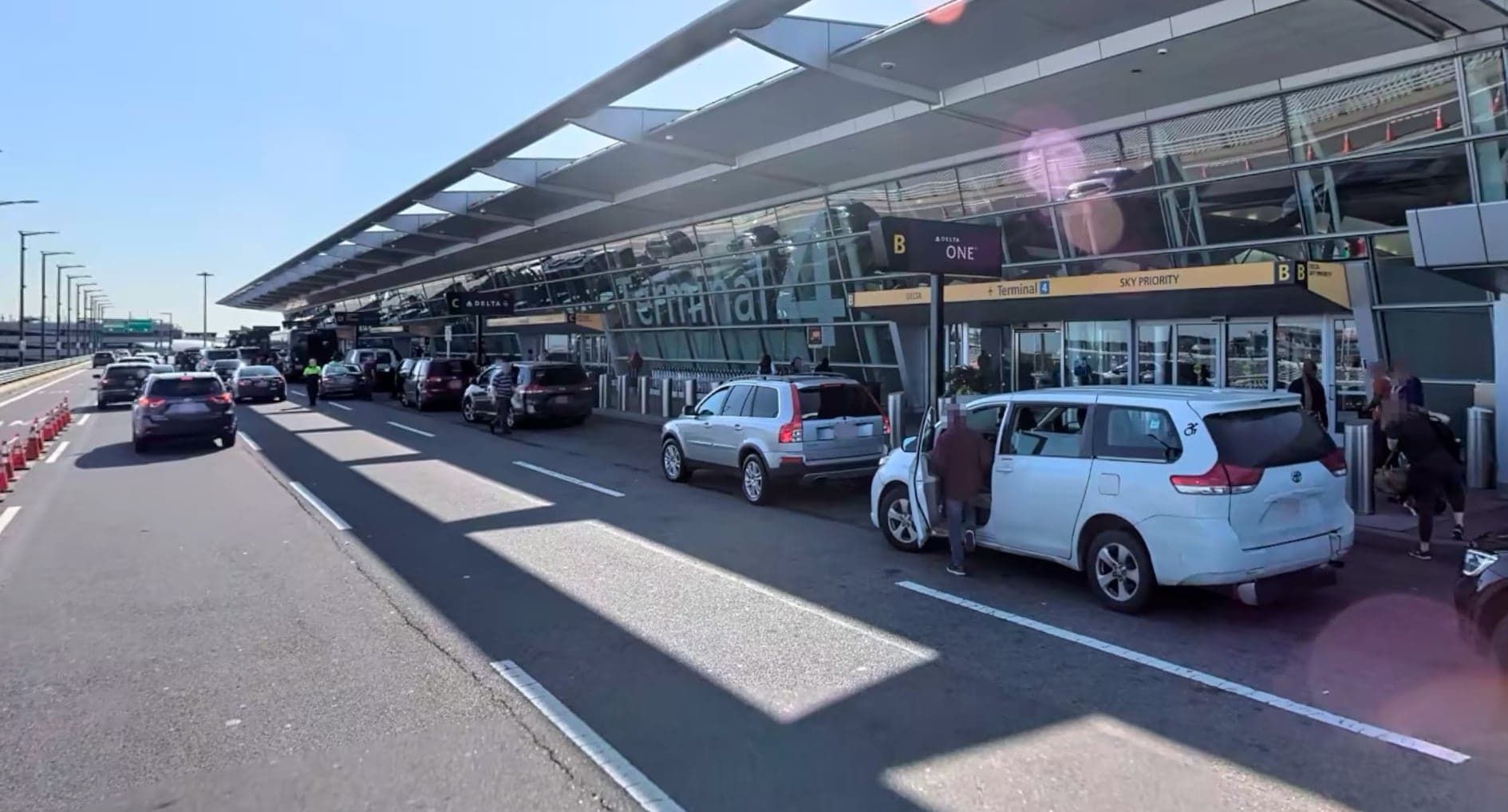
Opened in May 2001 on the site of the International Arrivals Building and run by JFKIAT, it is Delta's hub and the airport's busiest building: 1.5 million square feet, 26.3 million passengers in 2025, and recently extended with ten new aircraft stands.
Terminal 5
Opened 2008 · 29 gates · Design capacity 20 m passengers a year
JetBlue's home, opened in 2008 behind the TWA Flight Center and jointly financed with nearly $800 million from the Port Authority; an international arrivals extension, T5i, followed in 2014. It handled 14.3 million passengers in 2025.
New Terminal 6
10 gates
A $4.2 billion, 1.2-million-square-foot terminal developed by JFK Millennium Partners on the sites of the old Terminal 6 and the present Terminal 7, with ten gates, nine for wide-bodies, and an airside link to Terminal 5. It opens in phases, the first gates scheduled for 2026.
Terminal 7
Opened 1970
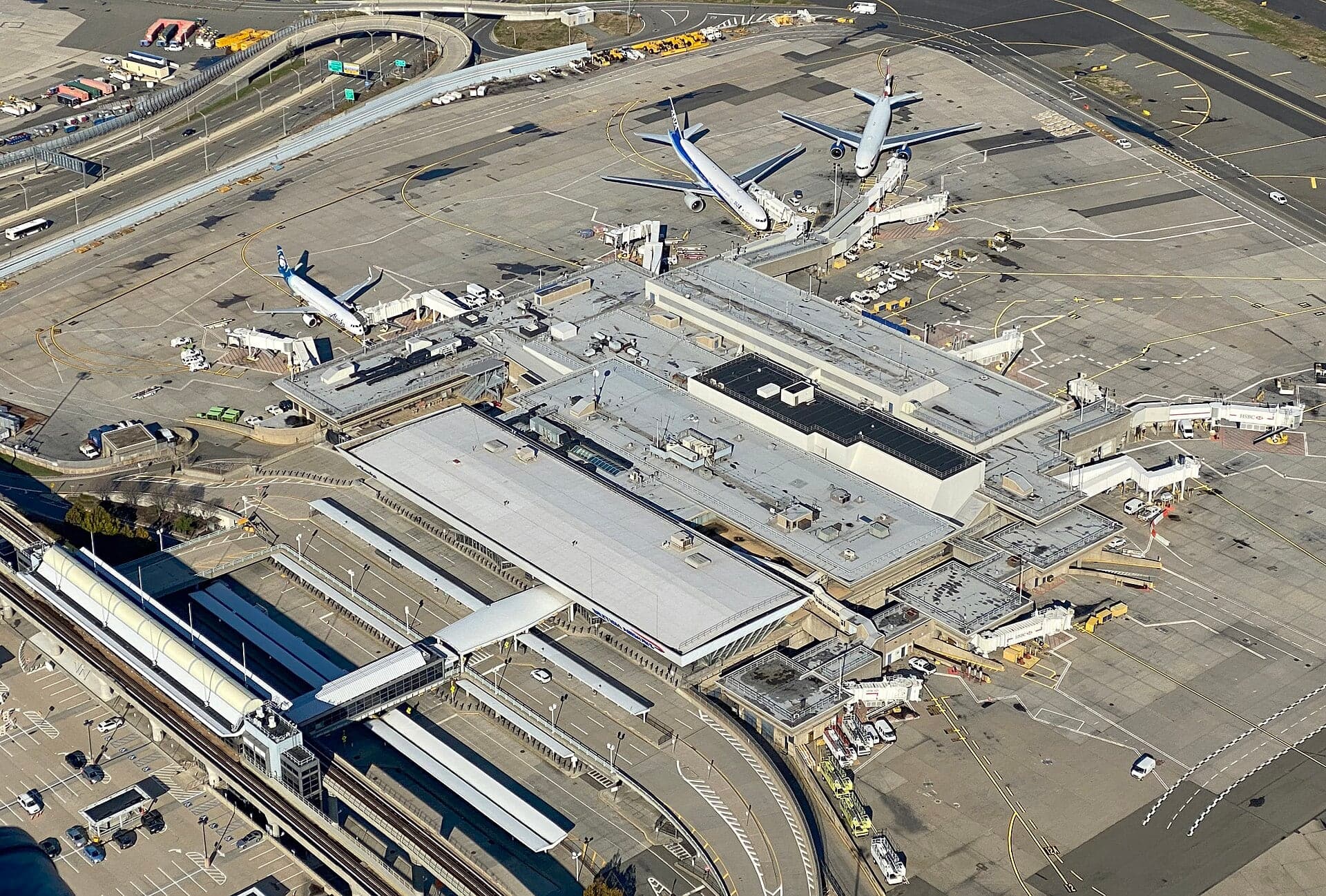
Built for British Airways and opened in 1970. After BA moved to Terminal 8 it housed a mix of domestic and international carriers: 4.4 million passengers in 2025: and it is to be demolished for the second phase of the new Terminal 6.
Terminal 8
Opened 2007
American Airlines' terminal, opened in 2007 in place of the old American and United buildings. A $400 million expansion completed in 2022 added five wide-body gates and premium facilities as British Airways joined American there. It handled 11.6 million passengers in 2025.
Closed
Terminal 2
1962–2023
Opened in 1962 for Northeast, Braniff and Northwest, later used by Delta. After sixty years in service it closed and was demolished in 2023 to clear ground for the New Terminal One.
Terminal 3
1960–2013 · Originally Pan Am Worldport · Tippetts-Abbett-McCarthy-Stratton
Pan Am's terminal, whose cantilevered elliptical roof sheltered aircraft parked nose-in beneath it. Enlarged for the Boeing 747 and renamed the Worldport, it passed to Delta in 1991 and was demolished in 2013 to 14.
International Arrivals Building
1957–2001 · Skidmore, Owings & Merrill
The Port Authority's own centrepiece of Terminal City, where most foreign airlines' passengers arrived for more than forty years and where the Beatles gave their first American press conference in 1964. Replaced by Terminal 4.
TWA Flight Center
1962–2001 · Eero Saarinen & Associates (Eero Saarinen and Kevin Roche)
Saarinen's concrete-shell terminal for TWA, begun in 1959 and opened in May 1962, a New York City landmark since 1994. Closed as a terminal after TWA was absorbed by American, it reopened in 2019 as the TWA Hotel.
Terminal 6
1970–2008 · Originally National Airlines Sundrome · I. M. Pei & Partners
A glass pavilion built for National Airlines, later used by other carriers and finally by JetBlue until Terminal 5 opened. Demolished in 2011; its site is part of the new Terminal 6.
Getting there
AirTrain JFK
since 2003
A driverless light-rail line looping through the terminals, with branches to Howard Beach for the A subway line and to Jamaica for the E, J and Z lines and the Long Island Rail Road. It carried a record 27 million riders in 2025.
Road
The Van Wyck Expressway leads into the central terminal area from the north and the Belt Parkway runs along the airport's edge. Inside the central area a $1.24 billion rebuild of the roads, with a new ground transportation centre and garage, has been under way since 2023. Taxis, ride-shares, coaches and hire cars serve all terminals; about 10,600 public parking spaces are available.
Timeline
1942
Construction begins at Idlewild
The City of New York begins building a new airport on marshland in southern Queens, on land that includes the Idlewild Golf Course.
June 1, 1947
The Port Authority takes over
The Port Authority begins operating the unfinished airport under a lease with the city.
July 1948
New York International Airport opens
Commercial flights begin, using a temporary terminal building and control tower.
1957
International Arrivals Building opens
The first building of the Terminal City plan, by Skidmore, Owings & Merrill.
October 1958
The first American transatlantic jet service
Pan Am begins Boeing 707 flights across the Atlantic from Idlewild.
May 1962
TWA Flight Center opens
December 24, 1963
Renamed for John F. Kennedy
A month after the president's assassination, the airport is rededicated as John F. Kennedy International Airport.
January 22, 1970
The first Boeing 747 service
Pan Am flies the first commercial 747 service, from JFK to London Heathrow.
June 24, 1975
Eastern Air Lines Flight 66
A Boeing 727 crashes on approach in a thunderstorm; 113 people are killed.
November 22, 1977
Concorde services begin
After the Port Authority's ban is overturned in the courts, Air France and British Airways start scheduled Concorde flights to JFK.
1994
New control tower; TWA terminal landmarked
The 321 ft tower opens, and the TWA Flight Center is designated a New York City landmark.
May 2001
Terminal 4 opens
October 24, 2003
The last Concorde leaves JFK
British Airways flies its final commercial Concorde service from JFK to Heathrow.