Airline
American Airlines
AA · AAL · AMERICANUnited StatesAmerican Airlines Group
American Airlines, Inc.
1,013
Aircraft
In service at December 31, 2025
224M
Passengers
in 2025
Identity
- IATA
- AA
- ICAO
- AAL
- Callsign
- AMERICAN
- Founded
- 1930
Company
- Legal name
- American Airlines, Inc.
- Headquarters
- Fort Worth, Texas
- Country
- United States
- Parent
- American Airlines Group
- Status
- Operating
Network
- Alliance
- Oneworld, founding member (1999)
- Load factor
- 83.6 %
Hubs and bases
Dallas/Fort Worth International AirportDFW
Hub
Charlotte Douglas International AirportCLT
Hub
Chicago O'Hare International AirportORD
Hub
Los Angeles International AirportLAX
Hub
Miami International AirportMIA
Hub
John F. Kennedy International AirportJFK
Hub
LaGuardia AirportLGA
Hub
Philadelphia International AirportPHL
Hub
Phoenix Sky Harbor International AirportPHX
Hub
Ronald Reagan Washington National AirportDCA
Hub
American Airlines is the mainline carrier of American Airlines Group, a Delaware holding company run from 1 Skyview Drive in Fort Worth, Texas, beside the airport that has shaped it more than any other. It is a founding member of the oneworld alliance and it flies from ten hubs, Dallas/Fort Worth, Charlotte, Chicago O'Hare, Los Angeles, Miami, New York Kennedy and LaGuardia, Philadelphia, Phoenix Sky Harbor and Washington National, supported by partner gateways at London, Doha, Madrid, Seattle/Tacoma, Sydney and Tokyo. No other airline in the world operates so many connecting complexes at once, and the difficulty of doing so is the argument that runs through the whole of its history.
The scale is easier to state than to picture. In 2025 approximately 224 million passengers boarded American's flights, on a network of more than 350 destinations; the group flew 250,294 million revenue passenger miles at a passenger load factor of 83.6 per cent. As of 31 December 2025 American operated 1,013 mainline aircraft, with a further 567 regional aircraft flown under the American Eagle brand by wholly-owned and contracted carriers, and employed approximately 139,100 full-time equivalent staff. Total operating revenues for 2025 were $54.633 billion and net income was $111 million: a margin of about two-tenths of one per cent, which is the other thing that runs through the whole of its history.
American is not a company that grew outward from a single founder's aeroplane. It is an accumulation: more than eighty small operators gathered into a holding company at the end of the 1920s, rebuilt after the air mail scandal of 1934, enlarged by the purchase of Trans World Airlines in 2001 and again by the merger with US Airways in 2013. The group itself dates American's founding to 1934 and traces its roots to an air mail carrier flying in the Midwestern United States in 1926. Almost every part of the modern airline can be followed back to one of those absorbed companies, and the seams still show, in the fleet, in the hub map, and in the labour agreements.
Formation
The oldest thread in American's genealogy is the Robertson Aircraft Corporation, formed in Missouri in 1921 and awarded Contract Air Mail Route 2, St Louis to Chicago, which it began flying on 15 April 1926 with Charles Lindbergh as its chief pilot. American Airlines Group's own filings put it exactly that way: American's roots trace back to an air mail carrier operating in the Midwestern United States in 1926. That is the legal ancestry of a company that now carries more people than any other, and it is worth stating plainly, because the airline did not grow out of a demand for passenger travel. It grew out of a federal decision to buy a national air network with postal money.
Robertson was one of dozens of such contractors, most of them undercapitalised and flying over short routes. In 1929 the Aviation Corporation, AVCO, a holding company assembled by the financier W. Averell Harriman and others: began buying them, and by 1930 it controlled interests in more than eighty small aviation companies. On 25 January 1930 those flying operations were consolidated into a single operating company, American Airways, Inc. It was a corporate structure before it was an airline: a collection of unconnected route fragments under one owner, with no coherent system and no reason for the pieces to fit together.
What made them fit was Postmaster General Walter Folger Brown. Armed by the Airmail Act of 1930 with the discretion to extend and alter mail routes, Brown convened the meeting of favoured carriers that became known as the Spoils Conference, deliberately excluding smaller operators, and distributed the transcontinental mail contracts among three large groups: the one that became United, the one that became TWA, and American Airways. For American the award was a southern transcontinental route and, with it, the first argument for the company as a connected system rather than a portfolio. The rationalisation worked. The method did not survive scrutiny: Senator Hugo Black's investigation of 1933 led President Roosevelt to cancel every domestic air mail contract in February 1934 and, by Executive Order 6591, hand the mail to the Army Air Corps, with fatal results for the Army's crews.
The reconstruction that followed is where American Airlines, as a name, begins. The Air Mail Act of 1934 rebuilt the system on new terms: holding companies could not own both a manufacturer and an airline, and carriers whose executives had attended Brown's conference were barred from bidding. American Airways was reorganised out from under AVCO's control, renamed American Airlines, Inc. in 1934, and put in the hands of a Texan accountant who had been running its southern division. Cyrus Rowlett Smith, C.R. Smith: became president at the age of 35 and stayed for thirty-four years, in which time, as the museum that carries his name puts it, the company grew from a small and unprofitable carrier into the largest airline in the world. His first strategic conviction was the one that defined the company: that an airline ought to be able to make money carrying people, without the mail.
The war years
The United States entered the war with a civil air transport industry that was small, modern and, for military purposes, exactly what was needed. Two hundred of the country's 360 airliners, the DC-3s above all, were drafted and placed under the Air Transport Command, formed in June 1942 on the order of General Henry H. Arnold to unify civil and military air transport. The ATC's two tasks were to move supplies and people between the United States and the combat theatres, and to ferry new aircraft from the factories to where they were needed.
The airlines supplied more than aeroplanes. Their pilots and crews, many already reserve officers, brought the one thing the Army did not have: practical experience of operating a scheduled service over long distances, at night and in weather, to a timetable. American's own contribution was its president. C.R. Smith was commissioned and served as executive officer of the Air Transport Command alongside Generals Robert Olds and Harold George, leaving the airline for the duration and returning as a major general. By the end of the war the ATC operated 3,700 aircraft with 209,000 military and 104,000 civilian personnel; in July 1945 alone it delivered 100,000 tons of cargo and carried 275,000 passengers.
The consequences for American were commercial as well as patriotic. The war built a generation of airline pilots, navigators and mechanics at government expense, proved long-range airline operation on a scale no peacetime market would have justified, and left behind airfields, radio aids and weather services that the postwar network was built on. The ATC itself lasted until 1 June 1948, when it was merged into the Military Air Transport Service in time for the Berlin airlift: an operation run on exactly the principles the airlines had taught it.
Growth and expansion
Smith's answer to the passenger question was an aeroplane that did not yet exist. He pressed Donald Douglas to build a sleeper version of the DC-2 with a wider fuselage, and the resulting Douglas Sleeper Transport first flew on 17 December 1935, the thirty-second anniversary of the Wright brothers' first flight. The day-seat version of the same machine was the DC-3. American began Flagship service with it on 26 June 1936, with simultaneous ceremonies at Newark and at Chicago's Midway, and the economics of the industry changed: the DC-3 made it possible to earn a profit carrying passengers alone, without a mail contract underneath. The C.R. Smith Museum at Fort Worth is built around a 1940 DC-3 restored by American's own retired pilots and staff, which is a fair measure of what the type meant to the company.
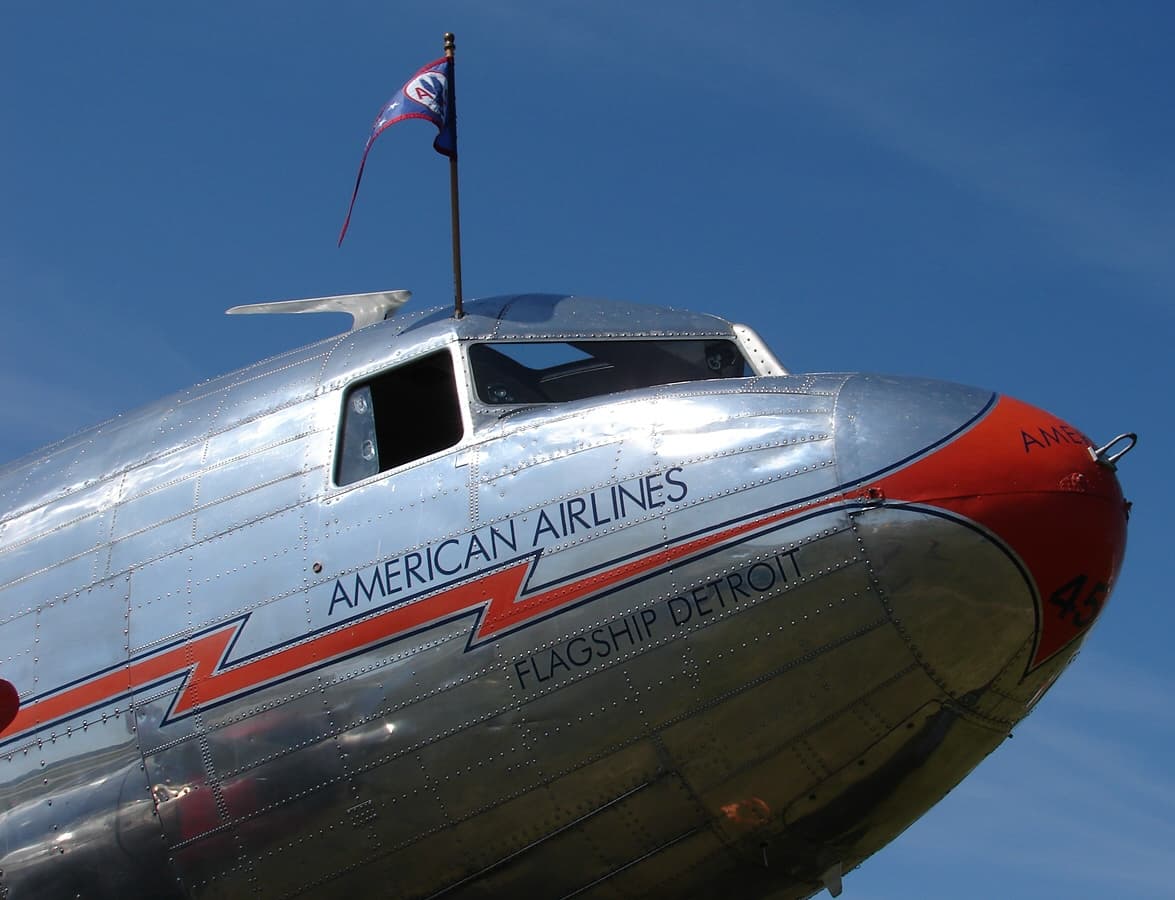
With the DC-3 came a vocabulary that the airline still uses. Aircraft were Flagships, each named for a city, Flagship Illinois, Flagship New York, Flagship Detroit. The first Admirals Club opened in 1939, and the nautical conceit that started as a marketing device in the 1930s survives today in the Flagship Lounge and the Flagship cabins. Few airlines have kept a brand language that long, and none has kept one invented for a propeller-driven airliner.
Peacetime expansion resumed in 1945 with pressurised four-engined equipment: the Douglas DC-6 from 1947 and the DC-7 from 1953, the latter giving American the first scheduled non-stop transcontinental service in both directions. The airline also briefly reached across the Atlantic. American Export Airlines, acquired and renamed American Overseas Airlines, flew to Europe from 1945 until 1950, when it was sold to Pan American: a decision that kept American a domestic carrier for another generation and left the international map to competitors who would later be absorbed or would fail.
The domestic map, meanwhile, was being drawn by regulation rather than by the airline. Until 1978 every route and every fare was a matter for the Civil Aeronautics Board, and an airline grew by applying for authority rather than by deciding where to fly. American's growth in this period was therefore incremental and political, and the company that emerged into deregulation was large, densely unionised, and structurally unprepared for competition on price.
The jet age
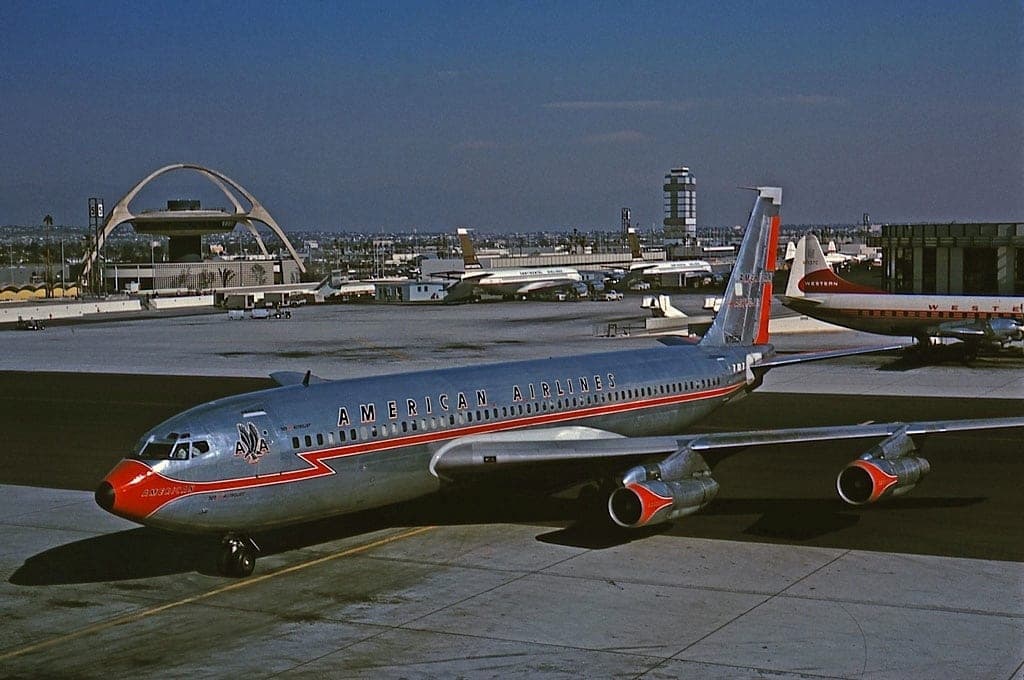
American opened the jet age in the United States on 25 January 1959, when it began the first scheduled transcontinental jet passenger service with the Boeing 707-123. Flagship California left Los Angeles at 6.58 a.m. Pacific time and reached New York Idlewild in four hours and three minutes: roughly half the time a DC-7 needed, and enough to make a coast-to-coast day trip conceivable for the first time. The airline marketed its 707s and Convair 990s as Astrojets, and within a decade the piston fleet was gone.
The more consequential machine of the period was not an aeroplane. Selling half again as many seats at twice the speed broke a reservations system run on card files and telephone calls, and American's answer, developed with IBM from a conversation between C.R. Smith and an IBM salesman on one of the airline's own flights, was Sabre. Built on technology derived from the SAGE air-defence project, the network went live across the country in 1964, linking some 1,500 terminals in 65 cities and returning the status of any flight in under three seconds. It was then the largest commercial real-time data-processing system in the world. Sabre gave American a structural advantage that lasted thirty years, was eventually spun off as a separate company, and is the direct ancestor of the global distribution systems through which most of the world's air tickets are still sold.
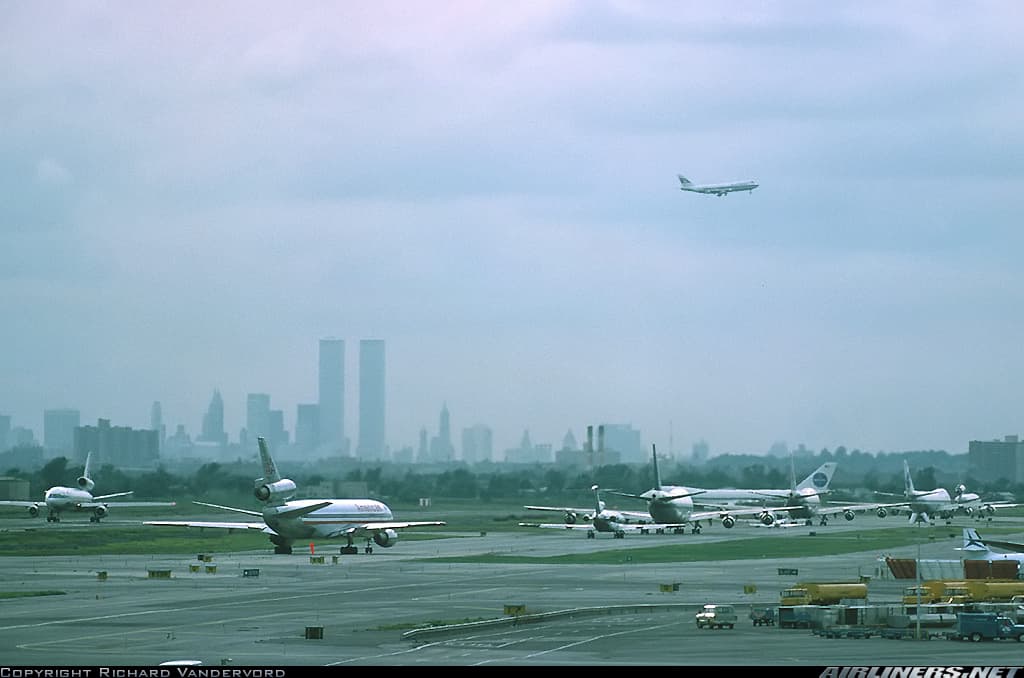
Widebodies arrived at the turn of the 1970s. American ordered the Boeing 747 and flew it on domestic trunk routes, and it launched the McDonnell Douglas DC-10 into service on 5 August 1971 between Los Angeles and Chicago. The DC-10 became the airline's long-haul workhorse and, in 1984, the reason for one of the odder transactions in airline history: American traded its 747 fleet to Pan American in exchange for Pan Am's DC-10s, simplifying its own operation and handing a struggling competitor an aircraft it could not afford to buy.
In 1979 the airline moved its headquarters from New York to Fort Worth, next to the enormous new Dallas/Fort Worth airport that had opened in 1974. The move looks administrative and was not. It committed American to a hub in the centre of the country, at a field with the room to grow that its eastern bases did not have, at precisely the moment when deregulation was about to make the hub, rather than the route, the unit of airline strategy.
Supersonic service
American was, on paper, a supersonic airline. It held options on four Concordes from 7 October 1963 and on two more from 16 January 1964, placing it among the crowd of Western carriers that reserved delivery positions in the early 1960s on the assumption that the transition from propellers to jets would repeat itself from jets to Mach 2. The American domestic programme, the Boeing 2707, was cancelled by Congress in 1971; the Anglo-French aircraft flew, but by the early 1970s traffic growth had flattened, fuel had not yet become expensive but airline balance sheets had already deteriorated, and the overland sonic boom had closed the transcontinental routes on which a US carrier would have had to earn the aircraft's keep.
American cancelled both sets of Concorde options in February 1973, along with almost every other airline outside Britain and France. The episode is worth keeping in view because it is the one strategic bet of the era that American declined and was right to decline: and because the company's actual answer to the same question, arrived at within a decade, was the opposite of speed: more seats, more connections, cheaper fares and a computer that knew what each one was worth.
Consolidation and merger
American's modern shape was assembled in three purchases across fourteen years. The first was small: AMR Corporation, the holding company formed in 1982 as American's parent, bought the California low-fare operator Reno Air in 1999 and folded it in, a transaction chiefly remembered for the pilot sick-out that followed it and the cost of the disruption.
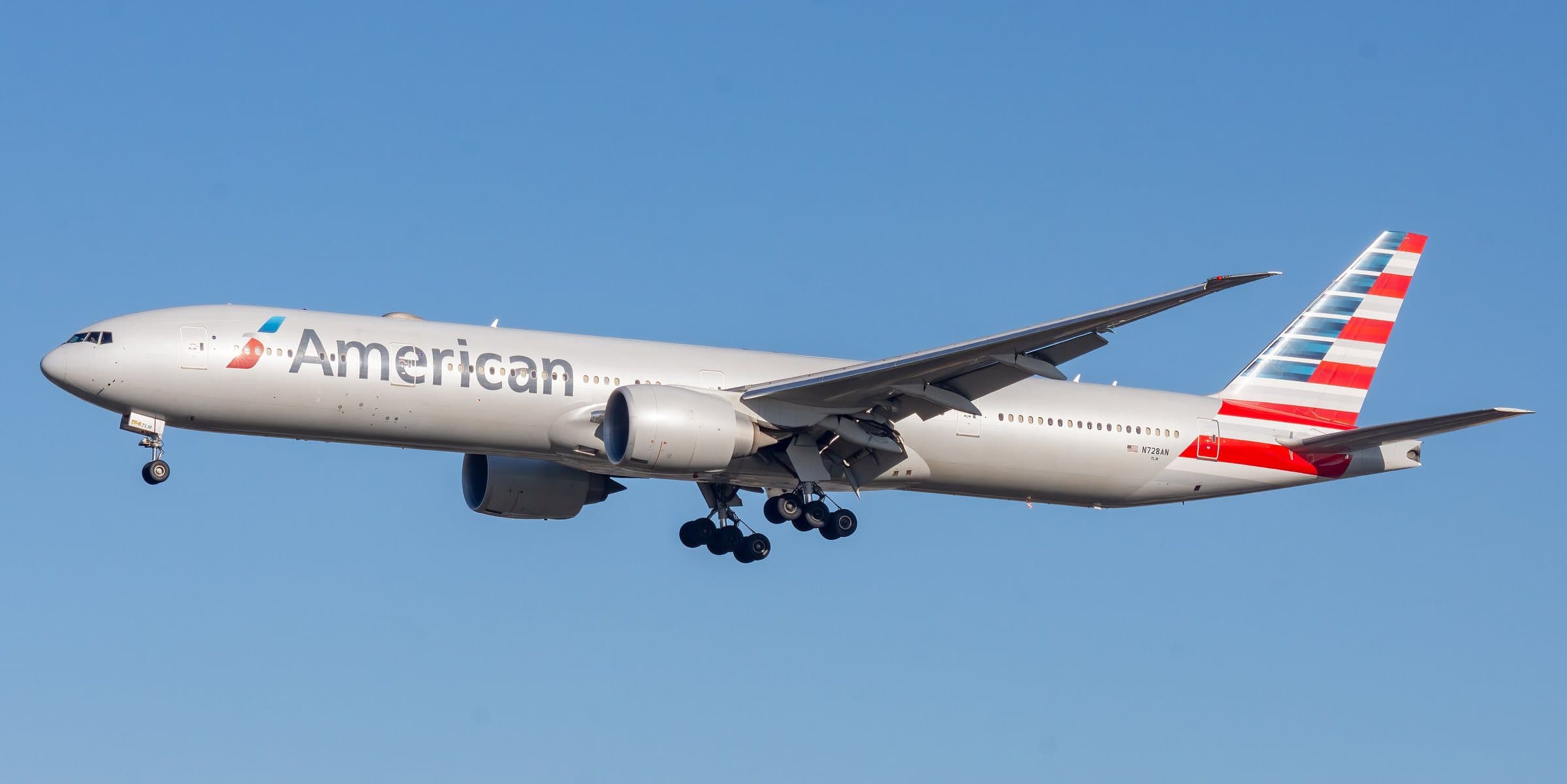
The second was the acquisition of Trans World Airlines, an airline older than American and by then on its third bankruptcy. TWA filed on 9 January 2001 and simultaneously announced American's bid; on 9 April 2001 American acquired substantially all of TWA's assets for approximately $625 million in cash, a figure that included satisfaction of $312 million of debtor-in-possession financing AMR had itself provided. With the assets came the St Louis hub, around 18,000 employees, 173 aircraft, and slots and gates across the network. TWA Airlines LLC flew its last service on 1 December 2001. The integration was overtaken almost immediately by the attacks of 11 September and the collapse in traffic that followed; St Louis was cut back to a spoke within a few years, and the seniority treatment of the former TWA pilots remained a grievance inside the combined airline for more than a decade.
The third transaction was the largest, and American entered it from bankruptcy rather than from strength. AMR Corporation filed for Chapter 11 protection on 29 November 2011, with assets of $24.7 billion against liabilities of $29.6 billion. US Airways, itself the product of a 2005 combination with America West, pursued a merger through the bankruptcy process, and on 9 December 2013 AMR emerged from Chapter 11 and simultaneously completed a $17.0 billion merger with US Airways Group. The combined company took the name American Airlines Group and the American brand, and became, by fleet and by passengers carried, the largest airline in the world.
Putting two airlines of that size into one is a regulatory exercise as much as a commercial one. On 8 April 2015 the Federal Aviation Administration granted the merged carrier a single operating certificate, the point at which two sets of manuals, procedures and callsigns legally become one airline. American's own account of the work gives its dimensions: a team of more than 700 people reviewed 465 manuals, more than 115,000 pages of new policy and procedure were published, and over 110,000 employees were retrained. US Airways was brought into oneworld and the two loyalty programmes were merged into AAdvantage. The reservations systems were cut over later the same year, and the hub map American flies today (Charlotte, Philadelphia, Phoenix and Washington National alongside the older four) is essentially the US Airways network laid over the American one.
Deregulation and decline
The Airline Deregulation Act of 1978 removed the Civil Aeronautics Board's control of routes and fares and exposed a high-cost, heavily unionised company to competitors with neither history. American's president and later chairman, Robert Crandall, spent the following twenty years devising the instruments the whole industry then copied. Discounted advance-purchase fares, sold under restrictions that stopped them cannibalising full-fare business travel, were introduced in the late 1970s and forced every competitor to match them. The AAdvantage frequent-flyer programme followed on 1 May 1981; it was among the first of its kind and it turned Sabre's passenger records into a means of buying loyalty rather than merely filling seats. Yield management: deciding, seat by seat and day by day, how many discounted fares a flight could afford to sell: was built on the same data, and remains the central commercial discipline of the industry.
None of it solved the underlying problem, which was cost. A two-tier wage agreement reached in 1983 allowed American to hire new employees on permanently lower scales, and the airline grew hard through the 1980s on that basis; the arrangement bought a decade and left a workforce divided against itself. An aggressive attempt in 1992 to simplify the industry's fare structure (four fares, no negotiation) was matched by competitors, cut revenue across the board and was abandoned. By the mid-1990s American had stopped growing on purpose.
The 2000s were worse. American lost two aircraft and their crews and passengers in the attacks of 11 September 2001, two months before it lost a third at Belle Harbor; traffic collapsed, insurance and security costs rose, and the airline came within days of filing for bankruptcy in the spring of 2003 before its unions accepted roughly $1.6 billion a year of concessions. Fuel prices then rose through the decade, the low-cost carriers took the domestic short-haul market, and the three legacy competitors (United, Delta and Northwest) restructured through Chapter 11 while American did not, which left it with higher costs than any of them. When AMR finally filed in November 2011 it was the last of the US legacy carriers to do so.
The balance sheet has not fully recovered. American emerged from the merger with the largest debt load of the three surviving US network carriers, and in 2025 the group turned $54.633 billion of revenue into $111 million of net income, an operating margin of 2.7 per cent and a net margin near zero. Its own filings list, at length, the reasons this is structural rather than accidental: fuel price volatility, labour cost, a fleet that must be renewed continuously, and an industry in which capacity is easy to add and hard to withdraw.
Network and hubs
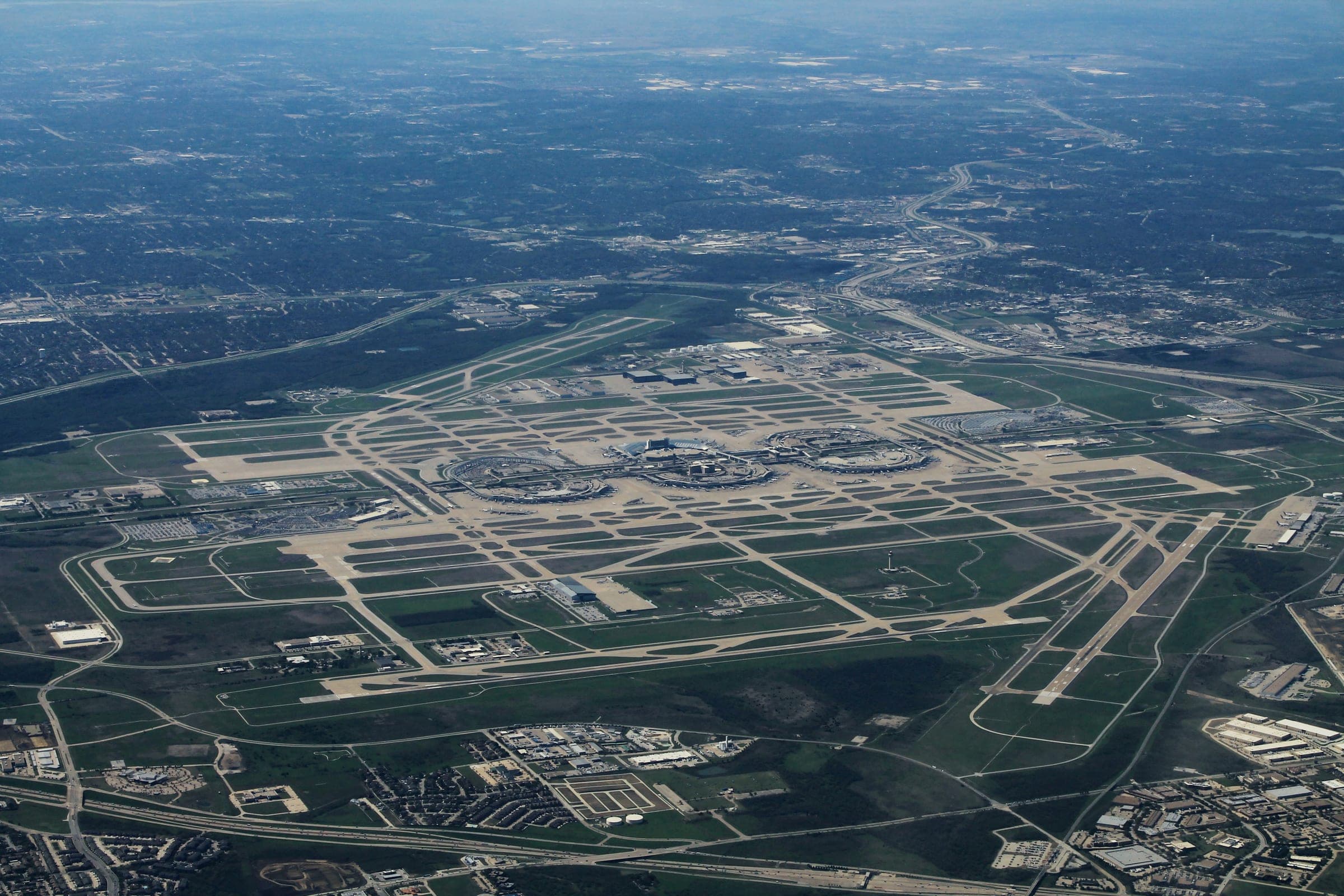
American runs ten hubs, which is more than any other airline attempts, and the count is a direct inheritance from the mergers rather than a design. Dallas/Fort Worth is the largest and the centre of gravity of the whole system; Charlotte, Philadelphia, Phoenix and Washington National came from US Airways; Chicago O'Hare, Los Angeles, Miami and New York, at both Kennedy and LaGuardia, are older. Miami is the group's gateway to Latin America and the Caribbean and is the one hub whose traffic is overwhelmingly international. Beyond its own hubs the airline reaches long-haul markets through partner gateways at London, Doha, Madrid, Seattle/Tacoma, Sydney and Tokyo, where a joint business or an equity partner carries traffic American does not fly itself.
The network served more than 350 destinations as of December 2025, and more than 60 new routes were launched during that year, including transatlantic services to Spain, Italy and Greece. The airline has announced over 20 further routes for 2026, among them its first transatlantic service flown by the Airbus A321XLR, from New York to Edinburgh: a narrowbody aircraft opening a thin long-haul market is the clearest statement of where the network is going next. American is a founding member of oneworld, which brought together fifteen member airlines as of the 2025 report, with Hawaiian Airlines expected to join in 2026.
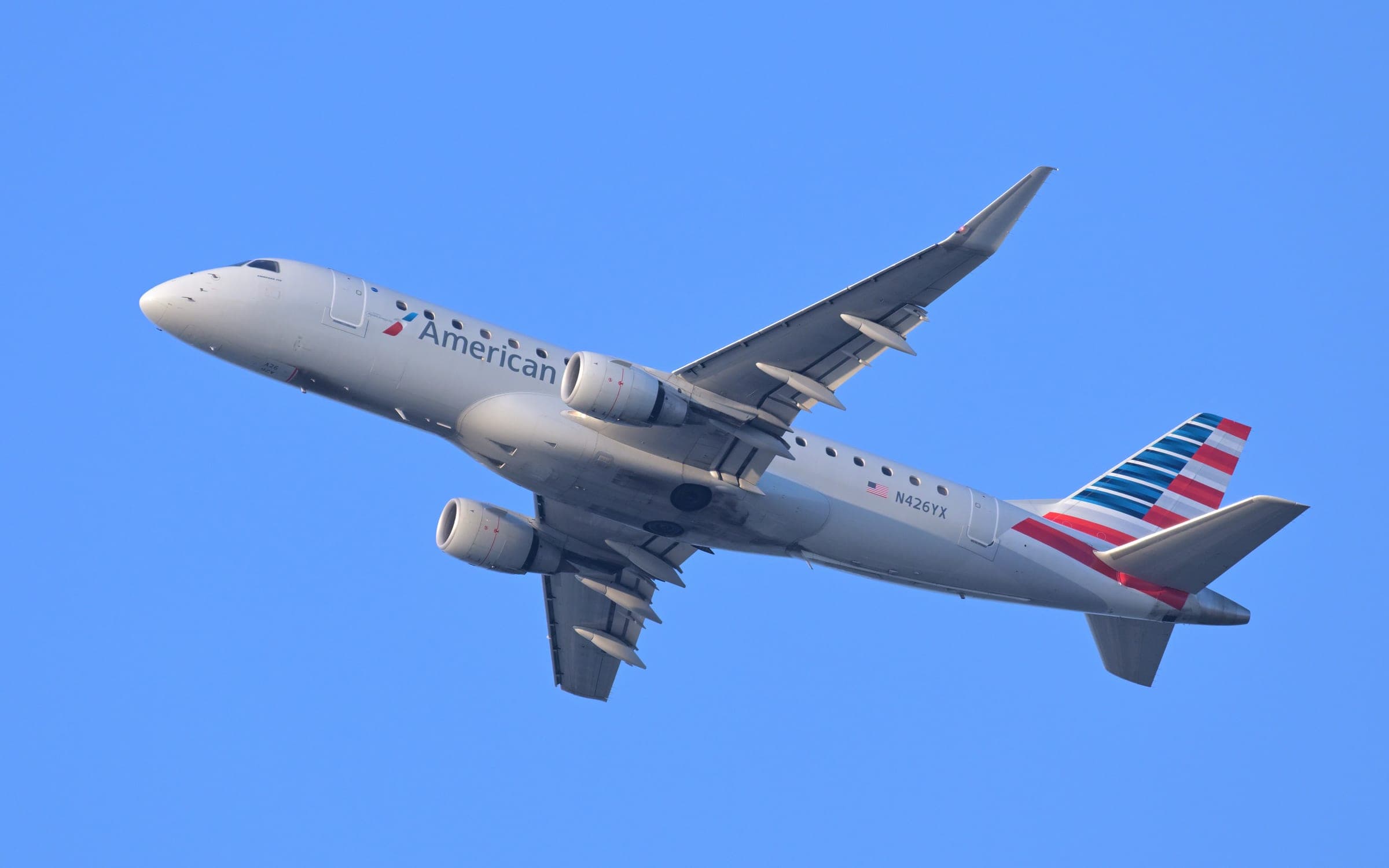
Roughly a third of the group's departures are not flown by American at all. Under the American Eagle brand, the wholly-owned regional carriers Envoy, PSA and Piedmont, together with the contracted operators Republic and SkyWest, flew 567 aircraft as of 31 December 2025 under capacity purchase agreements: the group buys the flying, sets the schedule and takes the revenue and the commercial risk. The regional fleet exists to feed the hubs from markets too small for a mainline jet, and its economics, its pilot supply and its labour agreements are a recurring constraint on how much of the network American can actually operate.
Fleet
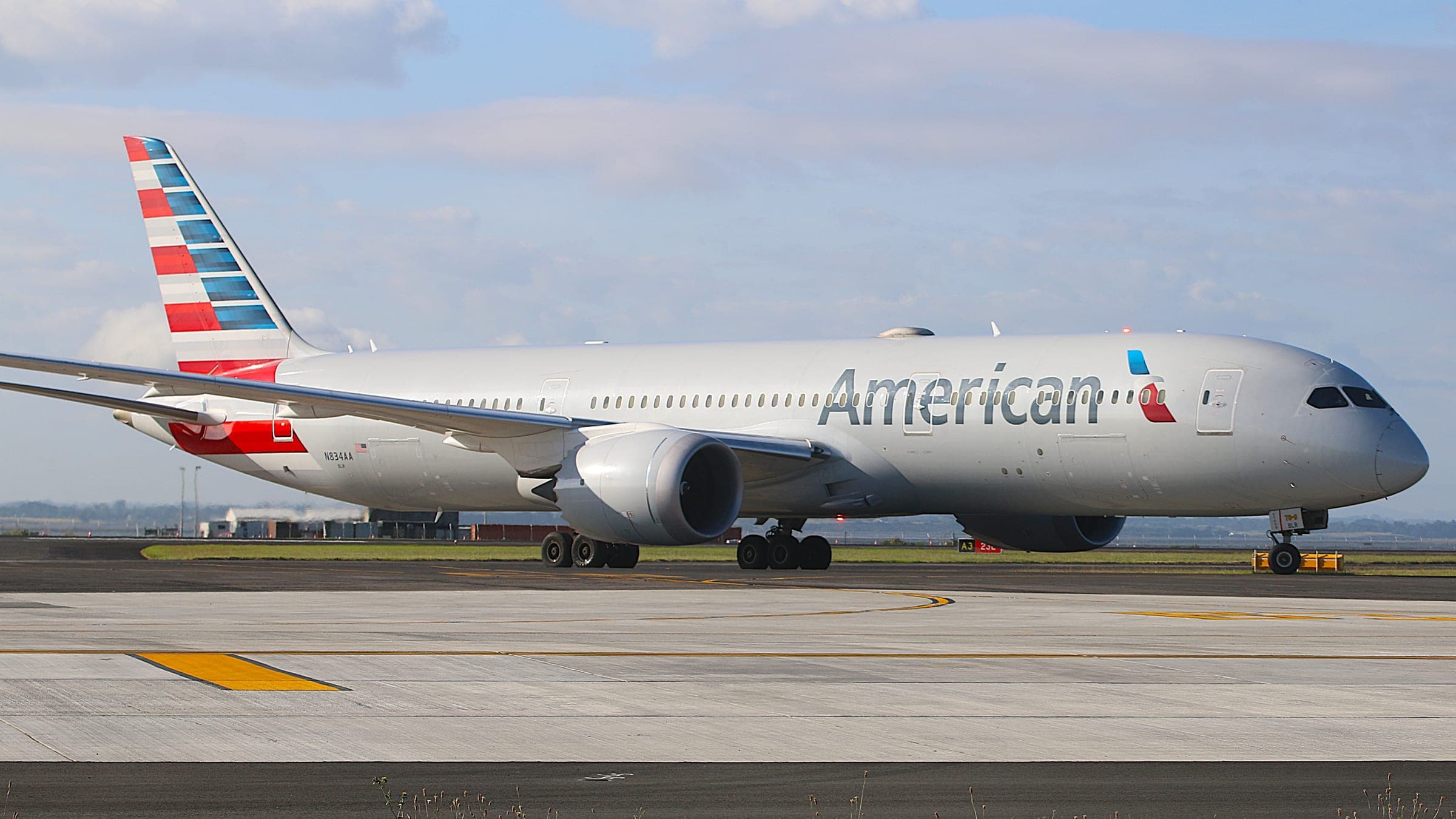
As of 31 December 2025 American operated 1,013 mainline aircraft, of which 547 were owned and 466 leased, at an average age of 14.3 years. The narrowbody fleet is split between the two manufacturers and dominated by two types: 303 Boeing 737-800s and 218 Airbus A321s, with 132 A319s, 89 Boeing 737-8 MAX, 84 A321neos, 48 A320s and the first two A321XLRs behind them. The widebody fleet is entirely Boeing (47 777-200ERs, 33 787-9s, 37 787-8s and 20 777-300ERs) and it is small relative to the airline's size, because American's long-haul exposure is modest next to its domestic and Latin American operation. The 777-200ERs, averaging 25 years old at the end of 2025, are the oldest aircraft on the property and the obvious next replacement problem.
The fleet is renewed continuously rather than in waves. Forty mainline aircraft were delivered during 2025 (23 Boeing 737-8 MAX, 11 Boeing 787-9, five Airbus A321XLR and one A321neo) and one leased aircraft was returned. At the end of the year the group held definitive purchase agreements for 383 further aircraft: 155 of the A320 family, 129 of the 737 family, 19 of the 787 family and 80 Embraer E175s for the regional operation, with 55 of them due in 2026. Forty-seven spare engines were also on order.
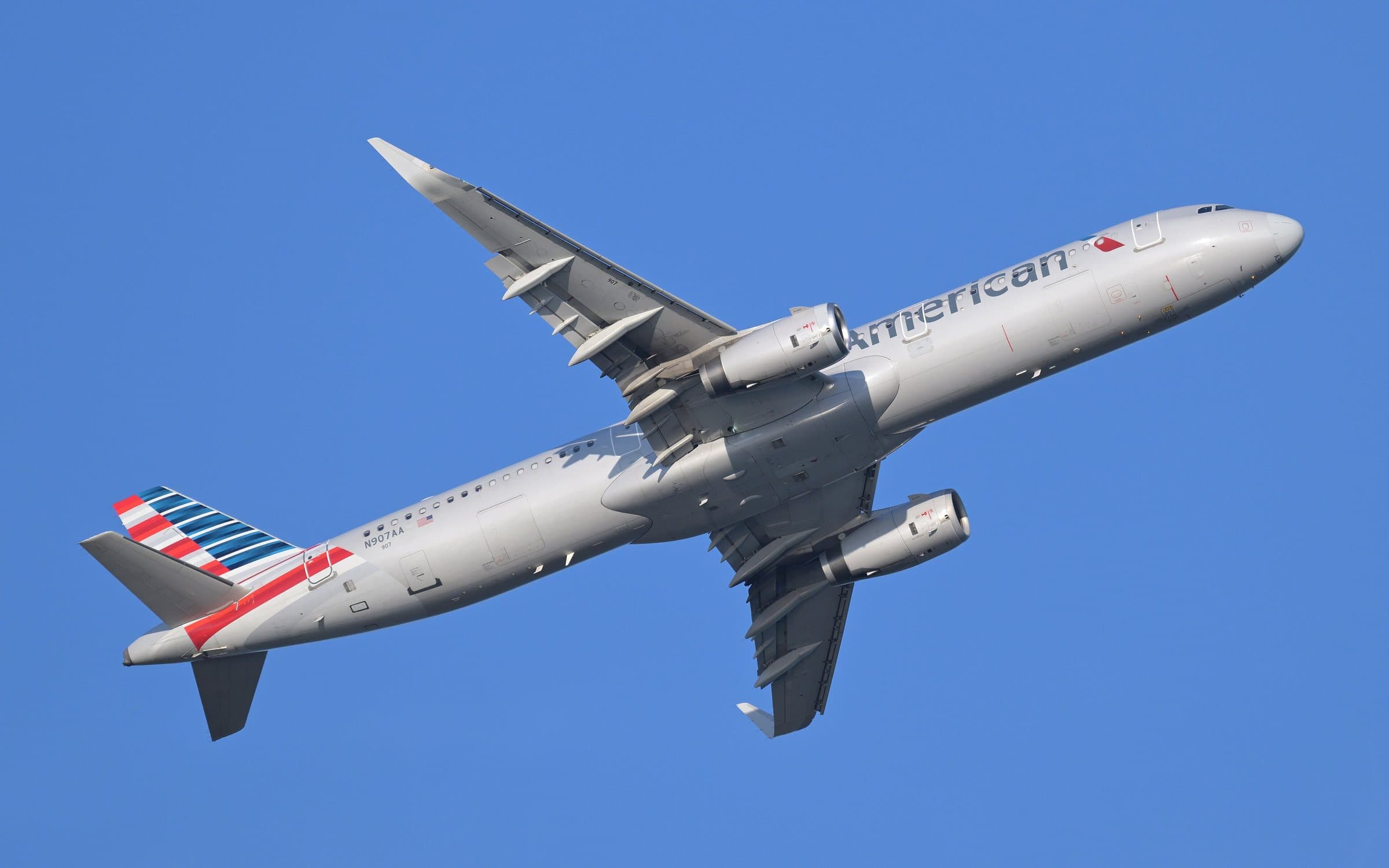
Historically American has been a launch customer or a defining operator more often than the fleet's current uniformity suggests. It forced the DC-3 into existence, opened US transcontinental jet service with the 707, launched the DC-10, and for many years flew the largest fleet of McDonnell Douglas MD-80s in the world: a type it retired on 4 September 2019, ending an association with Douglas narrowbodies that had lasted since the 1930s. The regional fleet is similarly concentrated: 232 Embraer E175s, 122 Bombardier CRJ700s, 86 CRJ900s, 71 ERJ145s and 56 E170s as of the same date.
Cabins and service
American sells four cabins, and the top of the range still carries the name Smith's marketing department invented in 1936. Flagship is the long-haul premium brand: Flagship Business on widebody aircraft, Flagship First (a separate, smaller first-class cabin) on a shrinking number of routes, and Flagship Suite, announced in September 2022 as the new standard for the long-haul fleet, with a privacy door, a chaise-longue seating position and more personal storage. The 787-9s delivered from 2024 carry 51 Flagship Suite seats, the A321XLR carries 20, and 20 Boeing 777-300ERs are being retrofitted with 70 each.
Premium Economy sits below Flagship on long-haul aircraft. American was the first United States airline to offer a true long-haul premium economy cabin, in 2016, and has been enlarging it since: 32 seats on the 787-9, 12 on the A321XLR, 44 on the retrofitted 777-300ER. The airline stated that premium seating across the long-haul fleet would grow by more than 45 per cent by 2026, which is the clearest expression of where airline revenue has moved in the last decade, away from the back of the aircraft.
Short-haul and domestic flying is sold as First, Main Cabin Extra, ordinary seats with additional legroom and earlier boarding, and Main Cabin. On the ground, the lounge network descends directly from the Admirals Club of 1939 and now runs alongside the Flagship Lounge, open to long-haul premium passengers and to the top AAdvantage tiers. The loyalty programme remains a substantial business in its own right rather than a marketing scheme: in 2025 members redeemed approximately 18 million awards, and about 9 per cent of the group's revenue passenger miles were flown on award tickets.
Livery and identity
American's visual identity has changed exactly twice in ninety years, and both changes are still argued about. The nautical language came first, with the DC-3 in 1936: aircraft named Flagships, a club called the Admirals Club, an eagle on the fin. In 1967 Massimo Vignelli gave the airline the identity most people picture: two red and blue As flanking a stylised eagle, set in Helvetica, on an aeroplane left as bare polished aluminium. The unpainted fuselage was not only a design decision; paint is weight, and an airline that did without it saved fuel on every flight for four decades. The result was one of the most recognisable liveries ever flown, and among the few that improved as the aircraft got larger.
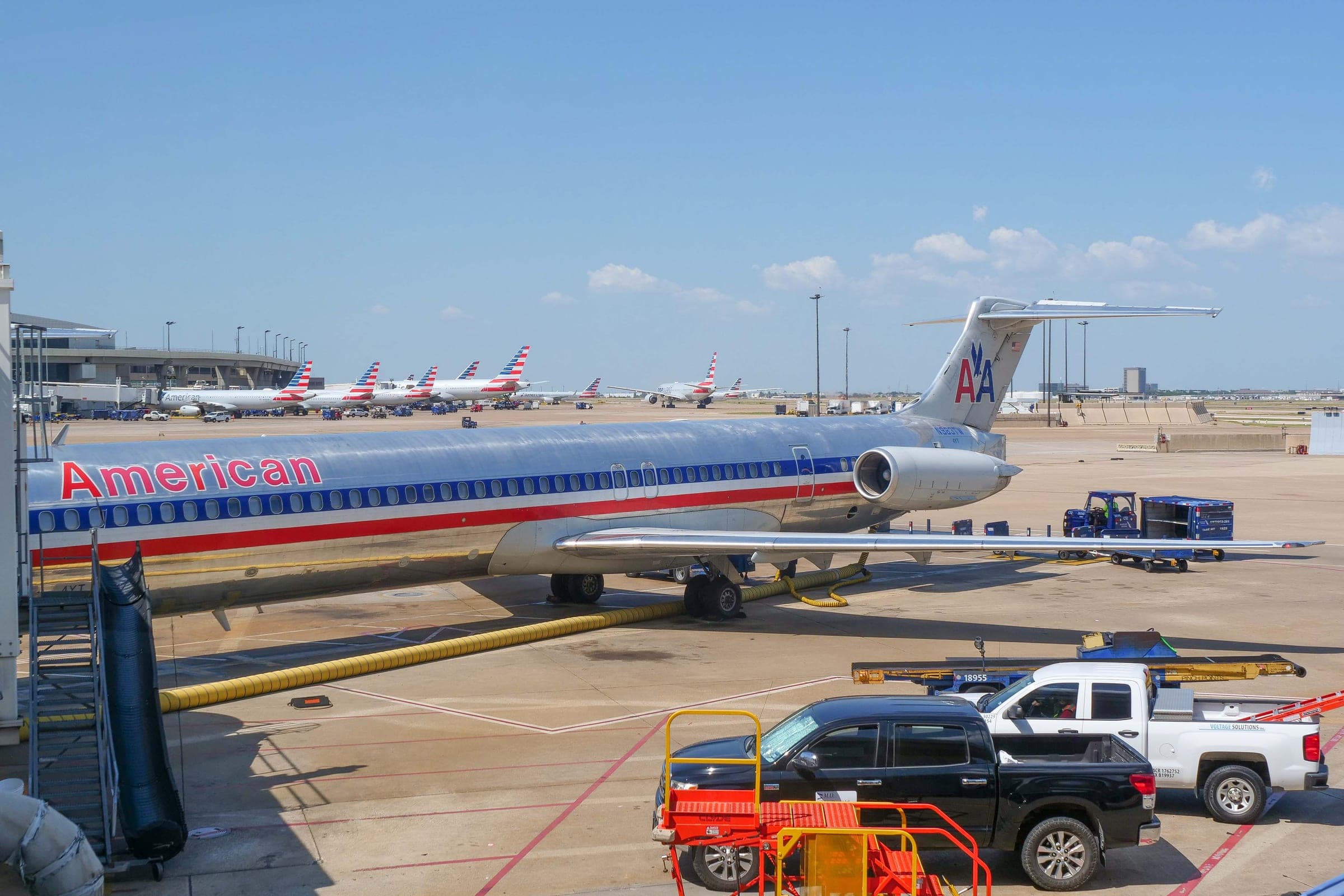
On 17 January 2013, in the middle of the bankruptcy and eleven months before the US Airways merger closed, American unveiled its first new look in more than forty years, designed with the consultancy FutureBrand. The eagle became the abstract flight symbol, incorporating the letter A and a star; the fin carried red, white and blue stripes; and the fuselage, which could no longer be bare metal on composite and modern aluminium airframes, was painted in a silver mica intended to recall the polished silver birds. Vignelli's reaction was public and unenthusiastic. American's employees were given a vote the following year on whether to keep the old tail design instead, and voted to keep the new one.
The company's other identity is the one it does not design. American is among the most heavily unionised firms in the United States: approximately 86 per cent of its roughly 139,100 full-time equivalent employees were represented by unions at the end of 2025: and its labour relations have shaped more of its strategy than its branding ever has. The two-tier wage deal of 1983, the pilots' sick-out of 1999, the concessions of 2003 and the seniority disputes that followed both mergers are not incidents in the corporate story; for most of the last fifty years they have been the corporate story.
Safety record
An airline this large, this old and this American has an accident record that is a substantial part of the public safety literature of the twentieth century. Two of its losses are among the worst in United States history, and both produced changes that outlived the aircraft involved.
On 25 May 1979, American Airlines Flight 191, a McDonnell Douglas DC-10-10, lost its left engine and pylon assembly, along with about 3 ft of the wing leading edge, during takeoff rotation from runway 32R at Chicago O'Hare. The aircraft climbed to about 325 ft, rolled left past the vertical and struck an open field beside a trailer park. All 271 people on board and two on the ground were killed. The National Transportation Safety Board determined the probable cause to be the asymmetrical stall and ensuing roll, caused by the engine separation, which in turn resulted from damage inflicted by a maintenance procedure that removed the engine and pylon as a single unit on a forklift. It remains the deadliest aviation accident to occur on United States soil.
On 12 November 2001, two months after the September attacks in which American lost Flights 11 and 77 and everyone aboard them, Flight 587 took off from New York Kennedy for Santo Domingo and encountered the wake of a preceding Boeing 747. The Airbus A300-605R's vertical stabiliser and rudder separated in flight and fell into Jamaica Bay; the aircraft struck a residential street in Belle Harbor, Queens. All 260 people on board and five on the ground died. The Safety Board found the probable cause to be the first officer's unnecessary and excessive rudder pedal inputs, with the characteristics of the A300-600 rudder control system and elements of American's own pilot training programme cited as contributing factors: a finding that changed how the whole industry teaches upset recovery and how rudder authority is described to pilots.
Three other losses defined periods of the airline's history. On 20 December 1995 Flight 965, a Boeing 757, flew into mountainous terrain near Buga while descending towards Cali, Colombia; of the 163 people aboard, 159 died and four survived, and Aeronáutica Civil of Colombia attributed the accident to the crew's failure to plan and execute the approach and their inadequate use of automation, a case that became foundational in the study of pilots' interaction with flight management systems. On 1 June 1999 Flight 1420, an MD-82, overran the runway at Little Rock in a thunderstorm; of 145 aboard, the captain and ten passengers were killed, and the NTSB's report is one of the most widely cited documents on pilot fatigue and the decision to continue an approach. Most recently, on 29 January 2025, a Bombardier CRJ700 operated by the wholly-owned subsidiary PSA Airlines as American Eagle Flight 5342 collided with a US Army UH-60 helicopter on approach to Washington National; all 64 people on the aircraft and the three aboard the helicopter were killed. The NTSB's final report, issued on 27 January 2026, found the probable cause to lie in the Federal Aviation Administration's placement of a helicopter route in close proximity to a runway approach path, and made 57 safety recommendations.
The record has to be read against the exposure. American and its regional affiliates carried approximately 224 million passengers in 2025 alone, and the deadly accidents above are separated by decades. The industry's safety improvement over that period is real, was driven in significant part by the investigations listed here, and is not a reason to state the losses in softer terms than the official reports do.
Legacy
American's legacy is larger than its route map, because three of the instruments the world's airlines now run on were built here. Sabre turned the reservation from a clerical act into a database transaction, and every global distribution system in use today descends from it. AAdvantage turned the passenger record into a balance sheet item, and there is now no significant airline on earth without a version of it. Yield management, built on both, decided that a seat has no single price: a principle that has since escaped aviation entirely and now governs hotel rooms, concert tickets and taxi rides.
The airline is also the surviving institutional continuation of the American air mail system. The companies Walter Brown gathered at the Spoils Conference produced three airlines; one of them, United, still flies, one, TWA, was absorbed by American in 2001, and the third became American itself. Almost every major United States carrier of the twentieth century now exists inside three companies, and American holds the largest share of that inheritance: Robertson, AVCO's eighty-odd operators, American Overseas, Reno Air, TWA, US Airways, America West, Piedmont, PSA. The genealogy diagram on this page shows only the trunk.
What that inheritance has not produced is a comfortable business. American ends its first century as the largest airline in the world by passengers carried and among the least profitable of the three US network carriers, operating more hubs than anyone has managed before, on the thinnest of margins, in an industry it did more than any other company to invent. Both halves of that sentence have been true for most of its history, and the second is the reason the first is interesting.
The fleet
In service at December 31, 2025
Long-haul
Boeing 777-200ER
47
Boeing 777-300ER
20
Boeing 787-8
37
Boeing 787-9
33
Total137
Medium-haul
Airbus A319
132
Airbus A320
48
Airbus A321
218
Airbus A321neo
84
Airbus A321XLR
2
Total876
Cabins
Flagship First
A separate first-class cabin above Flagship Business, retained on a small and shrinking number of long-haul aircraft.
Available onPart of the Boeing 777-300ER fleet.
Flagship Suite
The long-haul business suite announced in September 2022, with a privacy door, a chaise-longue seating position and increased personal storage.
Available onBoeing 787-9 and Airbus A321XLR aircraft delivered from 2024, and Boeing 777-300ERs being retrofitted from late 2024.
Flagship Business
The long-haul business cabin on widebody aircraft, with lie-flat seating and access to the Flagship Lounge.
Premium Economy
A separate long-haul cabin between business and economy, which American was the first United States airline to offer, in 2016.
Available onLong-haul widebody aircraft and the Airbus A321XLR.
First
The domestic and short-haul premium cabin, sold on narrowbody and regional aircraft.
Main Cabin Extra
Standard seats with additional legroom, earlier boarding and complimentary drinks, sold across the fleet.
Main Cabin
The economy cabin.
Subsidiaries
- Envoy Air
- Wholly-owned regional carrier operating as American Eagle; the largest of the group's regional operators, flying Embraer E170 and E175 aircraft as of December 2025.
- PSA Airlines
- Wholly-owned regional carrier operating as American Eagle, flying Bombardier CRJ700 and CRJ900 aircraft as of December 2025.
- Piedmont Airlines
- Wholly-owned regional carrier operating as American Eagle, flying the Embraer ERJ145 as of December 2025.
Genealogy
American's line: more than eighty small airlines, the oldest Robertson Aircraft of 1921, gathered by the Aviation Corporation in 1929, operated as American Airways from 1930 and renamed American Airlines in 1934; it took in TWA in 2001 and US Airways in 2013.
Scroll to see the full diagram
Timeline
April 15, 1926
The Robertson Aircraft Corporation begins flying Contract Air Mail Route 2, St Louis to Chicago
January 25, 1930
American Airways is formed from the flying operations of more than eighty small airlines held by the Aviation Corporation
1934
Reorganised and renamed American Airlines after the air mail scandal; C.R. Smith becomes president
December 17, 1935
The Douglas Sleeper Transport, built to American's specification and parent of the DC-3, first flies
June 26, 1936
DC-3 Flagship passenger service begins from Newark and Chicago
1939
The first Admirals Club opens
June 1942
C.R. Smith is commissioned as executive officer of the Air Transport Command
1950
American Overseas Airlines is sold to Pan American, ending the airline's first transatlantic operation
January 25, 1959
The first scheduled transcontinental jet service, with the Boeing 707
1964
The Sabre reservation network, built with IBM, goes live nationwide
August 5, 1971
American flies the first DC-10 service
February 1973
The airline's six Concorde options are cancelled
1979
The headquarters moves from New York to Fort Worth, beside Dallas/Fort Worth airport
May 1, 1981
The AAdvantage frequent-flyer programme is launched
1999
American is a founding member of the oneworld alliance
April 9, 2001
American acquires substantially all of the assets of Trans World Airlines
November 29, 2011
Parent AMR Corporation files for Chapter 11 protection
January 17, 2013
A new identity and livery, the first in more than forty years, is unveiled
December 9, 2013
AMR emerges from Chapter 11 and merges with US Airways to form American Airlines Group
April 8, 2015
The Federal Aviation Administration grants the merged airline a single operating certificate
September 4, 2019
The last McDonnell Douglas MD-80 service is flown
Accidents and defining events
Recorded as the investigators recorded them: what happened, where, and how many people died. Fatal accidents and the events that changed the airline, in date order.
May 25, 1979
AA191
McDonnell Douglas DC-10-10Chicago O'Hare International Airport, Illinois, United States
The left engine and pylon separated during takeoff rotation, taking part of the wing leading edge with them. The aircraft rolled left and struck the ground beside a trailer park. The NTSB attributed the separation to damage caused by a maintenance procedure that removed the engine and pylon as one unit. It remains the deadliest aviation accident on United States soil.
273 deaths (including 2 on the ground)271 people on board
December 20, 1995
AA965
Boeing 757-223Near Buga, Valle del Cauca, Colombia
The aircraft flew into mountainous terrain while descending towards Cali at night. Aeronáutica Civil of Colombia found the probable causes to include the crew's failure to plan and execute the approach adequately and their inadequate use of automation. Four passengers survived.
159 deaths163 people on board
June 1, 1999
AA1420
McDonnell Douglas MD-82Little Rock National Airport, Arkansas, United States
The aircraft overran runway 4R while landing in a severe thunderstorm and struck the approach lighting structure beyond the runway end. The NTSB cited the crew's failure to discontinue the approach and to ensure the spoilers had deployed, with fatigue among the contributing factors. The captain and ten passengers were killed.
11 deaths145 people on board
November 12, 2001
AA587
Airbus A300-605RBelle Harbor, Queens, New York, United States
The vertical stabiliser and rudder separated in flight after the first officer made excessive rudder pedal inputs in response to wake turbulence; the aircraft struck a residential street. The NTSB cited the A300-600 rudder control system's characteristics and elements of American's pilot training programme as contributing factors.
265 deaths (including 5 on the ground)260 people on board
January 29, 2025
AA5342
Bombardier CRJ700Potomac River near Ronald Reagan Washington National Airport, Washington, D.C., United States
Operated by the wholly-owned subsidiary PSA Airlines as American Eagle flight 5342, the aircraft collided on approach with a US Army UH-60L helicopter; all three aboard the helicopter also died. The NTSB's final report of 27 January 2026 found the probable cause to be the FAA's placement of a helicopter route in close proximity to a runway approach path, and issued 57 safety recommendations.
64 deaths64 people on board
In the catalogue
Aircraft central to this airline's story, as the encyclopedia records them.
- Form 10-K for the fiscal year ended December 31, 2025, American Airlines Group Inc.
- American Airlines Debuts New, Modern Look, American Airlines
- American Airlines Receives Single Operating Certificate, American Airlines
- Form 8-K, 9 April 2001: acquisition of substantially all of the assets of Trans World Airlines, AMR Corporation
- About the Museum, American Airlines C.R. Smith Museum
- Air Transport Command and the Airlines During World War II, Smithsonian National Air and Space Museum
- Aircraft Accident Report NTSB-AAR-79-17: American Airlines, Inc. DC-10-10, N110AA, Chicago-O'Hare International Airport, Chicago, Illinois, May 25, 1979, National Transportation Safety Board
- Aircraft Accident Report: Controlled Flight Into Terrain, American Airlines Flight 965, Boeing 757-223, N651AA, near Cali, Colombia, December 20, 1995, Aeronáutica Civil of the Republic of Colombia
- Aircraft Accident Report NTSB/AAR-01/02: Runway Overrun During Landing, American Airlines Flight 1420, McDonnell Douglas MD-82, N215AA, Little Rock, Arkansas, June 1, 1999, National Transportation Safety Board
- Aircraft Accident Report NTSB/AAR-04/04: In-Flight Separation of Vertical Stabilizer, American Airlines Flight 587, Airbus Industrie A300-605R, N14053, Belle Harbor, New York, November 12, 2001, National Transportation Safety Board
Checked September 29, 2026