Skip to content

Settings

Preferences for this browser. There is no account.

Language

Card size

Category cards

Prices

Units

Speed

Range

Altitude and dimensions

Weather

Privacy notice
FLYPEDIA

Settings

Preferences for this browser. There is no account.

Language

Card size

Category cards

Prices

Units

Speed

Range

Altitude and dimensions

Weather

Privacy notice

Airport

Charles de Gaulle

CDG · LFPG

ParisFrance

Paris to Charles de Gaulle Airport

72,030,000a year

Passengers

473,798a year

Aircraft movements

1,914,681t

Cargo

Figures for 2025

Identification

IATA code
CDG
ICAO code
LFPG
Status
In operation
Opened
March 8, 1974

Location

Serves
Paris
Country
France
Coordinates
49.0097° N, 2.5479° E
Elevation
390 ft
Distance to city
12 nm
Time zone
Europe/Paris
Site area
3,238 ha

Airfield

Runways
4
Longest runway
13,780 ft
Terminals in use
3

Network

Airlines
105
Hub for
Air France · easyJet · FedEx Express

Ownership

Operator
Aéroports de Paris SA, trading as Paris Aéroport, part of Groupe ADP
Owner
Aéroports de Paris SA is listed on Euronext Paris, with the French state the largest shareholder at just over half the capital: the reverse of Heathrow's wholly private consortium, and the reason the airport's expansion arguments are settled as public policy rather than in a planning inquiry.

Ownership as of 2025

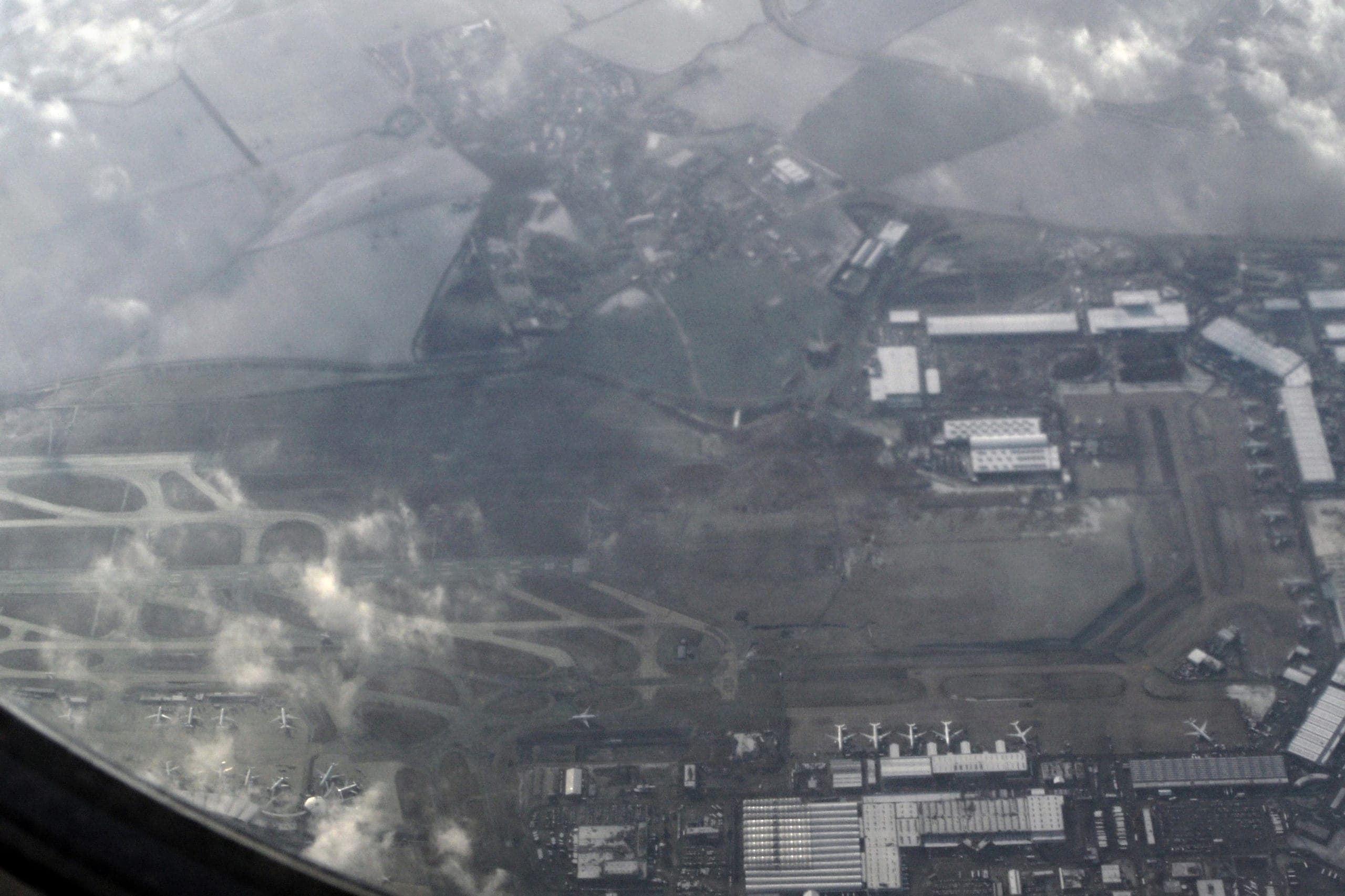
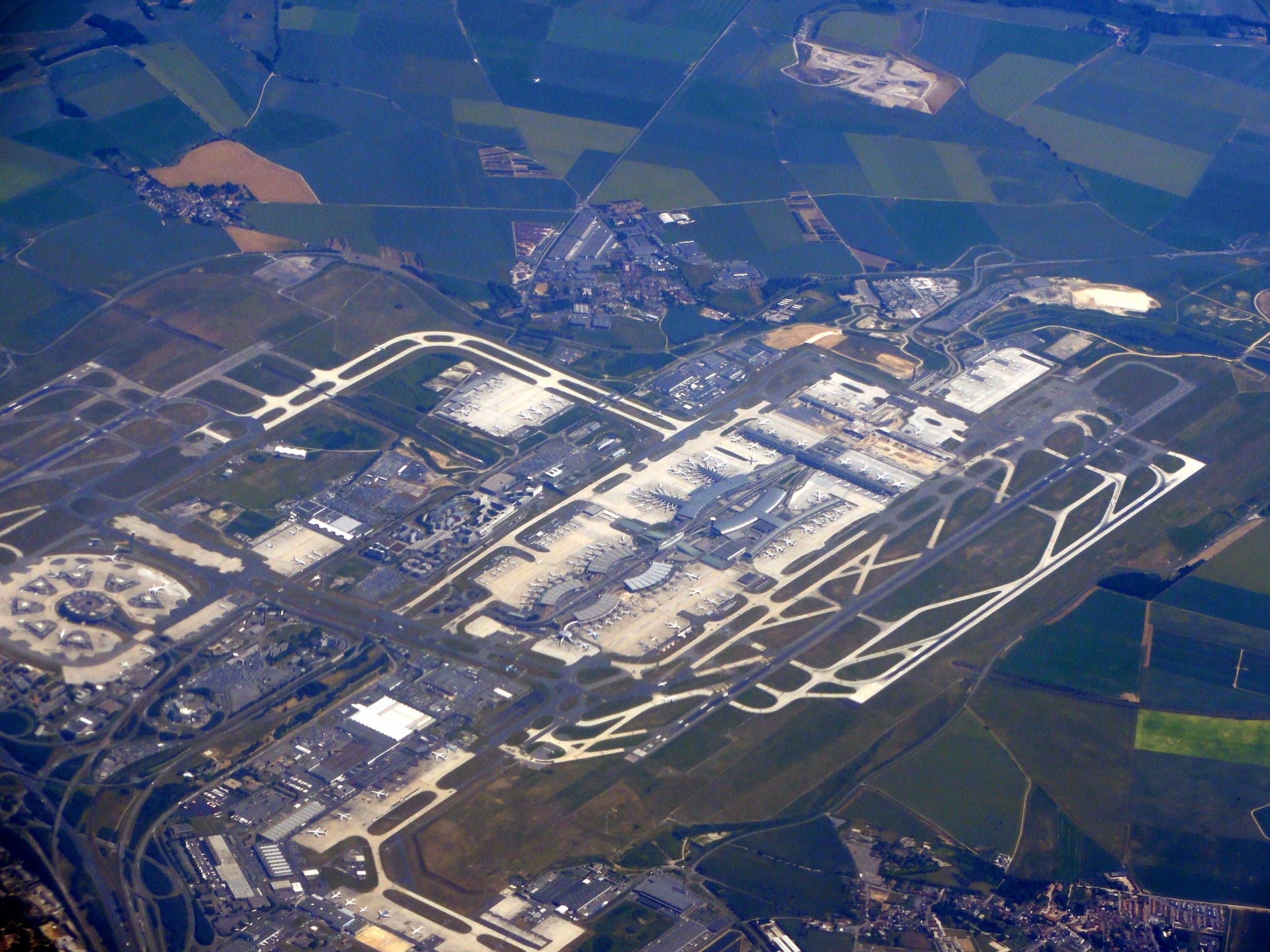
Paris to Charles de Gaulle from the air, the terminal area in the middle of the field with the runway doublets to either side
20101 / 6

Paris to Charles de Gaulle stands on 3,238 hectares of former farmland around the village of Roissy-en-France, twenty-three kilometres north-east of Notre-Dame, and is the largest airport in continental Europe by almost any measure you choose. In 2025 it handled 72.03 million passengers on 473,798 aircraft movements, and in 2024 it moved 1,914,681 tonnes of freight, more air cargo than any airport in Europe except Frankfurt, and more passengers than any except Istanbul and London Heathrow.

What separates it from Heathrow is not size but intention. Heathrow is a wartime airfield that a city grew around, and every decision since has been an argument about how to fit more into a boundary that was fixed in 1944. Charles de Gaulle was drawn on a clean sheet: the state bought thirty-two square kilometres of beet fields before the design existed, laid out four runways in two widely separated pairs, and put the terminals in the middle where they could be added to for the next half-century. The airport has never had to argue for a runway, because the runways were built before anyone needed them.

The cost of planning something whole is that you commit to a shape. Terminal 1, the concrete drum that Paul Andreu designed at twenty-nine, is the most admired airport building in Europe and cannot be enlarged. The answer was Terminal 2, which is not a building at all but a two-kilometre street of seven halls, and the argument between those two ideas, the perfect object and the extensible system, is the whole architectural history of the place.

History

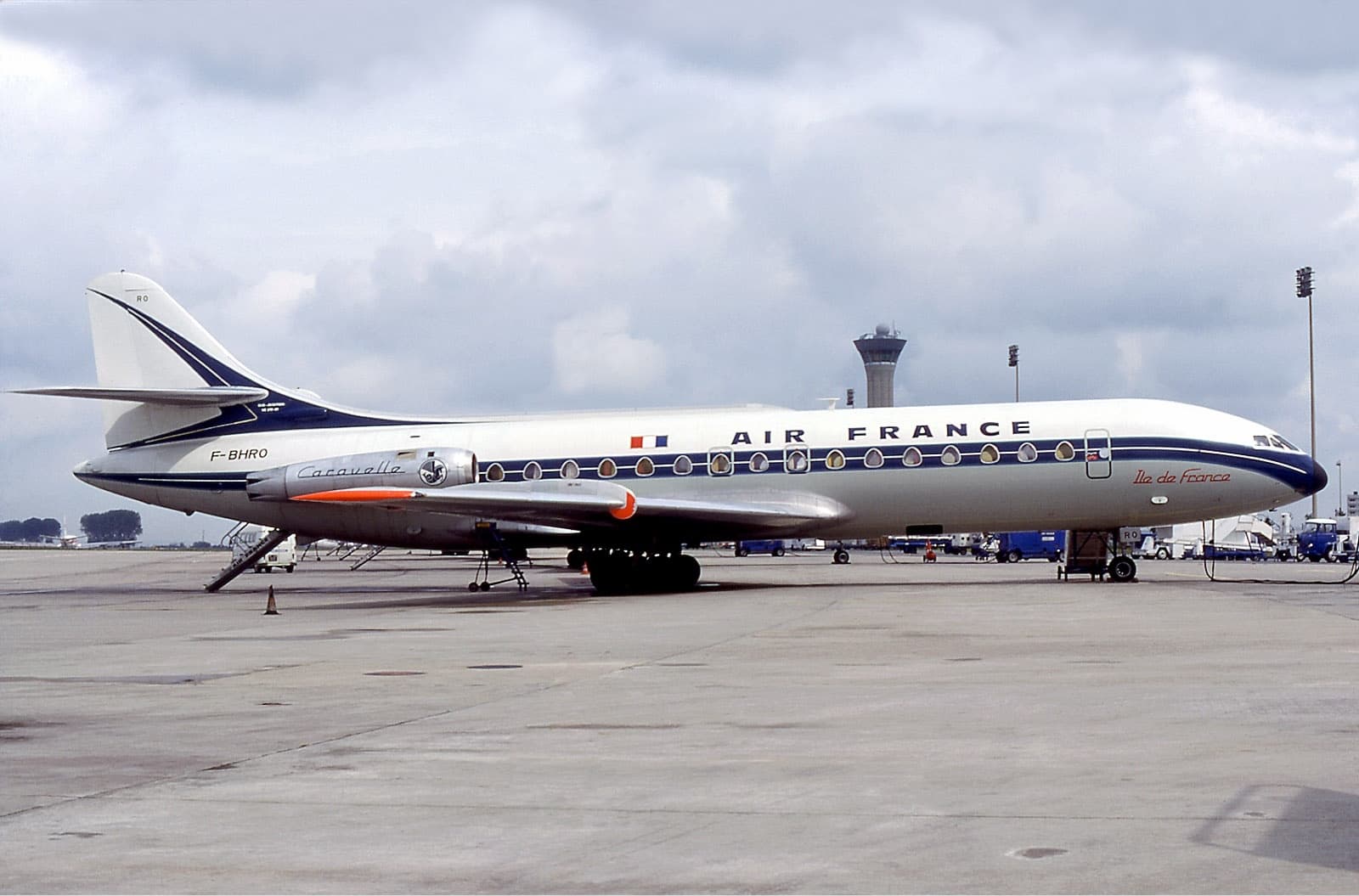
An Air France Caravelle at Charles de Gaulle in August 1977, three years after the airport opened, with its first control tower behind
An Air France Caravelle at Charles de Gaulle in August 1977, three years after the airport opened, with its first control tower behind (1977)

Paris had outgrown Orly by the early 1960s. Orly sits south of the city inside the suburbs, hemmed in exactly as Heathrow is, and by 1961 Aéroport de Paris, the state body that has run the region's airports since 1945, had concluded that no amount of building there would meet the traffic it expected. The decision was to start again somewhere with room.

In 1964 the site was fixed: the plain around Roissy-en-France, north-east of the city, flat, agricultural, thinly populated and crossed by the future line of the A1 autoroute. The state bought the land outright before the design existed. That sequence (land first, plan second) is the single fact from which everything else about the airport follows, and it is precisely the sequence Britain never managed.

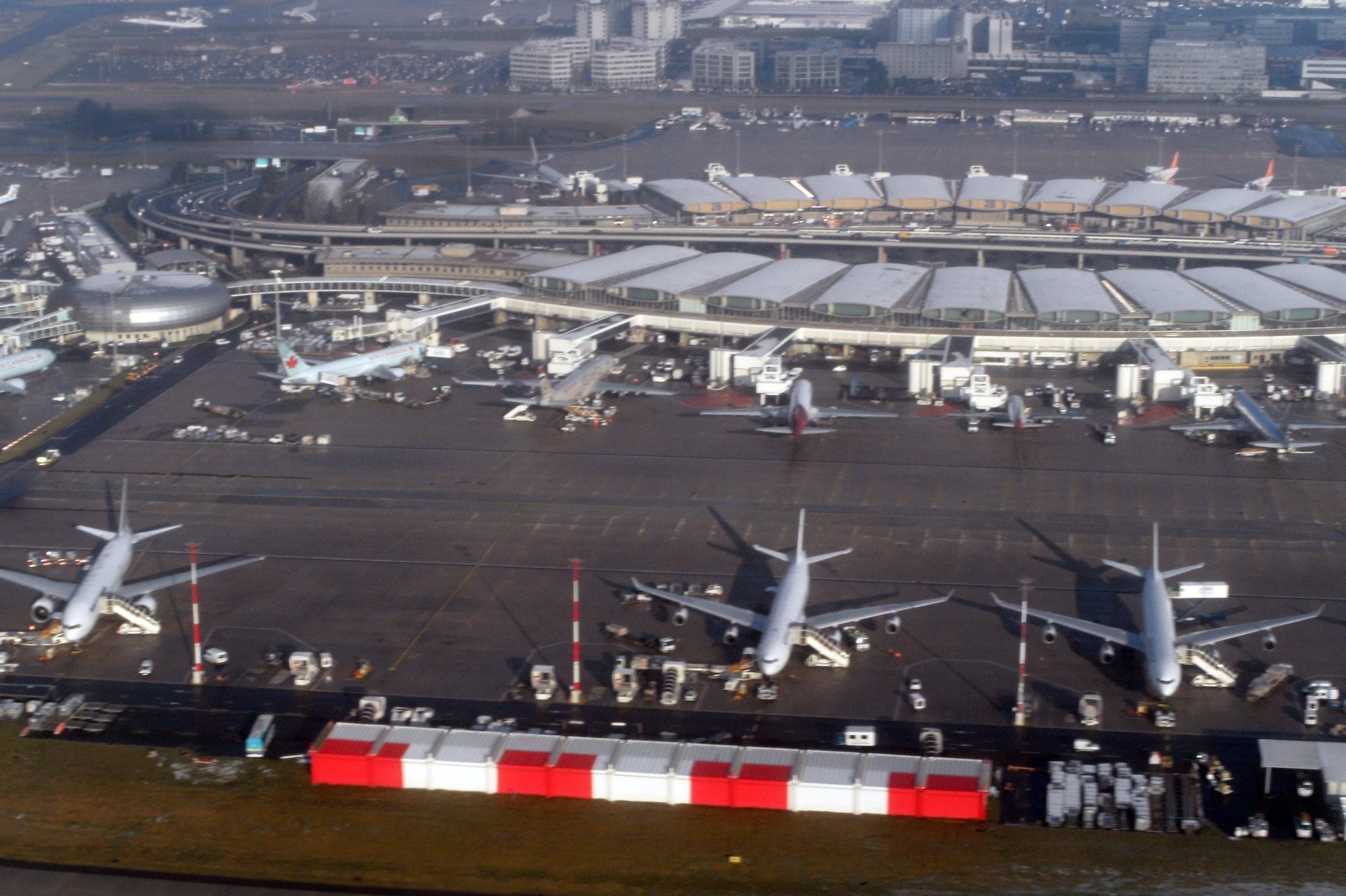
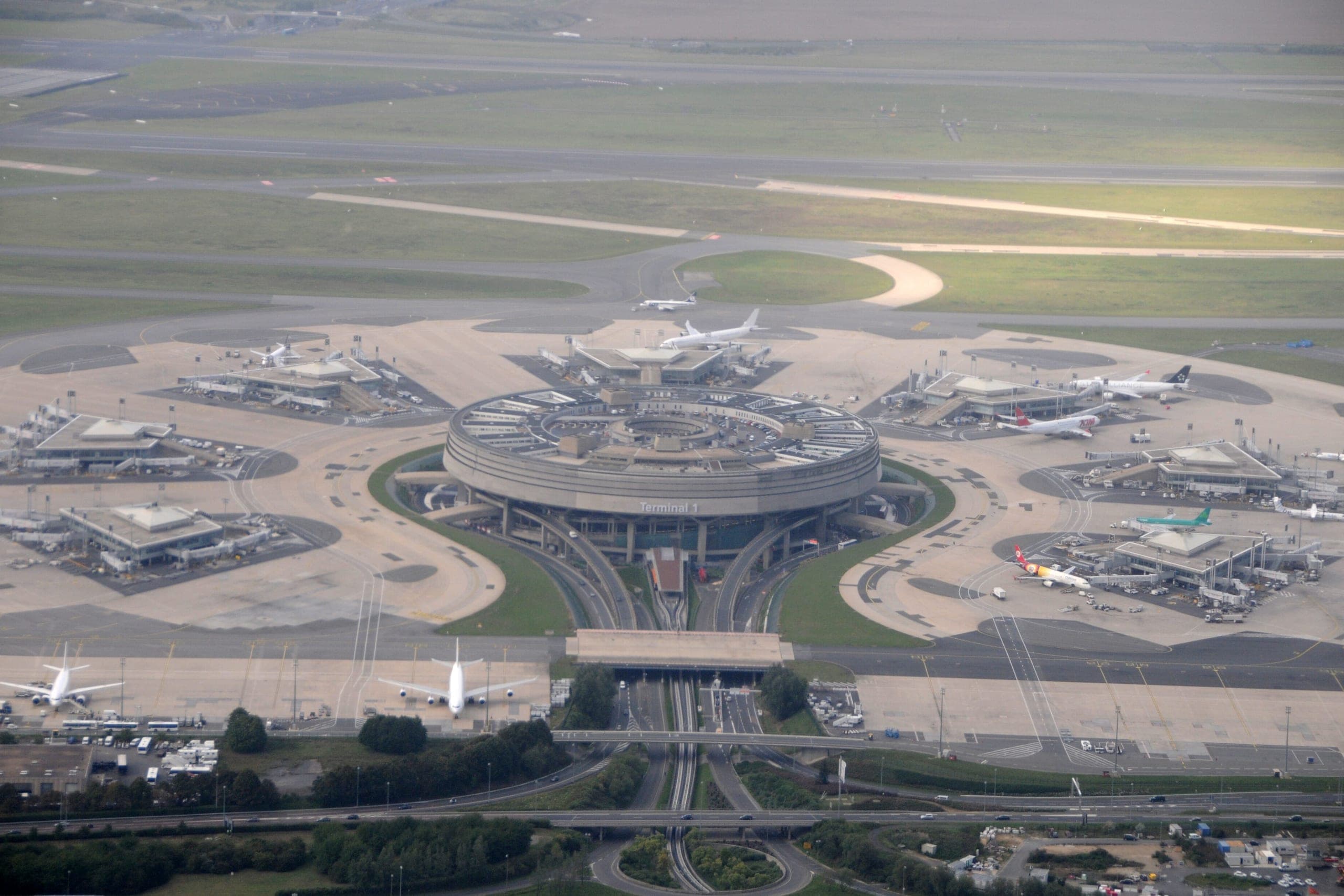
Terminal 1 from the air: Paul Andreu's circular concrete drum ringed by seven detached satellites, aircraft on stand at each, with a runway beyond
Terminal 1 from the air: Paul Andreu's circular concrete drum ringed by seven detached satellites, aircraft on stand at each, with a runway beyond (2010)

Construction began in 1966 on what was then called Aéroport de Paris Nord. The commission for the passenger terminal went to Paul Andreu, an engineer of the École Polytechnique who had qualified as an architect the year before and was twenty-nine years old. He would go on to design terminals at this airport for the next thirty-five years, and very little else at Roissy is not his.

The airport opened on 8 March 1974, renamed for the general who had died four years earlier, with one terminal, one pair of runways and an Air France departure for New York. Terminal 1 was finished on the opening day, which is worth stating plainly beside Heathrow's first morning in 1946: army tents on duckboards, and nine years before a permanent building.

Hall 2A from a departing aircraft, one of the facing crescents of the first pair of Terminal 2 halls
Hall 2A from a departing aircraft, one of the facing crescents of the first pair of Terminal 2 halls (2010)

Growth came in planned increments rather than crises. Terminal 2 began in 1982 and was added to for the next twenty-six years. The TGV station opened beneath Hall 2C in 1994. A third runway opened in 2001 and a fourth in 2000, completing the two doublets. The automatic shuttle that finally joined the terminals to each other arrived only in 2007: the one piece of the plan that was allowed to run late, and the one passengers complained about most.

An Air France Boeing 747-100 on the apron at Charles de Gaulle in May 1978
An Air France Boeing 747-100 on the apron at Charles de Gaulle in May 1978 (1978)

Aéroports de Paris was converted from a state body into a limited company in 2005 and floated on the Paris exchange in 2006, but the French state remains its largest shareholder with just over half the capital. The airport is therefore run commercially and owned politically, which is the opposite of Heathrow's arrangement and explains why expansion at Roissy is settled in government policy rather than in a decade-long planning inquiry.

The airfield

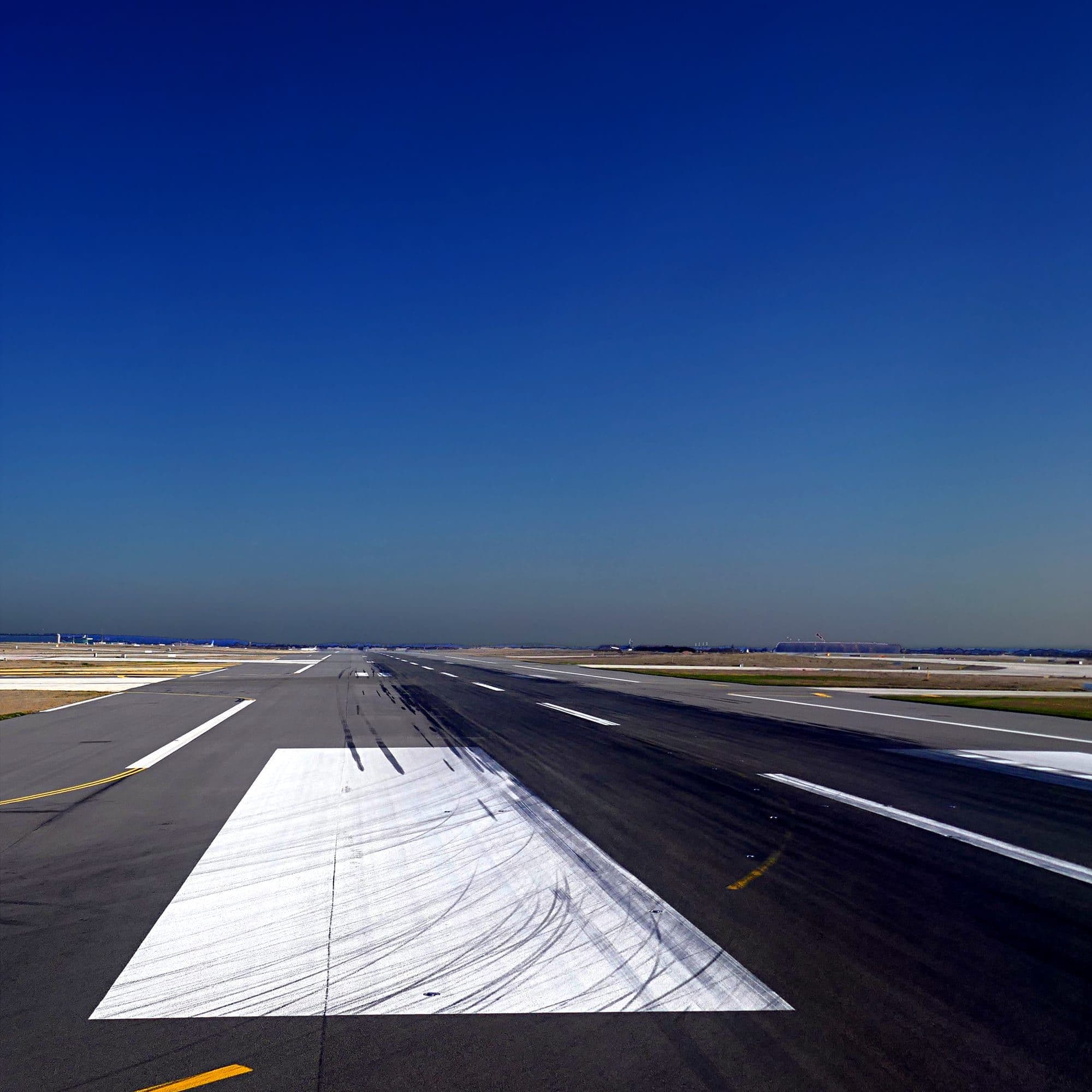
An airliner lining up on the runway centreline at Charles de Gaulle
An airliner lining up on the runway centreline at Charles de Gaulle (2018)

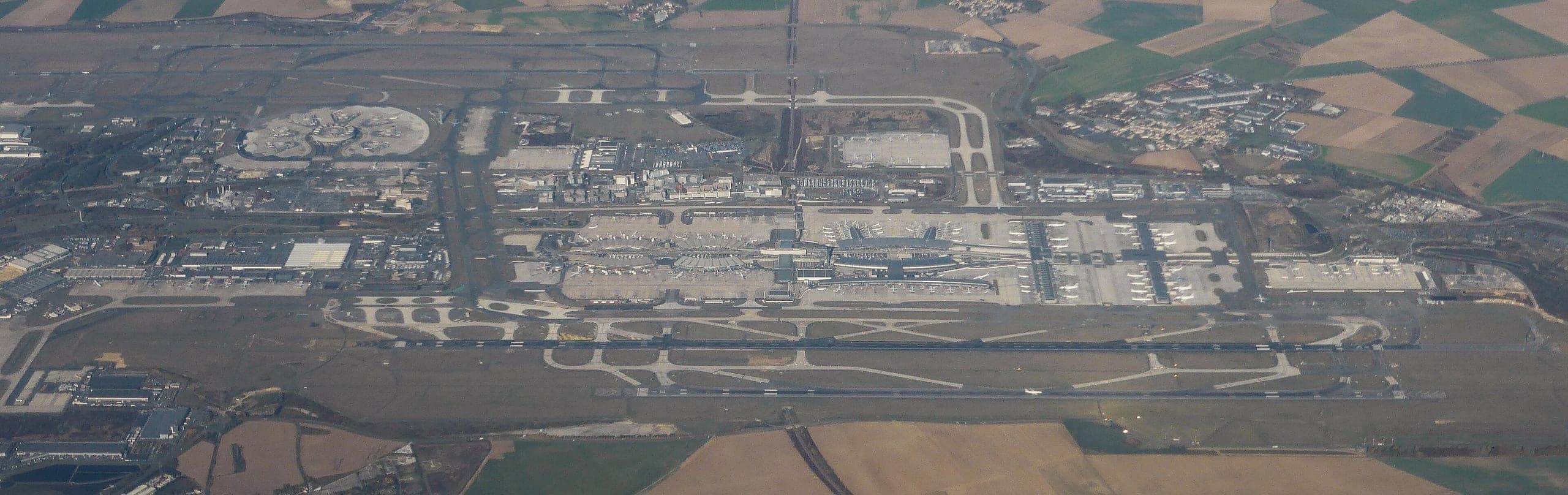
The airfield is four runways in two pairs, and the pairing is the point. Two strips lie north of the terminal area, 09R/27L at 14,000 ft and 09L/27R at 8,900 ft, and two lie south, 08L/26R at 13,590 ft and 08R/26L at 8,900 ft. Each pair is close-spaced and worked as a unit: one runway takes the arrivals, the other the departures, and the two doublets operate independently of one another. Four runways used this way give roughly twice the capacity of Heathrow's two, on a site that has room for the taxiways to reach them.

The original layout had only the two long strips; the two short ones were added in 2000 and 2001 to complete the doublets. That the airport could add a runway in a year, twice, without a public inquiry is the clearest single contrast with London, where the equivalent decision has been argued since the 1990s and is still not built.

The control tower at Charles de Gaulle, standing between the two runway doublets
The control tower at Charles de Gaulle, standing between the two runway doublets (2022)

All four are asphalt and equipped for Category III approaches, which matters on a plain that fogs in autumn. The prevailing wind is westerly, so most days the airport lands and departs on the 26 and 27 headings, over open country to the east and the Paris basin to the west.

The cargo area from a departing aircraft: the half of the operation that runs at night
The cargo area from a departing aircraft: the half of the operation that runs at night (2010)

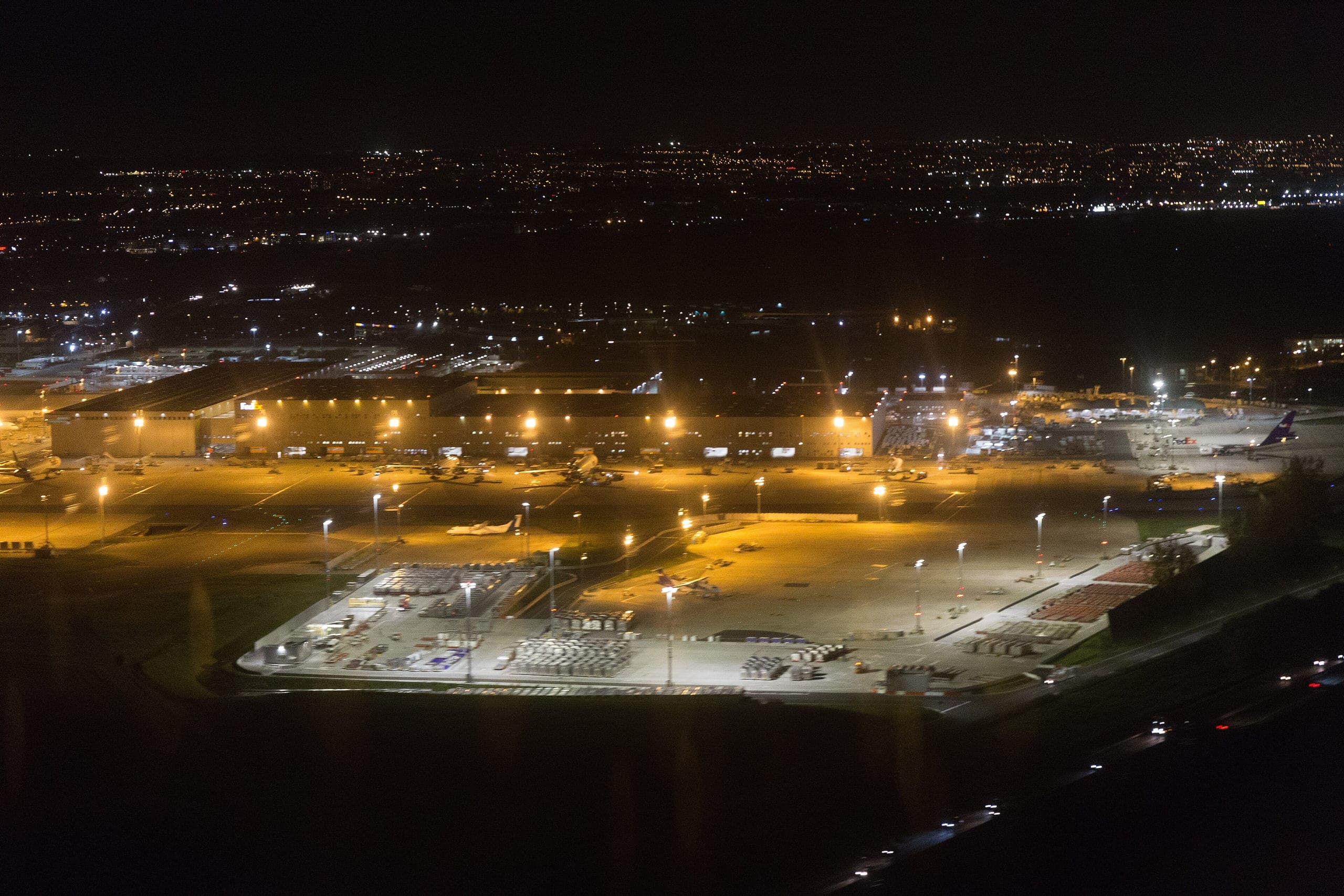
Freight is the other half of the operation and the half that does not show. Roissy moved 1,914,681 tonnes in 2024, second in Europe only to Frankfurt, and unlike Heathrow, where cargo travels in the holds of passenger aircraft because a freighter cannot justify a slot, a large share of it here moves in dedicated freighters at night. FedEx runs its European hub from the airport and Air France-KLM Martinair Cargo operates from it; the night quota is tighter than it once was, but the capacity exists because nobody had to choose between a passenger flight and a freighter for the same movement.

Terminals

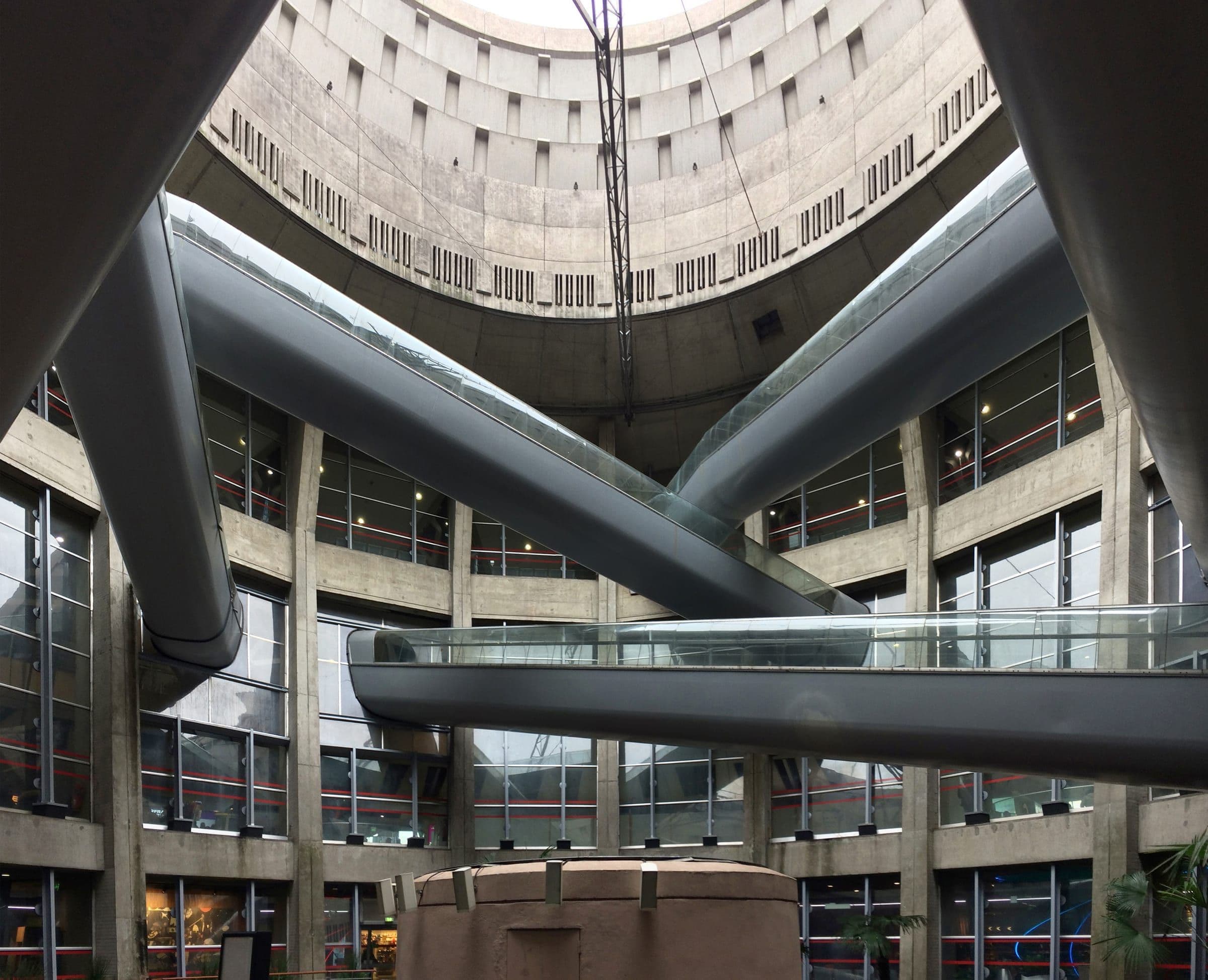
The interior of Terminal 1: escalators crossing the hollow centre of the concrete drum inside transparent tubes
The interior of Terminal 1: escalators crossing the hollow centre of the concrete drum inside transparent tubes (2018)

Terminal 1 is a drum. Ten storeys of raw concrete, two hundred metres across, hollow at the centre, with the check-in and gates arranged in rings and the passengers carried across the empty middle on escalators running inside transparent tubes. The aircraft do not touch it: they park at seven detached circular satellites reached by tunnels under the apron. Andreu's idea was that a passenger should walk as little as possible and see the whole machine while doing it, and the crossing tubes have been photographed more than any other airport interior in Europe.

It is also a building that cannot grow. A circle is finished the moment it closes, and by the time Roissy needed more capacity the only options were to demolish it or to build something else. The airport built something else, and Terminal 1 was refitted rather than replaced: most recently through a renovation completed in 2022 that kept the concrete and rebuilt everything inside it.

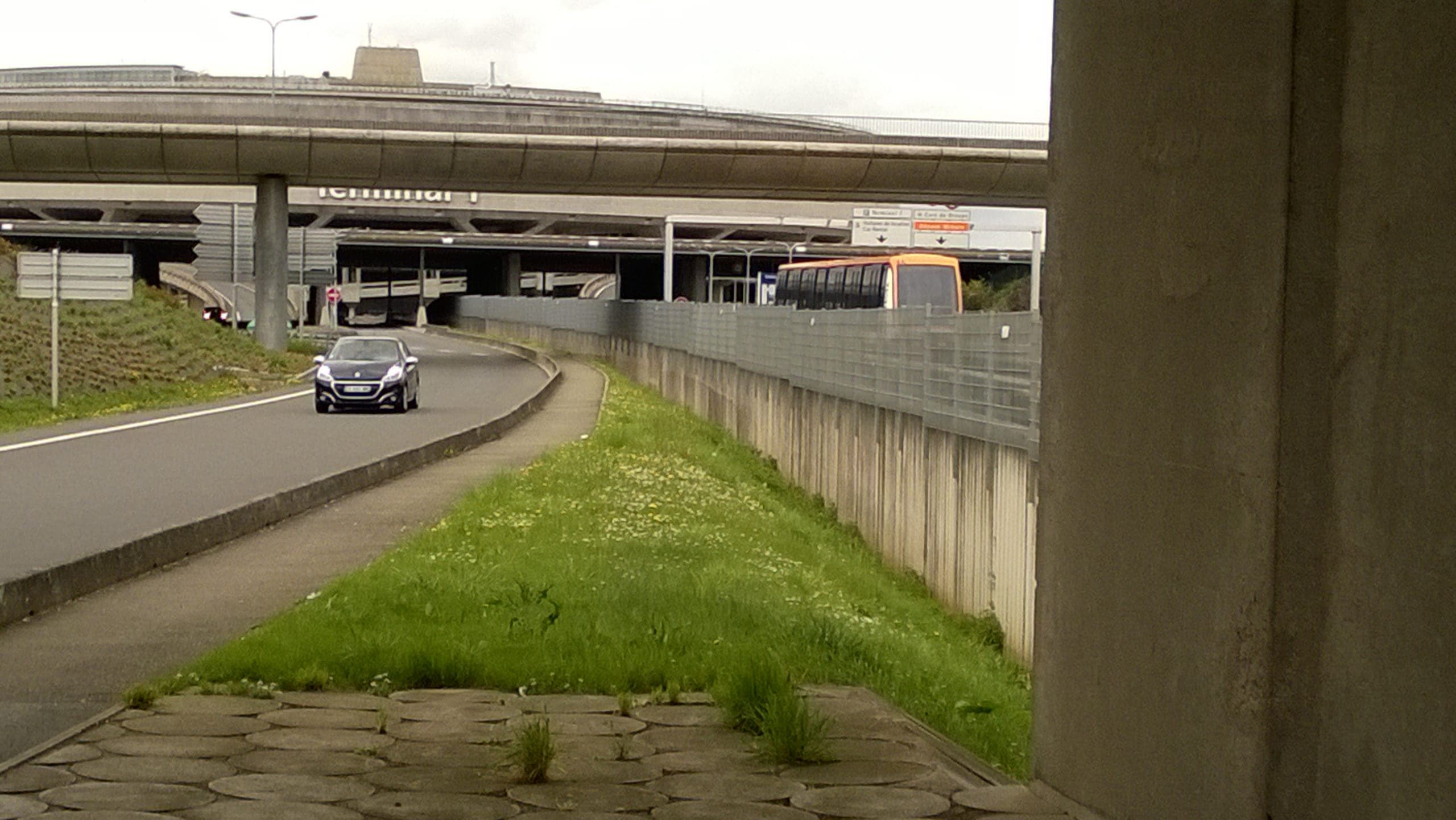
The access ramps threading between Halls 2E and 2F, the road system that gives Terminal 2 its shape as a street
The access ramps threading between Halls 2E and 2F, the road system that gives Terminal 2 its shape as a street (2018)

Terminal 2 is the opposite argument in built form. Begun in 1982, it is a two-kilometre spine with seven halls set along it in facing pairs, lettered 2A to 2G in the order they were needed rather than the order of the alphabet: 2A and 2B in 1982, 2D in 1989, 2C in 1993, 2F in 1999, 2E in 2003, 2G in 2008. Each is a different building by a different hand within Andreu's frame, and the sequence reads as a thirty-year argument about what a terminal should look like, from the low symmetrical crescents of the first pair to the concrete vault of 2E and the light steel shed of 2G. The railway station sits in the middle of the spine, which is why the whole thing is laid out as a street.

Terminal 3 is a shed. It opened in 1991 as Aérogare 9, a temporary building for charter traffic, and was never replaced. It has no jetways; passengers board by bus from remote stands. On an airport known internationally for its architecture, the plainest building handles the low-cost traffic, which is a fair description of how European aviation actually divided itself after 1995.

Operations

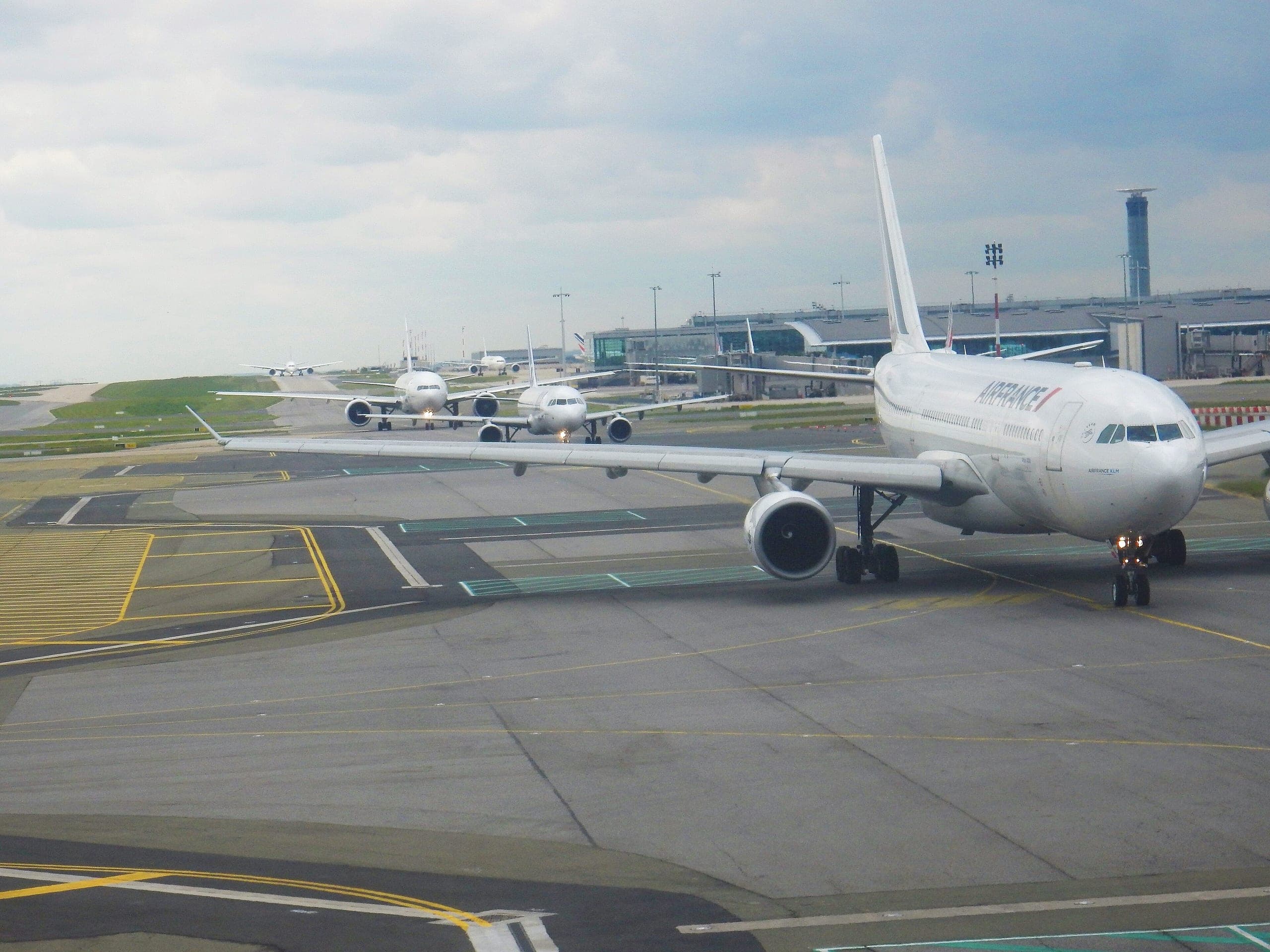
Air France aircraft queuing for departure at Charles de Gaulle, an A330 leading an A320 and a Boeing 777
Air France aircraft queuing for departure at Charles de Gaulle, an A330 leading an A320 and a Boeing 777 (2019)

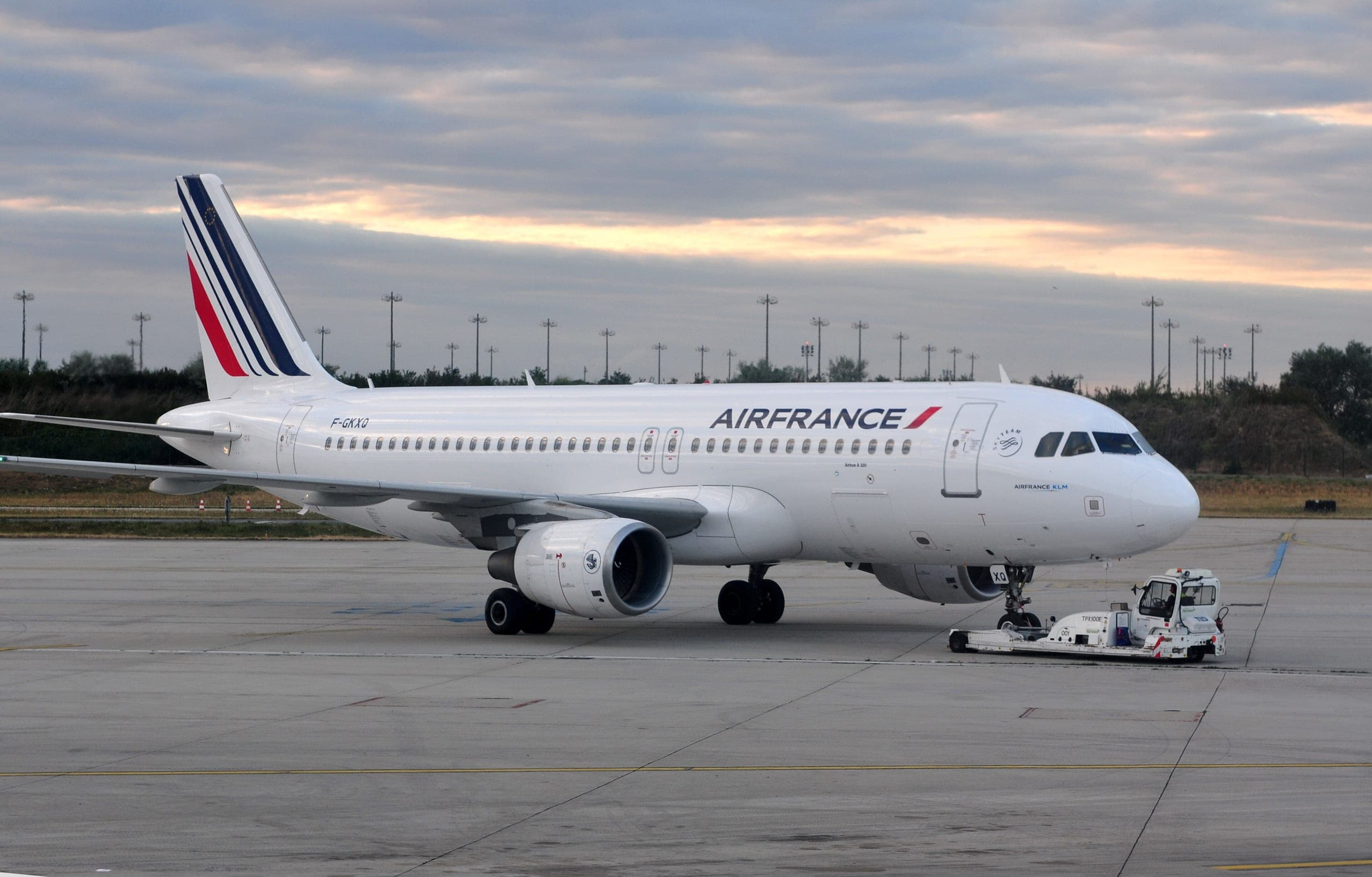
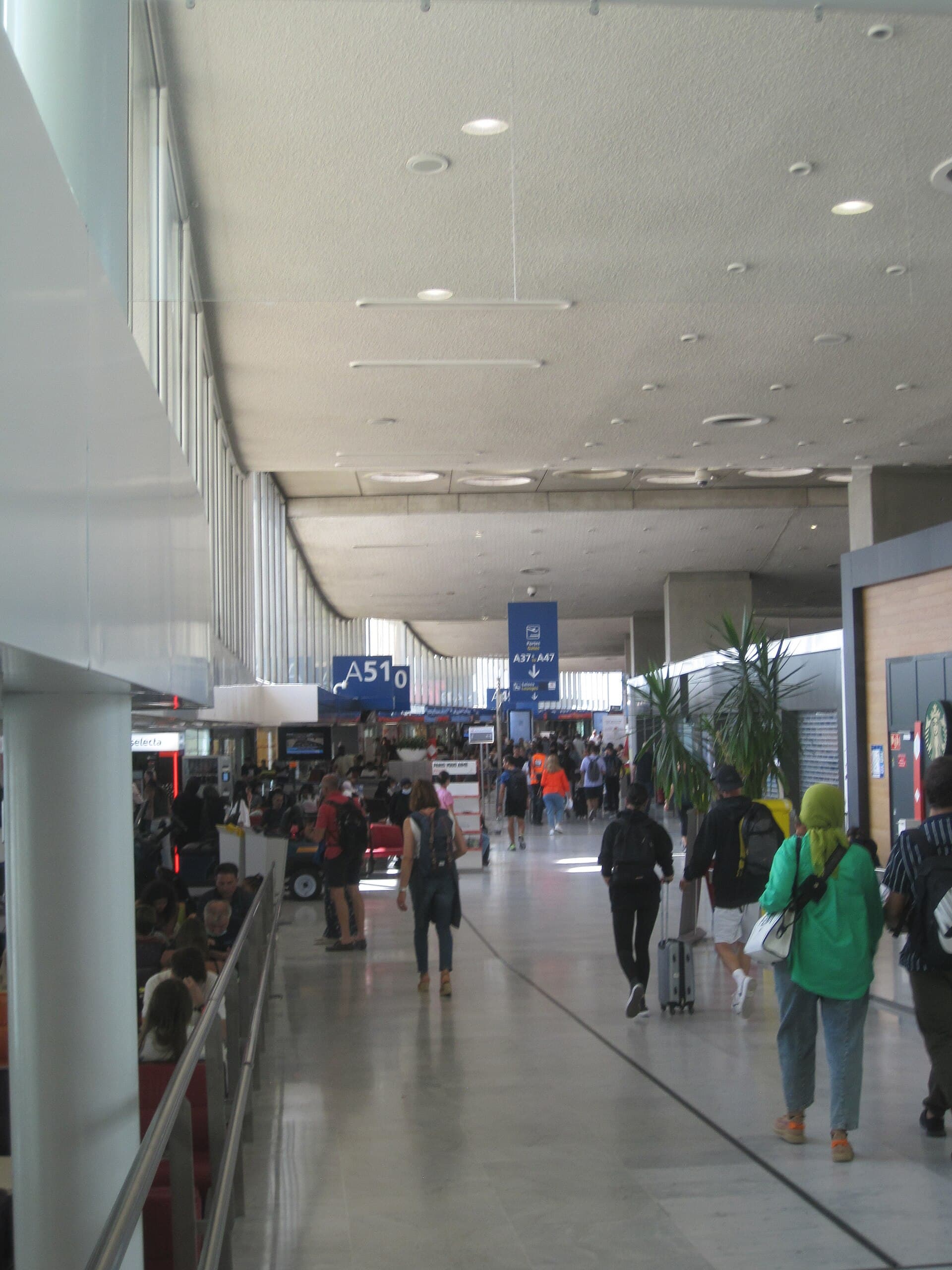
Charles de Gaulle is Air France's hub and has been since the airline moved its long-haul operation here from Orly. The carrier and its SkyTeam partners occupy most of Terminal 2 (2E and 2F for the long-haul and Schengen banks, 2G for the regional feed) and the whole shape of the day is built around connecting one to the other. Around a third of the airport's passengers are transferring rather than starting or ending a journey in Paris.

The airport was designed for that. The runways are far enough apart that arrivals and departures do not interfere, the halls are laid out so a bank can be turned inside a single building, and the terminals sit between the doublets rather than at one end of the field. It is a hub in the way an American hub is a hub, built for the purpose rather than adapted to it, and the contrast with Heathrow, where connecting passengers cross under a runway between terminals, is the plainest illustration of what planning whole buys you.

An Air France Airbus A320 on stand at Charles de Gaulle, the airline whose hub the airport was rebuilt around
An Air France Airbus A320 on stand at Charles de Gaulle, the airline whose hub the airport was rebuilt around (2015)

easyJet operates a large base here and FedEx Express runs its European freight hub from the cargo area, so the airport carries three quite different businesses on one field: a legacy long-haul hub, a low-cost short-haul base, and an overnight express operation. About 105 airlines use it.

The number the airport does not have is a movement cap of the kind that governs Heathrow. Roissy operates under noise-related restrictions, particularly at night, but not under a hard annual ceiling on flights, and its constraint is the practical one of runway and airspace capacity rather than a figure written into a planning consent. That difference is why the two airports' growth curves look nothing alike.

Ground access

Two railways serve the airport and they do quite different jobs. The RER B, the regional express line, runs from stations beneath Terminal 2 and Terminal 3 into Gare du Nord, Châtelet and the Latin Quarter in about thirty-five minutes. It is the cheap route and the crowded one: it is a suburban line first and an airport link second, shared with the northern suburbs it passes through, and it has been the subject of complaint for as long as it has existed.

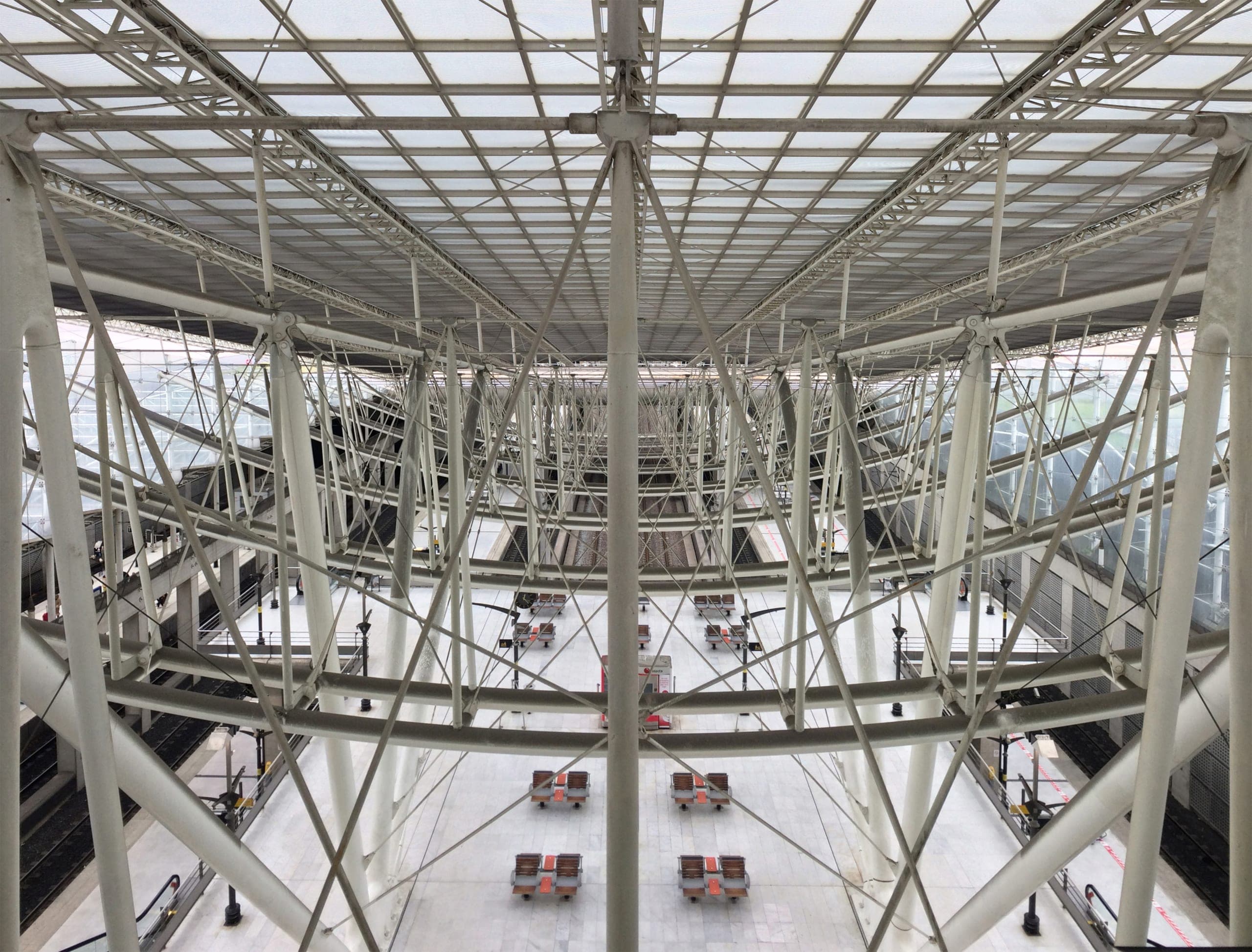
The Aéroport Charles de Gaulle 2 TGV station, the high-speed main-line platforms built under Hall 2C in 1994
The Aéroport Charles de Gaulle 2 TGV station, the high-speed main-line platforms built under Hall 2C in 1994 (2018)

The other is a main-line high-speed station. Aéroport Charles de Gaulle 2 TGV opened under Hall 2C in 1994 on the eastern interconnection line, and it puts Lille, Brussels, Lyon, Marseille, Bordeaux and Strasbourg within a direct train of the departure gates without touching Paris at all. No other European hub has this. It is why Air France sells rail legs under its own flight numbers, why a passenger from Lille flies from Roissy rather than from Lille, and why the airport's catchment is a large part of northern France rather than a single city.

A CDGVAL shuttle passing Terminal 1, the driverless link that finally joined the terminals in 2007
A CDGVAL shuttle passing Terminal 1, the driverless link that finally joined the terminals in 2007 (2018)

Inside the airport, CDGVAL, a driverless shuttle opened in 2007, links the three terminals to the car parks and both stations. Before it, moving between Terminal 1 and Terminal 2 meant a bus on the public road, which for thirty-three years was the weakest part of an otherwise carefully planned machine.

By road the airport sits between the A1 to the west and the A104 to the south. A dedicated non-stop rail link to central Paris, CDG Express, has been promised, funded, litigated and delayed for two decades and is still not open: the one piece of the Roissy plan that has taken longer than a British planning inquiry.

Expansion

Roissy has no third-runway argument, because it built its third and fourth runways in 2000 and 2001 and nobody had to be persuaded. What it has instead is an argument about terminals, and it is the same argument in a different form: how much more traffic should be brought to a place that already has a great deal of it.

Inside Hall M, the Terminal 2E satellite built after the 2004 collapse and now the airport's principal long-haul pier
Inside Hall M, the Terminal 2E satellite built after the 2004 collapse and now the airport's principal long-haul pier (2019)

The largest proposal of the last decade was Terminal 4, a new complex east of the existing ones that would have added capacity for something like forty million passengers a year and made Roissy comfortably the busiest airport in Europe. It was abandoned in February 2021. The government asked Aéroports de Paris to withdraw the scheme on environmental grounds, and the company did, a decision with no British parallel, and one that arrived by ministerial instruction rather than through a court.

What has replaced it is renovation rather than extension. Terminal 1 was rebuilt inside its concrete drum in a programme completed in 2022; Terminal 2B and 2D were joined and reworked into a single junction building; the 2E satellites carry the long-haul growth. The airport's stated direction is now to raise the quality and the environmental performance of what exists rather than to add another terminal to the eastern fields.

That is a real difference in kind from London. Heathrow's expansion question is whether it may add its first new runway since 1946. Roissy's is whether it should use the capacity it already built: and the answer, so far, has been not all of it.

Noise and environment

The plain north-east of Paris was chosen in 1964 partly because few people lived on it, and that choice has aged better than almost any other decision in European airport planning. Roissy's approaches cross open country and small towns rather than a dense city, and the airport is not the permanent political problem that Heathrow's noise footprint has been for sixty years.

The FedEx Express European hub at Charles de Gaulle from the air at night, freighters on stand around the sort building
The FedEx Express European hub at Charles de Gaulle from the air at night, freighters on stand around the sort building (2019)

It is not silent. Night flights are the sharp edge here as everywhere: the airport carries a large overnight freight operation, and the communities of the Val-d'Oise and Seine-et-Marne under the approach paths have campaigned for years against movements between midnight and five. France has tightened the night quota progressively, capping the number of permitted night slots and banning the noisiest aircraft outright, and the argument continues within those limits rather than about whether they should exist.

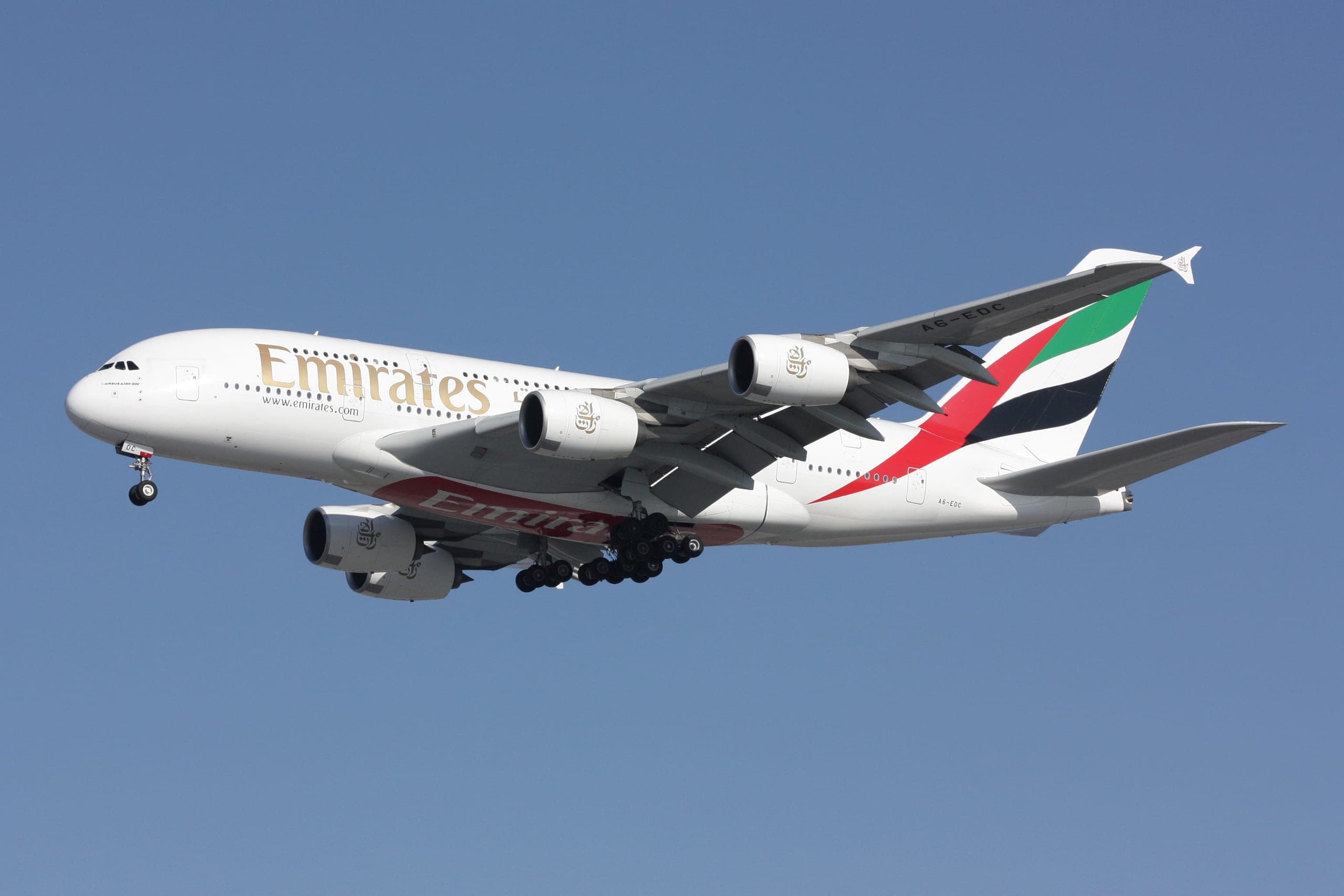
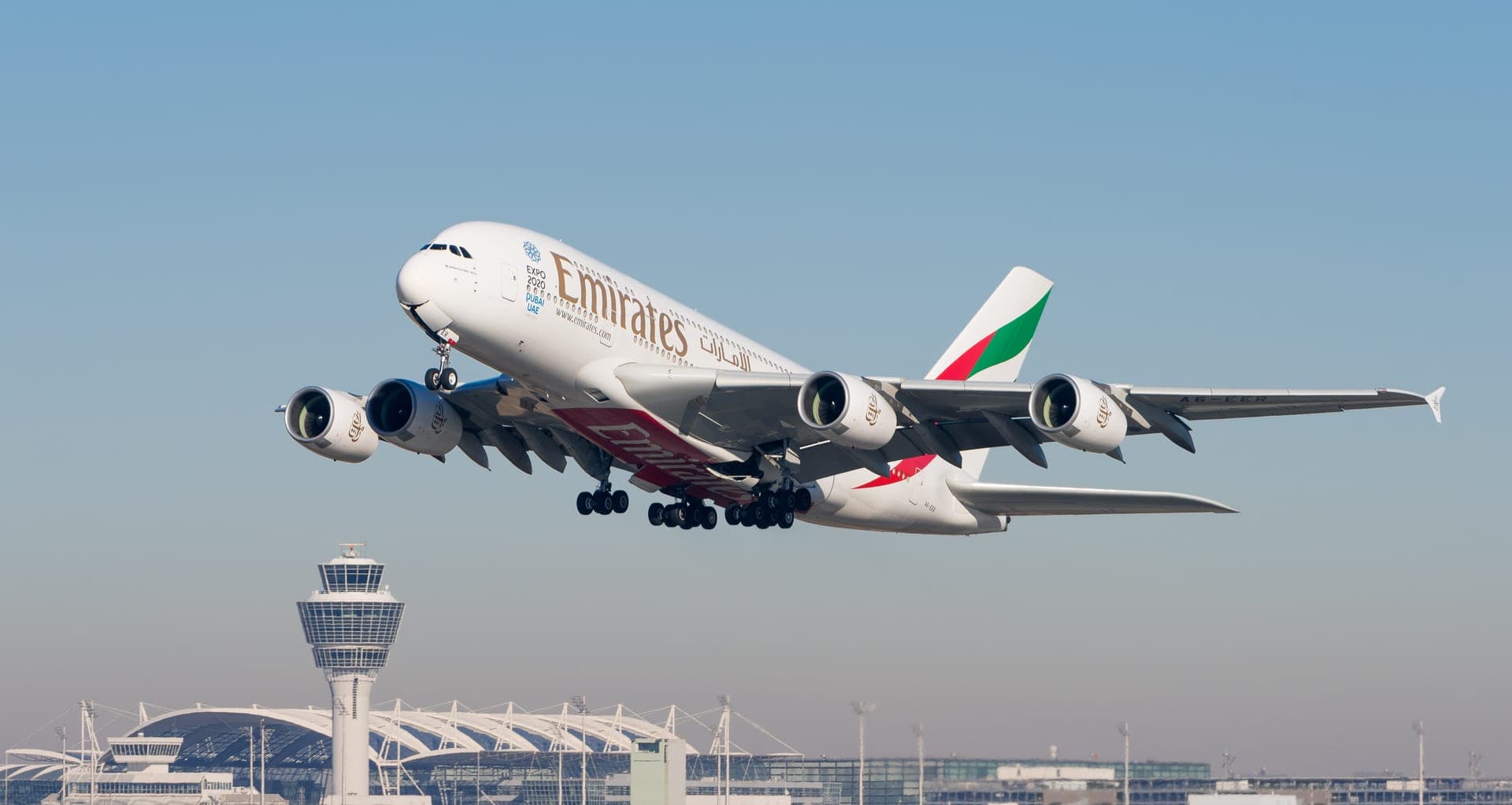
An Emirates Airbus A380 on final approach to runway 27R at Charles de Gaulle
An Emirates Airbus A380 on final approach to runway 27R at Charles de Gaulle (2010)

Air quality and ground access carry the rest of the environmental case. The airport is bounded by two motorways and generates a large amount of road traffic that the RER B was never sized to absorb, which is the main environmental argument for CDG Express and one reason the project has survived twenty years of delay.

The Terminal 4 cancellation in 2021 was the first time a major European airport expansion was stopped by its own government on climate and environmental grounds before any court was involved. Whatever one makes of the decision, it settled a question at Roissy that London has spent two decades unable to settle at all.

Notable events

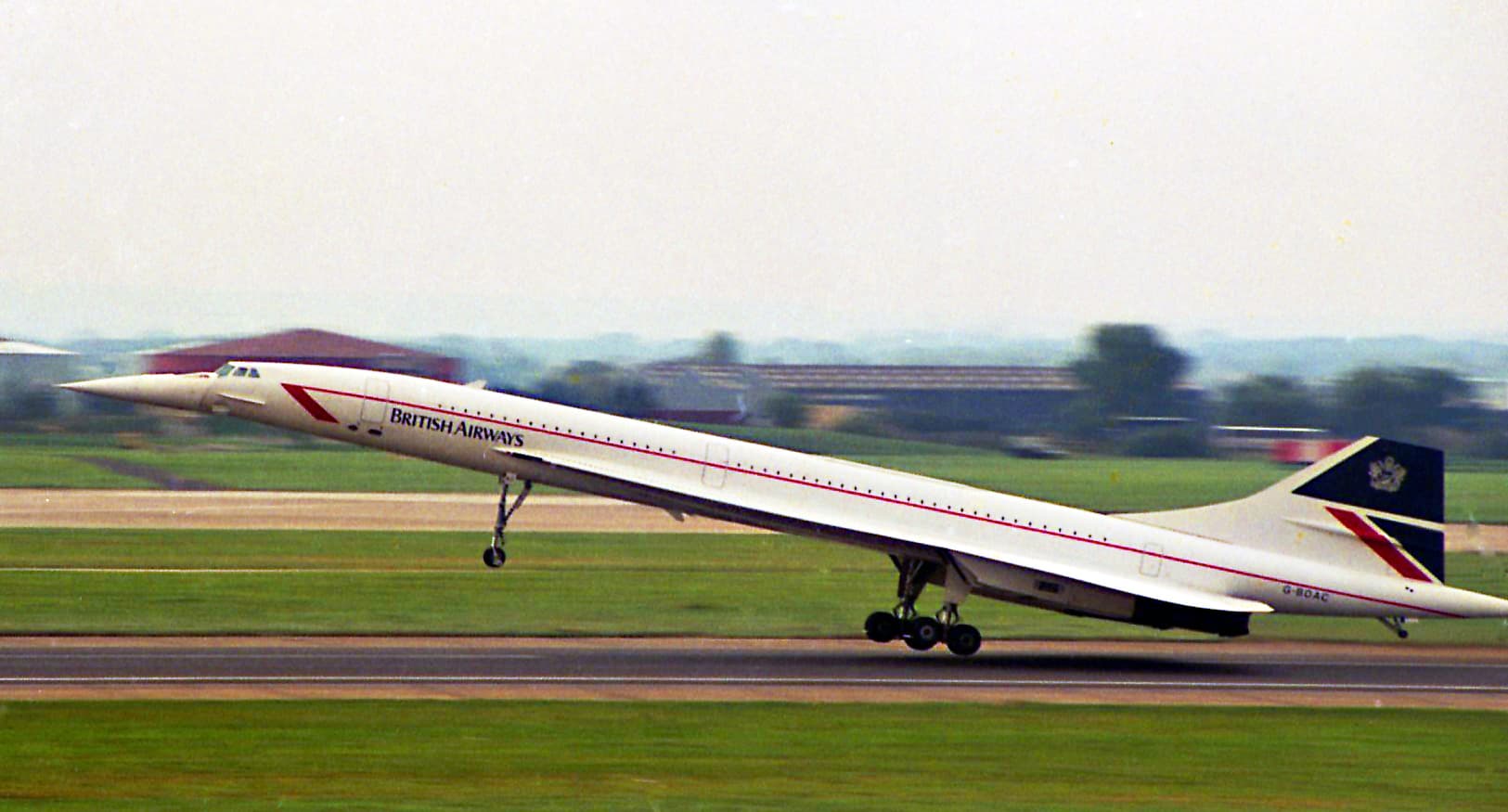
An Air France Concorde at Charles de Gaulle in July 1978, two years into supersonic service
An Air France Concorde at Charles de Gaulle in July 1978, two years into supersonic service (1978)

On 21 January 1976 an Air France Concorde left for Rio de Janeiro at the same moment a British Airways Concorde left Heathrow for Bahrain, the two first scheduled supersonic passenger services in the world, timed to depart together. Paris to New York opened in November 1977, and Air France flew Concorde from Roissy until 2003. The type's whole commercial life ran between this airport and London's.

Air France Concorde F-BVFF preserved on display at Charles de Gaulle, where the type flew from 1976 until 2003
Air France Concorde F-BVFF preserved on display at Charles de Gaulle, where the type flew from 1976 until 2003 (2011)

Concorde's end also began here. On 25 July 2000 an Air France Concorde bound for New York struck debris on the runway during its take-off roll, suffered a tyre burst that ruptured a fuel tank and crashed at Gonesse shortly afterwards, killing all 109 people on board and four on the ground. The type was grounded, modified and returned to service, but never recovered commercially and was withdrawn in 2003.

The airport's other defining event was structural. Hall 2E opened in June 2003 as Andreu's long concrete vault, a boarding pier built as a tube without internal columns. At about seven in the morning on 23 May 2004, a section roughly thirty metres long collapsed onto the concourse below, killing four people. The administrative inquiry reported in February 2005 that there had been no single failure: the design had carried very little margin, the concrete shell had been weakened where metal struts pierced it, and the structure had little capacity to redistribute load once any part of it gave way. The pier was demolished and rebuilt to a different structural principle, and the satellites added afterwards now carry the airport's long-haul and A380 gates.

A widebody on the apron at Charles de Gaulle
A widebody on the apron at Charles de Gaulle (2013)

It is worth stating plainly rather than dramatically. Four people died in a building barely a year old, designed by the architect of the airport itself, and the finding was not a villain but an accumulation of decisions each of which had almost enough margin. That is how most structural failures actually happen, and it is why the rebuilt pier looks heavier than the one it replaced.

Place in world aviation

Charles de Gaulle is the argument for planning an airport whole, and it is a strong one. Four runways in two independent doublets, terminals in the middle with room to be added to, a high-speed railway under the departure hall, and a site large enough that none of those decisions had to be traded against another. Every one of those things is difficult or impossible to retrofit, and every one of them is something Heathrow has spent decades trying to obtain by other means.

A wide aerial panorama across the whole airport, terminals in the centre between the northern and southern runway doublets
A wide aerial panorama across the whole airport, terminals in the centre between the northern and southern runway doublets (2016)

It is also the argument against believing a plan will survive contact with fifty years. Terminal 1 is a masterpiece that cannot be extended. Terminal 2 grew into something nobody drew in 1982 and is coherent only in the way a street is coherent. The shuttle that ties it all together arrived thirty-three years late, the express rail link to Paris still has not arrived, and the terminal that was to complete the plan was cancelled by the government that owns the airport. A whole plan is not the same as a finished one.

Its place in world aviation is as the largest airport in continental Europe, the second-busiest on the continent by passengers and by freight, Air France's hub and the European gateway that a French rail passenger reaches without changing trains. Alongside Heathrow it forms the pair that most of the transatlantic and Europe-to-Asia traffic is routed through, and the two are usually described as rivals. They are better read as two answers to one question, how a European capital builds an airport, given sixty years apart, by two countries with very different ideas about who decides.

Runways

09R/27L

Northern doublet

Length
13,780 ft
Width
148 ft
Surface
Asphalt
Approach category
CAT III

The airport's longest strip, and the one that took Concorde on its Atlantic departures.

09L/27R

Northern doublet

Length
8,858 ft
Width
197 ft
Surface
Asphalt
Approach category
CAT III

Opened in 2001 as the third runway, close-spaced beside 09R/27L so the pair can be worked as one arrival and one departure runway.

08L/26R

Southern doublet

Length
13,589 ft
Width
148 ft
Surface
Asphalt
Approach category
CAT III

08R/26L

Southern doublet

Length
8,858 ft
Width
197 ft
Surface
Asphalt
Approach category
CAT III

The fourth runway, opened in 2000. Its arrival is the one that passes closest to the terminals.

Terminals

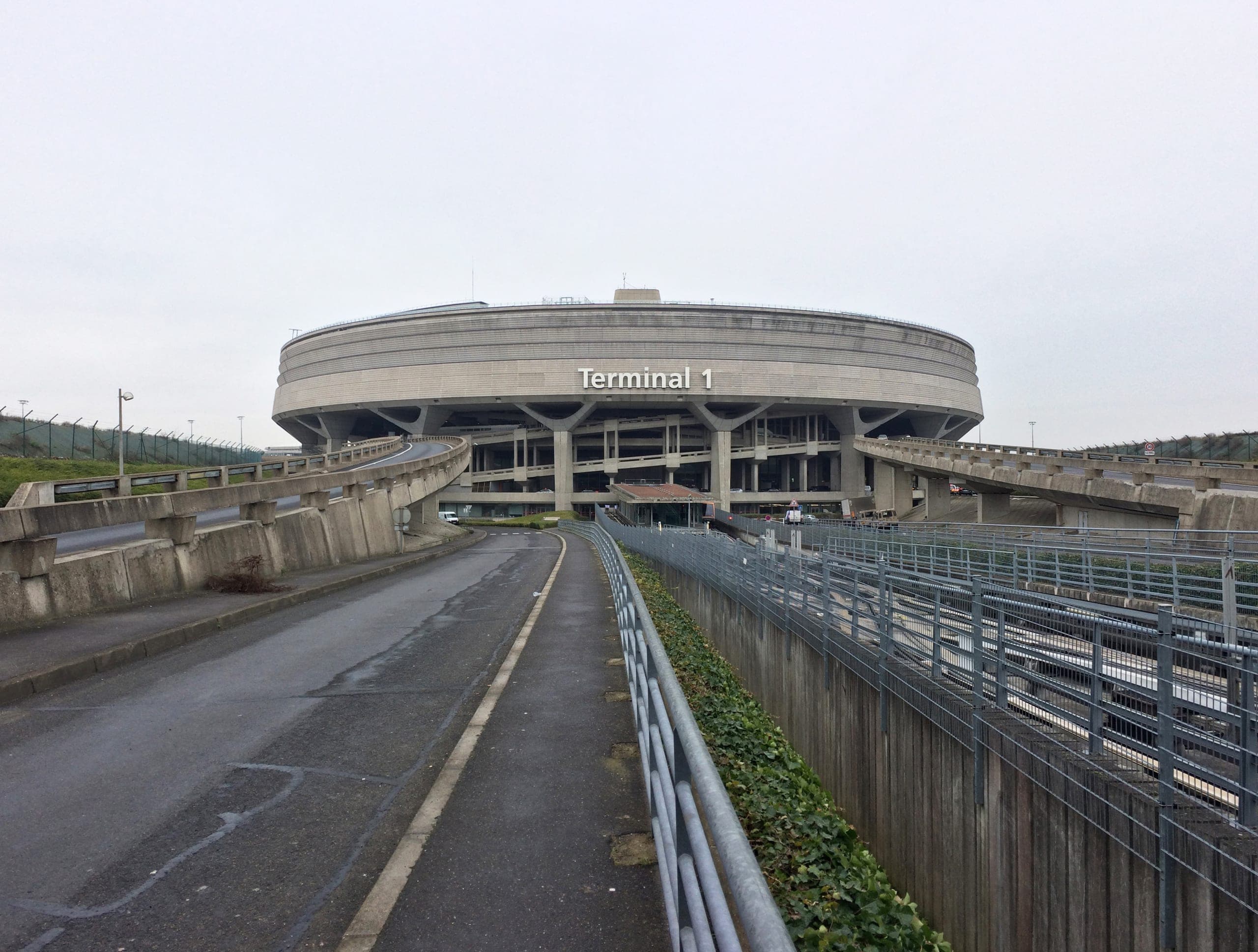
Terminal 1 seen from its access ramp, the drum raised on splayed concrete legs above the roadway

Terminal 1

Opened 1974 · Paul Andreu

The building the airport was designed around: a ten-storey concrete drum 660 ft across, hollow at the centre, with escalators crossing the void inside transparent tubes and the aircraft parked at seven detached satellites reached by tunnels. Andreu was twenty-nine when he was given it. It is the most photographed airport interior in Europe and, by the standards of the traffic it now carries, a small building: which is the price of a shape that cannot be extended sideways.

  • Satellites 1 to 7
The frontage of Hall 2A, low and horizontal where Terminal 1 is vertical

Terminal 2

Opened 1982 · Paul Andreu

Not a building but a street of them: seven halls lettered A to G, laid out in facing pairs along a two-kilometre spine with the railway station in the middle. Begun in 1982 as a deliberate rejection of Terminal 1's geometry, a shape that could be extended by adding the next hall, it took thirty years to finish and changed architectural language as it went, from the low symmetrical pairs of 2A and 2B to the concrete vault of 2E and the steel-and-glass shed of 2G. It is Air France's home and the largest terminal complex in Europe.

  • Hall 2A1982
  • Hall 2B1982
  • Hall 2D1989
  • Hall 2C1993
  • Hall 2F1999
  • Hall 2E2003
  • Hall 2G2008
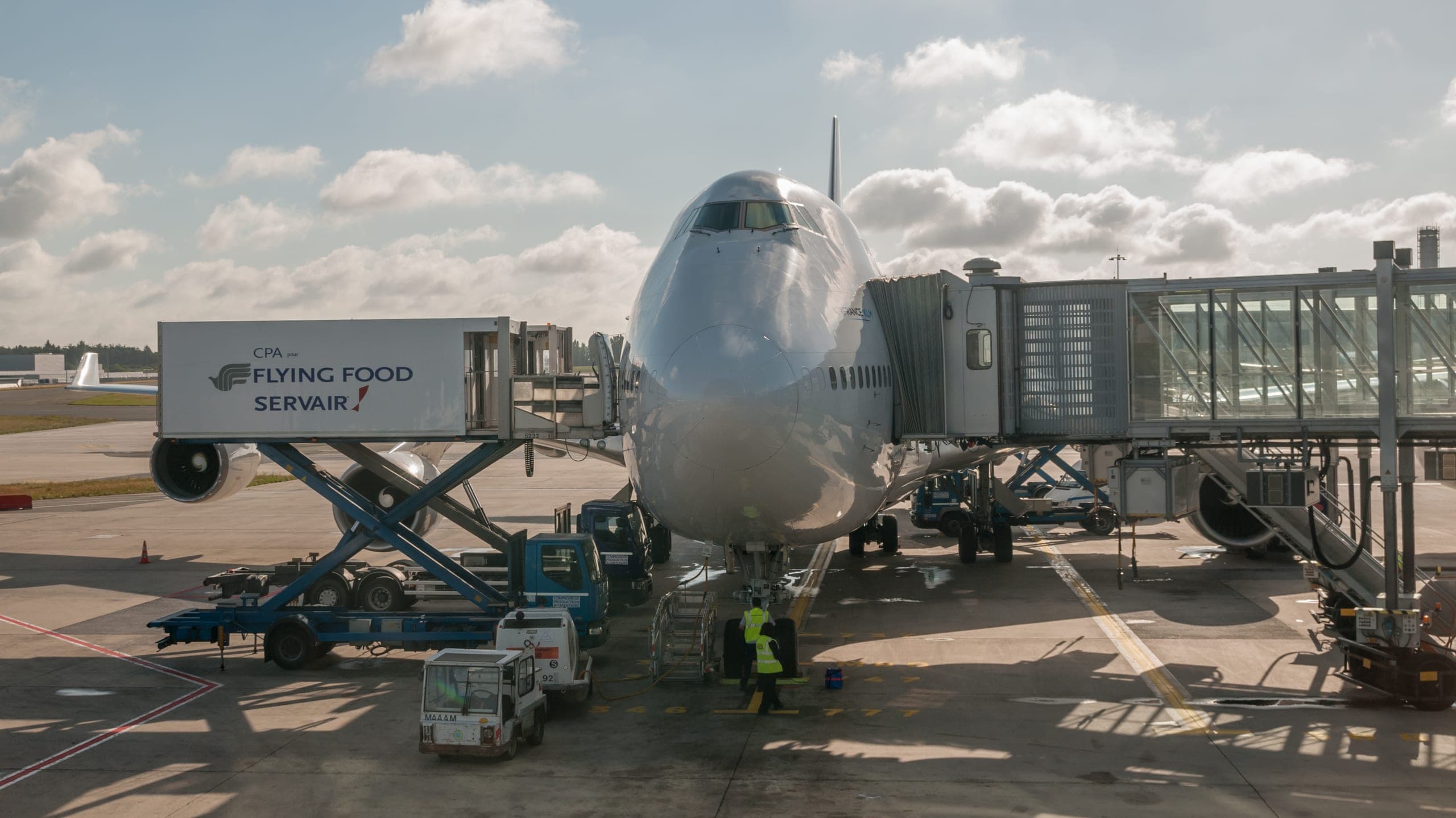
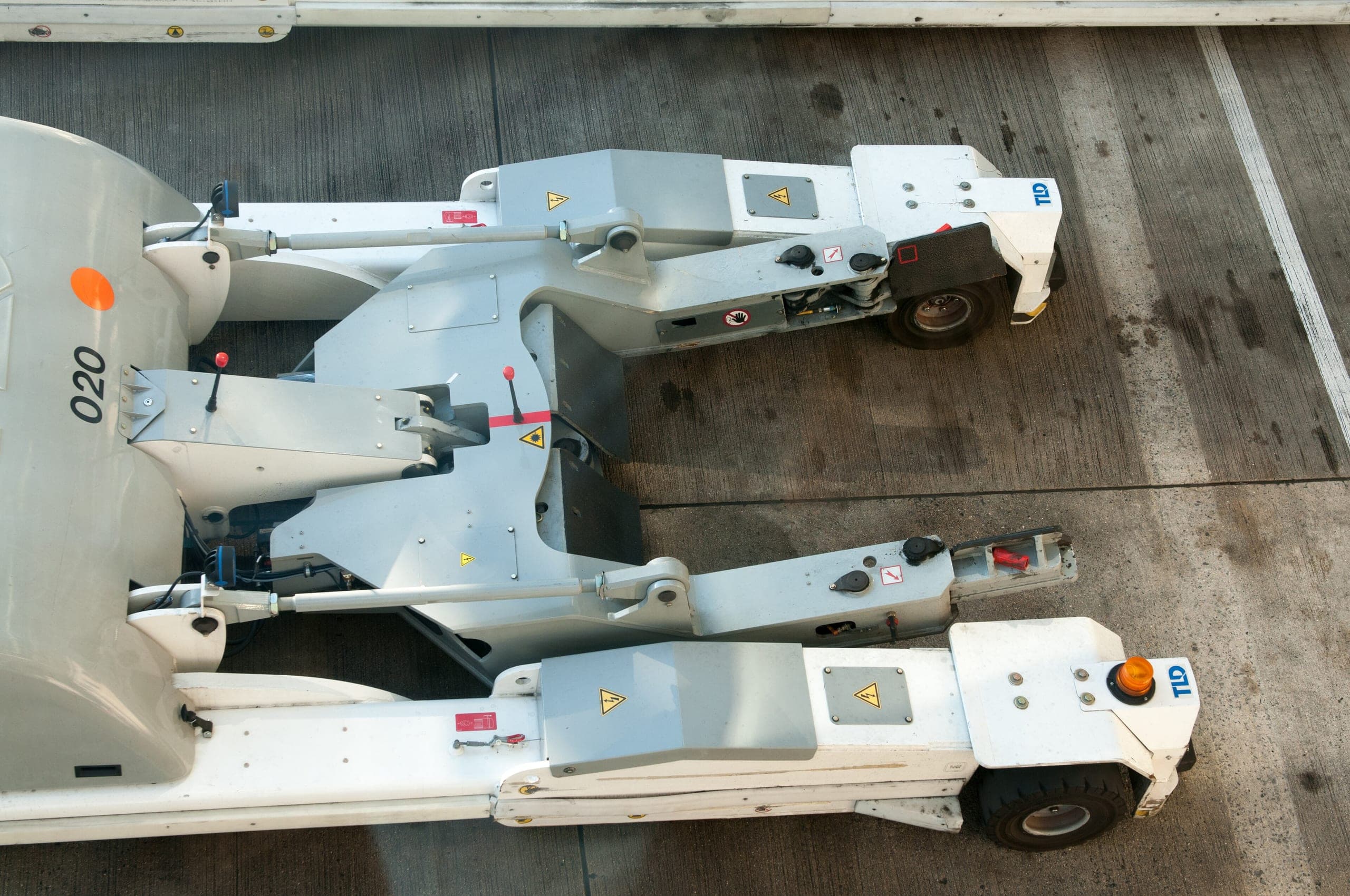
A pushback tractor working the apron at Charles de Gaulle

Terminal 3

Opened 1991 · Originally Aérogare 9

A single-storey shed built in 1991 as a temporary charter facility called Aérogare 9 and never replaced. It handles low-cost and charter traffic on remote stands, boarded by bus, and is the plainest building on an airport otherwise known for its architecture.

Getting there

RER line B
35 min to the city · since 1976
The regional express line runs from beneath Terminal 2 and Terminal 3 to Gare du Nord, Châtelet and the Latin Quarter. It is the cheap way in and the crowded one, shared with the northern suburbs it crosses.
Aéroport Charles de Gaulle 2 TGV station
since 1994
A main-line high-speed station inside the airport, opened with Hall 2C in 1994 on the LGV Interconnexion Est. Trains run to Lille, Brussels, Lyon, Marseille, Bordeaux and Strasbourg without touching Paris: which is why Air France sells rail legs under its own flight numbers and why the airport's catchment is most of northern France rather than one city.
CDGVAL
since 2007
The airport's own driverless shuttle, opened in 2007, linking Terminals 1, 2 and 3 with the car parks and the two rail stations. Before it, moving between terminals meant a bus on the public roads.
Road
The A1 autoroute runs along the western edge of the site and the A104 along the southern, with the airport's own internal road network inside them. A dedicated Paris rail link, CDG Express, has been under construction for years and is not yet open.

Timeline

  1. 1964

    The site is chosen

    Aéroport de Paris settles on farmland around Roissy-en-France, twenty-three kilometres north-east of the city, for an airport to relieve Orly. The decision is taken before the design exists: the state buys the land first and works out what to build on it afterwards.

  2. 1966

    Construction begins

    Work starts on Aéroport de Paris Nord, as it is then called. Paul Andreu, twenty-nine and newly qualified, is appointed architect of the passenger terminal.

  3. March 8, 1974

    The airport opens

    Renamed for Charles de Gaulle, who had died in 1970, the airport opens with one terminal, one runway pair and an Air France flight to New York. Terminal 1 is complete on day one, the opposite of Heathrow, which opened with tents and spent nine years building its first permanent building.

  4. January 21, 1976

    Concorde enters service

    An Air France Concorde leaves for Rio de Janeiro at the same moment a British Airways Concorde leaves Heathrow for Bahrain. Paris to New York follows in November 1977 and runs until 2003.

  5. 1982

    Terminal 2 begins

    The first two halls, 2A and 2B, open as facing crescents. The design is a deliberate answer to Terminal 1's drum: a form that grows by repetition rather than one that is finished the day it opens.

  6. 1994

    The TGV arrives

    A high-speed station opens under Hall 2C on the new eastern interconnection line, putting Lille, Lyon and Brussels within direct reach of the terminals and giving the airport a catchment no other European hub has.

  7. 2000

    The southern doublet is completed

    A fourth runway opens, giving the airport two close-spaced pairs (one north of the terminals, one south) and the capacity to run arrivals and departures simultaneously on each. It is the decision Heathrow has spent forty years arguing about.

  8. June 2003

    Hall 2E opens

    Andreu's long concrete vault opens as the airport's new long-haul pier, a tube without internal columns.

  9. May 23, 2004

    The Terminal 2E collapse

    A thirty-metre section of the vault falls at about seven in the morning, killing four people. The administrative inquiry reports in February 2005 that there was no single fault but a design with very little margin, weakened where steel struts pierced the concrete shell. The pier is demolished and rebuilt to a different structural design.

  10. 2007

    CDGVAL opens

    A driverless shuttle finally joins the three terminals to each other and to the rail stations, thirty-three years after the airport opened.

  11. 2008

    Hall 2G, and the A380

    The last of Terminal 2's halls opens for regional flights, and Air France begins Airbus A380 operations from the rebuilt 2E satellites.

  12. 2024

    Continental Europe's largest airport

    The airport handles 70.3 million passengers, second in Europe behind Heathrow by passengers and second by freight, on a site more than two and a half times Heathrow's area.

  13. 2025

    A record year

    Paris-Charles de Gaulle carries 72.03 million passengers on 473,798 aircraft movements, up 2.5 per cent on 2024 and the busiest year in its history.
Aircraft in this story

Types whose story is bound up with this airport.