Engine
General Electric GE90
GE AerospaceUnited States
- Type
- High-bypass turbofan
- Introduced
- 1995
9:1
Bypass ratio
513.95kN
Peak thrust
Figures for the GE90-115B
General
- Type
- High-bypass turbofan
- Status
- In service
Programme
- Introduced
- 1995
- Built
- 2,800 (as of July 2020)
Architecture
- Configuration
- Two-spool high-bypass turbofan: single-stage fan and 4-stage low-pressure compressor driven by a 6-stage low-pressure turbine; 9-stage high-pressure compressor driven by a 2-stage high-pressure turbine
Induction and fuel
- Fuel system
- Full Authority Digital Engine Control (FADEC), thrust set on fan speed
Weight and size
- Fan diameter
- 127.99 in
- Dry weight
- 19,315 lb
- Length
- 286.65 in
- Width
- 148.39 in
- Height
- 154.57 in
Performance
- Maximum speed
- 11,292 rpm
- Thrust
- 513.95 kN
- Bypass ratio
- 9:1
- Overall pressure ratio
- 42:1
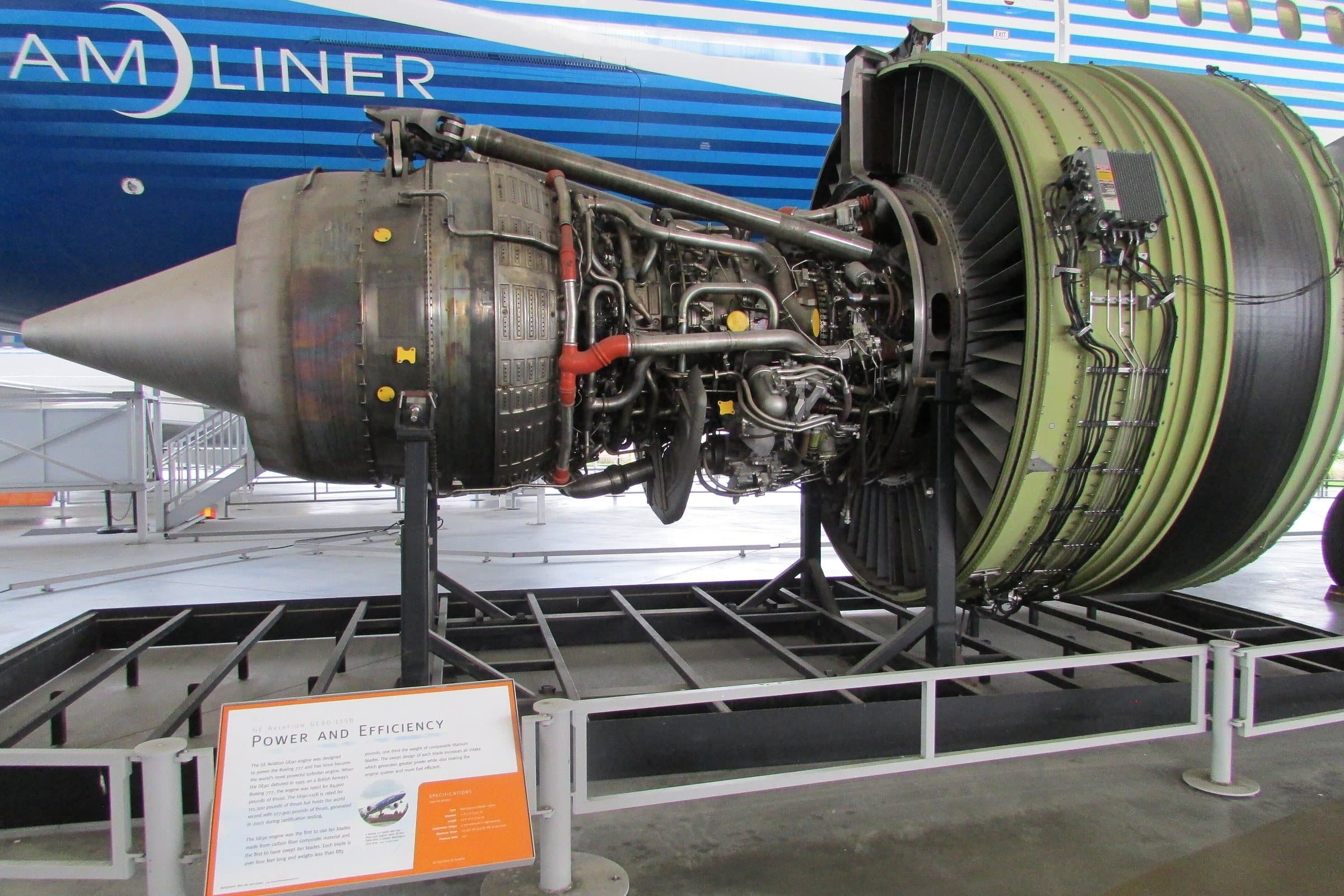
The General Electric GE90 is the family of two-spool high-bypass turbofans built for the Boeing 777, and the engine that carried civil propulsion into the hundred-thousand-pound thrust class. Across the eight models on its type certificate the family is approved for take-off thrusts from 81,070 lbf on the original GE90-76B to 115,540 lbf on the GE90-115B, all measured sea-level static on a calibrated test stand at sea level and 15 °C. On the early 777s it was one of three competing engines; on the long-range versions that followed (the 777-300ER, the 777-200LR and the 777 Freighter) it is the only engine Boeing ever offered, which is an unusual position for a large civil turbofan and the commercial heart of the programme.
Three numbers are habitually confused when the GE90 is written about, and they are worth separating at the outset. The **certified** take-off rating of the most powerful model is 115,540 lbf, which is the figure on the type certificate data sheet and the only one with legal force. The figure GE **markets** is 115,300 lbf, a rounder number the manufacturer prints on its own product page. And the **test** figure is 127,900 lbf, reached on a development engine at Peebles, Ohio, during certification running and recognised by Guinness World Records under a title that says so explicitly: most powerful commercial aircraft jet engine, test performance. None of the three is wrong; they answer different questions, and an article that quotes one without saying which has published a number the reader cannot use.
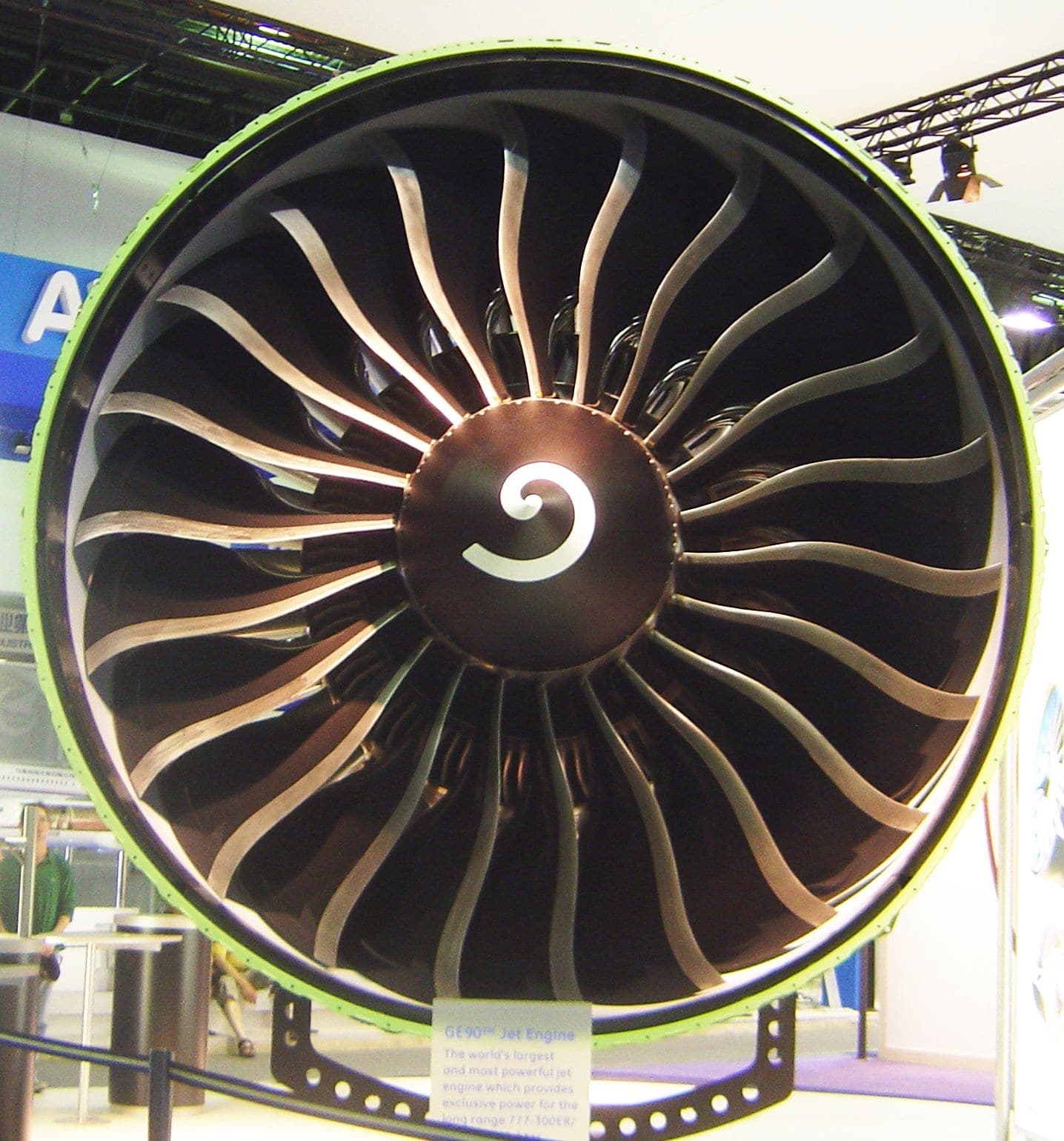
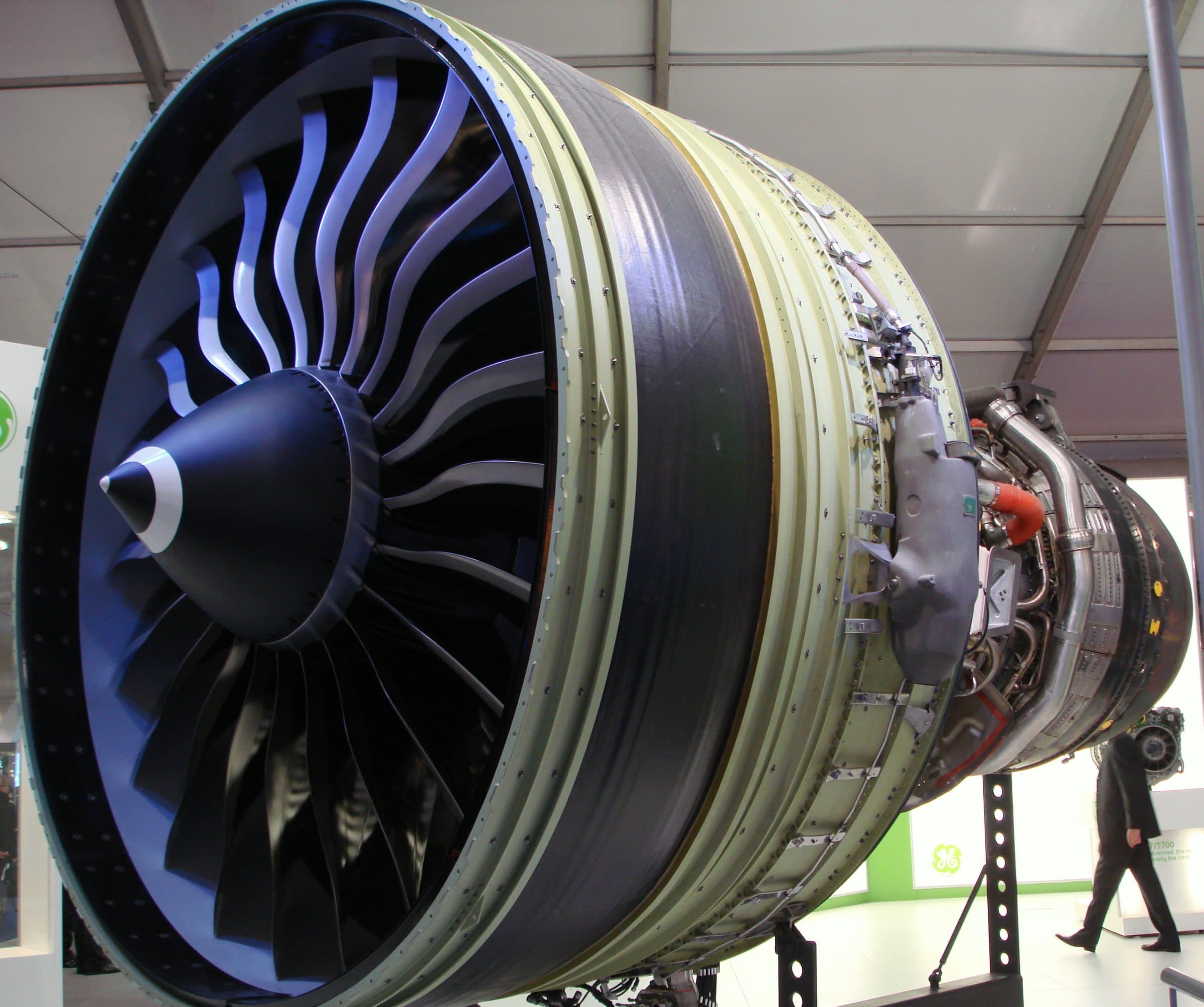
What made the engine technically notable was not its size but its fan. The GE90 was the first commercial turbofan certified with fan blades of carbon-fibre composite rather than titanium, twenty-two of them, swept in three dimensions, with a titanium leading edge, each weighing between 30 lb and 50 lb. That decision propagated forward through every large GE engine since, and no other manufacturer has followed it into production. The engine also carried the first additively manufactured part the United States Federal Aviation Administration certified to fly inside a GE commercial engine.
The family's service record is its other claim. In July 2020 GE announced that the fleet had passed 100 million flight hours, with more than 2,800 GE90-94B and -115B engines delivered, more than 1,200 aircraft flying, seventy operators and dispatch reliability of 99.97 per cent: roughly 2.5 billion passengers carried. Its successor, the GE9X, has a larger fan at 11 ft against the GE90-115B's 10.7 ft and a higher test figure of 134,300 lbf; the GE90 nevertheless remains, by certified take-off thrust, the most powerful engine in airline service.
Aircraft fitted with this engine
Year each aircraft entered service with this engine.
- 1995GE90-76B, -77B, -85B, -90B
Boeing 777-200
One of three engine choices, with the Pratt & Whitney PW4000 and the Rolls-Royce Trent 800. The GE90 entered service on the type with British Airways.
- 2004GE90-115B
Boeing 777-300ER
The exclusive engine. Certified with the aircraft on 19 March 2004 and in service with Air France from May 2004; the best-selling 777 and the largest part of the GE90 fleet.
- 2006GE90-110B1, -115B
Boeing 777-200LR
The exclusive engine. Pakistan International Airlines took the first aircraft from Paine Field on 25 February 2006.
- 2009GE90-110B1L
Boeing 777F
The exclusive engine. Delivered to launch customer Air France on 19 February 2009.
- GE90-76B to -94B
Boeing 777-200ER
One of three engine choices; the extended-range 777-200 on which most early GE90s flew.
- GE90-94B
Boeing 777-300
One of three engine choices on the first stretched 777.
6 aircraft
Development
The GE90 did not begin as a 777 engine. Its composite fan blades came out of GE's experimental work of the 1980s on the GE36 unducted fan, an open-rotor demonstrator whose blades taught the company how to lay up, cure and instrument a large composite aerofoil; when the 777 requirement arrived, that experience was the one asset GE had which nobody else did. The programme was launched in 1990 as GE's entry into the 100,000 lbf class, and it was a deliberate bet by Brian Rowe, then chief executive of the engine business, on Boeing's proposition that a very large long-range airliner could be flown on two engines instead of four. Making that true meant building engines larger than anything in service and using materials civil aviation had not accepted before.
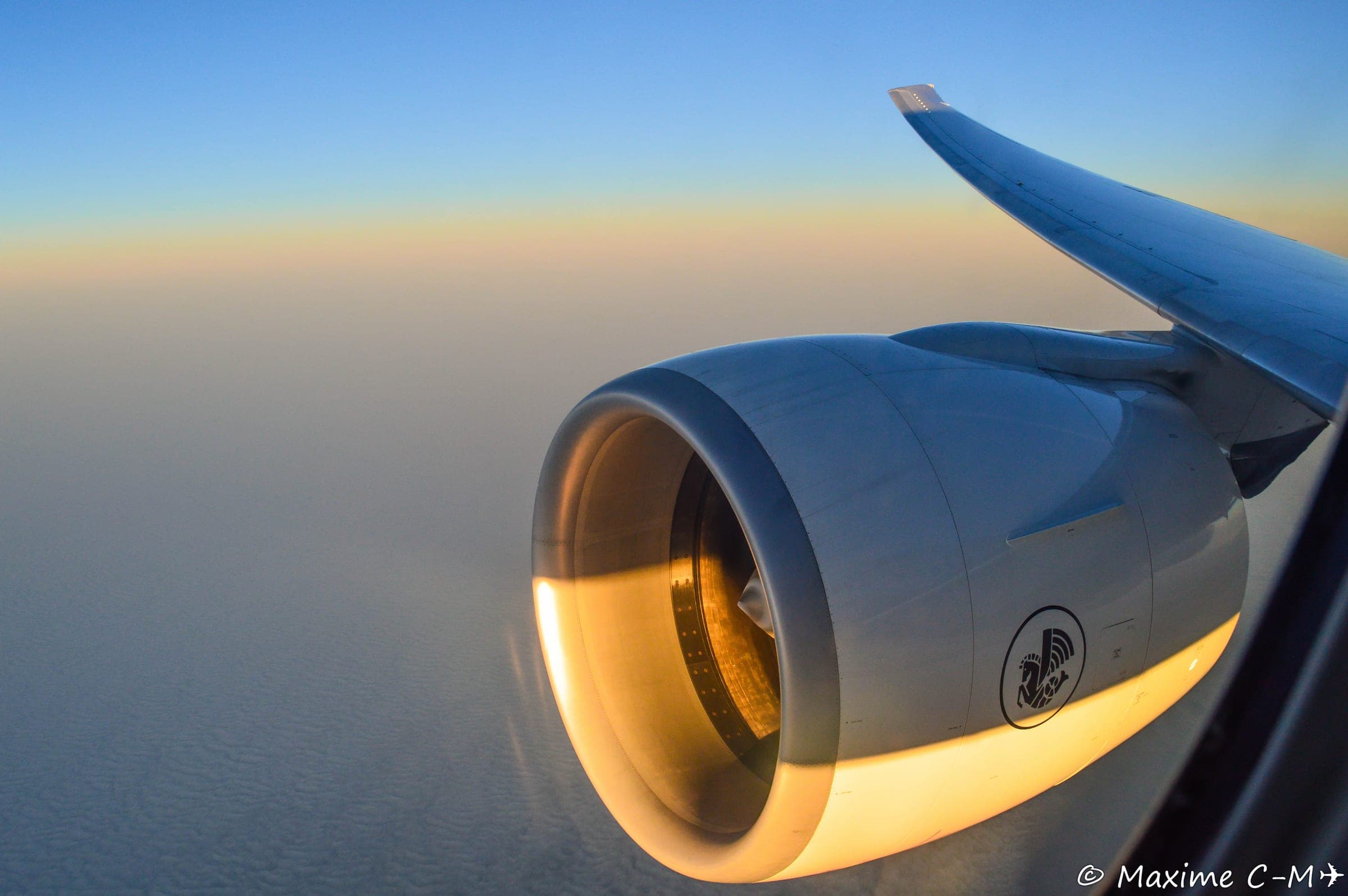 GE90-115B
Certification ran on both sides of the Atlantic at once. GE applied to the Joint Aviation Authorities for the GE90-76B and -85B on 24 January 1992. GE dates the American certificate to Friday 2 February 1995, signed in a conference room at Evendale, Ohio; the European certificate for the same two models followed on 3 November 1995. The engine entered service on 17 November 1995 with British Airways, on a Boeing 777 between London and Dubai.
Then the programme very nearly died. The GE90 was expensive, unproven and, in the judgement of the airlines being asked to buy it, risky, and it lost sale after sale to the Rolls-Royce Trent 800 and the Pratt & Whitney PW4000. British Airways, the launch operator, ordered Rolls-Royce for its later aircraft. GE took a write-off of 275 million dollars in 1998, and Jack Welch, the chairman of the parent company, told an executive that the GE90 was dead and to put a stake in its heart. By GE's own later account, what saved it was that the engineering team at Evendale, backed by the aviation unit's president Jim McNerney, refused to accept the verdict, and that the GE90's fuel efficiency was quietly winning it admirers among the 777 operators who had bought it.
The rescue came from the airframe. Boeing wanted a much longer-ranged 777, and that aeroplane needed more thrust than anything certified. After eight months of negotiation Boeing selected the GE90-115B in July 1999 as the sole powerplant of the longer-range 777 family, the decision that turned the programme around and, with it, GE's position in the widebody market for the next two decades.
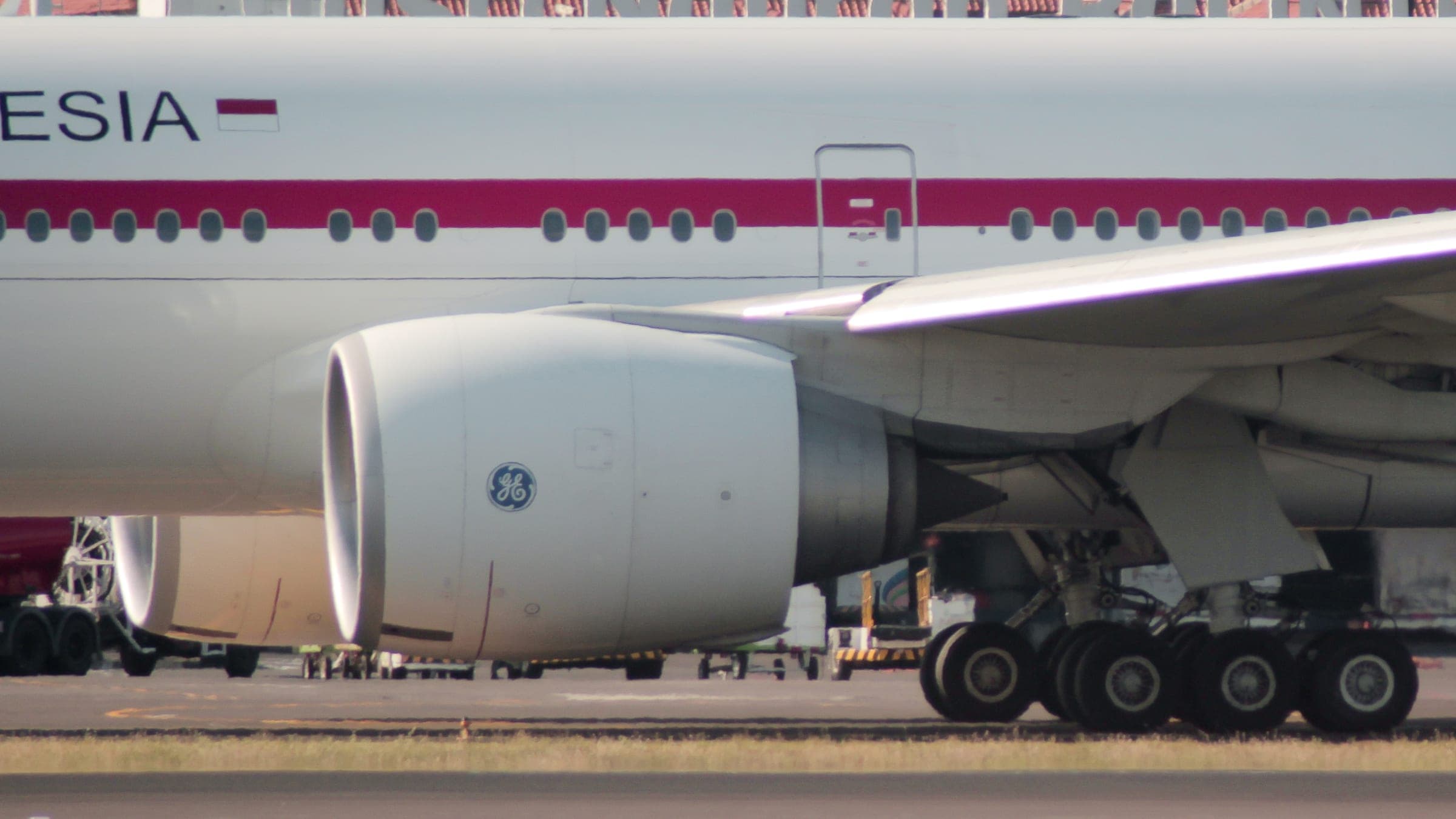 GE90-115B
The GE90-115B was a substantial redesign rather than a rating change. The fan grew from 10.2 ft to 10.7 ft in diameter, keeping the same fibres and resin system as the existing composite blades but in a new swept form; the high-pressure compressor was reduced from ten stages to nine with three-dimensional aerodynamics; the low-pressure compressor gained a fourth stage; and a new high-strength steel, GE1014, was used for the fan mid-shaft to carry the extra torque without growing the shaft. Blade impact testing with birds of 2.5 lb to 8 lb ran through the summer of 2001, and the first complete engine ran at Peebles, Ohio, on Friday 16 November 2001. Three days later it produced 120,316 lbf, settling at 117,446 lbf in steady state, already a record, and beat that again on the Monday.
The engine first flew on 18 September 2002, hung on GE's Boeing 747 flying testbed at Mojave, California, for a flight of 2 hours 13 minutes. It completed its FAR Part 33 certification testing on 31 January 2003, and it was during the mandatory 150-hour block test, some sixty hours of it at triple red-line, meaning maximum fan speed, maximum core speed and maximum exhaust gas temperature together, that it reached 127,900 lbf. GE's own chief executive at the engine business, David Calhoun, was careful about what that meant: the record, he said, was not a test objective but simply what fell out of a programme designed for airworthiness certification. The FAA certified the -115B in July 2003; the European certificate for the -110B1, -113B and -115B is dated 18 December 2003 on the type certificate data sheet, and GE announced it on 22 December.
The aeroplane followed. On 15 October 2003 a 777-300ER flew from Seattle to Taipei in about thirteen hours with one GE90-115B shut down for 330 minutes, the longest single-engine demonstration ever flown in support of extended-range twin-engine operations approval. The FAA and EASA certified the GE90-115B-powered 777-300ER on 19 March 2004 after an eleven-month flight-test programme of nearly 1,500 flight hours and a thousand hours on the ground, and the aircraft entered revenue service with Air France in May 2004.
Design
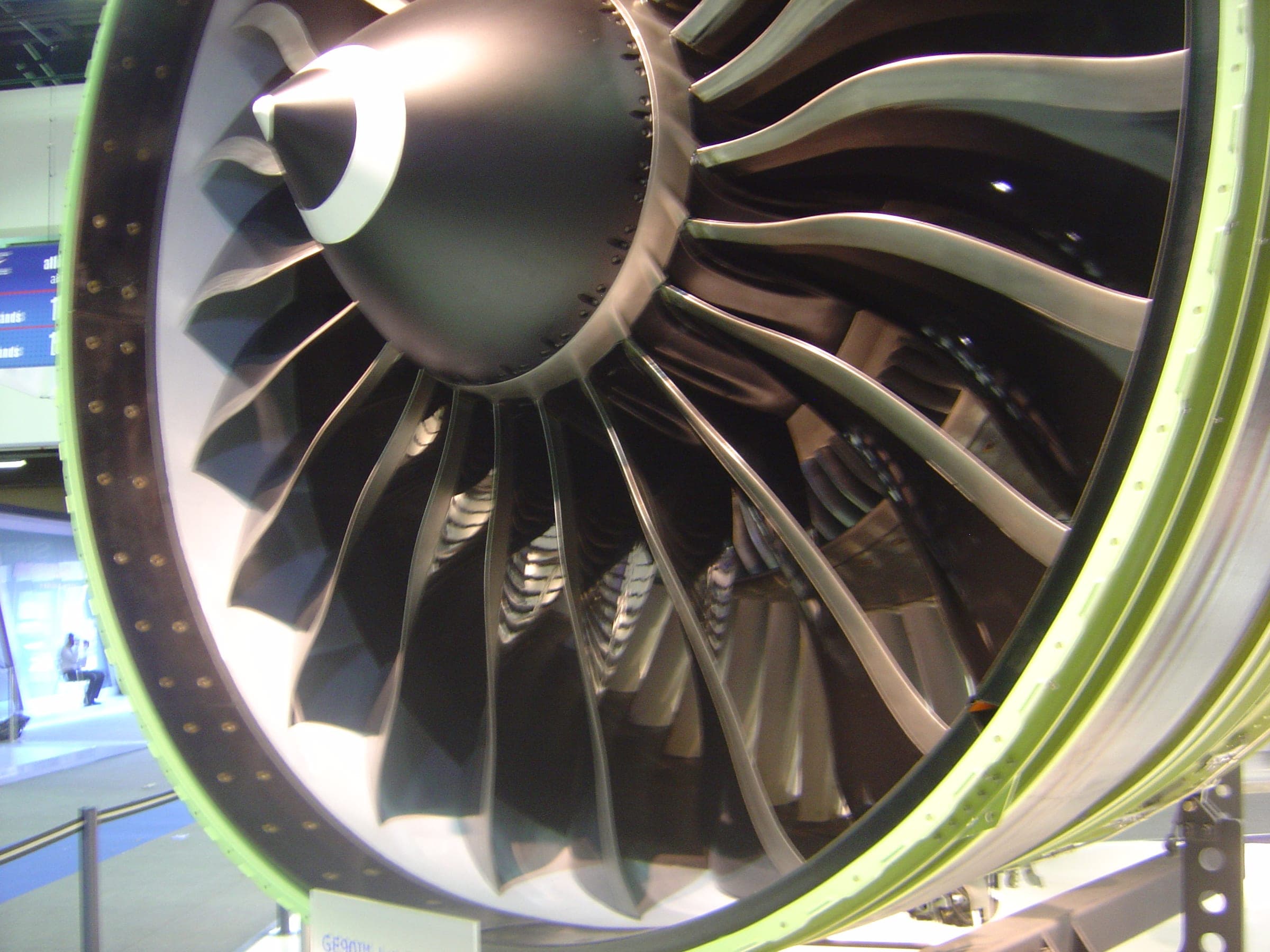
Architecturally the GE90 is conventional: a two-spool, axial-flow, high-bypass turbofan, with none of the three-shaft intricacy of its Rolls-Royce contemporary. The type certificate describes the first five models as a single-stage fan and three-stage low-pressure compressor driven by a six-stage low-pressure turbine, with a ten-stage high-pressure compressor driven by a two-stage high-pressure turbine. The -100 series (the -110B1, -113B and -115B) rearranges the same architecture: four low-pressure compressor stages instead of three, and nine high-pressure stages instead of ten, the reduction bought with three-dimensional aerodynamic blading. The certificated engine includes its starter and mounts and excludes the thrust reverser, which is a Boeing part.
The proportions are what a reader notices. The -100 series is 23.9 ft long from fan spinner to nozzle centre body, 12.9 ft tall and 12.4 ft wide at the maximum envelope, and weighs 19,310 lb dry; the earlier models are two millimetres longer, a little wider, and much lighter at 17,400 lb. The fan turns at 2,355 rpm at 100 per cent on the -100 series against 2,261.5 rpm on the earlier engines, and the core turns at 9,332 rpm at 100 per cent on every model in the family. Bypass ratio is about 9:1 and overall pressure ratio is 40 on the GE90-94B and 42 on the -115B. GE's comparison for the fan diameter is the fuselage of a Boeing 727.
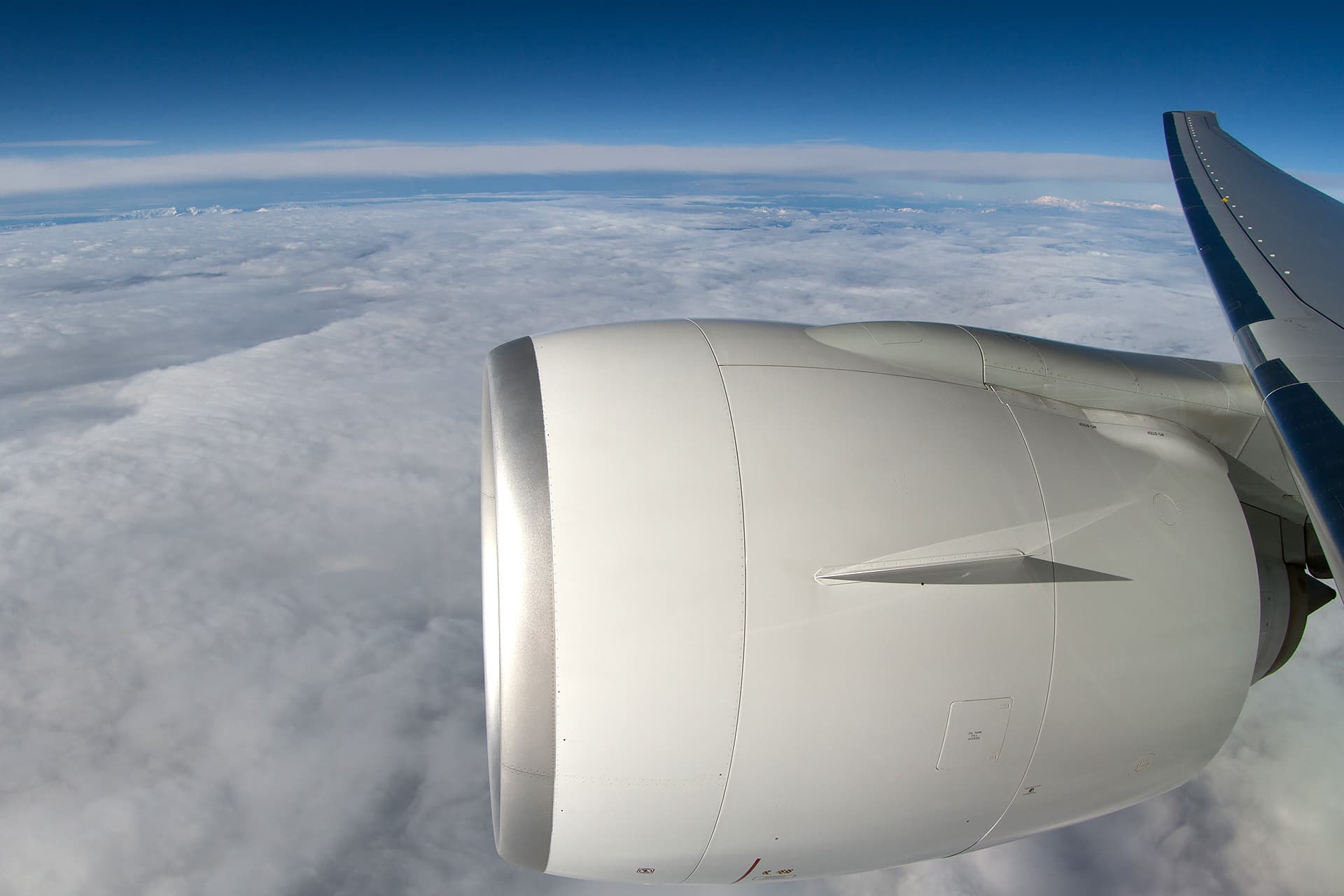
The fan is the engine's argument. Twenty-two blades of carbon fibre in a toughened epoxy matrix, each nearly 4 ft long, are given a titanium leading edge to take erosion and impact, and each weighs between 30 lb and 50 lb: the composite is what makes that possible, and it is also what makes the blades black. They are swept in three dimensions rather than merely being cambered, because at take-off power the blade tip is travelling faster than sound and the curve is an attempt to keep the shock wave off the blade surface. GE's reasoning for the whole arrangement is that composite blades weigh about a third of a titanium blade of the same strength, and a lighter blade can be a bigger blade: a bigger fan moves more air, which raises bypass ratio, which is where a modern turbofan's efficiency lives. A slower-turning fan of large diameter is also quieter than a smaller one making the same thrust, which in 1997 GE was already claiming allowed twice as many movements as competing engines at noise-restricted airports such as Heathrow and Gatwick.
The fan's containment is treated as a certification subject in its own right: fan blade containment is one of three special conditions the European authority imposed on the -110B1, -113B and -115B, alongside medium and large bird ingestion and the use of programmable logic devices. The certificate also carries notes on what happens when a blade does let go: the loads from a blade released at the inner flow-path line are specified in the installation manual, and the loads from a release at the outermost retention groove are held by GE, and a note restricting repair of composite blade material in the root section to the procedures in the airworthiness limitations.
Control is by full-authority digital engine control, with the rating itself set by a plug: the difference between a GE90-76B and a GE90-85B, or between a -113B and a -115B, is in several cases a rating plug change and nothing more in the gas path. Thrust is set and checked on fan speed rather than on pressure ratio, and speed sensors are part of the engine assembly for that purpose. The engine also drives the aircraft's accessories through a gearbox with pads for a 120 kVA integrated drive generator, a hydraulic pump and a variable-speed constant-frequency generator, rated at 243, 85 and 58 horsepower continuous respectively. GE's own list of the engine's firsts includes a core designed to be free of foreign object damage, using variable bleed valve doors to throw ingested debris outward into the bypass duct rather than let it into the compressor.
Fuel and carburation
The GE90 is flat-rated, which is the single most important thing to understand about its published thrust. The engine holds its certified take-off figure as the ambient temperature rises until it reaches a stated limit, and only above that does thrust fall away. The limits are model-specific and are on the certificate: 30 °C for the GE90-85B, -90B, -94B, -113B and -115B; 32.8 °C for the -76B and -77B; and 33 °C for the -110B1, the highest in the family. Maximum continuous ratings are flat-rated to 25 °C throughout. The published ratings assume a calibrated test stand with no customer bleed or shaft power extraction, an ideal inlet with full ram recovery, production cowling and instrumentation, and a fuel of 42,798 kJ/kg lower heating value: conditions that are all stated on the certificate precisely because none of them obtains on a wing.
Fuel and oil specifications are held on the American certificate rather than the European one, which defers to it. The pressure limits at the engine pump inlet are on both: a maximum of 482.6 kPa, a minimum of 34.5 kPa with the aircraft fuel system fully operational, and at 38,000 ft and below a tolerance for excursions of fifteen seconds or less down to 20.7 kPa provided the average stays above 27.6 kPa. Oil is allowed to 132 °C continuous and 143 °C transient for a quarter of an hour on the -100 series, against 124 °C and 135 °C on the earlier models, a plain measure of how much harder the later engines run. Exhaust gas temperature, measured at the low-pressure turbine inlet, tells the same story: 1,090 °C at take-off on the -100 series against 975 °C on the GE90-76B.
All GE90 models are approved for time-limited dispatch, the arrangement that allows an aircraft to be released with a redundant channel of the engine control system inoperative for a defined interval, with the configurations and maximum intervals set out in the airworthiness limitations section of the engine manual.
The family's most recent fuel story is about what goes into it rather than how it is metered. On 30 January 2023 Emirates flew a Boeing 777-300ER out of Dubai for more than an hour over the coast with one GE90 running on 100 per cent sustainable aviation fuel and the other on conventional kerosene: the first time a passenger airline had run a GE engine on a Boeing 777 that way. 40,000 lb of fuel were blended for the flight, combining hydroprocessed esters and fatty acids from Neste with a hydrodeoxygenated synthetic aromatic kerosene from Virent, the aromatic component being what allows an unblended synthetic fuel to behave like the jet fuel the aircraft's seals and systems were designed around. Sustainable fuel is approved in service only in blends of up to 50 per cent, and the point of the flight was to add evidence towards approval of higher proportions; the engine required no modification and no special maintenance procedure.
Production
The GE90 is built by a consortium rather than by GE alone. Snecma of France, now Safran Aircraft Engines, IHI of Japan and FiatAvio of Italy are all revenue-sharing partners on the programme, and GE identified the three of them as such when the GE90-115B first flew in 2002. Assembly and the programme office are at Evendale, Ohio, and development running is done at the open-air test complex at Peebles in the same state, where both the 2001 and 2003 thrust records were set.
The composite fan blades are made by a company created for the purpose. CFAN was set up in 1993 as a fifty-fifty joint venture between GE and Snecma at San Marcos, Texas, and it has made the GE90's blades from the start. The learning curve was severe and GE has published the numbers: at the beginning of production the yield on a composite fan blade was under 30 per cent, meaning that more than two blades in three were scrapped, and by 2015 it was above 97 per cent. Output over the same period tells the story from the other side (5,000 blades in 2009 and 14,000 in 2014) as the same plant took on the blades of the GEnx and later the GE9X.
Deliveries are substantial for an engine of this size and this narrow an application. By early 2020 GE put the total at close to 3,000 engines since 1995, of which more than 2,500 were then in service with over seventy carriers, most of them the higher-thrust GE90-115B. The July 2020 milestone announcement counted more than 2,800 GE90-94B and -115B engines delivered, and GE's product page still gives more than 2,800 delivered worldwide. Orders ran well past the programme's own expectations: GE's account of the turnaround records an internal forecast of some 500 engines against which Boeing's orders were a considerable overshoot.
The production ramp of the -115B can be read in the order book of the time. In February 2003, at the record test, twenty-one customers had ordered 225 firm and 44 option GE90-powered 777s, more than 7.5 billion dollars of engine value. By December 2003 the -115B alone accounted for orders of more than 2.6 billion dollars against 76 longer-range aircraft, and by mid-2006 nearly 900 GE90s had been ordered for the 777 family, about 450 of them -115Bs.
In service
The GE90 entered service on 17 November 1995, on a British Airways Boeing 777 from London to Dubai. Twenty months later GE was able to publish a record that few new large turbofans have matched: no in-flight shutdowns at all, 99.97 per cent dispatch reliability and more than 30,000 revenue flight hours. The fleet at that point was small, twelve aircraft at British Airways and six at China Southern, with orders from Air France, Continental, Kuwait Airways, Lauda Air, Saudi Arabian Airlines and two leasing companies behind them.
The GE90-115B's entry was the one GE called its best ever. The engine went into service with Air France in May 2004 on a 777-300ER leased from International Lease Finance Corporation. By July 2006 the -115B fleet had accumulated more than 360,000 flight hours across 46 aircraft with 99.97 per cent departure reliability, no in-flight shutdowns, no forced removals and only two scheduled ones; Emirates, with sixteen aircraft, had recorded a single engine-caused delay and no removals since April 2005. GE ran a four-year reliability and maturation programme in parallel using three development engines to simulate twenty years of airline life, and at the March 2004 certification it had completed about a quarter of the cycles.
The fleet then grew for fifteen years without interruption, because its aircraft did. On 24 July 2020 GE announced that the GE90 had passed 100 million flight hours, an average of more than four million a year, with over 1,200 aircraft flying, seventy operators, more than 2,800 engines delivered, dispatch reliability of 99.97 per cent and roughly 2.5 billion passengers carried. GE's own figure for total flights was around 28 million. Among the largest operators are Emirates, Qatar Airways, Cathay Pacific and Air France, each with more than a hundred engines, principally on the 777-300ER.
A caution about the fleet numbers is worth stating, because the encyclopedia's own sources disagree. On how long the GE90 held the thrust record, GE has published "13 years", "nearly 15 years" and "17 years" in three different documents within the same year; the underlying dates, a record set in 2002 and a rival figure reached in November 2017 and certified in July 2019, are consistent, and it is the arithmetic in the marketing copy that varies. Where a figure here decays with time, it carries the date GE published it.
Reliability and maintenance
For an engine whose early reliability GE advertised, the GE90's troubles have been few, specific and mostly mechanical rather than thermodynamic. The first arrived within two years of service entry: gearbox bearing wear on British Airways' GE90-76Bs, which led the airline to withdraw its 777s from transatlantic flying in 1997 and to return them later the same year. Accounts of the episode are secondary and the encyclopedia has not been able to find a primary record of the withdrawal, so it is stated here as reported rather than as established.
What is on the record is a life-limits directive of the same period. In 1997 GE's refined analysis of low-cycle fatigue found calculated lives on several rotating parts of the GE90-76B lower than the retirement lives already published, and the FAA responded with airworthiness directive 98-09-15, effective 6 July 1998, cutting the limits on the high-pressure compressor rotor spool, its compressor discharge pressure seal and the low-pressure turbine cone shaft. The unsafe condition named was low-cycle fatigue failure of a rotating component and possibly an uncontained engine failure: which is to say that the analysis, not a service failure, drove the action.
The family's most serious service problem was in the transfer gearbox of the -100 series. In May 2013 two GE90-110B1 and -115B transfer gearboxes failed in service, each causing an in-flight shutdown, and investigation traced both to cracking and separation of the transfer gearbox radial gear; inspection found two further cracked gears. The FAA issued emergency airworthiness directive 2013-10-52 on 16 May 2013, adopted in the Federal Register on 26 June, prohibiting operation of an aircraft with affected gearboxes on both engines: a prohibition that cost operators nothing directly, since it was an operating restriction rather than a modification, and which affected twenty engines on the United States register.
The same component returned eight years later across almost the whole family. Two more in-flight shutdowns were traced to high-cycle fatigue failure of the transfer gearbox radial gearshaft, and GE determined that rework of the gear-tooth chamfers during manufacture had left local burrs and microcracks. Airworthiness directive 2021-26-06, effective 15 February 2022, required a one-time visual inspection of the radial gearshaft on GE90-76B, -85B, -90B, -94B, -110B1 and -115B engines with the affected part fitted, and replacement where burrs or rework were found.
Against that, the fleet-wide figures have stayed where GE put them. Dispatch reliability is quoted at 99.97 per cent for the family and 99.98 per cent for the mature GE90-115B, and the engine has spent a quarter of a century as the benchmark for extended twin-engine operations.
Upgrades
The GE90's development pattern is unusual in that most of its models are the same engine at a different setting. The certificate's own summary makes this plain: the GE90-85B differs from the basic -76B only in higher thrust ratings and a rating plug change; the -77B adds an improved high- and low-pressure turbine flowpath; the -90B is a -77B at higher ratings; and the -94B is a -90B with a three-dimensional aerodynamic high-pressure compressor. Within the -100 series the -113B and the -115B are each described as the -110B1 at a higher rating, with a rating plug change and nothing else. A programme that can raise thrust by reprogramming a plug has a great deal of margin designed into it, and that margin is what the test record of 127,900 lbf demonstrates.
The one genuine step change is the -100 series itself, and the certificate is precise about what it involved: the -110B1 differs from the basic model primarily in fan, low-pressure compressor, high-pressure compressor, high-pressure turbine and low-pressure turbine hardware, with higher take-off thrust, increased rotor speeds and raised temperature limits. Permissible speeds went from 2,465 to 2,602 rpm on the low-pressure rotor and from 10,918 to 11,292 rpm on the high-pressure spool, and take-off exhaust gas temperature from 1,030 °C to 1,090 °C.
Continuous improvement then happened inside the fleet rather than in new model numbers. GE credits the mature GE90-115B with a 3.6 per cent reduction in fuel burn against its initial configuration and a reliability rate of 99.98 per cent, and the 777-300ER's own fuel burn beat prediction by that same 3.6 per cent, over a million litres of fuel a year on a single aircraft.
The most widely noted retrofit was small and made in a new way. The housing of the T25 sensor, which sits in the inlet to the high-pressure compressor and reports pressure and temperature to the engine control, had a history of icing trouble. GE redesigned it as an additively manufactured part in cobalt-chrome, the FAA certified it on the GE90-94B in February 2015, and GE announced in April that it was being retrofitted into more than 400 engines in service. It was the first 3D-printed part the FAA certified to fly inside a GE commercial engine, and the programme manager's estimate was that printing it saved about a year of the development time a conventionally cast housing would have taken. The technique went on to the fuel nozzles of the LEAP and the GE9X.
Applications
Every GE90 ever built has flown on a Boeing 777, and the certificate is the reason it could not easily have been otherwise. Two of its notes record that compliance with the icing requirements of FAR 33.68 and with the thrust-response requirement was demonstrated specifically for the 777-200LR, the 777-300ER and the 777 Freighter installations, and that fitting a -110B1, -113B or -115B to any other aircraft type would require a separate evaluation of both. The engine is not a general-purpose powerplant; it is a 777 powerplant.
 GE90-94B
On the original aircraft it competed. The 777-200 and the 777-200ER were offered with the GE90, the Pratt & Whitney PW4000 and the Rolls-Royce Trent 800, and the GE90 entered service on the type with British Airways in 1995. The stretched 777-300 that followed was likewise a three-engine choice, with the GE90-94B the GE option. It was on these aircraft that the engine came closest to failing commercially, which makes the second half of its application list the more striking.
The longer-range aircraft are GE-only. The 777-300ER entered service with Air France in May 2004 on the GE90-115B; the 777-200LR entered service with Pakistan International Airlines, which took the world's first aircraft from Paine Field on 25 February 2006 and flew it via Manchester to Islamabad before opening non-stop Karachi to Toronto service on 3 March; and the 777 Freighter was delivered to launch customer Air France on 19 February 2009 with GE90-110B1L engines, carrying 227,000 lb of payload over 4,880 nm. On all three, the GE90 is not an option but the aircraft's only engine, and that exclusivity is why GE90-powered aircraft dominate the 777 fleet: GE's 2020 count was more than 1,200 aircraft with seventy operators.
Operators of the GE90 read as a list of the long-haul industry. Emirates, Qatar Airways, Cathay Pacific and Air France each operate more than a hundred of the engines, principally on the 777-300ER, and by 2020 seventy carriers between them had over 2,500 in service. The fleet's freight half is smaller but strategically important, since the 777 Freighter is the aircraft that made large twin-engine freighters economically credible against the four-engine 747.
Records
The GE90's records are worth reading with the units and the basis attached, because the engine's reputation rests on a figure that is not its rating.
The thrust record was set at Peebles, Ohio, during certification running of a GE90-115B development engine, and announced on 5 February 2003: 127,900 lbf, reached in the course of the mandatory 150-hour block test, about sixty hours of which were run at triple red-line. GE said the figure surpassed a previously recognised mark of 122,965 lbf. Guinness World Records recognised it under the title "most powerful commercial aircraft jet engine (test performance)", and the parenthesis is the whole point: this is what a development engine did on a stand, not what a production engine is approved to deliver. The certified take-off rating of the GE90-115B is 115,540 lbf; the figure GE prints for the same engine is 115,300 lbf. The record was superseded by GE's own GE9X, which reached 134,300 lbf during an engineering test at the same Peebles complex on 10 November 2017 and was recognised by Guinness on 12 July 2019.
Progressive records had come earlier in the same programme. On the -115B's first test run in November 2001 the engine reached 120,316 lbf and settled at 117,446 lbf in steady state, a record it then broke again the following day. The engine had not yet flown.
The aircraft's records are the GE90's too, since it was the only engine available. On 9 to 10 November 2005 a Boeing 777-200LR flew 11,664 nm non-stop and without refuelling from Hong Kong to London in 22 hours 42 minutes, eastbound across the North Pacific, North America and the north Atlantic: recognised by Guinness World Records as the farthest flight by a commercial aircraft, and the longest flight ever made by an unmodified airliner. And in the operational rather than the record category, the GE90-115B's combination of efficiency, reliability and power is what allowed the 777-300ER to be approved for extended twin-engine operations of about 330 minutes, meaning the aircraft could fly nearly six hours on one engine to reach a diversion airport, the capability GE's own engineers describe as having opened the southern hemisphere to twin-engine airliners.
Preservation
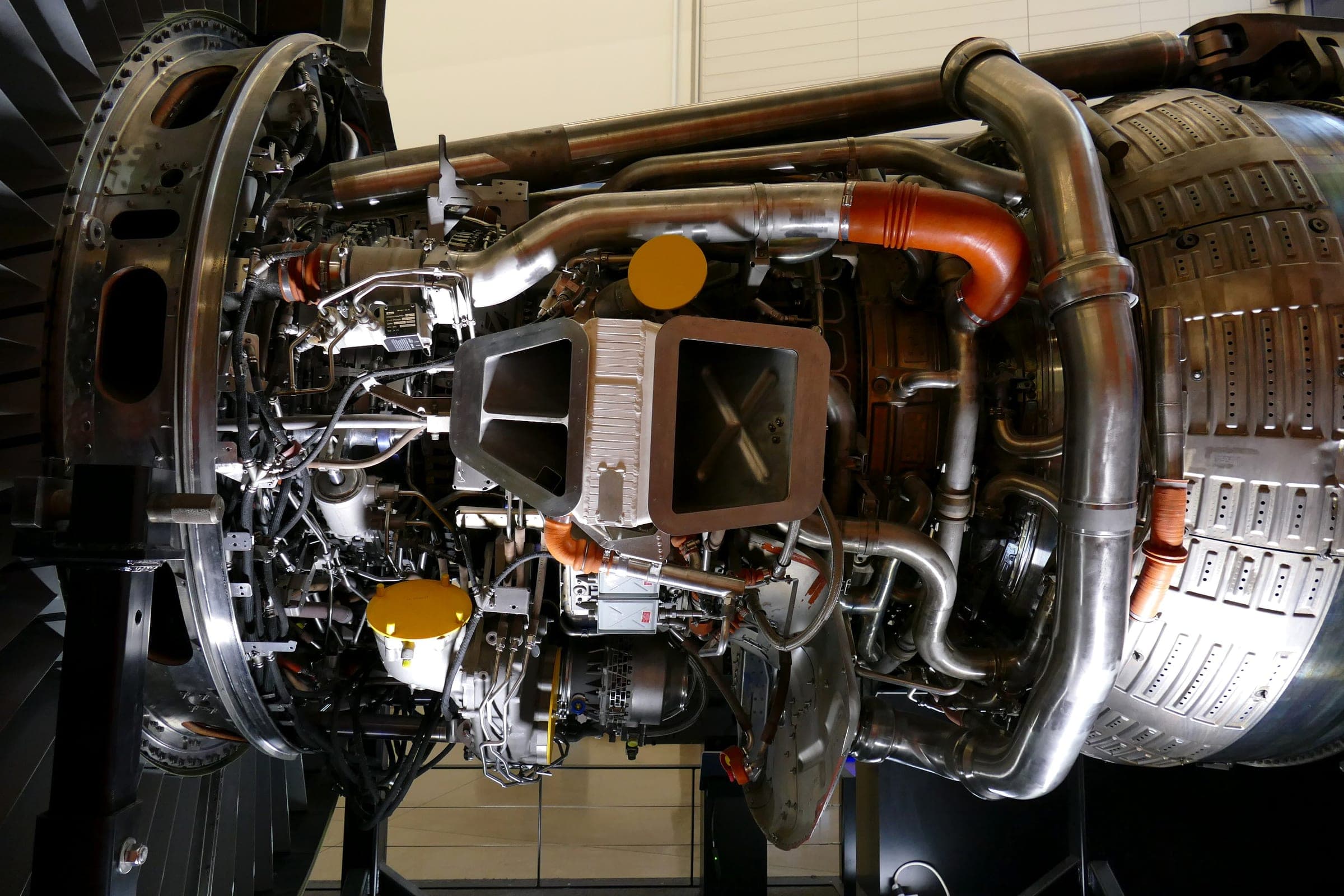
The GE90's best-known preserved object is a single fan blade. On 16 November 2004 the Museum of Modern Art in New York announced that it had acquired a GE90-115B fan blade for its Architecture and Design collection: a carbon-fibre composite aerofoil nearly 4 ft long with a titanium leading edge, one of the twenty-two that made the engine possible. GE's own account of the acquisition is unusually candid about why a museum would want it: the blade's undulating form is not styling but the direct expression of an aerodynamic problem, which is as close as a jet engine comes to the museum's usual argument about design.
Whole engines are shown rather than preserved, because the GE90 is still in production and still in service. A complete engine is displayed at the Future of Flight centre beside Boeing's Everett plant, the factory where every 777 was assembled, and cutaway and display engines have appeared regularly at the major air shows: a GE90 was among the exhibits at Farnborough in 2008. These are exhibition engines rather than museum pieces in the ordinary sense: no GE90 has yet reached the end of its type's life, and the family's retirement, when it comes, will be a slow one following the 777s it powers.
Legacy
The GE90's legacy is not its thrust but its fan. Having certified the first composite fan blades in commercial aviation, GE never went back: every large engine it has launched since carries them, and no other manufacturer has yet followed the technology into production. The lineage is visible in the blade count, because a stronger, stiffer composite lets each generation do the same work with fewer and thinner blades: twenty-two on the GE90, eighteen on the GEnx together with a carbon-fibre composite fan case that took nearly 400 lb out of the engine, sixteen on the GE9X. CFM's LEAP carries composite blades from the same lineage onto the narrowbody. GE's engineers describe the GE9X's first flight on the 777X not as a new era but as the continuation of one, because its two most conspicuous features, composite blades and additively manufactured parts, both began on the GE90.
The second inheritance is commercial. The GE90 was GE's entry into the 100,000 lbf class, and the argument it was built to prove was Boeing's: that a very large, very long-range airliner could be flown on two engines instead of four, saving fuel, which is up to a fifth of an airline's operating cost, and halving the number of engines to maintain. The GE90-115B and the 777-300ER settled that argument. Extended twin-engine operations of about 330 minutes turned oceans and empty hemispheres into ordinary twin-engine airspace, and the four-engine long-haul airliner has not been launched since.
The third is a lesson in programme management that GE tells about itself. An engine written off for 275 million dollars in 1998, that the chairman of the parent company declared dead, and whose launch operator defected to a competitor, went on to become the most-delivered engine in its class, to hold the world thrust record for the better part of two decades, to pass 100 million flight hours, and to carry something like 2.5 billion passengers. GE's own retrospective calls it the company's greatest comeback story, and the more sober version of the same claim is on the certificate: eight models, one airframe family, and thirty years of continuous service from an engine nobody wanted to buy.
Output by altitude
A piston engine has no single power figure. Each rating below is what the sources publish for one mark under one set of conditions, at the altitude it was measured at.
| Mark and conditions | Altitude | Output |
|---|---|---|
| GE90-76Btake-off, 5 minutes, sea-level static · flat-rated to 32.8 °C | Sea level | 360.62kN |
| GE90-77Btake-off, 5 minutes, sea-level static · flat-rated to 32.8 °C | Sea level | 363.42kN |
| GE90-85Btake-off, 5 minutes, sea-level static · flat-rated to 30 °C | Sea level | 395.31kN |
| GE90-90Btake-off, 5 minutes, sea-level static · flat-rated to 30 °C | Sea level | 418.13kN |
| GE90-94Btake-off, 5 minutes, sea-level static · flat-rated to 30 °C | Sea level | 432.81kN |
| GE90-110B1take-off, 5 minutes, sea-level static · flat-rated to 33 °C | Sea level | 492.68kN |
| GE90-113Btake-off, 5 minutes, sea-level static · flat-rated to 30 °C | Sea level | 505.01kN |
| GE90-115Btake-off, 5 minutes, sea-level static · flat-rated to 30 °C | Sea level | 513.95kN |
| GE90-115B, maximum continuousmaximum continuous, sea-level static · flat-rated to 25 °C | Sea level | 489.3kN |
Mark evolution
GE90-76B
1995360.62 kNThe basic model, certified in Europe on 3 November 1995 and the engine the GE90 entered service with on a British Airways Boeing 777.
GE90-77B
1997363.42 kNCertified in Europe on 23 January 1997.
Improved high- and low-pressure turbine flowpath and a higher take-off rating; rating plug change.
GE90-85B
1995395.31 kNCertified in Europe on 3 November 1995 alongside the -76B.
Higher thrust ratings only; rating plug change.
GE90-90B
1997418.13 kNCertified in Europe on 23 January 1997.
A GE90-77B at higher thrust ratings; rating plug change.
- GE90-94B
A GE90-94B under the wing of a Continental Airlines Boeing 777-200ER in 2009 GE90-94B
2000432.81 kNCertified in Europe on 8 November 2000; the most powerful engine of the original series and the model that carried the first additively manufactured part GE flew.
Three-dimensional aerodynamic high-pressure compressor and higher thrust ratings; rating plug change.
GE90-110B1
2003492.68 kNCertified in Europe on 18 December 2003 and the engine of the 777 Freighter, in which form it is designated GE90-110B1L. Flat-rated to 33 °C, the highest in the family.
New fan, low- and high-pressure compressor, and high- and low-pressure turbine hardware; higher take-off thrust with increased rotor speeds and raised temperature limits.
GE90-113B
2003505.01 kNCertified in Europe on 18 December 2003.
A GE90-110B1 at higher thrust ratings; rating plug change.
- GE90-115B
A GE90-115B installed on a Boeing 777 in 2015 GE90-115B
2004513.95 kNThe most powerful model, certified in Europe on 18 December 2003 and in service with Air France on a Boeing 777-300ER from May 2004. It reached 127,900 lbf on test in 2002, a record it held until the GE9X.
A GE90-110B1 at higher thrust ratings; rating plug change.
- GE90, GE Aerospace
- GE90-115B fan completing blade testing; schedule for first engine test, GE Aerospace
- GE90 engine establishes new thrust record during tests, GE Aerospace
- World's most powerful jet engine takes off: GE90-115B completes its first flight, GE Aerospace
- GE90 sets new world record thrust; engine completes FAR 33 certification tests, GE Aerospace
- GE90-115B receives EASA certification, GE Aerospace
- FAA and EASA certify GE90-115B-powered Boeing 777, GE Aerospace
- GE90-115B: GE's best-ever new jet engine entry into airline service, GE Aerospace
- GE90 demonstrates reliable performance in first 20 months of revenue service, GE Aerospace
- GE Aviation's first additive manufactured part takes off on a GE90 engine, GE Aerospace
Checked September 29, 2026