Engine
Pratt & Whitney R-1830 Twin Wasp
Pratt & WhitneyUnited States
- Type
- Fourteen-cylinder two-row radial piston engine
- First run
- 1931
29.98L
Displacement
1,200hp
Peak output
Figures for the R-1830-S1C-G, the commercial mark whose figures are published in full
General
- Type
- Fourteen-cylinder two-row radial piston engine
- Status
- Retired
Programme
- First run
- April 16, 1931
- Introduced
- 1932
- Produced
- 1932 to 1951
- Built
- 173,618
Architecture
- Configuration
- Fourteen cylinders in two rows of seven, air-cooled; gear-driven centrifugal supercharger, single-speed on this mark and two-speed, two-stage or exhaust-turbo-supercharged on others
- Cylinders
- 14
- Bore
- 5.5 in
- Stroke
- 5.5 in
- Compression ratio
- 6.7:1
- Valves per cylinder
- 2
- Valve gear
- One inlet and one sodium-cooled, stellite-faced exhaust valve per cylinder; ball-bearing rocker arms and aluminium-alloy pushrods driven by two shelf cams at one-eighth crankshaft speed
- Cooling
- Air-cooled
Induction and fuel
- Supercharger
- Single-speed General Electric centrifugal supercharger
- Fuel system
- Stromberg injection carburettor with automatic mixture control and idle cut-off
- Fuel
- 95 to 100 octane petrol
- Reduction gear
- Epicyclic, 3:2 (16:9 on many variants)
Weight and size
- Dry weight
- 1,250 lb
- Length
- 59.06 in
- Width
- 48.03 in
Performance
- Maximum speed
- 2,700 rpm
- Specific fuel consumption
- 295 g/kWh
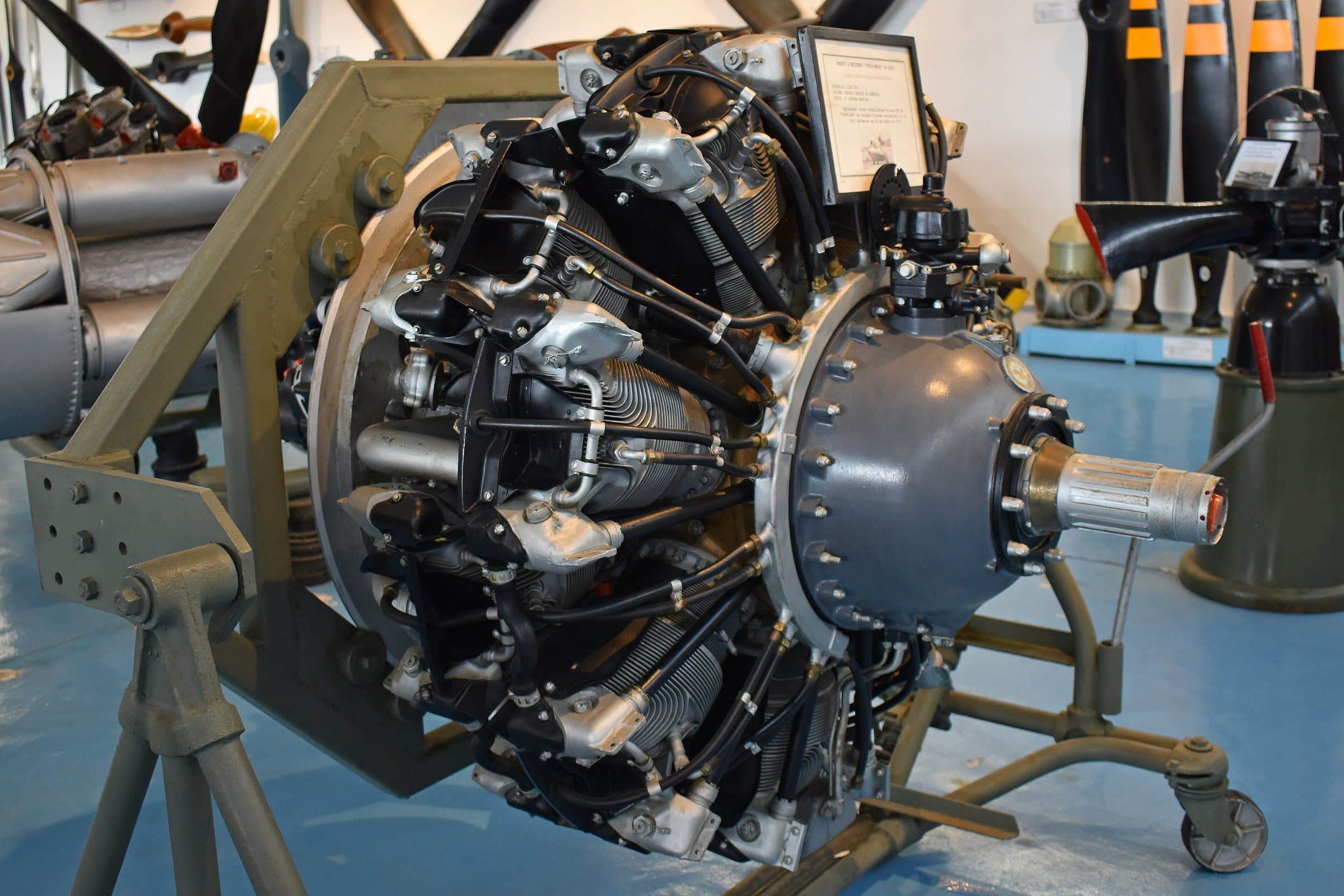
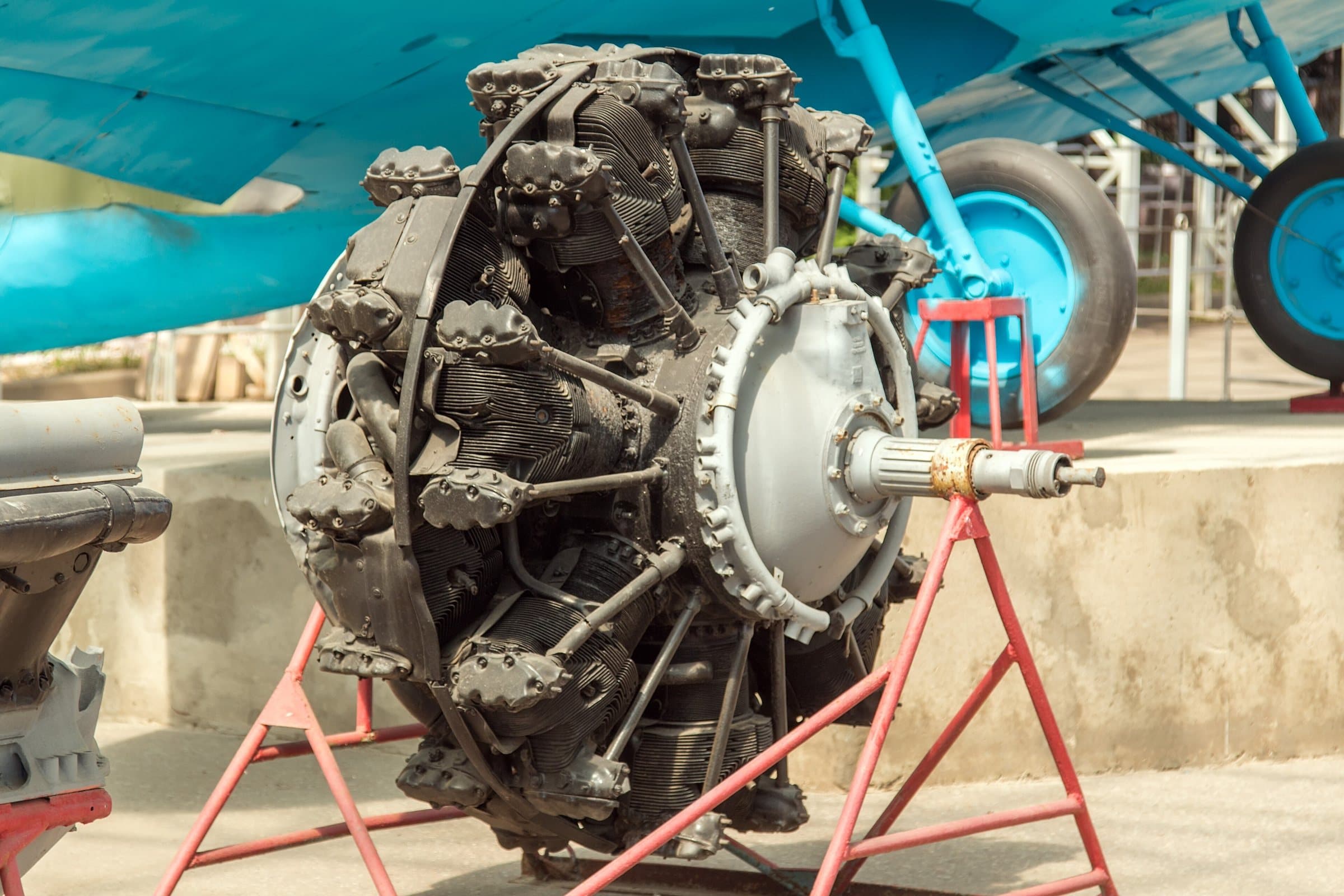
The Pratt & Whitney R-1830 Twin Wasp is a fourteen-cylinder, two-row, air-cooled radial of just under 30 litres, and it is the most-produced aircraft piston engine in history. Pratt & Whitney and its licensees completed 173,618 of them between 1932 and 1951, more than any other aero engine, before or since, on either side of any war. The engine first ran on 16 April 1931 and the first production example was delivered to the United States Navy on 9 November 1932, and it left production nineteen years later having outbuilt the Rolls-Royce Merlin, the Wright Cyclone and every other candidate for the title.
That total is not an accident of one long production run. It is the arithmetic of being chosen for two of the most-built aeroplanes ever made, and of one of them having four engines. The Consolidated B-24 Liberator carried four Twin Wasps and was built in numbers variously given as 18,188 and 18,482, something like seventy-five thousand engines in that application alone. The Douglas DC-3 and its military versions carried two, and the DC-3 family ran to 16,079 aircraft. Add the Consolidated PBY Catalina, the Grumman F4F Wildcat, the Douglas TBD Devastator, the Consolidated PB2Y Coronado and PB4Y-2 Privateer, the Curtiss P-36, the Seversky P-35, the Lockheed Model 18 Lodestar, the Martin M-130 flying boats that opened the Pacific, and British types including the Short Sunderland V and the Vickers Wellington IV, and the shape of the number becomes obvious.
Nothing about the engine itself is exotic. Bore and stroke are equal, a square engine, the compression ratio is modest, the cooling is air and forward motion, and each of the fourteen cylinders has one inlet and one exhaust valve. Pratt & Whitney's own account of it is almost dismissive in its plainness: the Twin Wasp was the company's first twin-row design, displacing 1,830 cubic inches, delivering up to 1,350 horsepower, and distinguished by a new multilayered master rod bearing that could take the stresses of the higher ratings. It performed magnificently, the company says, and was selected to power fighters, bombers and transports. That is the whole argument.
The name needs one clarification, because Pratt & Whitney reused it. The R-1830 is the Twin Wasp; the smaller R-1535 is the Twin Wasp Junior; and the bored-out derivative of the R-1830 that appeared in the early 1940s for the Douglas DC-4 is the R-2000, sometimes catalogued as the Twin Wasp D. All three are separate engines. The R-1830 is retired as a manufactured product, the last ones came off the line in 1951, but it is not retired as a working engine. Douglas DC-3s and Catalina water bombers still fly on Twin Wasps, spares are still traded, and a visitor to an airshow in 2026 can still hear one start.
Aircraft fitted with this engine
Year each aircraft entered service with this engine.
- 1935
Martin M-130
Pan American's transpacific flying boats, on the earliest Twin Wasps of 800 hp.
- 1936R-1830-90C, -92, S1C3-G, S3C4-G and others
Douglas DC-3 and C-47 Skytrain
16,079 airframes in the family, of which 10,174 C-47s; the two-engine application that never stopped.
- 1936R-1830-64, -92
Consolidated PBY Catalina
3,308 built in the United States, Canada and the Soviet Union; convoy escort, anti-submarine patrol and the night-attack Black Cat squadrons.
- 1940R-1830-76, -86, -90
Grumman F4F Wildcat
The US Navy and Marine Corps' front-line fighter until late 1942; credited with 1,006 enemy aircraft by the end of the war.
- 1941R-1830-33, -41, -43, -65
Consolidated B-24 Liberator
Four turbo-supercharged engines each, on 18,188 to 18,482 aircraft: the largest single consumer of Twin Wasps.
- R-1830-45
Consolidated C-87 Liberator Express
The Liberator's transport version, built alongside the bomber at Ford's Willow Run plant.
Consolidated PB2Y Coronado
A four-engined patrol flying boat on Twin Wasps.
Consolidated PB4Y-2 Privateer
Deliberately built without turbo-superchargers, to save weight and suit low- and medium-altitude maritime patrol.
Douglas TBD Devastator
The Navy's torpedo bomber at Midway.
Short Sunderland V
Twin Wasps in place of the Bristol Pegasus, which transformed a persistently underpowered flying boat.
Vickers Wellington IV
The Twin Wasp version of a Bristol-engined bomber.
- R-1830-92
DAP Beaufort
The Australian-built Beaufort, designed for the Bristol Taurus and built with licence-made Twin Wasps; some 700 delivered by August 1944.
CAC Boomerang
Australia's locally designed emergency fighter, on Lidcombe-built engines.
FFVS J 22
Sweden's emergency fighter, on the Svenska Flygmotor copy of the engine.
Saab 17
The definitive B 17A used the Swedish-built STWC-3.
Saab 18
Also flown on the Swedish copy of the Twin Wasp.
Curtiss P-36 Hawk
One of the pre-war American fighters built around the engine.
Seversky P-35
With its XP-41 development, an early Twin Wasp fighter.
Republic P-43 Lancer
A turbo-supercharged Twin Wasp fighter, and the ancestor of the P-47 airframe.
Lockheed Model 18 Lodestar
Usually a Wright Cyclone aircraft; a minority, including the Canadian Museum of Flight's, have Twin Wasps.
Boeing XB-15
The experimental heavy bomber that preceded the B-17.
SAAB Scandia
A post-war Swedish airliner, on Pratt & Whitney's own list of Twin Wasp applications.
22 aircraft
Development
Pratt & Whitney began work on a two-row radial in late 1929, and the first thing it built was not the Twin Wasp. It was the R-2270, an experimental fourteen-cylinder engine assembled largely from existing Wasp and Hornet parts, which first ran on 14 May 1930. The R-2270 was a way of finding out what a two-row engine did rather than a product; what it produced was the confidence to design one properly. The Twin Wasp that followed first ran on 16 April 1931.
The reason for two rows is a single sentence of aerodynamics. A radial engine's output is limited in practice not by how much displacement you can arrange around a crankcase but by how much frontal area the aeroplane can afford to drag through the air, because every cylinder must sit in the cooling airflow. Putting a second row of seven cylinders behind the first buys displacement and power at almost no cost in diameter. The penalty is that the rear row sits in air already warmed by the front row, and the whole subsequent history of the big American radial is a history of cooling baffles, cowl flaps and fin area.
The detailed design was led by Luke Hobbs, later one of the defining figures of Pratt & Whitney engineering. The crankcase was a forged aluminium structure, magnesium was used liberally to save weight, and unusual attention was given to the engine mounting arrangements to keep vibration out of the airframe. For most of the 1930s the R-1830 was the largest engine Pratt & Whitney had under development, which is worth remembering when reading the modest early ratings: this was the company's flagship, not a stopgap.
The dates on which the engine "arrived" depend on which milestone is being counted, and the sources do not agree on a single one. Pratt & Whitney's own record gives a first run and a first flight in 1931 and production years of 1932 to 1951. The Aircraft Engine Historical Society dates the first run precisely to 16 April 1931 and the first production delivery to the Navy to 9 November 1932. The Smithsonian's National Air and Space Museum says the Twin Wasp was certificated in 1933. All three are compatible (run, delivery, certification) and none of them is the answer to "when did it enter service", which was 1935, in a Pan American flying boat.
What followed was two decades of uprating with no change of architecture. The earliest production engines gave 800 hp; the Martin M-130s of 1935 were re-engined within months to an 830 hp standard and later to 950; the commercial marks of the late 1930s reached 1,050; and 1,200 hp at 2,700 rpm became the wartime norm across the -41, -43, -65, -76, -86, -90 and -92. The top of the range was 1,350 hp, in marks such as the -75 and the -94. Across the whole family the take-off rating spans 630 to 1,350 hp, better than a doubling from an engine whose bore, stroke and cylinder count never moved.
Pratt & Whitney's stated enabler for that climb is specific and mechanical: a new multilayered master rod bearing, the component that carries the loads of a whole row of cylinders through one crankpin and the first thing to fail when a rating rises. When Pratt & Whitney wanted more than the architecture could give, it stopped uprating and bored the cylinders out instead, producing the R-2000 from 1941.
Design
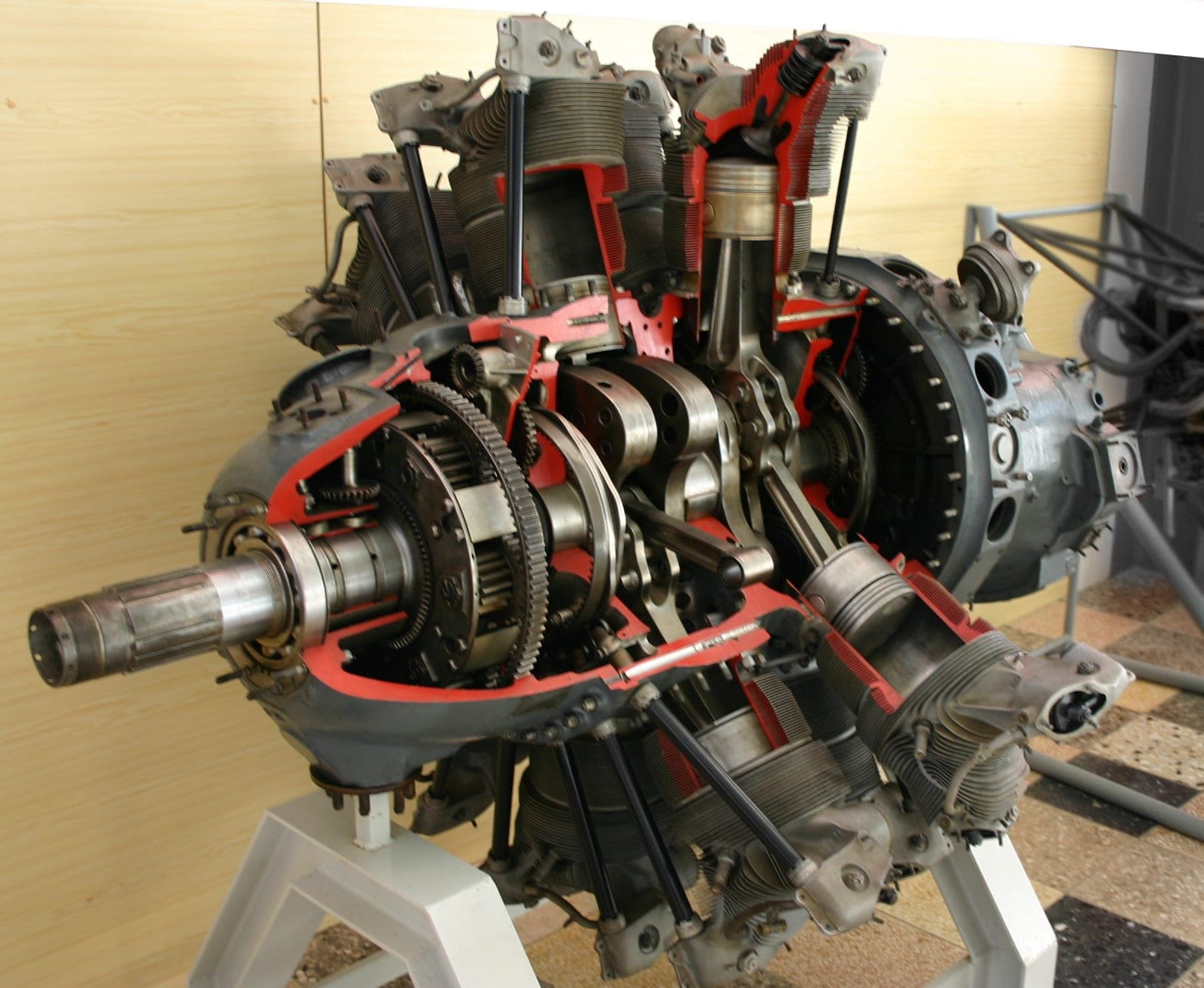
Fourteen cylinders in two rows of seven, air-cooled, with a bore and a stroke that are identical, in just under 30 litres. Dry weight across the family runs from 1,162–1,467 lb depending on mark and equipment, and the diameter is the number that matters to an airframe designer, because it sets the nacelle. A two-row fourteen is a specific compromise: enough displacement for a 1,200 hp class engine, in a circle barely larger than a nine-cylinder single row.
The cylinders are built up rather than cast in one piece. A cast aluminium head, with the valve mechanism housings integral to it, is screwed and shrunk onto a forged steel barrel with integral cooling fins. The exhaust ports carry shrunk-in stainless steel liners that form slip joints with the steel exhaust pipes, so that thermal expansion does not fight the exhaust system. Intake valve seats are aluminium bronze and exhaust seats steel, both shrunk into the head. Pressure baffles are fitted to force uniform cooling air over every cylinder in every flight condition, which is the engineering answer to the rear row sitting in the front row's wake.
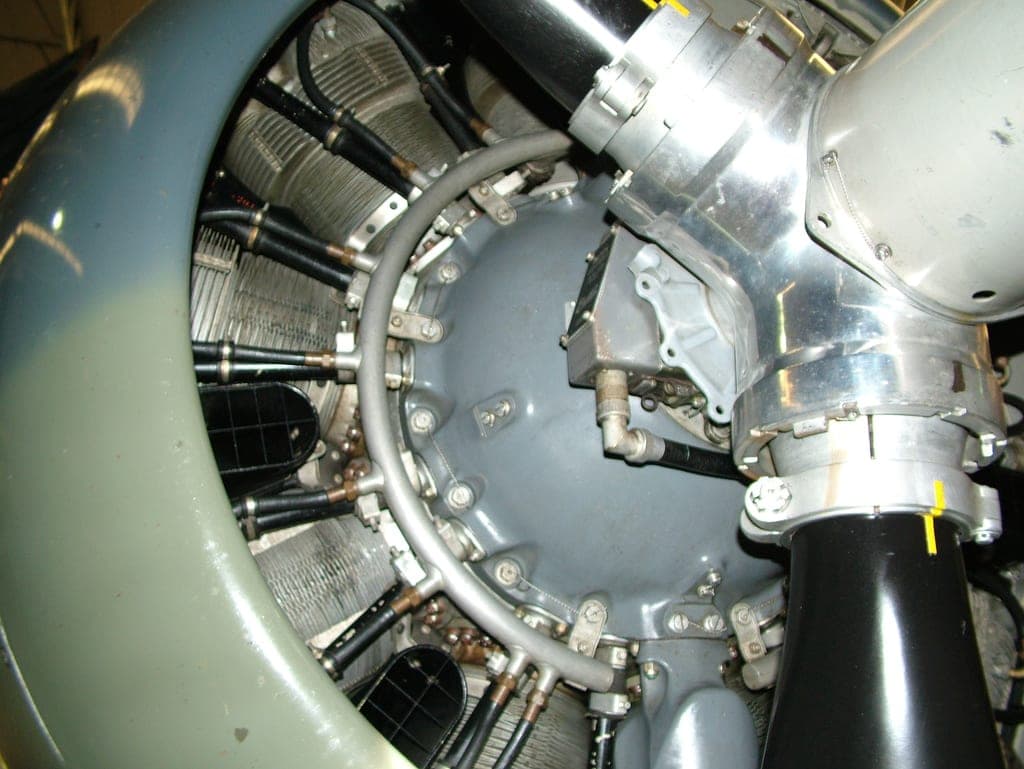 R-1830-36
Inside, the pistons are forged aluminium, ribbed on the undersides of their heads and the insides of their skirts for both strength and heat transfer, each carrying three compression rings, an oil scraper ring and a dual oil control ring. Each row's master rod has a detachable cap and a lead-silver bearing, with six articulated rods attached by knuckle pins and bronze bushings at both ends. The crankshaft is a one-piece two-throw forging carried on three roller bearings in the crankcase sections and located by the front main bearing; the propeller shaft runs inside the crankshaft on a lead-copper pilot bearing and takes its thrust on a deep-groove ball bearing in the nose section.
The crankcase is made up of six sections, and that modularity is a large part of why the engine could be built by car companies. The power section parts are forged and machined together and joined by through bolts. The nose section houses the reduction gears and, on geared versions, the provision for a Hamilton Standard Hydromatic full-feathering propeller, with a drilled oil passage in its upper part to work the pitch control. The blower section bolts to the power section, holds the supercharger, and carries the bronze-bushed forged steel engine mount lugs. A blower intermediate section supports the downdraught carburettor and houses the impeller gear train, and an accessory section bolts to that.
The valve gear is simple and completely enclosed. One inlet and one exhaust valve per cylinder, the exhaust valve sodium-cooled and stellite-faced, operated by ball-bearing rocker arms and pushrods of heat-treated aluminium alloy with hardened steel ball ends. Two shelf-mounted cams, one in the front power section and one in the rear, are driven by spur gears directly off the crankshaft at one-eighth crankshaft speed. Everything including the pushrods is oil-tight, with internally drilled passages feeding the pushrods and rocker bearings. Ignition comes from two Scintilla flange-mounted magnetos, each firing an independent set of plugs through a single radio-shielded manifold mounted on the front of the power section, which gives the shortest possible leads and makes the ignition accessible without disturbing anything else.
Lubrication is dry-sump, as a radial must be, since cylinders pointing in fourteen directions cannot be served by a pan. A gear-type pump with a separate low-pressure section feeds the rear accessory drives through an independent relief valve, and inter-rocker-box and inter-cylinder drains collect into a separate sump that a pump in the nose scavenges. The propeller reduction gear is a planetary bevel set of Pratt & Whitney design; the Historical Society gives its ratio as 0.7625, while published specifications for other marks quote 3:2 and 16:9, so the number is a property of the mark rather than of the engine.
Every accessory is grouped at the rear and driven from one splined shaft off the back of the crankshaft: two magnetos, two tachometers, a vacuum pump, oil and fuel pumps, a starter, a generator, and provision for two gun synchronisers or auxiliary pumps. The generator drive is rated to take 30 hp off the engine for a remote accessory gearbox. It is a thoroughly practical layout, arranged so that the things that need attention are where a mechanic standing behind the engine can reach them.
Supercharging
 R-1830-45
Every production Twin Wasp had a gear-driven supercharger, and the differences between marks are very largely differences of blower. The baseline installation is a single-stage, single-speed General Electric centrifugal blower with a large-diameter impeller on high-capacity ball bearings, driven through dual intermediate gears with spring-type flexible couplings to absorb shocks and equalise the driving loads, at a step-up of about 7.15 times crankshaft speed. Air arrives from a downdraught Stromberg carburettor, passes through vanes in the intermediate section into the impeller, and leaves through a diffuser and induction passages arranged for even distribution to fourteen cylinders.
Two-speed drive was the first refinement, and the aeroplane that shows why is the C-47B. The Skytrain's job over the Hump, the air bridge from India into China across the eastern Himalaya, demanded cruise performance at altitudes a single-speed blower could not hold, so the C-47B took R-1830-90 engines with two-speed superchargers specifically for better altitude performance, and 3,364 of that version were built. The postscript is just as instructive: with the war over and the mountains no longer the point, the C-47D was simply the same aircraft with the two-speed superchargers replaced by single-speed units. The high-altitude gear was worth its complexity only where the altitude was worth having.
Two stages were the next step, and they made the Twin Wasp briefly the most important high-altitude fighter engine in American naval aviation. The Grumman F4F-3 was ordered in October 1938 with the R-1830-76, a two-stage two-speed engine, and the results were startling for 1939: on first flight in February 1939 the aeroplane reached 289 kt, a service ceiling of 33,000 ft and an initial climb of 3,000 ft/min, and the production F4F-3 was credited with 285 kt at 21,000 ft and a ceiling of 37,500 ft. That high-altitude performance is what made the Wildcat the most effective American fighter opposing Japanese naval aviation in the months after Pearl Harbor. When two-stage superchargers ran short, the F4F-3A was built instead with the single-stage two-speed R-1830-90: and it was unpopular, for exactly the reason one would expect.
The most elaborate arrangement was not Pratt & Whitney's at all. The Consolidated B-24 was turbo-supercharged: an exhaust-driven General Electric turbine spinning a compressor that force-feeds the carburettor, costing no shaft power because the gas driving it has already done its work in the cylinders, and, unlike a geared blower, not losing output as the air thins. Early Liberators had the mechanically supercharged R-1830-33; those were replaced with turbo-supercharged R-1830-41s with GE B-2 turbochargers rated at 1,200 hp, and the B-24D and B-24E followed with the -43 and the -65. The Liberator Express transport version used turbo-supercharged R-1830-45s. The price was plumbing: exhaust collected and piped to a remote turbine, compressed air piped forward through an intercooler, a waste gate to dump gas when full boost was not wanted, four times over on a four-engined aeroplane.
And the counter-example is on the record too, which is the useful thing about a family this large. When the Navy wanted a dedicated long-range patrol bomber from the same airframe, the PB4Y-2 Privateer was built with non-turbo-supercharged engines, deliberately, to save weight and to optimise for the low and medium altitudes at which maritime patrol is actually flown. The same engine, in the same company's airframe, with the blower chosen to match the mission rather than to maximise a number.
Fuel and carburation
The induction system is one Stromberg injection carburettor with automatic mixture control, idle cut-off, and primer tubing and distributor. The automatic mixture control deserves more credit than it usually gets: it is what allows a pilot without a flight engineer's training to climb through twenty thousand feet without leaning the engine into detonation or drowning it, and on an engine that would be flown by hastily trained wartime crews in enormous numbers, that is a safety feature and a maintenance feature at once. Published specifications for the commercial R-1830-S1C-G describe a two-barrel Stromberg carburettor and a fuel requirement of 95 to 100 octane.
The fuel grade rose with the ratings, and the early figures are a useful corrective to the late ones. Pan American's engineers recorded that the Martin M-130s of 1935 and 1936, with the earliest Twin Wasps, ran on what was then the new 87-octane petrol. By the war the higher-rated marks needed better fuel, and when Pratt & Whitney wanted more power still it did not simply demand a higher grade. It bored the cylinders out: the R-2000 of the early 1940s was an enlarged Twin Wasp with a number of detailed changes made specifically to improve fuel economy and to allow higher power ratings on lower-octane fuel. That is an unusual design brief, and it says something about where the constraint really lay in 1942.
Fuel consumption is the figure that decided what the engine could be used for. The commercial R-1830-S1C-G is quoted at a specific fuel consumption of about 0.49 lb per horsepower-hour, or roughly 295 grams per kilowatt-hour. In service the best figures were better than that: on the transpacific flights of 1935 and 1936, Pan Am measured minima of about 0.41 lb per horsepower-hour and believed them to be the lowest yet recorded in flight. Those numbers are the reason a flying boat with an unremarkable lift-to-drag ratio of a little over 12 could cross from California to Hawaii carrying mail and passengers at all, the superior range came from fuel capacity, propeller efficiency and low engine consumption rather than from aerodynamics. The Alameda to Honolulu legs averaged 126.6 gallons an hour across the first year of operation.
Production
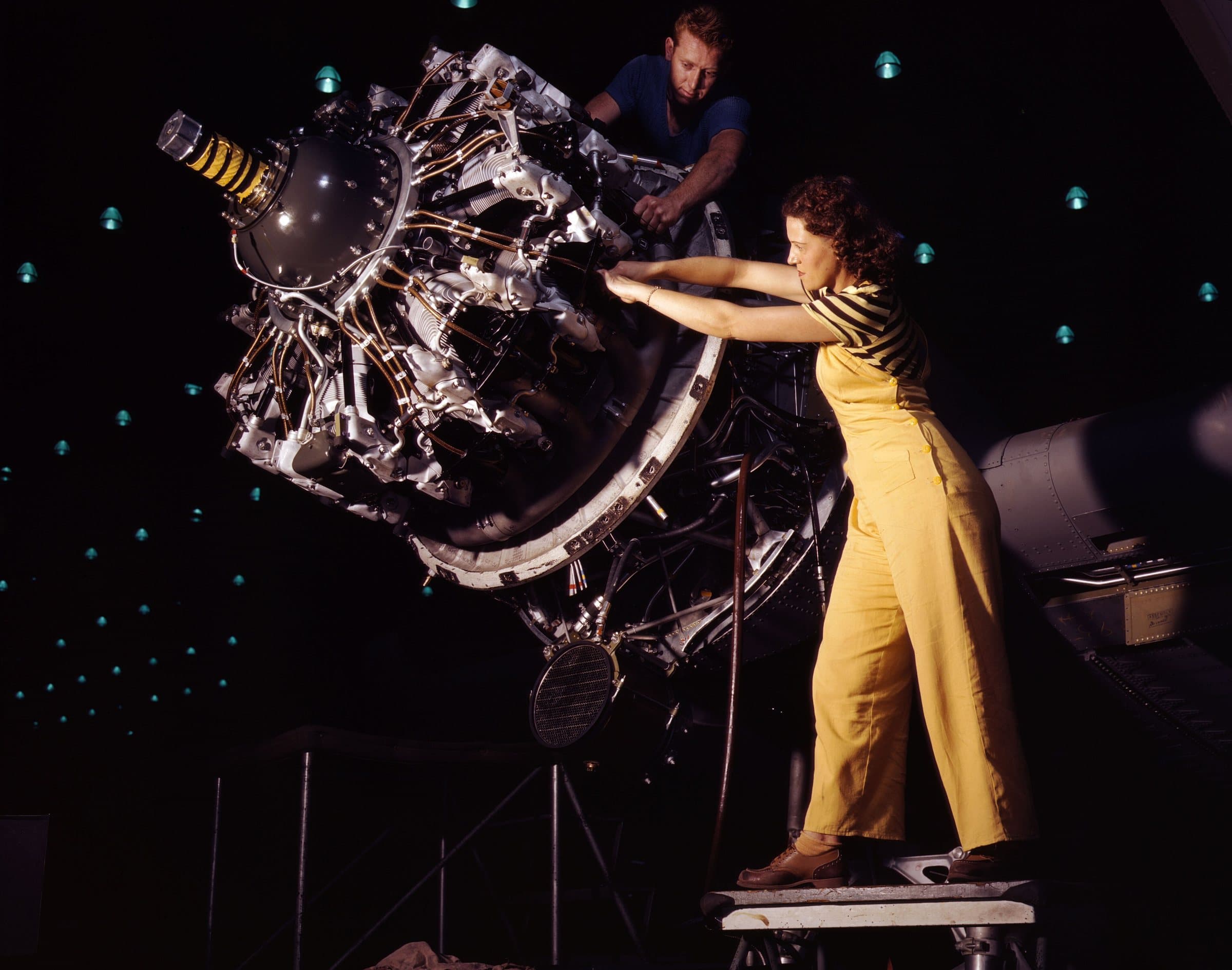
173,618 Twin Wasps were built between 1932 and 1951, by Pratt & Whitney at East Hartford, Connecticut, and Kansas City, Missouri, and by its licensees. Set against the roughly 150,000 Merlins or the 119,975 Wright Cyclones, it is the largest aero-engine production run there has ever been, and it was achieved by an engine of entirely ordinary specification.
The annual figures show how sharply that total is concentrated. Output was 6,441 engines in 1941, 22,655 in 1942, 59,561 in 1943, and 65,060 in 1944, an average of about 178 engines a day, every day, for a year. Then it collapsed: 12,787 in 1945 as contracts were cancelled, and a long tail of a few hundred a year into 1951. Nineteen years of production, and more than four-fifths of it inside four of them.
Pratt & Whitney could not build that alone and did not try. The largest single contribution came from Buick, which built R-1830s in a government-owned plant at Melrose Park, Illinois, west of Chicago. The figure usually given is around 74,000 engines, roughly 43% of every Twin Wasp ever made, though published accounts differ in the detail, quoting 74,198 and 74,797, so the precise number should be treated as approximate. Buick-built engines went exclusively into the B-24 until April 1944, after which the company was contracted to build the slightly different C-47 version as well, and it later added 2,548 of the derivative R-2000. Melrose Park won the Army-Navy "E" Award five times.
The scale of the component work behind those engines is easy to overlook and is, in its way, the more revealing number. Buick made 3,120,000 aluminium cylinder heads for Pratt & Whitney radials, of which only about a third were needed for its own engine assembly; the rest went out as spares, because a cylinder is the part of an air-cooled radial most often replaced in the field and an army that intends to keep flying has to stock them by the million. Chevrolet built complete R-1830s as well. An engine designed in Hartford in 1931 was, by 1944, being turned out by the American motor industry at a rate closer to automobile practice than to aero-engine practice, which is precisely what 173,618 requires.
Licence production
 R-1830-92
The Twin Wasp was licensed more widely than most American engines of its generation, and the record of who built it, and who built it without asking, is unusually tangled. Pratt & Whitney's licensees are normally listed as Buick and Chevrolet in the United States, the Commonwealth Aircraft Corporation in Australia, and Flygmotorbolaget in Sweden after the Second World War.
Australia's licence was a response to a supply failure. The Australian-built version of the Bristol Beaufort was designed around the Bristol Taurus, and when Taurus deliveries from Britain failed to materialise, the Commonwealth Aircraft Corporation's factory at Lidcombe in New South Wales had to tool up for the Twin Wasp instead, from 1940. The substitution worked: Australian Beauforts were fitted with licence-built R-1830-92s, some 700 were delivered before production ceased in August 1944, and the same engine went into the CAC Boomerang, the locally designed emergency fighter. A large facility at Rockley in Queensland repaired and reconditioned Twin Wasps for both American and Australian forces. For a country with no aero-engine industry to speak of in 1939, building an American radial in quantity in Sydney was a considerable act of improvisation.
 STW-C3
Sweden's Twin Wasps are a different story, and the sources genuinely conflict. Sweden was neutral and embargoed, and the United States government refused a request to buy a licence to build the Twin Wasp. Svenska Flygmotor (the former Nohab, renamed in 1941) therefore reverse-engineered it: engineers measured every part, ran material tests, and built a copy without American drawings, designated STWC-3 for Swedish Twin Wasp C-3, rated at 1,050 hp at 2,700 rpm. It powered the FFVS J 22 fighter, the Saab 17 and the Saab 18, and the technical difficulties were severe enough that the first fully approved engine was not delivered until 24 October 1944. Some accounts add that after the war Svenska Flygmotor volunteered to pay a licence fee and that a symbolic one US dollar was agreed. Whether Sweden is properly called a licensee therefore depends on the date: a museum list of Pratt & Whitney's post-war licensees includes the Swedish firm, while the aircraft histories describe a wartime copy built without one. Both can be true of the same company.
The consequence, as with every widely licensed engine, is that the design outran its owner. An unused Swedish-built STW-C3 spare engine for a Saab 17A now sits in a museum in central Finland; a Buick-built Twin Wasp hangs in the nacelle of a flying B-24 in the United States; an R-1830-92 built under licence in Sydney powered a British-designed torpedo bomber in the South-West Pacific. Very few artefacts of 1931 American engineering were manufactured on three continents within a decade.
In service
 R-1830-92
The Twin Wasp's service life is dominated by transport aviation, and specifically by one aeroplane. The Douglas DC-3 and its military derivatives account for 16,079 airframes, of which only 607 were civil DC-3s built as such; the C-47 Skytrain alone runs to 10,174. The definitive military version, the C-47B and C-47D, used the R-1830-90C: 1,200 hp for take-off and 1,000 hp normal rating at 14,500 ft. Wherever the Second World War required something to be carried, two Twin Wasps carried it: paratroops into Normandy, fuel over the Himalaya, casualties out of the Pacific, and after 1945 the freight of every airline and air force that could buy a surplus airframe.
At sea the engine's most characteristic application was the Consolidated PBY Catalina, of which 3,308 were built: 2,661 in the United States, 620 in Canada and 27 in the Soviet Union. The Catalina's virtues were endurance and visibility rather than speed, and the two Twin Wasps that gave it those virtues spent the war doing the least glamorous and most consequential work available, convoy escort, anti-submarine patrol, search and rescue, and, as the black-painted "Black Cat" squadrons from December 1942, night attacks at mast height on Japanese shipping. A patrol aeroplane's engines are judged on hours rather than on horsepower, and the Catalina's flew very long ones.
The fighter record belongs to the Grumman F4F Wildcat, which was the Navy and Marine Corps' premier fighter until late 1942 on Twin Wasps of 1,200 hp. By the end of 1942 its pilots had accumulated a nine-to-one kill ratio over Japanese aircraft despite the reputation of the A6M Zero; by the end of the war the type was credited with 1,006 enemy aircraft and had produced 58 aces. Two British Martlets, the Royal Navy's F4F-3, shot down a Ju 88 near Scapa Flow on Christmas Day 1940, before the United States was in the war at all. None of that is attributable to the engine alone, but the Wildcat's capacity to absorb damage and keep flying is not separable from having an air-cooled radial with no cooling system to lose.
And then there is the B-24, which consumed more Twin Wasps than everything else combined. Whether the Liberator total is 18,188 or 18,482, the two figures come from different authorities and both are in print, four engines apiece puts the Liberator alone at around three-quarters of the entire Twin Wasp production run. Buick-built engines went into nothing else until April 1944.
The engine's service did not end with the war, and this is where it separates itself from most of its contemporaries. DC-3s carried on in commercial work for decades, Catalinas were converted into water bombers and flew fire seasons into the twenty-first century, and estimates put around 2,000 DC-3s and derivatives still flying in 2013, more than 300 in 2017 and about 150 in 2023. That decline is the honest shape of it: a shrinking but genuinely operational fleet, ninety years after the first engine was delivered.
Reliability and maintenance
The structural case for an air-cooled radial is that there is nothing to lose. No radiator to be holed, no coolant to boil away, no pump to seize, no header tank to be punctured. The cylinders have fins, the propeller and forward motion do the rest, and an engine with a cylinder shot away has thirteen left. That is the property that put Twin Wasps on carrier fighters, on maritime patrol aircraft crossing thousands of miles of empty ocean, and on a heavy bomber expected to come home from Germany.
It was not reliable from the beginning, and the first operator's experience is on the record in unusual detail. Pan American's Martin M-130s went into service in late 1935 with the earliest Twin Wasps, and the airline's own engineering account records that in spite of early service troubles with the engines the Clippers' service record was good. Overheating caused much of the trouble, and it was cured by replacing the engine cowlings and cowl flaps before passenger service began, a cooling-installation problem rather than an engine problem, but indistinguishable from one at the time. Then, on a Honolulu to Alameda leg in December 1935, the Philippine Clipper turned back with a blown spark plug, took off again, and had to shut down its number one engine after about eleven hours and fly the remaining six on three. Inspection found the failure serious enough to cause concern for the future. Both aircraft were re-engined with 830 hp engines with improved bearings, and Pan Am's chief engineer required each aeroplane to accumulate thirty hours of flying before its next dispatch. Two of the next few months went on engine changes and test flights.
That episode identifies the component the whole engine turns on. In a radial, the master rod bearing carries the loads of an entire row of cylinders through one crankpin, and it is the first thing to give when the rating rises. Pratt & Whitney's own summary of the Twin Wasp names a new multilayered master rod bearing as the feature that let the engine withstand the stresses of the higher ratings: which is to say that the difference between an 800 hp Twin Wasp and a 1,350 hp one is, more than anything else, a bearing. The lead-silver master rod bearing, the detachable cap, and the sodium-cooled stellite-faced exhaust valves are the three pieces of metallurgy that made the rest of the engine's history possible.
The maintainability is the other half of the reliability story, and it is not incidental: it is the reason the engine could be operated at all at the scale it was built. The layout described above puts everything that needs attention where a mechanic standing behind the engine can reach it, and a cylinder can be changed without dismantling the engine, which is why Buick had to make cylinder heads by the million. Photographs from 1942 of women being trained in a few weeks to install and maintain Twin Wasps at Douglas Long Beach, at Willow Run and at Naval Air Station Corpus Christi are not propaganda about the workforce alone; they are evidence about the engine. It was designed to be worked on by people who had not done it before.
The honest counterweight is that a late Twin Wasp at 1,350 hp, with a turbine in the exhaust on some installations, is a demanding engine. Cylinder head temperatures, mixture, ignition timing and valve condition matter continuously rather than occasionally, and the consequence of neglect on an air-cooled radial arrives as a partial power loss at low altitude. Eighty years on, the shrinking population of people who can maintain one properly is the real constraint on how much longer these engines fly.
Applications

The Liberator family is the largest single block. Four turbo-supercharged Twin Wasps powered the B-24 in all its marks, the Consolidated C-87 Liberator Express transport, the Navy's PB4Y-1, and, with the turbochargers deleted for low-altitude patrol, the PB4Y-2 Privateer. Ford's Willow Run plant near Ypsilanti, Michigan, built B-24s and C-87s on an automotive assembly line, and the photographs of women fitting R-1830-45s into C-87 nacelles there are among the clearest surviving images of what mass-produced aviation looked like in 1943.
The Navy's use of the engine was otherwise dominated by flying boats and carrier aircraft. The PBY Catalina and its Canadian-built Canso equivalents, the four-engined PB2Y Coronado, the Naval Aircraft Factory PBN, the Sikorsky VS-44A, and the torpedo bombers: the Douglas TBD Devastator, which flew to its destruction at Midway, and the Grumman F4F Wildcat and its Eastern-built FM-1 version. Several of these aeroplanes were chosen for the Twin Wasp specifically because a long overwater mission wants an engine with no cooling system in it.
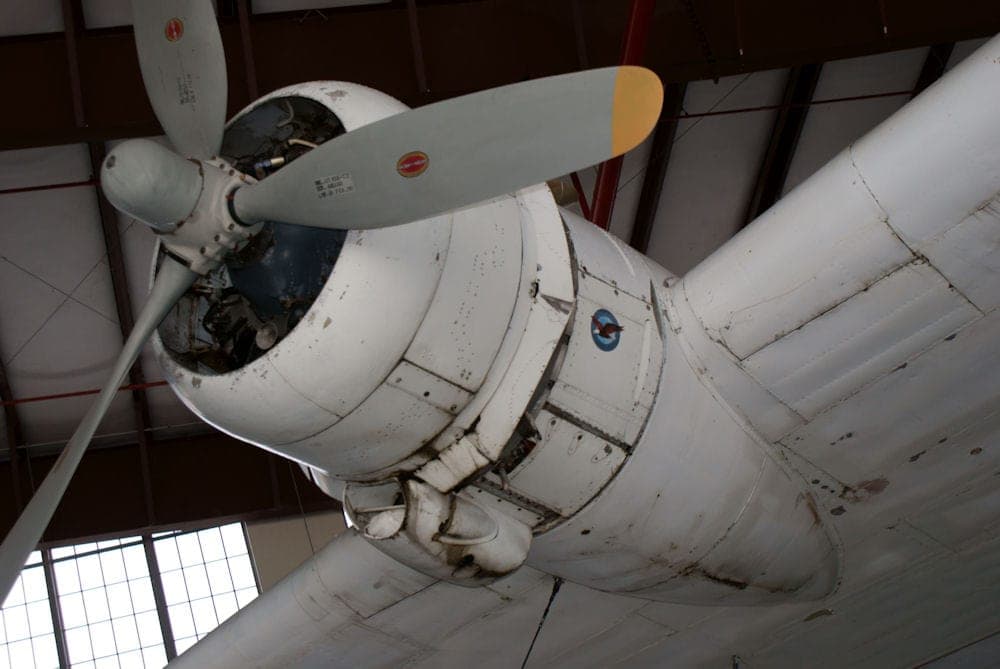
On the Army side the engine went into a generation of fighters that the war then mostly passed over: the Curtiss P-36 Hawk, the Seversky P-35 and its XP-41 development, the Republic P-43 Lancer, the Vultee P-66 Vanguard. It also powered the Boeing XB-15, the enormous experimental bomber that preceded the B-17, and a long list of trainers and utility types. The Australian CAC Boomerang and CAC Woomera belong to the same category: aircraft designed around the engine that was actually available.
In transport and commercial aviation the Twin Wasp's reach is wider than the DC-3 alone. It powered the Martin M-130 flying boats that opened the Pacific, the Lockheed Model 18 Lodestar, the Budd RB Conestoga, the Fiat G.212 and Savoia-Marchetti SM.95 in post-war Italy, the Bloch 174 and Lioré et Olivier LeO 45 series in France, and the SAAB Scandia. The Canadian Museum of Flight's Lodestar is a good illustration of how far the substitution went: most Lodestars used Wright Cyclones, and theirs has Twin Wasps.
The British and Commonwealth applications are almost all substitutions, and they are the most revealing entries on the list. The Short Sunderland V took Twin Wasps in place of the Bristol Pegasus, and the change transformed a flying boat that had been persistently short of power. The Vickers Wellington IV was a Twin Wasp version of a Bristol-engined bomber. The Australian DAP Beaufort was designed for Bristol Taurus engines and built with American ones. The RAF Museum's summary of the engine lists, quite simply, the Wildcat, the Dakota, the Sunderland and some of the Liberators the Royal Air Force used, four types on three very different duties, all on the same fourteen cylinders.
Records
The Twin Wasp's place in the record books was made by aeroplanes designed to carry things, not to race.
The first claim belongs to the Catalina. The prototype XPBY-1, re-engined with 900 hp R-1830-64s and given redesigned vertical tail surfaces to cure a tendency for the tail to submerge on take-off, made its maiden flight on 19 May 1936: and on that first flight set a record non-stop distance of 3,443 miles. A maiden flight that sets a world distance record is an unusual event, and it tells you what the airframe and the engines had been optimised for.
The larger achievement was Pan American's, and it was commercial rather than sporting. Pan Am had asked aircraft manufacturers in June 1931 for an aeroplane capable of transocean payloads; only Sikorsky and Martin replied, and the Martin M-130 was the first aircraft that met the requirement. The China Clipper, delivered on 9 October 1935 and powered by four of the earliest Twin Wasps at 800 hp, left Alameda on 22 November 1935 and arrived at Manila on schedule on 29 November, with a flying time of 59 hours 48 minutes and a one-day layover at Guam caused by confusion over the International Date Line. It returned from Manila on 2 December and reached Alameda on 6 December in 63 hours 24 minutes, 123 hours 12 minutes for the round trip. It carried mail and a contractual payload of 2,300 pounds, cruised at about 110 kt at 8,000–10,000 ft, and had a still-air range of a little over 3,000 nm.
What made that possible was not the airframe. The M-130's lift-to-drag ratio was a little over 12, it had corrugated hull skinning, external bracing and no wing flaps, and it was slower than the Sikorsky S-42 that preceded it. Its range came from fuel capacity, propeller efficiency and engine economy: the 0.41 lb per horsepower-hour that Pan Am's engineers thought was the lowest specific fuel consumption yet measured in flight. Before the DC-3 had flown, four Twin Wasps had carried a certificated commercial aeroplane, in full compliance with safety regulations, across the Pacific Ocean on a schedule. Every previous crossing had been a stunt in a specially tanked aircraft taking off overweight.
Preservation
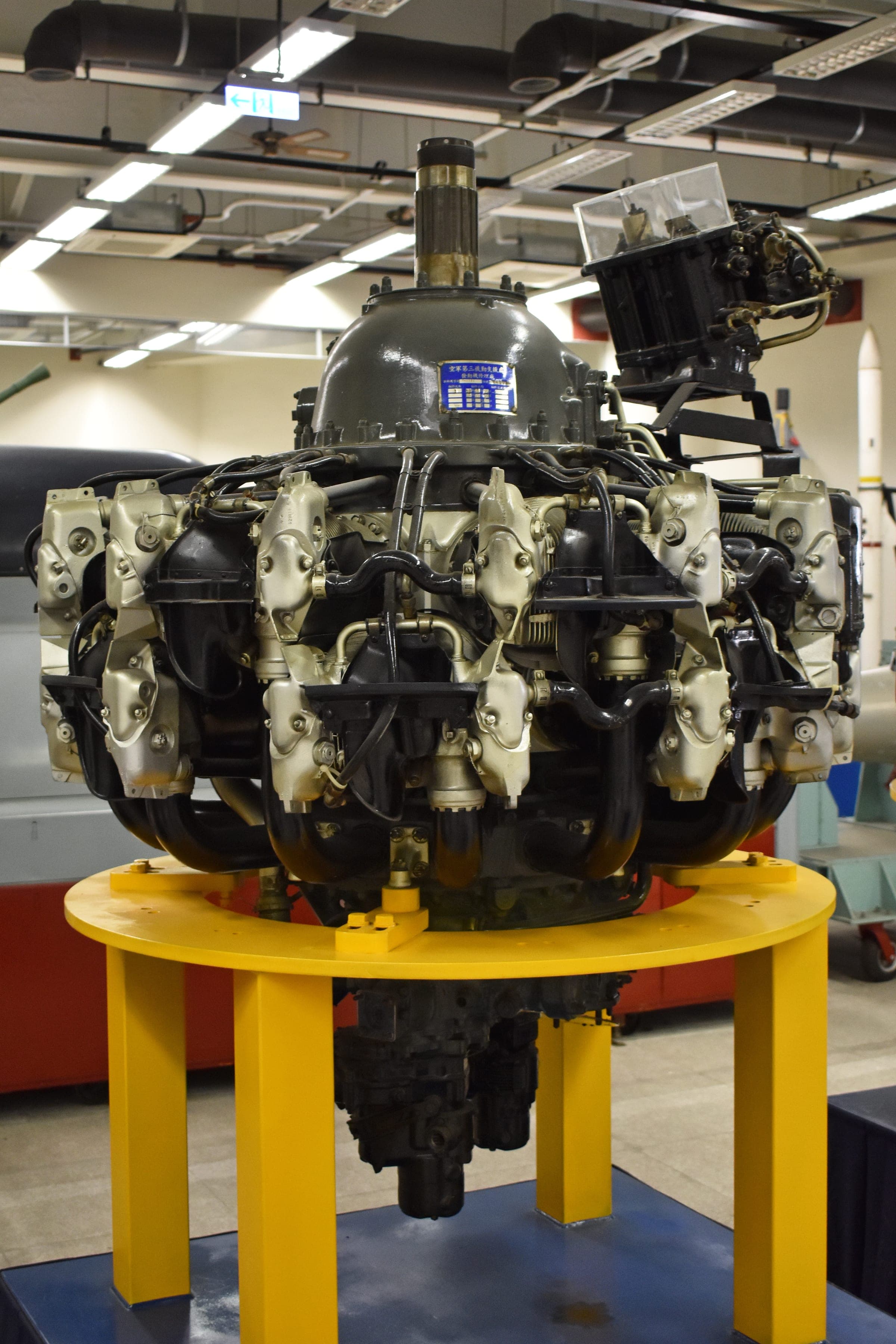 R-1830-92
Twin Wasps survive in quantity, and the geography of the survivors is a fair map of where the engine went. The Smithsonian's National Air and Space Museum holds an R-1830-92 given by Grumman Aerospace, displayed in the America by Air gallery, and an R-1830-90C of about 1938 in storage. The Royal Air Force Museum has an R-1830-90D on display in Hangar 1 at its Midlands site, catalogued with the plain observation that this engine was fitted to the Wildcat, the Dakota, the Sunderland and some Liberators. The Canadian Museum of Flight has Twin Wasps in both its DC-3 and its Lodestar. There are preserved examples at the Museu do Ar at Alverca in Portugal, at the Republic of China Air Force Museum at Gangshan in Taiwan, at the Ballarat Aviation Museum in Australia, and at the Museum of the Great Patriotic War in Moscow.
Two of those holdings are worth singling out. The Aviation Museum of Central Finland has both a commercial R-1830-S1C3G and an unused Svenska Flygmotor STW-C3: the Swedish copy, serial number 1123, a spare engine for a Saab 17A that was never fitted. A reverse-engineered Twin Wasp, never run, sitting a few hundred kilometres from a genuine one is about as compact a statement of the engine's licensing history as a museum could arrange.
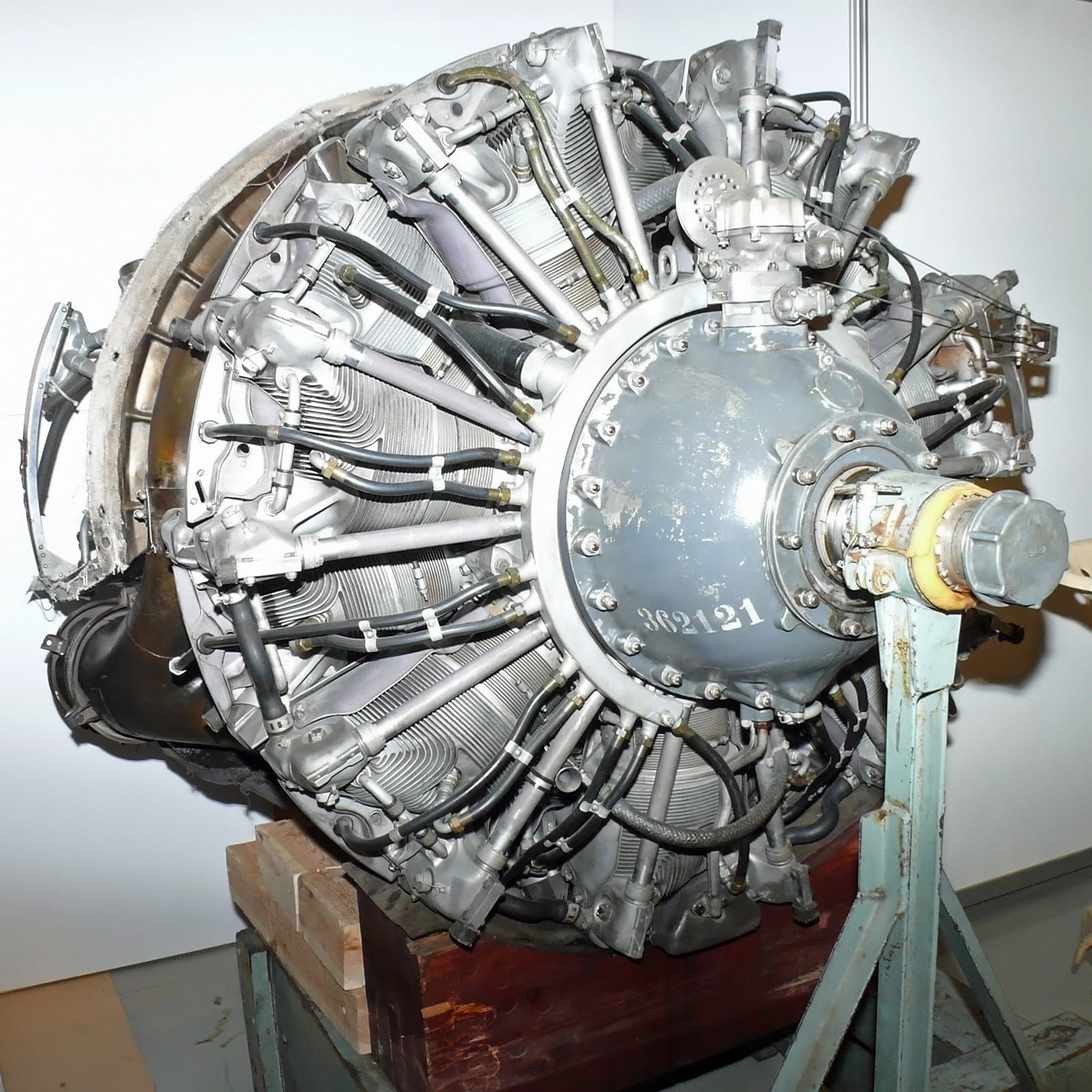 R-1830-S1C3G
The flying population is smaller and more fragile. The R-1830 has not been manufactured since 1951, and it is not going to be again; what keeps DC-3s, Catalina water bombers and a handful of B-24s and Wildcats in the air is a trade in spares and second-hand engines, small-batch remanufacture, and a shrinking number of overhaul shops and individuals who know the engine properly. Around 150 DC-3s were estimated to be still flying in 2023, down from roughly 2,000 a decade earlier. Each of those aircraft is two Twin Wasps that somebody has to keep serviceable, and the constraint is not the airframe.
There is no equivalent of the Wright Cyclone's second life here. The Cyclone's Soviet descendant, the ASh-62, is still being manufactured in Poland; nothing descended from the R-1830 is still in production anywhere. The Twin Wasp's survival is entirely a matter of husbanding what was built before 1951: which, given that 173,618 were built, is a larger inheritance than any other piston aero engine has.
Legacy
The first part of the legacy is the number, and it is worth stating plainly what 173,618 means. It is more aero engines than any other design has ever produced, and it belongs to an era that will not return: a modern airliner turbofan sells in the low thousands over a thirty-year programme. The Twin Wasp's total was reached because the United States decided in 1941 to build aeroplanes the way it built cars, and because Pratt & Whitney had a design simple enough and modular enough for Buick and Chevrolet to make. The engine is the most-produced aero engine in history largely because it was easy to produce.
The second part is direct descent. When Pratt & Whitney needed more than the R-1830's architecture would give, it bored the cylinders out to produce the R-2000, from 1941, an enlarged Twin Wasp with detailed changes to improve fuel economy and permit higher ratings on lower-grade fuel. 12,966 R-2000s were built between 1941 and 1959, for the Douglas DC-4 and C-54 Skymaster and later the de Havilland Canada DHC-4 Caribou, and Buick built 2,548 of them alongside its R-1830s. The R-2000 is the reason the four-engined civil airliner of the late 1940s exists in the form it does.
The third is what the two-row layout did to Pratt & Whitney's catalogue. The Twin Wasp was the company's first twin-row design, and everything large that followed was built on the principle it proved: the eighteen-cylinder R-2800 Double Wasp, which overtook the R-1830 in the company's own output before the war ended, and the twenty-eight-cylinder R-4360 Wasp Major. Pratt & Whitney's piston production between 1926 and 1960 is essentially the story of adding rows to a proven cylinder, and the R-1830 is where the adding began. By 1944 the company and its licensees were turning out 65,060 R-1830s and 45,259 R-2800s in the same year.
The fourth is the one visible from an airfield. The Douglas DC-3 is the aeroplane most often called irreplaceable, and it is a Twin Wasp aeroplane: the C-47 version was built 10,174 times, the family 16,079 times, and a small fleet of them is still working. The Catalina still fights fires. The engine that powered the first scheduled commercial flight across the Pacific in 1935, that carried the Eighth Air Force's bombs and the paratroops of Normandy, and that sat in front of the Wildcat pilots who held the line in 1942, is retired as a product and still, in small numbers, at work. Very few machines designed in 1931 can say that.
Output by altitude
A piston engine has no single power figure. Each rating below is what the sources publish for one mark under one set of conditions, at the altitude it was measured at.
| Mark and conditions | Altitude | Output |
|---|---|---|
| Early production, Martin M-130 (1935)87 octane | Sea level | 800hp |
| R-1830-S1C-G, take-off2,700 rpm · 95 to 100 octane | Sea level | 1,200hp |
| R-1830-S1C-G, cruise2,325 rpm | 13,123 ft | 700hp |
| R-1830-90C, normal rating (C-47B/D) | 14,501 ft | 1,000hp |
Mark evolution
R-1830-1
1932800 hpThe first production standard, delivered to the US Navy from 9 November 1932.
R-1830-SC-G
900 hpAn early commercial mark of the geared, supercharged family.
R-1830-S1C-G
1,200 hpThe commercial mark whose full specification is the most widely published: 6.7:1 compression, single-speed General Electric blower at a 7.15:1 step-up, epicyclic reduction gear.
R-1830-33
1,200 hpMechanically supercharged, fitted to the first Liberators.
Replaced on later B-24s by turbo-supercharged marks.
R-1830-41
1,200 hpFitted with a General Electric B-2 exhaust-driven turbo-supercharger. Early Liberators could not hold their rated power at bombing altitude.
R-1830-43
1,200 hpThe B-24D's engine, and the first Liberator mark built in large numbers.
R-1830-45
1,050 hpTurbo-supercharged, used on the C-87 Liberator Express transport.
R-1830-65
1,200 hpThe B-24E and the later Fortress-era Liberators.
R-1830-76
19391,200 hpThe Grumman F4F-3's engine, with a two-stage, two-speed supercharger.
Its altitude performance made the Wildcat the most effective American fighter against Japanese naval aviation in the months after Pearl Harbor.
R-1830-86
1,200 hpThe F4F-4's engine, with a single-stage supercharger.
R-1830-90C
1,200 hpTwo-speed supercharged, for the C-47B over the Hump; the civil equivalent is the R-1830-S3C4-G of the DC-3C.
R-1830-92
1,200 hpThe Catalina's engine, and the mark built under licence in Australia for the DAP Beaufort.
R-1830-94
1,350 hpAmong the highest-rated Twin Wasps, at the top of what the architecture would take.
SFA STWC-3
19441,050 hpThe Swedish reverse-engineered copy, built by Svenska Flygmotor without American drawings after the United States refused a licence.
Technical difficulties delayed the first fully approved engine to 24 October 1944.
- R-1830 Twin Wasp Engine, Pratt & Whitney (via Internet Archive)
- Pratt & Whitney Twin Wasp R-1830-90C (R-1830-S3C4-G), 2 Row Radial 14 Engine, National Air and Space Museum, Smithsonian Institution
- F4F-3 Wildcat, National Naval Aviation Museum, Naval History and Heritage Command
- Engine – Pratt & Whitney R-1830-90D Twin Wasp, Royal Air Force Museum
- Pratt & Whitney R-1830 Twin Wasp, Canadian Museum of Flight
- Pratt & Whitney R-1830, Ballarat Aviation Museum
- Transpacific Flight and the China Clipper, Pan Am Historical Foundation
- Pratt & Whitney Twin Wasp (R-1830), Aircraft Engine Historical Society
- Pratt & Whitney Piston Engine Production, Aircraft Engine Historical Society
- Buick, The American Automobile Industry in World War Two
Checked September 29, 2026