Engine
Rolls-Royce Trent 900
Rolls-RoyceUnited Kingdom
- Type
- Three-shaft high-bypass turbofan
- First run
- 2003
8.5–8.7:1
Bypass ratio
341.41kN
Peak thrust
Figures for the Trent 972-84 (EASA type certificate data sheet E.012, Issue 12)
General
- Type
- Three-shaft high-bypass turbofan
- Status
- In production
Programme
- First run
- March 18, 2003
- First flight
- May 17, 2004
Architecture
- Configuration
- Three-shaft, axial-flow: single-stage fan, 8-stage intermediate-pressure and 6-stage high-pressure compressors, single annular combustor, single-stage high-pressure and intermediate-pressure turbines, 5-stage low-pressure turbine. The high-pressure assembly rotates opposite to the other two.
Weight and size
- Fan diameter
- 116.14 in
- Dry weight
- 13,770 lb
- Length
- 215.65 in
- Width
- 155.28 in
Performance
- Maximum speed
- 12,200 rpm
- Thrust
- 341.41 kN
- Bypass ratio
- 8.5–8.7:1
- Overall pressure ratio
- 37–39:1
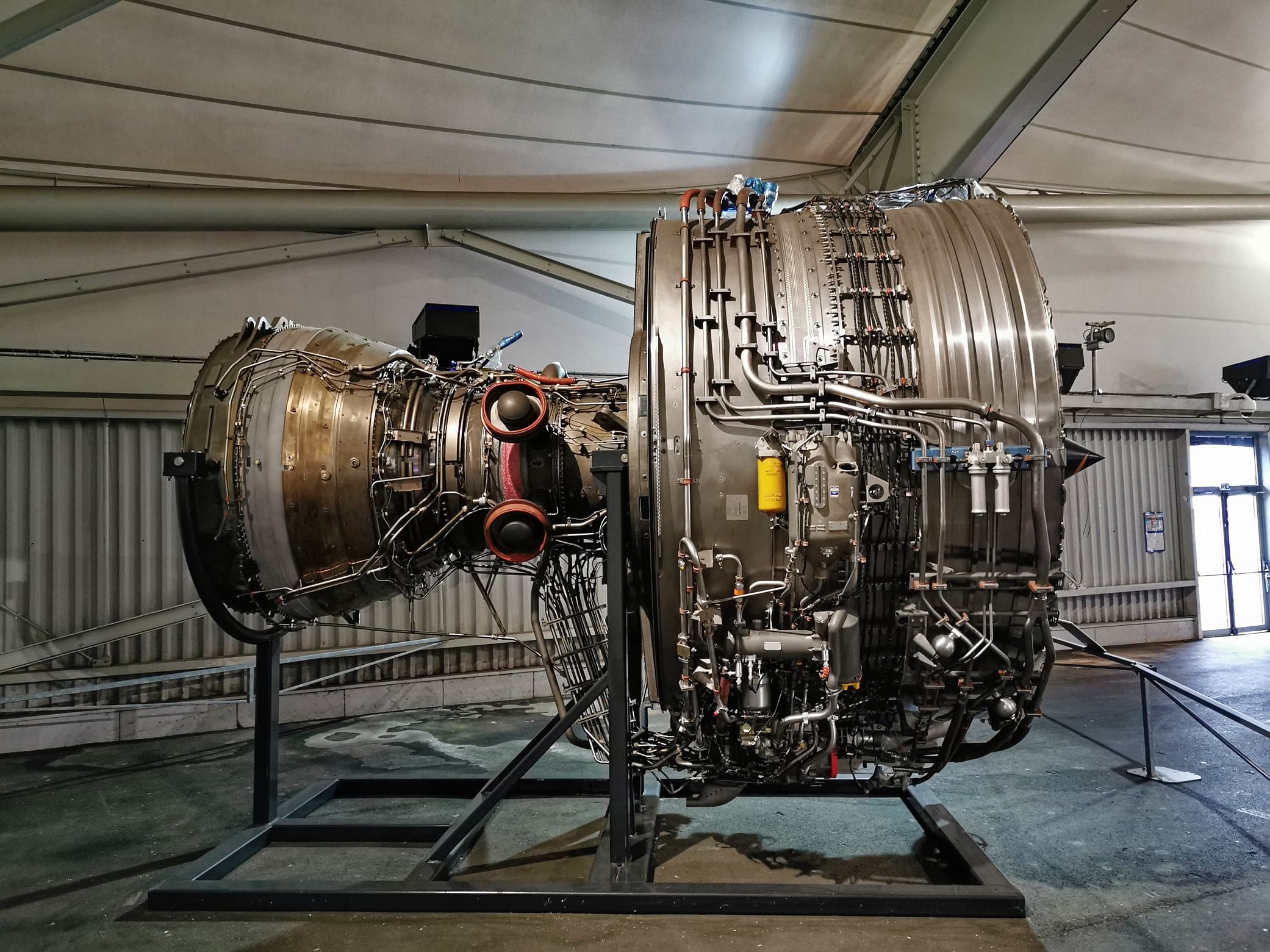
The Rolls-Royce Trent 900 is the three-shaft high-bypass turbofan built for the Airbus A380, and the only large civil engine Rolls-Royce has ever designed for a single aircraft type. It was the first engine ordered for the aeroplane, the first to fly on it, and, at a fan of 9.68 ft, the largest the company had built when it entered service. Five A380 operators out of every eight chose it over the rival Engine Alliance GP7200, and roughly three in five of the 251 A380s ever completed left Toulouse with four of them under the wing.
Architecturally it is a Trent, which is to say it splits the job across three concentric shafts rather than the two almost every other large turbofan uses. A single-stage fan and a five-stage low-pressure turbine share the outer shaft; an eight-stage intermediate compressor and a single-stage intermediate turbine share the middle one; a six-stage high-pressure compressor and a single-stage high-pressure turbine share the inner. Each spool is therefore free to turn at the speed its own aerodynamics want, which is the argument for the extra shaft and the extra bearings it costs.
What the engine is for is easier to state than what it is. An A380 at maximum take-off weight is the heaviest passenger aircraft ever certified, and four Trent 900s have to lift it out of a runway on a hot day at an airport that may be a long way above the sea. The certificate answers that requirement with flat rating: the engine holds its full take-off thrust until the ambient temperature reaches ISA +15 °C, and is cleared to operate up to ISA +40 °C. Thrust is not a headline figure on this engine so much as a promise about the conditions under which the headline figure still applies.
The type certificate has been pruned as the fleet settled. EASA certified the first model, the Trent 970-84, on 29 October 2004; the Trent 972-84 followed on 11 August 2005 and the Trent 972E-84 on 28 April 2017. Five further variants that were once on the certificate (the 970B-84, 972B-84, 977-84, 977B-84 and 980-84) were removed by partial surrender in March 2026. What remains is a certificate for three engines rated between 334.29 kN and 341.41 kN for take-off, weighing 13,770 lb dry and measuring 18 ft from the tip of the spinner to the tail bearing housing.
Aircraft fitted with this engine
Year each aircraft entered service with this engine.
1 aircraft
Development
The Trent 900 began as an engine for an aeroplane that was never built. Rolls-Royce first offered it in July 1996 for Boeing's proposed 747-500X and 747-600X, stretched and re-winged derivatives of the 747 intended to answer the demand airlines were said to have for something larger. Boeing abandoned the pair in January 1997, and the engine went looking for another airframe. It found one at Airbus, where the A3XX study had reached the point of choosing powerplants.
By July 2000 the Trent 900 was the first engine ordered for the A3XX, and when Airbus launched the aircraft as the A380 on 19 December 2000 the engine had a programme. Singapore Airlines and Virgin Atlantic both chose it over the GP7200 that General Electric and Pratt & Whitney were developing jointly for the same aeroplane, and the Trent's early lead in the order book was never entirely surrendered.
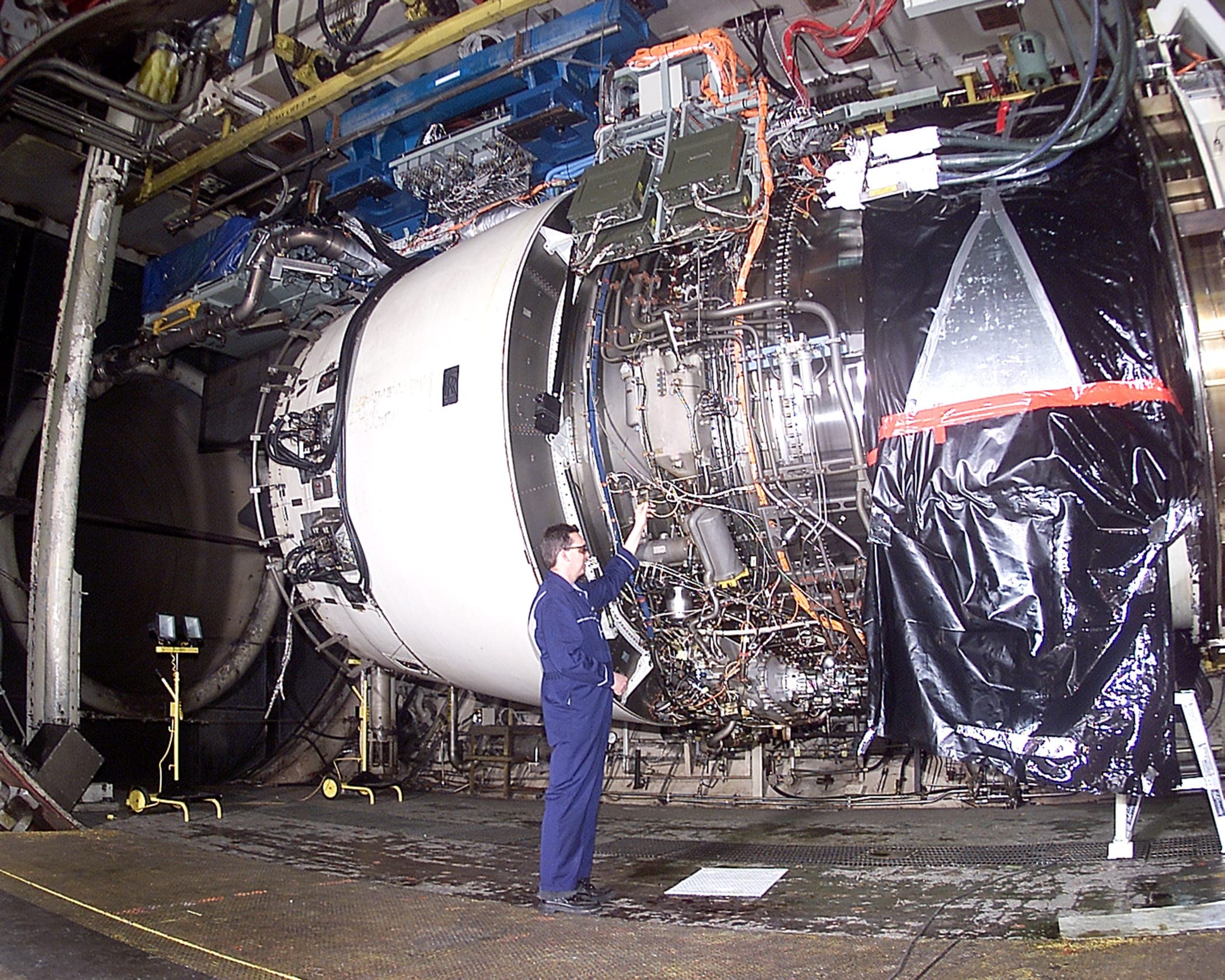
Formal certification work began with an application to the European Aviation Safety Agency on 3 April 2002, a date the type certificate data sheet still records as the certification reference date for every model in the family. The first engine ran on 18 March 2003. It reached its certification thrust of 81,000 lbf on 2 April 2003 and 88,000 lbf a week after that, and went on to altitude testing: the photograph above was taken at the Arnold Engineering Development Center in Tennessee, where a Rolls-Royce fitter is checking instrumentation before a run.
Flight testing followed on 17 May 2004, with the Trent 900 hung on an Airbus A340 flying testbed in place of one of that aircraft's four CFM56s. EASA certified the Trent 970-84 on 29 October 2004, together with the 970B-84, 977-84, 977B-84 and 980-84: a wide initial catalogue for an aeroplane that had not yet flown. The A380 itself first flew on 27 April 2005, on Trent 900s.
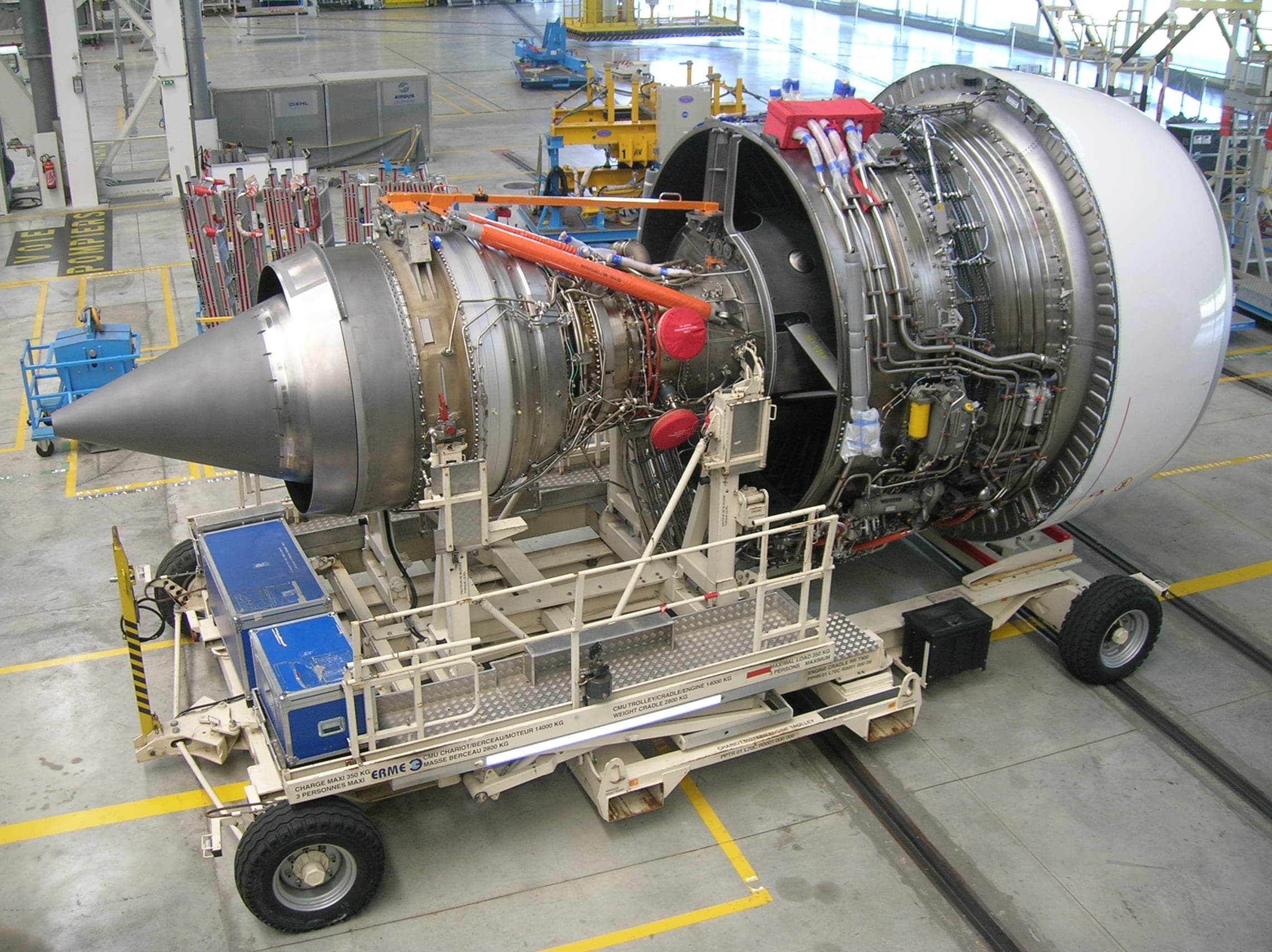
The certification programme itself left an unusually detailed trail, and the data sheet preserves it. The Trent 900 was certified against JAR-E Amendment 11 of 1 November 2001, with two later CS-E paragraphs applied on top: CS-E 800(c) for large flocking bird ingestion, and, for the first model only, CS-E 580(b) for failure of external air ducts. A special condition was raised for programmable logic devices, a category of hardware the 2001 code had not anticipated. Four equivalent safety findings were accepted, three of them about birds: a fan rig test in place of a medium bird ingestion test on the engine, a separate finding for the flock encounter case, and a substitution for the 150-hour endurance test.
The family then grew slowly and unevenly, in step with an aircraft programme that was itself in trouble. Rolls-Royce applied for the Trent 972-84 on 11 April 2005 and had it certified on 11 August that year. Production was suspended for twelve months while Airbus worked through the wiring and assembly delays that pushed the A380's first delivery back by two years, and restarted in October 2007. The last new model, the Trent 972E-84, was applied for on 10 August 2015 and certified on 28 April 2017, nearly thirteen years after the first.
Design
The three-shaft layout is the Trent family's inheritance from the RB211, and the Trent 900 carries it to a size no Rolls-Royce engine had reached before. The low-pressure assembly is a single-stage fan driven by a five-stage turbine. The intermediate assembly is an eight-stage compressor driven by a single-stage turbine. The high-pressure assembly is a six-stage compressor driven by a single-stage turbine. The three shafts are coaxial, and the combustion system between them is a single annular combustor with a tiled low-NOx liner.
One detail separates the Trent 900 from its predecessors and is visible only in the certificate: the high-pressure assembly turns the other way. Viewed from the rear of the engine, the low-pressure and intermediate assemblies rotate anti-clockwise and the high-pressure assembly rotates clockwise. Rolls-Royce's own description of the engine puts the reason plainly, the high-pressure shaft rotates in the opposite direction to the other two "for greater fuel efficiency", because a counter-rotating spool lets the gas leave one turbine already swirling the way the next one wants it.
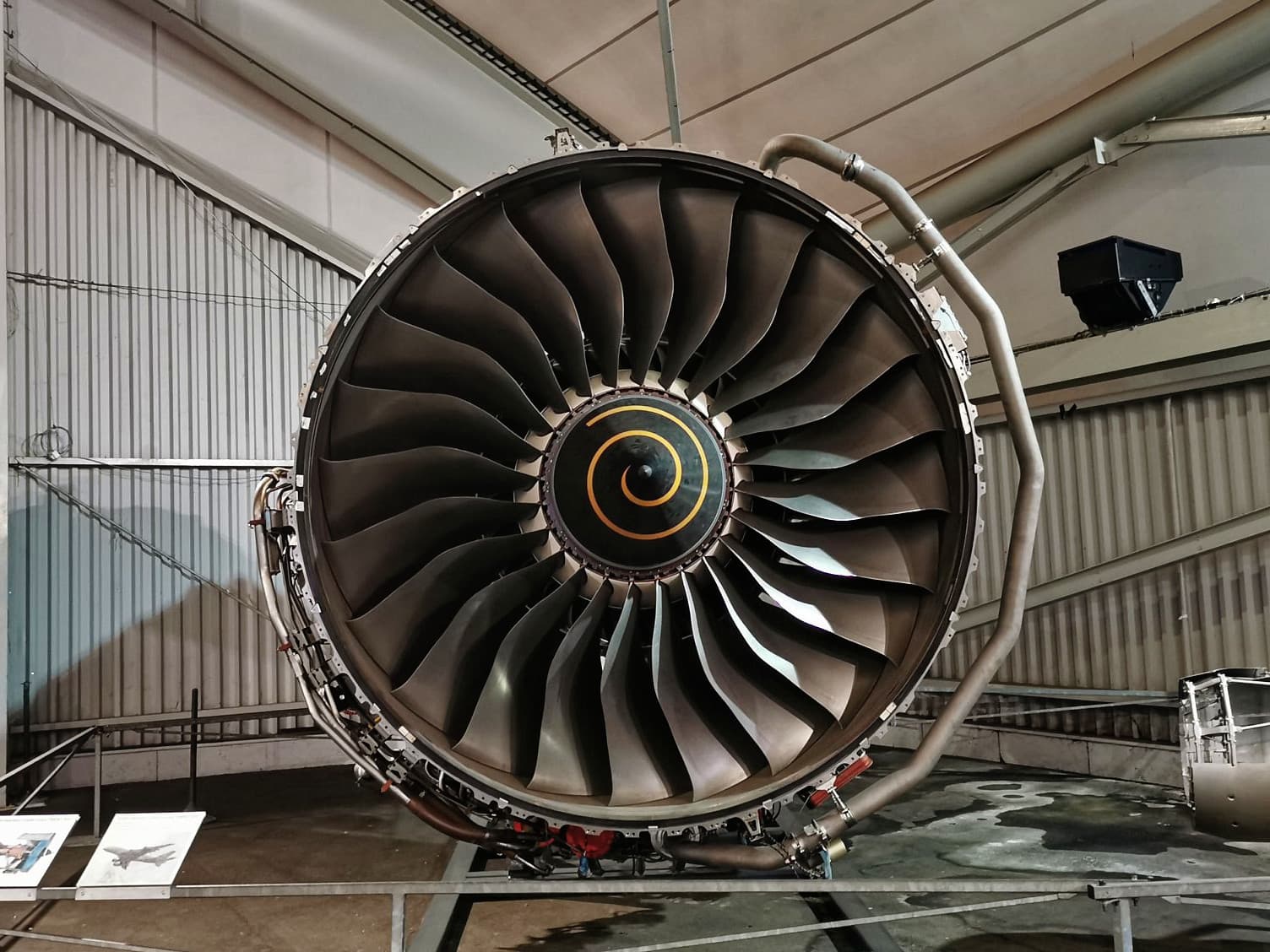
The fan is the part everybody sees. Its twenty-four blades are, in Rolls-Royce's words, "a new swept design that reduces the effect of shock waves as the tip of the fan rotates supersonically": the curve is not decoration but an attempt to keep the shock off the blade where the tip is going faster than sound. Behind it sits another first: the containment case that has to catch a blade if one lets go was, on this engine, the first Rolls-Royce built from titanium rather than Kevlar, which the company credits with reducing both noise and weight.
The accessories the airframe hangs on the engine are modest for something this size: two hydraulic pumps and one variable-frequency generator, driven through the accessory gearbox. The generator's cooler is bolted far enough out on the case that it sets the engine's maximum diameter, which is why the certificate's dimension is qualified as being measured around the centre line and including the cooler but excluding the drains mast. Turbine gas temperature is read by thermocouples at the first-stage nozzle guide vane of the low-pressure turbine: a long way downstream of where the gas is hottest, which is why the published limits look low for a modern core.

Control is a full-authority digital system. An Electronic Engine Controller talks to the airframe over an AFDX digital bus, the switched-Ethernet standard the A380 introduced to civil aviation, and a separate Engine Monitoring Unit watches the engine's health. The controller does more than set thrust: on the ground it prevents the engine from being held between 64 and 72 per cent low-pressure shaft speed, and above 78 per cent, a restriction the certificate calls the Keep Out Zone. The protection is active only below sixty knots and is released for flight once power has stabilised.
The numbers the certificate holds define the envelope. Reference speeds at 100 per cent are 12,200 rpm for the high-pressure shaft, 8,300 for the intermediate and 2,900 for the low-pressure; take-off is limited to 97.8, 98.7 and 97.2 per cent of those. Turbine gas temperature may reach 900 °C for the five minutes of a take-off, 850 °C continuously, and 920 °C for twenty seconds in an over-temperature. The engine is flat rated to ISA +15 °C at all altitudes and approved for ambient temperatures up to ISA +40 °C. Its maximum diameter, measured around the centre line and including the variable-frequency generator cooler, is 12.94 ft.
The control software is certified to EUROCAE ED-12B, the European twin of RTCA DO-178B, which was the standard for airborne software when the engine was designed and remains the standard the certificate names. The engine is also approved for Time Limited Dispatch: an operator may fly with certain control-system faults present for a defined number of cycles before rectification, which for a four-engined aircraft crossing oceans is less a convenience than a scheduling necessity. The maximum rectification period for each dispatchable state is published in the installation manual rather than in the certificate.
Fuel and carburation
An A380's air comes from its engines, and the Trent 900's bleed arrangement is more elaborate than most because of how much of it the aeroplane wants. Air for the environmental control system and the wing anti-ice is taken from the eighth stage of the intermediate compressor at take-off, climb and cruise, and from the sixth stage of the high-pressure compressor at descent and ground idle. In the hold, between 5,000 ft and 30,000 ft, the engine switches from one to the other. The rule underneath is a pressure one: air comes from the intermediate port whenever that port is above 206.8 kPa, and from the high-pressure port when it is not.
The switch between bleed sources is not a simple altitude rule but a pressure one wrapped in an altitude band, and the certificate publishes both the normal and the abnormal cases. With four bleeds and two air-conditioning packs running, the normal condition, the engine draws from the intermediate port whenever that port exceeds 206.8 kPa. With two bleeds and one pack, the abnormal condition, the threshold rises to 231 kPa, and to 237.9 kPa in icing. The numbers are specific because the consequence of getting them wrong is not a warning light but a compressor working outside the map it was designed against.
Nacelle anti-icing is drawn separately, from the third stage of the high-pressure compressor, and modulated through a regulating valve so that the engine sees a constant demand rather than one that swings with power. A further high-pressure tapping feeds the pre-cooler, which uses air from the fan outlet to bring the cabin bleed down to a temperature the ducts can accept. All of these flows are published in the certificate as percentages of core mass flow against turbine entry temperature, and all of them vary linearly between the listed points.
Fuel temperature limits are set at the wing tank rather than at the engine. The certificate allows a minimum of −54 °C in flight and a maximum of 55 °C from the ground to the top of the climb, falling to 50 °C at the top of descent. The document is candid about why the limit is written that way: neither the minimum nor the maximum is measured on the engine, and neither is presented to the flight deck. What the crew can see is the tank temperature, and the certificate simply assumes the difference between the tank and the engine inlet is negligible.
Production
The Trent 900 is manufactured by Rolls-Royce plc, but the certificate that governs it has moved. Rolls-Royce plc of Buckingham Gate, London, held the type certificate from the day it was granted, 29 October 2004, until 20 February 2019. On 21 February 2019 it passed to Rolls-Royce Deutschland Ltd & Co KG at Dahlewitz, south of Berlin, under a different design organisation approval. The change is recorded in the data sheet's own administrative section, and it is the kind of fact that exists nowhere else in the public record with a date attached.
The transfer to Dahlewitz was not a move of manufacture. Rolls-Royce plc remains the named manufacturer in the certificate; what changed hands was the design organisation approval and with it the legal responsibility for the type design. Rolls-Royce Deutschland had been building and supporting the BR700 family at Dahlewitz for two decades by then, and consolidating certificate-holding there placed the Trent 900's continuing airworthiness inside an EU design organisation at a moment when the United Kingdom's relationship with EASA was about to change.
Output has never been steady, because the A380's was not. The twelve-month suspension while Airbus worked through the delays of 2006 stopped the line before the first engine had been delivered to a customer; production restarted in October 2007, the month the first aeroplane was handed over. Thereafter the rate simply followed A380 deliveries, rising through the early 2010s and falling away once Airbus decided to close the programme.
The single largest commitment came late. Rolls-Royce's 2015 annual report records an agreement with Emirates for Trent 900 engines and TotalCare service support for fifty A380s, worth US$9.2 billion, of which US$6.1 billion was recognised in the order book. It was a reversal: Emirates had taken its first ninety A380s with the GP7200, and switching to the Trent for its last tranche handed Rolls-Royce a fleet it had not expected to win. Airbus delivered the final A380 of all, to Emirates, on 16 December 2021.
In service
The Trent 900 entered service on 15 October 2007, when Airbus handed the first A380 to Singapore Airlines at Toulouse. Rolls-Royce's release two days later noted that four of the five A380 test aircraft had by then flown more than 14,000 hours on Trent 900s, and claimed that eight of the aeroplane's eleven airline customers had chosen the engine, giving the company "a market-leading 61 per cent share of firm and option orders". Sir John Rose, then chief executive, called the engine "a good example of the success of this strategy" of investing in efficiency and environmental performance.
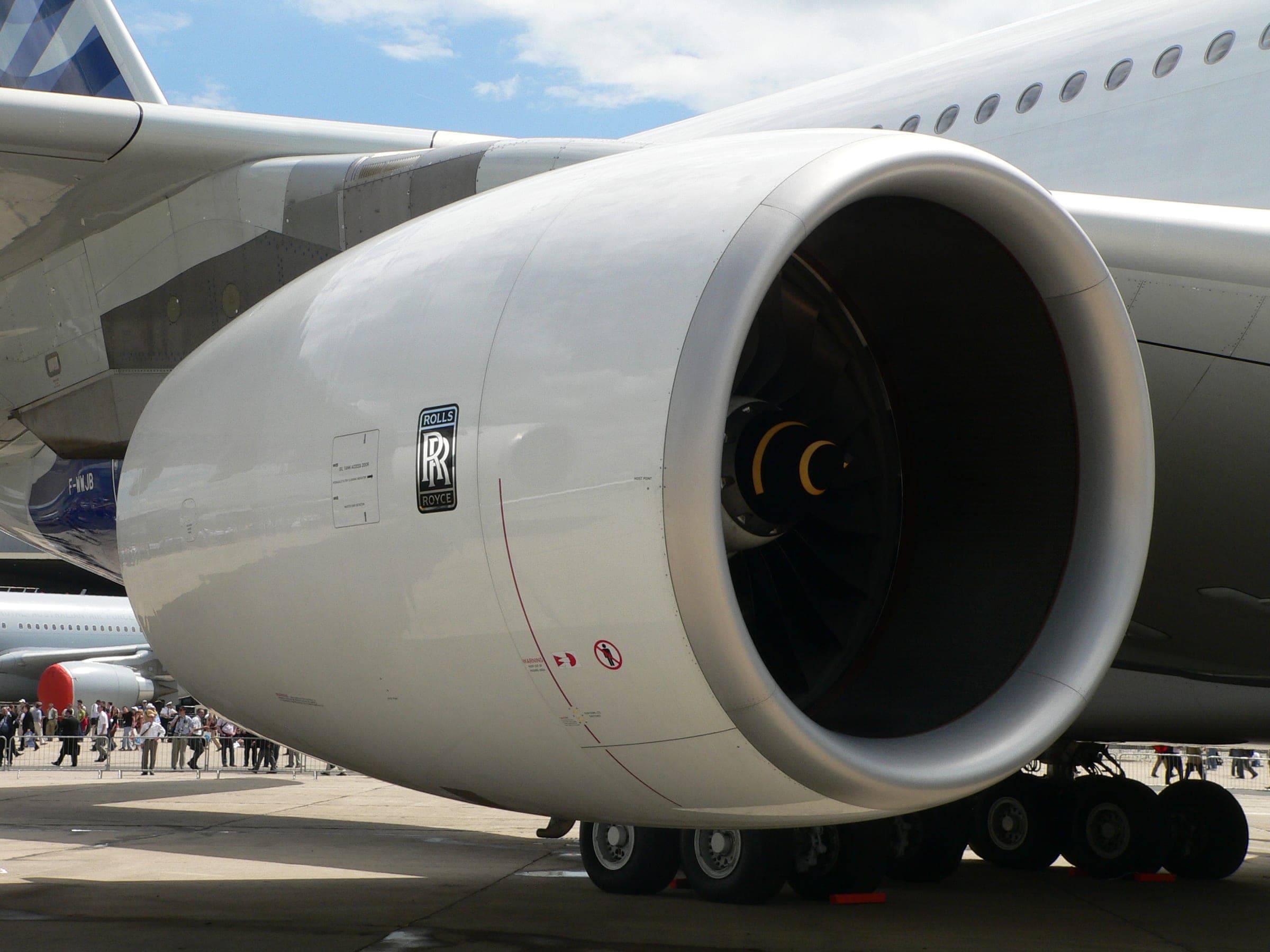
The operators that followed were among the largest long-haul fleets in the world. Singapore Airlines flew it first; Qantas, British Airways, Lufthansa, China Southern, Thai Airways International and Malaysia Airlines all took Trent-powered aircraft, and Emirates (the A380's overwhelming customer, with 123 of the 251 built) took thirty-three of its fleet on Trent 900s after ninety on the GP7200. Across the whole programme, roughly sixty per cent of A380s were delivered with the Rolls-Royce engine.
Dispatch reliability of a four-engined aircraft is a different arithmetic from a twin's, and the Trent 900 was certified with that in mind. The take-off rating may be held for five minutes in normal operation and for ten in the event of an engine failure, an allowance that matters on an aeroplane which loses a quarter rather than half of its thrust. The engine's approval for time-limited dispatch permits departure with defined control-system faults unrectified for a stated number of cycles. Neither provision makes the engine more reliable; both make an unreliable moment less likely to strand an aircraft.

Its working life has been shaped by the aeroplane's. The A380's retirement from several fleets during the pandemic put dozens of Trent 900s into storage at once, and the type's subsequent partial return: Singapore Airlines, Qantas, British Airways, Lufthansa and Emirates all brought aircraft back: put them into service again on a schedule nobody had planned for. The engines came back with the airframes, which is a different kind of durability test from the one the certification programme ran.
The A380's final delivery in December 2021 did not end the Trent 900's story, because nothing about an engine's service life is tied to the production line that fed it. Emirates has been explicit about intending to fly its A380s into the 2040s, which implies a support commitment running two decades past the last delivery, and Rolls-Royce has structured for it.
In November 2025 the two companies announced that Emirates would join Rolls-Royce's global maintenance, repair and overhaul network and service its own Trent 900s, with the first engine induction forecast from 2027 in a new facility. The TotalCare agreement covering the fleet was extended into the 2040s. Ahmed Safa, Emirates' head of engineering and MRO, put the reasoning simply: "With Emirates' plans to continue operating our Airbus A380 fleet into the 2040s, we wanted to secure our own engine maintenance capabilities."
Reliability and maintenance
On 4 November 2010 the number two engine of an Airbus A380-842 registered VH-OQA, operating Qantas Flight 32 from Singapore to Sydney with 469 people aboard, suffered an uncontained failure while the aircraft was climbing through 7,000 ft after departing Changi. The engine was a Trent 972-84. Debris left the engine with enough energy to penetrate the leading edge and front spar of the left wing, damage a fuel tank and sever around 650 wires in two main looms. The crew returned to Singapore and landed the aeroplane. Nobody was hurt.
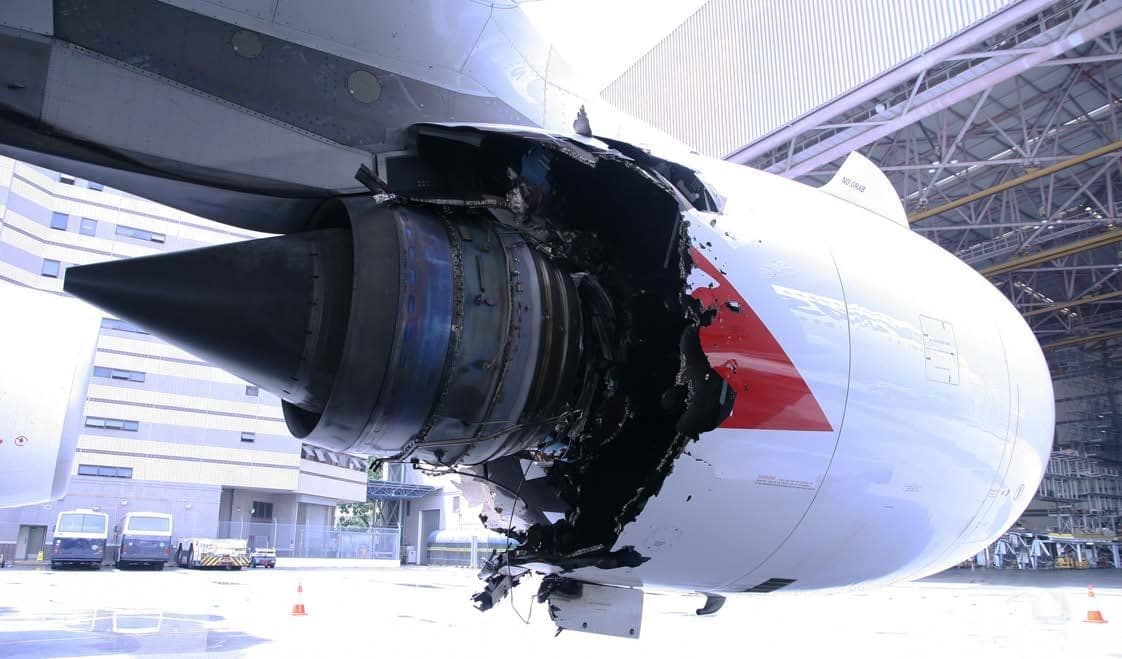
The cause was a pipe. An oil feed stub pipe in the high-pressure/intermediate-pressure bearing structure had been counter-bored off-centre during manufacture, leaving a wall thinner on one side than the drawing allowed. Under operating stresses that thin section cracked in fatigue; the crack leaked oil into the bearing chamber, where it auto-ignited in air hot enough to light it without a spark. The fire weakened the drive arm of the intermediate-pressure turbine disc until the disc parted from its shaft, overspeeded with nothing left to hold it back, and burst.
EASA's account, written into the airworthiness directive it issued while the investigation was still running, is precise about the chain: an oil fire in the structure cavity "may have initiated a sequence of events leading to rupture of the drive arm of the IP Turbine (IPT) disc and subsequent overspeed and burst of that same disc". A month later the agency could go further, concluding that "the most probable primary failure was the oil feed tube fracture initiated by thin wall section" and that the thin wall "has now been confirmed to have originated during the manufacturing process".
The regulatory response was immediate and iterative. EASA issued emergency airworthiness directive 2010-0236-E on 10 November 2010, superseded it with 2010-0242-E on 22 November, and revised that again as 2010-0242R1 on 21 December. The directives required repetitive inspection of the low-pressure turbine case drain, the bearing structure's air buffer cavity and the oil service tubes for abnormal leakage, and prohibited further operation of any engine where a discrepancy was found. The December revision relaxed the interval for engines whose bearing structures the manufacturer's analysis placed in a lower-risk population, a concession earned by evidence rather than by time.
The other number in the certificate that traces back to that morning is easy to miss. The intermediate-pressure shaft is allowed 99.5 per cent of its reference speed for twenty seconds as a maximum over-speed, the only shaft of the three for which the data sheet publishes an over-speed limit at all, and the shaft whose disc burst over Batam Island. The turbine gas temperature table carries a matching twenty-second over-temperature limit of 920 °C. A certificate is partly a record of what an engine has been found to do when something lets go, and this one is more explicit than most about which shaft the designers watch.
Qantas grounded its entire A380 fleet the day of the failure and began returning it on 27 November 2010, after its own analysis was ratified by Rolls-Royce and accepted by Australia's Civil Aviation Safety Authority, initially flying only sectors that did not require maximum thrust. Rolls-Royce developed engine control software to prevent an intermediate-pressure turbine overspeed and tightened its inspection regime for counter-bore misalignment, shortening the compliance window from twenty flight cycles to two. The Australian Transport Safety Bureau published its final report on 27 June 2013.
Upgrades
Rolls-Royce has improved the Trent 900 in packages rather than continuously, in the manner the company applies across the Trent family. The Enhanced Performance programme delivered its second package, EP2, in 2013: better sealing of the low-pressure turbine, tighter fan blade tip clearances, and changes carried across from the Trent 1000 and Trent XWB, which were being developed for the Boeing 787 and Airbus A350 at the time. EASA approved a major change to the type certificate on 11 December 2013 concerning turbine gas temperature adjustments, the certificate's own record of the work.
The packages are cumulative rather than alternative, and they are applied through service bulletins to engines already in the field rather than only to new build. The data sheet handles this by listing build profiles: a table of standards that may be installed on particular models, with the service bulletins and hardware each requires. Profiles eight and nine apply only to the Trent 970-84 and 972-84; profile ten may be retrofitted to both and is the minimum service standard on the 972E-84. An engine's model number, in other words, no longer tells you what is inside it.
A third package, EP3, followed in 2016. Rolls-Royce's current description of the engine states the cumulative result rather than the increments: "fuel burn improvements since EIS of up to 1.6%". For a four-engined aircraft burning as much as an A380 does, one and a half per cent is a figure airlines notice, and it is the sort of gain that arrives only by returning to a mature engine repeatedly with small changes.
The certificate has also been revisited for reasons that have nothing to do with performance. In March 2013 the whole family was recertified against the CAEP/6 nitrogen oxide standard; in October 2022 a further change recorded compliance with the CAEP/11 standard for non-volatile particulate matter, both mass and number. An engine certified in 2004 is now held to emissions rules written more than a decade after it first ran, and the data sheet carries the paperwork for each step.
Applications
The Trent 900 powers one aircraft. That is unusual for a Trent (the 700 went on the A330, the 800 on the 777, the 1000 on the 787) and it is the central fact of this engine's commercial life. It was designed around the A380's thrust requirement, certified for it, and never offered on anything else. When Airbus ended A380 production the engine's addressable market ended with it, and what remained was a fleet to support rather than a line to sell into.

Three models are certified today. The Trent 970-84 is rated at 334.29 kN for take-off and 319.60 kN maximum continuous. The Trent 972-84 and the later Trent 972E-84 share a take-off rating of 341.41 kN and the same 319.60 kN continuous figure. All three are flat rated to ISA +15 °C, and all three may use the take-off rating for five minutes: extended to ten in the event of an engine failure, which on a four-engined aeroplane is a meaningful allowance.
The absence of a second application is not for want of an airframe to be aimed at. The engine had been pitched first at Boeing's 747-500X and 747-600X, and the death of those proposals is the only reason it reached Airbus at all. After the A380 was launched, nothing else in its thrust class followed: the A380 was the last four-engined airliner either manufacturer put into production, and its engine therefore has no second home to move to.
The A380 installation is not symmetrical, and the certificate says so. At certification the engine was approved for use with an Aircelle thrust reverser unit at the inboard positions only; the outboard engines have a fixed fan duct and no reverser at all. Airbus's reasoning was that reversers on the outboard engines, which overhang unpaved ground at many airports, would ingest debris for little benefit. The engine therefore exists in two installed forms that differ in what is bolted around them rather than in the engine itself.
Records
When it entered service the Trent 900 was the largest engine Rolls-Royce had ever built. The company said so in its own words at the first A380 delivery, describing a fan diameter of almost ten feet on "the largest engine Rolls-Royce has ever built", a claim later surpassed within the Trent family itself by the Trent XWB, and comprehensively by the UltraFan demonstrator, but true on the day.
The fan is the measurement most often quoted, and the figure that gives it scale is the engine's own. At 9.68 ft across, the fan accounts for three quarters of the engine's maximum diameter and more than half its overall length: a Trent 900 is, in plan, mostly fan. Twenty-four blades sweep that circle at a tip speed that goes supersonic at take-off power, which is the condition the swept design exists to manage.
It also holds a quieter first. The fan containment case: the ring of structure whose whole purpose is to catch a fan blade if one ever leaves the disc: was on this engine the first Rolls-Royce had manufactured from titanium rather than Kevlar. The change reduced noise and weight while increasing efficiency, and the approach has been standard on the company's large fans since.
Legacy
The Trent 900's technical legacy is mostly architectural. The counter-rotating high-pressure spool it introduced to the Trent line, the swept fan and the titanium containment case all carried forward into the Trent 1000 and the Trent XWB, which between them power the Boeing 787 and every Airbus A350. An engine built for an aeroplane that sold 251 examples ended up seeding two that have sold well over a thousand each.
There is a commercial lesson in it too, and Rolls-Royce has not repeated the experiment. Designing a large civil engine for a single airframe concentrates the risk of that airframe entirely onto the engine programme: when the A380's order book thinned, there was nowhere for the Trent 900 to go. Every Trent since has been aimed at a family or at an aircraft with a long production horizon, and the Trent 7000, which is close kin to the Trent 1000 rather than a clean sheet, shows how firmly the company has moved away from bespoke engines for bespoke aeroplanes.
Its safety legacy is narrower and sharper. Qantas Flight 32 was not a design failure: the three-shaft layout, the disc, the bearing structure all did what they were meant to. It was a manufacturing and inspection failure, a counter-bore drilled off-centre and not caught, and the corrective action was correspondingly specific: better control of the machining, a shorter compliance window for finding the defect, and software to stop a turbine running away if the restraint ever went again. It is one of the most thoroughly documented uncontained failures in civil aviation, and the documentation is the point.
The engine has outlived the aeroplane's production by four years and counting, and will outlive it by two decades if Emirates does what it says. The type certificate tells that story in miniature: a catalogue of eight variants in 2005, pruned to three by a partial surrender in March 2026, supporting a fleet that is smaller than it was and more settled than it has ever been. Few engines get to finish like that, not withdrawn, not superseded, simply narrowed down to the ones still flying.
Output by altitude
A piston engine has no single power figure. Each rating below is what the sources publish for one mark under one set of conditions, at the altitude it was measured at.
| Mark and conditions | Altitude | Output |
|---|---|---|
| Trent 970-84, take-offtake-off, ISA sea-level static, 5 minutes | Sea level | 334.29kN |
| Trent 970-84, maximum continuousmaximum continuous, ISA sea-level static | Sea level | 319.6kN |
| Trent 972-84 and 972E-84, take-offtake-off, ISA sea-level static, 5 minutes | Sea level | 341.41kN |
| Trent 972-84 and 972E-84, maximum continuousmaximum continuous, ISA sea-level static | Sea level | 319.6kN |
Mark evolution
Trent 970-84
2004334.29 kNThe first model certified, on 29 October 2004, and the engine the A380 first flew on.
Certified against JAR-E Amendment 11 with CS-E paragraphs added for large flocking bird ingestion and for failure of external air ducts, the only model to carry the second of those.
Trent 972-84
2005341.41 kNApplied for on 11 April 2005 and certified on 11 August 2005, raising take-off thrust while leaving the maximum continuous rating unchanged.
Take-off rating increased to 341.41 kN; maximum continuous unchanged at 319.60 kN.
Trent 972E-84
2017341.41 kNThe last model added to the certificate, applied for on 10 August 2015 and certified on 28 April 2017, nearly thirteen years after the first.
Shares the 972-84's ratings, and carries build profile 10 as its minimum service standard rather than as a retrofit.
- Trent 900, Rolls-Royce
- Rolls-Royce Trents power first A380 to Singapore, Rolls-Royce
- Emirates to join Rolls-Royce global Maintenance, Repair and Overhaul network from 2027, Rolls-Royce
- Rolls-Royce plc Annual Report 2015, Rolls-Royce
- Emirates completes A380 fleet with 123rd delivery of iconic aircraft, Emirates
- Type-Certificate Data Sheet E.012, RB211 Trent 900 series engines, Issue 12, European Union Aviation Safety Agency
- Airworthiness Directive 2010-0242R1: Engine — High Pressure / Intermediate Pressure Structure — Inspections, European Union Aviation Safety Agency
- Safety action, in-flight uncontained engine failure Airbus A380-842 VH-OQA (AO-2010-089), Australian Transport Safety Bureau, republished by the US Federal Aviation Administration
- Uncontained Failure, Flight Safety Foundation, AeroSafety World
- Rolls-Royce Trent 900, Wikipedia
Checked September 28, 2026